

A resource rent tax is an economic charge levied on upstream petroleum projects when profits exceed the minimum required rate of return. Corporate finance teams calculate this tax to protect investment baseline returns while ensuring compliant fiscal administration.
In modern energy markets, governments impose resource rent taxes to capture excess profits during high commodity price cycles. Unlike standard corporate income taxes that apply to standard taxable income, a resource rent tax activates only after a project recovers its capital expenditure and achieves a specified threshold return rate. Upstream petroleum companies must model these fiscal mechanics to prevent cash flow miscalculations and protect project net present value.
Workforce competency gaps in energy fiscal frameworks directly undermine financial modeling accuracy and cross-departmental decision-making. When exploration, operations, and corporate finance teams fail to understand how windfall charges function, organizations misprice capital expenditure proposals or understate sovereign risk profiles. Structured corporate training aligns engineering, legal, and financial planning departments around standardized economic evaluation practices.
Building organizational capability in petroleum fiscal design requires systematic skill acquisition across several core domains:
Professional training programs address these knowledge gaps by teaching teams to differentiate standard revenue taxes from profit-linked mechanisms. Energy professionals analyze host government contracts, concession agreements, and production sharing arrangements to identify exact tax triggers. Teams establish clear internal protocols for monitoring hurdle rates, uplift provisions, and ring-fencing constraints.
Providing decision-makers with advanced analytical tools converts complex fiscal terms into actionable financial metrics. Structured corporate learning builds an integrated workforce capable of optimizing capital allocation across high-tax sovereign jurisdictions.
How Does Resource Rent Tax Training Function in Corporate Environments?
Resource rent tax training functions as a structured corporate upskilling process that integrates legal, financial, and operational data into standardized economic models. Cross-functional teams learn to evaluate fiscal terms through hands-on case analyses, practical calculations, and policy frameworks.
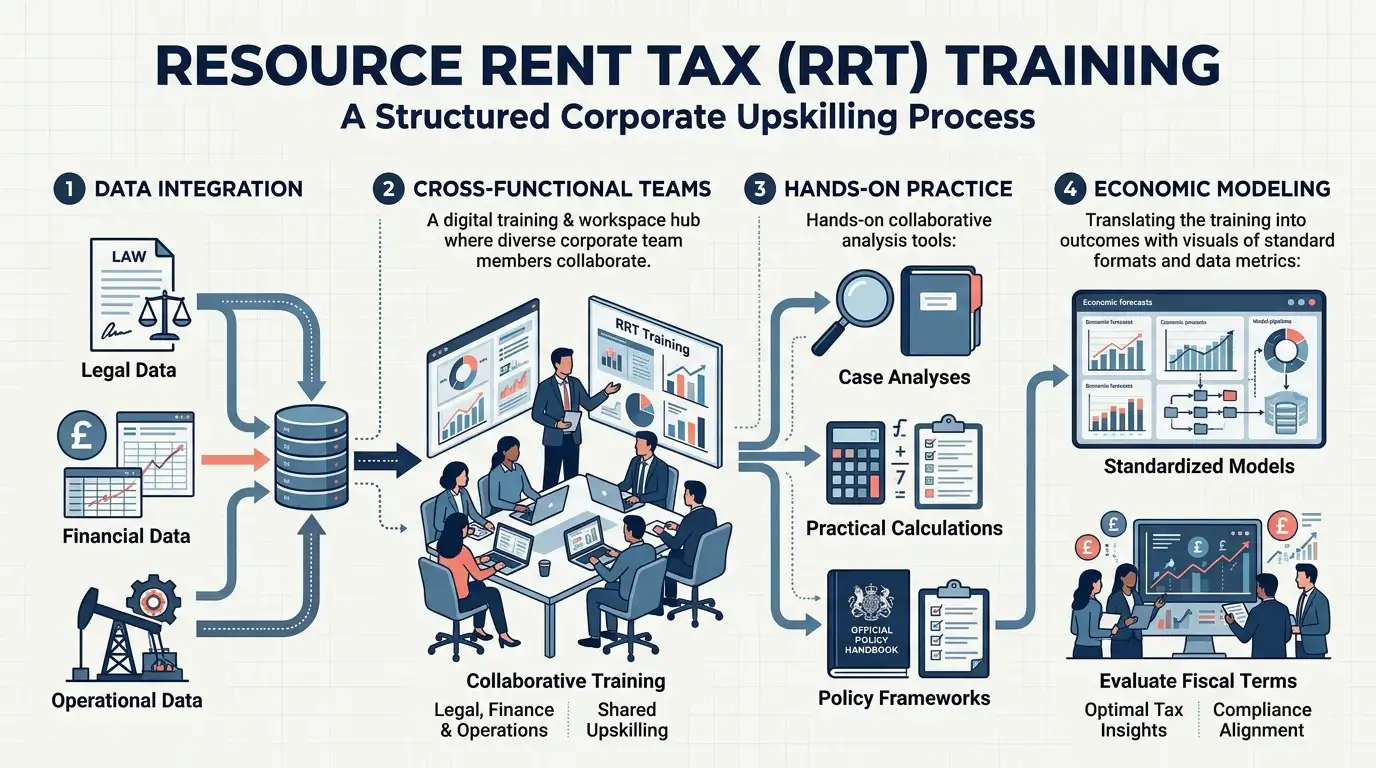
Implementation begins with an organizational skill audit to evaluate existing knowledge across commercial teams. Finance managers, tax accountants, business development executives, and petroleum engineers participate in initial baseline assessments. This diagnostic phase identifies operational misalignments between technical reservoir forecasts and corporate financial reporting structures.
Corporate execution follows a structured, multi-stage delivery model:
Diagnostic Competency Mapping: Internal learning audits assess current knowledge of fiscal regimes across operational, financial, and legal departments.
Structured Classroom and Virtual Workshops: Instructors lead intensive 3-day to 5-day technical modules covering tax mechanics, calculation algorithms, and contract structures.
Practical Financial Simulation: Learners build dynamic cash flow spreadsheets incorporating uplift allowances, ring-fencing, and variable pricing triggers.
Cross-Departmental Case Studies: Mixed functional teams analyze historical petroleum fiscal changes in international basins to identify cash flow exposure.
Post-Training Proficiency Testing: Formal evaluations measure individual calculation accuracy, model audit capabilities, and risk evaluation skills.
Training delivery relies on practical, outcome-focused learning methodologies. Participants construct economic models using real-world asset data from mature and frontier basins. Role-play scenarios simulate host government fiscal negotiations, forcing technical teams to defend project economics under aggressive tax scenarios.
Workforce development programs integrate digital learning platforms to support ongoing performance after formal workshops end. Teams access reference calculation tools, standardized tax definitions, and template sensitivity models within corporate knowledge repositories. This continuous learning framework ensures that commercial teams maintain high analytical precision during fiscal regime changes.
What Key Components Are Included in Upstream Tax Education?
Upstream tax education includes core modules on fiscal regime design, tax stacking interactions, uplift calculations, and financial modeling tools. These components equip commercial teams with analytical frameworks to evaluate complex petroleum fiscal regimes, contractual terms, and corporate risk profiles.
A complete training program addresses both macro-level fiscal policy and micro-level accounting adjustments. Technical components focus on specific tax instruments utilized across major oil-producing nations. Participants examine the mechanics of supplementary charges, windfall taxes, energy profit levies, and additional profits taxes.
Training covers critical tax interaction mechanics to eliminate accounting errors in project appraisal. Learners examine the deductibility of standard corporate income taxes against supplementary levies, calculating the true effective tax rate across multi-tiered fiscal regimes. Instructors guide participants through complex scenarios involving marginal tax rate stacking, where uncoordinated tax layers suppress field development economics.
To build practical mastery, organizations combine technical instruction with targeted professional development pathways:
Petroleum Fiscal Regime Analysis: Mapping royalty rates, tax-paid concessions, and production sharing terms across international jurisdictions like the UK North Sea, Norway, and West Africa.
Advanced Tax Stacking Calculations: Determining how primary income taxes, windfall surcharges, and local levies interact within field cash flow models.
Capital Deductibility and Uplift Application: Applying capital depreciation schedules, immediate write-offs, and uplift percentages to cash flow statements.
Ring-Fencing and Loss Rollover Protocol: Structuring asset-level accounting to prevent tax leakage between exploration blocks and producing fields.
Dynamic Sensitivity Modeling: Stress-testing net present value and internal rate of return outputs against volatile crude oil and natural gas prices.
Mastery of these components ensures that project evaluation teams produce accurate investment proposals. Financial analysts learn to identify subtle tax triggers that alter field abandonments, tie-back economics, and secondary recovery investments. Standardizing these technical skills across regional offices eliminates reporting inconsistencies and improves corporate governance.
How Do Organizations Benefit From Resource Rent Tax Competency?
Organizations benefit from resource rent tax competency through reduced fiscal modeling errors, optimized investment timing, improved capital allocation, and aligned commercial decision-making. Workforce proficiency in fiscal mechanics directly protects project profitability during price surges and legislative changes.
Establishing technical tax expertise across commercial departments protects corporate capital. Companies eliminate financial blind spots by ensuring that asset managers, reservoir engineers, and corporate planners understand host government tax structures. Well-trained teams evaluate host government fiscal changes rapidly, allowing executive management to adjust capital expenditure plans before margin compression occurs.
The strategic benefits of corporate fiscal training manifest across multiple business functions:
Organizational Objective | Traditional Approach | Competency-Trained Workforce Outcome |
Financial Modeling Accuracy | Isolated tax inputs in spreadsheet models | Integrated, dynamic tax stacking calculation models |
Investment Decision Speed | Delayed cross-departmental reviews | Fast-track project screening using standard fiscal frameworks |
Sovereign Risk Management | Reactive responses to tax law changes | Proactive scenario planning and fiscal sensitivity testing |
Cross-Functional Alignment | Siloed communication between technical and finance teams | Unified commercial strategy across engineering, legal, and tax teams |
Commercial teams with advanced fiscal knowledge make accurate project recommendations during asset acquisitions and divestments. Evaluating the true economic rent of an upstream asset requires analyzing historical tax baselines, remaining loss carry-forwards, and special investment allowances. Competent teams detect hidden tax liabilities during due diligence, preventing overpayment for producing field rights.
Workforce alignment enhances negotiation capabilities during host government discussions. When corporate negotiators understand the economic mechanics of resource rent thresholds, they propose fiscal modifications that protect downside returns while offering governments fair upside participation. This technical credibility strengthens long-term commercial relationships with state energy authorities.
What Corporate Use Cases Require Specialized Fiscal Tax Training?
Specialized fiscal tax training is required during international asset acquisitions, host government contract renegotiations, field development planning, and corporate fiscal policy shifts. Organizations deploy targeted learning programs to prepare multidisciplinary project teams for complex commercial decisions.

Large energy corporations, national oil companies, independent exploration firms, and professional advisory practices face distinct operational scenarios requiring specialized tax knowledge. Training interventions align team skill sets with immediate commercial objectives.
Specific corporate use cases include:
International Exploration Expansion: Business development teams entering new sovereign jurisdictions must evaluate regional tax regimes to screen prospective licenses accurately.
Asset Acquisition Due Diligence: Mergers and acquisitions specialists require deep understanding of historical tax balances, ring-fencing constraints, and loss carryovers to value target assets.
Major Field Development Approvals: Joint venture management teams must model the exact cash flow impact of capital expenditure uplifts before sanctioning multi-billion-dollar field investments.
Fiscal Policy Adaptation: Corporate planning units operating in regions undergoing tax reform must analyze new profit levies to update corporate capital allocation strategies.
In joint venture management, operating partners and non-operating investors frequently dispute capital allocation due to conflicting tax interpretations. Structured team training establishes a shared technical baseline, enabling joint venture partners to align on investment timing and cost recovery mechanisms.
Advisory firms, financial institutions, and legal practices also utilize corporate tax training to enhance client service quality. Commercial bankers and project finance specialists evaluate resource rent structures to assess loan repayment security under depressed commodity price scenarios. Equipping advisory professionals with deep fiscal knowledge ensures precise project risk assessments.
How Do Misconceptions and Training Failures Damage Project Economics?
Misconceptions and training failures damage project economics by introducing structural errors into financial models, miscalculating tax deductibility, and overestimating project cash flows. Generic or theoretical training programs fail to build the practical modeling skills required to navigate modern fiscal changes.
A common organizational misconception is that resource rent taxation is solely the responsibility of corporate tax departments. In practice, petroleum engineers, commercial managers, and asset directors make daily operational decisions that directly trigger tax liabilities. When technical teams design field development strategies without understanding ring-fencing rules or capital uplift deadlines, companies forfeit substantial tax deductions.
Training programs frequently fail due to specific structural flaws:
Organizations often rely on generic finance courses that treat petroleum taxation as a simple overhead percentage. Standard corporate tax rules fail to capture the dynamic mechanics of threshold rates, uplift allowances, and multi-layered profit levies. To build actionable competency, enterprise learning programs must reflect real-world oil and gas fiscal terms.
Evaluating the impact of complex tax structures requires structured professional development. Commercial managers who learn How to Evaluate Resource Rent Tax Structures and Their Impact on Oil and Gas Project Returns gain the practical framework necessary to audit corporate cash flow models. Enrolling key decision-makers in a specialized Petroleum Taxation Fundamentals for Resource Rent Taxes Training Course eliminates conceptual errors, ensures accurate tax stacking calculations, and protects project returns across international upstream portfolios.
Eliminating fiscal misunderstandings requires continuous learning integrated directly into operational workflows. Organizations that invest in practical, simulation-based tax education build a resilient workforce capable of optimizing capital allocation in changing regulatory environments.
Frequently Asked Questions
What is included in Oil & Gas Petroleum Taxation training?
Institute For Oil & Gas Training provides comprehensive programs covering petroleum fiscal regimes, host government contracts, tax stacking mechanics, and additional profit levies. Professionals learn practical financial modeling techniques to calculate ring-fencing constraints, capital uplifts, and effective tax rates across exploration and production assets.
How does understanding resource rent tax benefit petroleum companies?
Mastering resource rent tax structures allows commercial and financial teams to model true project economic returns accurately. Institute For Oil & Gas Training delivers Oil & Gas Petroleum Taxation education to help organizations prevent cash flow miscalculations, optimize capital allocation strategies, and mitigate sovereign fiscal risks in international upstream projects.
Who should undertake Oil & Gas Petroleum Taxation courses?
Oil & Gas Petroleum Taxation modules are tailored for finance managers, legal advisors, tax accountants, petroleum engineers, and commercial directors working in energy sector operations. Institute For Oil & Gas Training equips cross-functional decision-makers with the technical capabilities required to evaluate fiscal terms, audit cash flow statements, and participate in host government contract negotiations.
Why is cross-tax deductibility important in energy project economics?
Cross-tax deductibility determines how standard corporate income taxes interact with windfall levies, supplementary charges, and royalties. Programs hosted by Institute For Oil & Gas Training explain these tax stacking interactions so financial planning teams can precisely compute overall marginal tax rates and avoid overestimating field development net present values.
How do organizations implement corporate training in petroleum taxation?
Organizations implement Oil & Gas Petroleum Taxation programs through customized executive workshops, interactive financial modeling simulations, and blended corporate learning modules. Institute For Oil & Gas Training works directly with enterprise clients to align course content with specific regional fiscal frameworks, asset portfolios, and operational competency gaps.
Related training courses
Oilfield Production Chemicals and Treatment Applications Training Course
- Specialisation
- Oil & Gas Process Engineering and Operations
- Duration
- 5 days · 15 CPD hours
Hazardous Liquid Pipeline Inspection and Integrity Management Training Course
- Specialisation
- Oil & Gas Pipeline Integrity and Inspection
- Duration
- 5 days · 15 CPD hours
API 653 Storage Tank Inspection and Integrity Assessment Training Course
- Specialisation
- Oil & Gas Inspection and Non-Destructive Testing
- Duration
- 5 days · 15 CPD hours
More articles

How to Evaluate Transfer Pricing Risks and Intercompany Transactions in Oil and Gas Groups
Evaluate transfer pricing risks in oil and gas intercompany transactions. Learn methods, functional analysis, and arm's length compliance strategies.
Read article →
Why Transfer Pricing Matters for Multinational Oil and Gas Groups
Learn why transfer pricing matters for multinational oil and gas groups, including compliance frameworks, risk management, and workforce development.
Read article →
Withholding Tax Compliance and Treaty Relief Training for Oil and Gas Tax Professionals
Master cross-border oil and gas tax compliance. Evaluate syllabus, delivery, and outcomes for the Institute For Oil & Gas Training course.
Read article →