

Joint venture disbursement controls represent structured financial governance frameworks that regulate cash call releases, partner payment authorisations, and treasury transfers within multi-operator petroleum ventures. These mechanisms prevent unauthorized capital outflows, ensure contract compliance, and safeguard joint operating agreement funds.
In upstream and midstream petroleum operations, joint ventures (JVs) require multiple corporate entities to pool financial resources for exploration, drilling, and production. The operating partner manages daily capital expenditures, issuing cash calls to non-operating partners to cover operational expenses. Disbursement controls establish strict institutional protocols governing how these collected funds are verified, authorized, and released to third-party vendors, host governments, and joint account contractors.
Without rigorous disbursement governance, joint ventures face severe exposure to overbilling, duplicate vendor disbursements, unapproved budget overrides, and regulatory non-compliance. From an organizational development standpoint, establishing these financial safeguards requires specialized technical competencies across finance, treasury, legal, and operational accounting teams. Corporate training initiatives bridge the capability gaps that lead to weak oversight, enabling cross-functional teams to enforce contractual terms, maintain audit trails, and execute accurate payment controls across complex international asset portfolios.
How do organizations implement joint venture disbursement control training in the workplace?
Organizations implement joint venture disbursement control training through a structured 4-stage corporate learning path comprising capability gap analysis, simulation-based workshop execution, workflow integration, and post-implementation audit assessments over a 12-week operational learning timeline.
The implementation process begins with a comprehensive diagnostic assessment of internal finance, operational, and joint venture accounting teams. Learning administrators evaluate existing workflows against Joint Operating Agreement (JOA) standards, Accounting Procedure guidelines, and international treasury regulations to pinpoint specific operational vulnerabilities. This initial phase establishes baseline metrics regarding processing error rates, payment approval cycle times, and partner dispute frequencies.
The second stage delivers target-driven technical instruction using a hybrid learning model. Participants engage in 3-day intensive masterclass workshops supplemented by 8 weeks of interactive online scenario modules. Training instruction centers on real-world case studies involving complex capital expenditure authorizations, emergency procurement cash calls, and disputed joint account billings. Learners utilize specialized treasury management software simulations to practice real-time validation of supplier invoices and partner billing statements.
The third stage integrates newly acquired capabilities directly into daily corporate workflows. Teams establish standardized checklists for cash call reviews, construct dual-authorization payment matrices, and embed [cash call disbursement controls](How to Evaluate Payment Approval Processes and Disbursement Risks in Petroleum Joint Ventures) within their enterprise resource planning (ERP) platforms. Department heads conduct weekly peer-review sessions to ensure consistent application of governance standards across all operating units.
The final stage measures organizational transformation through structured performance audits conducted at 30, 60, and 90 days post-training. Compliance officers track key operational indicators, including authorization turn-around speed, vendor payment accuracy rates, and the total reduction in joint interest audit exceptions.
What key components comprise a modern joint venture payment control framework?
A modern joint venture payment control framework comprises 5 core operational components: cash call authorization protocols, partner payment authorisation matrices, sanctions screening systems, segregated duty structures, and comprehensive digital payment audit trails.
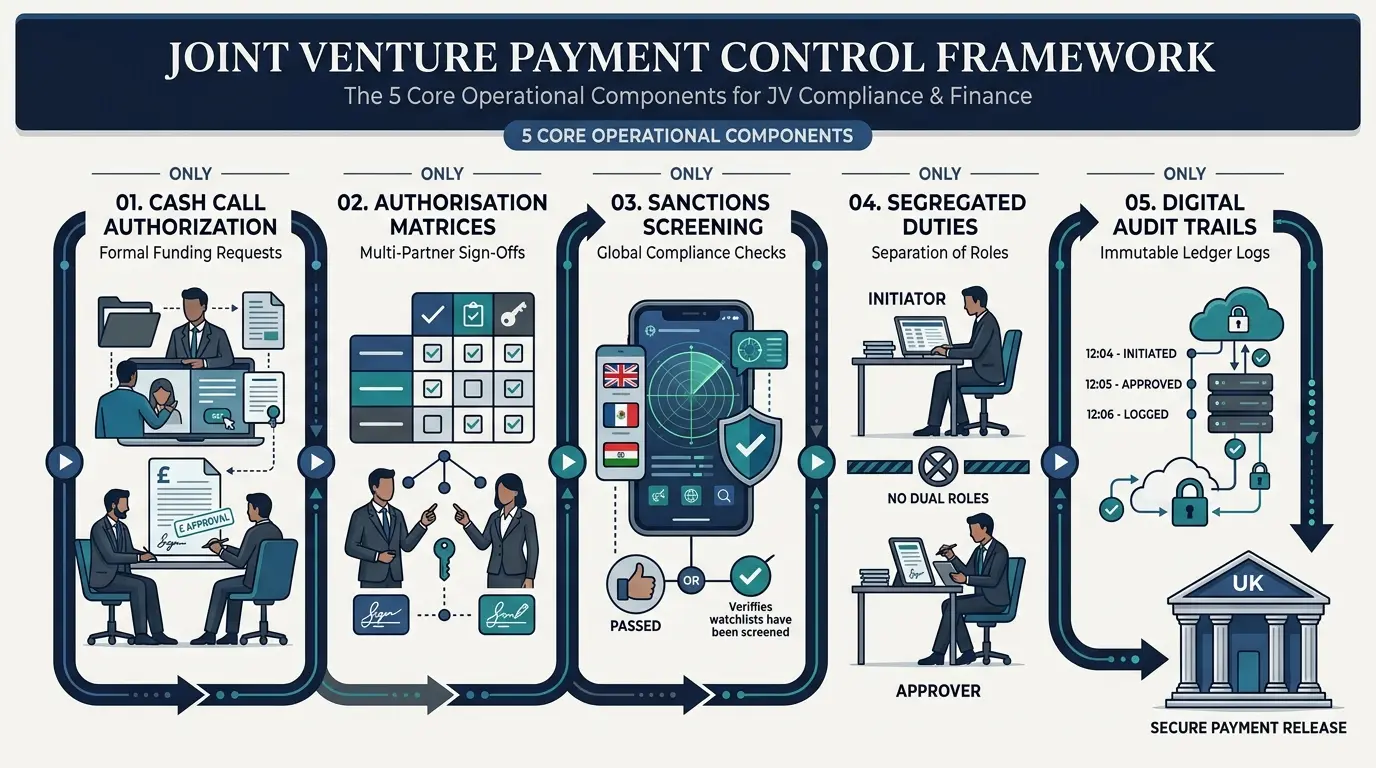
Cash call authorization protocols
Cash call protocols dictate the exact criteria under which operating partners request, hold, and release funds provided by non-operating co-venturers. These protocols enforce strict compliance with the Joint Operating Agreement financial provisions, establishing mandatory documentation requirements for every capital call. Teams verify project milestone completion, budget line-item availability, and cash flow forecasts prior to sanctioning cash disbursements to project bank accounts.
Partner payment authorisation matrices
Payment authorization matrices define clear monetary thresholds and approval hierarchies for all joint account expenditures. These frameworks dictate which executive levels must approve disbursements based on transaction size, vendor risk profiles, and operational urgency. A standard 4-tier matrix assigns primary review to JV accountants, mid-level authorization to treasury managers, senior sign-off to financial controllers, and executive board approval for high-value capital projects exceeding 5,000,000 USD.
Sanctions and compliance screening systems
Sanctions screening protocols mandate real-time automated verification of all payees, contractors, and financial intermediaries against global risk databases. Foreign asset control regulations require joint venture operators to screen every payee against international sanction lists, anti-money laundering registries, and politically exposed person databases prior to releasing funds. Implementing automated pre-payment checks prevents catastrophic regulatory fines and asset freezing orders in high-risk operational jurisdictions like West Africa, South America, and the Middle East.
Segregation of duties in payments
Segregation of duties (SoD) frameworks prevent internal fraud and accidental financial misstatements by dividing critical payment responsibilities among separate individuals. The framework dictates that no single employee possesses end-to-end authority over any transaction. Separate personnel handle vendor bank account setup, invoice verification, payment batch creation, disbursement approval, and bank reconciliation. This balance of power ensures mandatory peer verification across every transaction lifecycle.
Payment audit trail mechanisms
Digital audit trail mechanisms generate permanent, time-stamped records of every decision, modification, and approval occurring within the payment pipeline. Advanced accounting systems record user credentials, exact timestamp data, supporting documentation attachments, and IP addresses for every action. This electronic chain of custody allows joint interest auditors and internal control teams to verify treasury compliance during annual financial reviews.
What business benefits do joint venture disbursement controls deliver to petroleum enterprises?
Joint venture disbursement controls deliver 4 primary organizational benefits: a 45% reduction in joint interest audit disputes, total elimination of unauthorized capital disbursements, a 30% acceleration in payment processing efficiency, and full alignment with international treasury governance standards.
Reduction in joint account audit disputes
Establishing precise disbursement standards significantly decreases billing friction between joint venture partners. When operating companies enforce standardized payment controls, non-operating partners receive fully documented, pre-audited cash call justifications. This structural transparency reduces post-hoc joint interest audit exceptions by up to 45%, saving organizations millions of dollars in contested charges and avoiding costly legal arbitrations.
Elimination of unauthorized capital leakage
Rigorous payment authorization frameworks eradicate unapproved expenditures, duplicate vendor invoices, and fraudulent transactions. By requiring multi-party verification and automated sanction checks, organizations secure cash assets held in joint accounts. Companies implementing comprehensive dual-control authorization matrices achieve a 100% elimination rate of unauthorized capital transfers across their global operating ventures.
Increased operational and treasury efficiency
Streamlined approval hierarchies eliminate administrative bottlenecks in vendor payment processing. Standardized verification checklists and digital workflows reduce payment processing cycles from 21 days down to 5 days. Rapid payment settlement improves relationships with key oilfield service contractors, secures early-payment discounts, and prevents project execution delays caused by unpaid supplier disputes.
Enhanced treasury policy compliance monitoring
Comprehensive disbursement frameworks give corporate treasurers total visibility over cash balances, foreign currency exchange exposures, and joint bank accounts. Automated tracking systems ensure 100% compliance with internal corporate treasury policies, regional tax laws, statutory royalty obligations, and host government concession agreements.
Performance Metric | Baseline Pre-Training Standard | Post-Implementation Target | Total Operational Impact |
JV Audit Exception Frequency | 18% of billings disputed | Under 3% of billings disputed | 83% reduction in partner legal friction |
Payment Approval Cycle Time | 21 business days | 5 business days | 76% increase in treasury processing speed |
Unapproved Capital Outflows | 2.5% budget overrun risk | 0% tolerance / 0 incidents | Complete protection of venture capital |
Sanctions Check Coverage | 65% manual sampling | 100% automated pre-payment | Total elimination of compliance breach risks |
Which corporate teams and industry sectors require disbursement control capabilities?
Joint venture disbursement control capabilities are required by corporate finance teams, joint interest accounting units, treasury divisions, legal compliance officers, and commercial managers across capital-intensive industries like oil and gas, mining, infrastructure, and renewable energy.
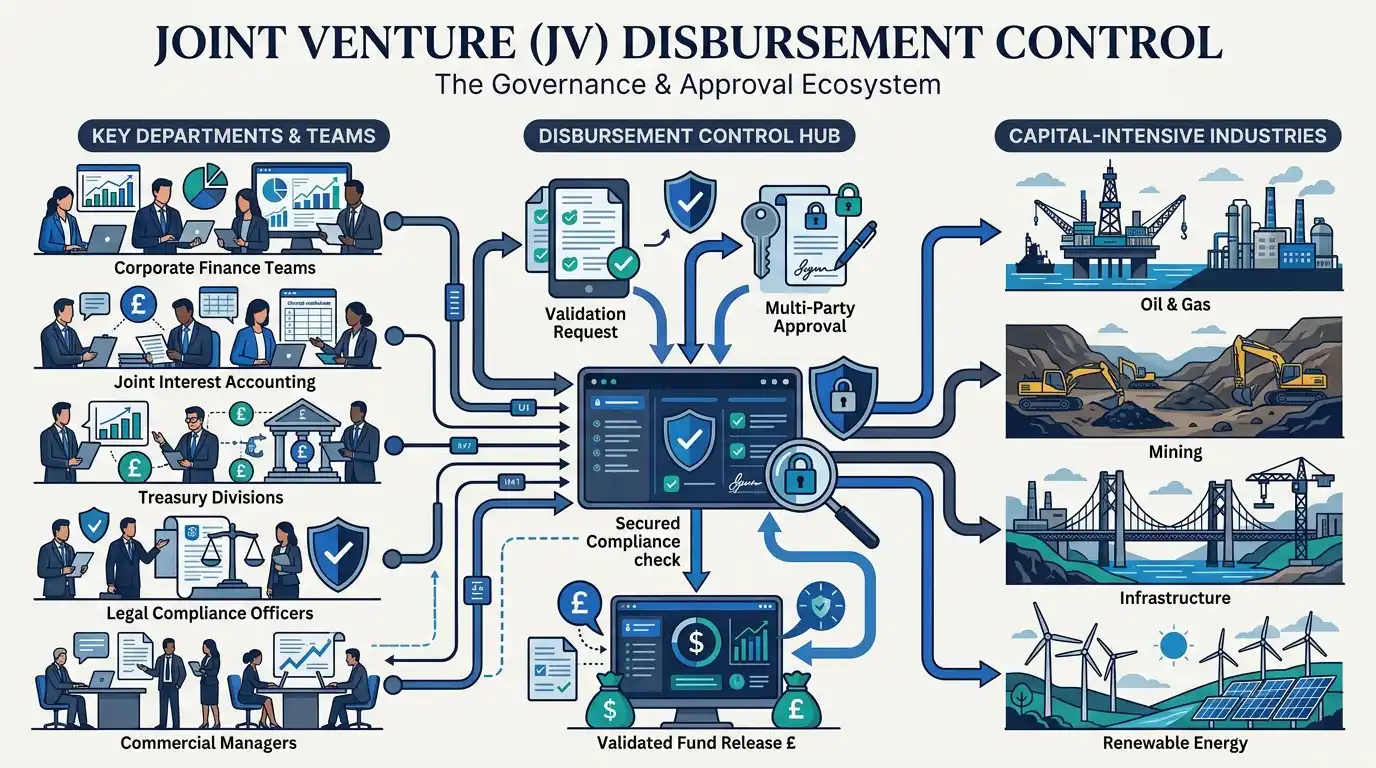
Joint interest accounting departments
Joint interest accountants manage daily cash call reconciliations, partner billings, and vendor invoice verifications. These professionals require technical mastery over joint accounting codes, COPAS guidelines, and cost-allocation methodologies to ensure operating expenses match contractual cost-sharing ratios precisely.
Corporate treasury teams
Treasury specialists oversee liquidity management, foreign exchange execution, and cash concentration across multi-currency joint accounts. Training equips treasury personnel with skills to manage escrow account governance, monitor real-time banking interfaces, enforce single-day cash pool reconciliations, and execute royalty and tax payment controls without incurring late penalties from state regulators.
Procurement and vendor contract managers
Procurement professionals draft supply chain contracts, negotiate vendor payment terms, and verify performance milestone sign-offs. Developing disbursement control expertise ensures contract managers align third-party compensation structures with joint venture approval frameworks, eliminating unapproved change orders and off-contract expenditure commitments.
Upstream and midstream energy operations
Extractive industries like offshore oil and gas exploration, deepwater drilling ventures, LNG processing facilities, and pipeline transmission systems rely heavily on joint operating agreements. These capital-intensive sectors process billions of dollars in annual disbursements across international borders, making strict control enforcement essential to preserving operating margins.
What operational problems arise from inadequate joint venture payment governance?
Inadequate joint venture payment governance leads to 4 critical organizational failures: severe financial leakage from unverified invoices, legal penalties for international sanction violations, prolonged partner disputes, and internal fraud resulting from weak segregation of duties.
Financial leakage through unverified vendor billings
Without standardized review procedures, accounting teams routinely process vendor invoices containing inflated rates, duplicated line items, or unperformed service charges. In complex offshore operations involving hundreds of service contractors, unverified payments erode project profitability, leading to cost overruns that average 12% to 15% above approved annual operating budgets.
Regulatory non-compliance and legal liability
Failing to perform automated payee screening prior to releasing funds exposes corporations to severe international regulatory penalties. Transferring capital to sanctioned entities, unverified sub-contractors, or unvetted foreign officials violates global legislation such as the UK Bribery Act and US Foreign Corrupt Practices Act (FCPA). Penalties include multi-million dollar corporate fines, revocation of operating licenses, and criminal charges against corporate directors.
Strained joint venture partner relationships
Opaque billing practices and uncoordinated cash calls destroy trust between operating and non-operating partners. When non-operators discover unapproved expenses or accounting errors during annual audits, they routinely withhold subsequent cash call payments. This cash flow starvation delays ongoing field operations, damages joint venture viability, and leads to expensive legal litigation between consortium members.
Exposure to internal fraud and asset misallocation
Lax internal control environments characterized by overlapping duties allow dishonest staff to manipulate payment systems. Single-user approval workflows allow unauthorized wire transfers, ghost vendor creation, and personal account diversions. Establishing rigorous treasury policy compliance monitoring eliminates these structural vulnerabilities entirely.
How can organizations select the right professional development framework for payment controls?
Organizations select the right professional development framework by evaluating 4 core criteria: alignment with international petroleum accounting standards, integration of realistic simulation exercises, trainer industry expertise, and post-training capability measurement metrics.
Standardized industry curriculum alignment
Selected educational programs must align directly with established international accounting guidelines and legal frameworks, including the Council of Petroleum Accountants Societies (COPAS) standards, Association of International Energy Negotiators (AIEN) model contracts, and International Financial Reporting Standards (IFRS 11 Joint Arrangements). Generic corporate finance courses fail to address the specific contractual nuances of petroleum joint venture operations.
Case-based learning and practical simulations
Effective professional development avoids purely theoretical lectures. Decision-makers must prioritize programs built upon hands-on problem-solving, real-world petroleum case studies, and interactive software simulations. Participants must actively practice evaluating disputed cash calls, setting up approval matrices, and performing real-time payee risk assessments within simulated ERP environments.
Companies seeking comprehensive skill development for their financial and operational leaders should consider structured professional programs like the [Payment Controls & Treasury Governance for JV Disbursements Training Course](How to Evaluate Payment Approval Processes and Disbursement Risks in Petroleum Joint Ventures) to build sustainable internal governance capabilities.
Measurable return on investment and skill validation
Corporate learning initiatives must include robust pre- and post-course assessment mechanisms. Decision-makers should choose training frameworks that evaluate individual participant competency through practical examinations, capstone project presentations, and 90-day workplace application reviews. This rigorous evaluation methodology guarantees that skill gains translate directly into improved operational compliance, error reduction, and financial protection for the enterprise.
Frequently Asked Questions
What is covered in the Oil & Gas Petroleum Treasury, Cash and Banking training?
The Oil & Gas Petroleum Treasury, Cash and Banking program by the Institute For Oil & Gas Training covers capital call management, foreign exchange exposure, cash pooling, and bank account governance within joint operating environments. Professionals learn how to structure multi-currency liquidity models, secure escrow accounts, and maintain treasury compliance under international accounting standards. The curriculum focuses on practical financial risk management to protect corporate cash flow across complex energy projects.
How does treasury management differ in joint venture petroleum operations?
Petroleum treasury management requires specialized oversight of shared bank accounts, cash call schedules, and joint operating agreement financial terms between co-venturers. Unlike standard corporate liquidity workflows, joint venture cash management involves managing partner advances, host government royalty payments, and strict segregation of duties to prevent unauthorized disbursements. Training from the Institute For Oil & Gas Training prepares treasury teams to manage these unique multi-party cash flow complexities efficiently.
Who should attend the Oil & Gas Petroleum Treasury, Cash and Banking course?
The Oil & Gas Petroleum Treasury, Cash and Banking course is designed for corporate treasurers, joint venture accountants, financial controllers, cash management specialists, and commercial finance managers in the energy sector. Professionals seeking to master petroleum cash call workflows, foreign currency hedging, and joint account banking controls benefit directly from the curriculum. The training strengthens core financial governance capabilities for both upstream and midstream organizational roles.
How do petroleum enterprises protect joint venture accounts from disbursement risks?
Energy companies protect joint venture accounts by implementing strict approval matrices, automated sanctions screening, and formal cash call authorisation protocols. Establishing immutable digital audit trails and dual-control banking frameworks prevents unauthorized capital transfers and reduces partner billing disputes. Practical training modules delivered by the Institute For Oil & Gas Training equip treasury units to embed these internal payment controls directly into enterprise accounting systems.
What measurable benefits does specialized petroleum treasury training deliver?
Specialized petroleum treasury training improves cash management speed, eliminates unapproved capital leakages, and reduces joint interest audit exceptions across operating ventures. Organizations gain enhanced visibility over international banking structures, foreign exchange risks, and statutory tax payment deadlines. Implementing these standardized treasury frameworks through the Institute For Oil & Gas Training leads to stronger partner transparency and accelerated payment settlement cycles.
Related training courses
Amine Gas Treating and Regeneration Operations Training Course
- Specialisation
- Oil & Gas Process Engineering and Operations
- Duration
- 5 days · 15 CPD hours
Industrial Steam Boiler Systems and Operational Control Training Course
- Specialisation
- Oil & Gas Process Engineering and Operations
- Duration
- 5 days · 15 CPD hours
Pipeline Inspection and Integrity Assessment Training Course
- Specialisation
- Oil & Gas Pipeline Integrity and Inspection
- Duration
- 5 days · 15 CPD hours
More articles

How to Evaluate Transfer Pricing Risks and Intercompany Transactions in Oil and Gas Groups
Evaluate transfer pricing risks in oil and gas intercompany transactions. Learn methods, functional analysis, and arm's length compliance strategies.
Read article →
Why Transfer Pricing Matters for Multinational Oil and Gas Groups
Learn why transfer pricing matters for multinational oil and gas groups, including compliance frameworks, risk management, and workforce development.
Read article →
Withholding Tax Compliance and Treaty Relief Training for Oil and Gas Tax Professionals
Master cross-border oil and gas tax compliance. Evaluate syllabus, delivery, and outcomes for the Institute For Oil & Gas Training course.
Read article →