

The Petroleum Taxation Fundamentals for Resource Rent Taxes Training Course is an advanced professional training program designed by Institute For Oil & Gas Training to bridge technical knowledge gaps in evaluating resource rent tax regimes, managing marginal tax rate stacking, and calculating effective tax rates for upstream capital allocation.
In the international upstream oil and gas industry, capital investment decisions depend heavily on fiscal terms, fiscal neutrality, and the financial exposure created by host country taxation frameworks. Many finance managers, commercial analysts, tax practitioners, and petroleum economists struggle to model specialized tax mechanisms that activate when project returns exceed designated threshold rates. Conventional corporate income tax knowledge is often insufficient when project evaluations must account for complex fiscal instruments, including an excess profits tax, a supplementary charge, or a temporary windfall tax. Failing to model these fiscal regimes accurately leads to mispriced project risk, faulty valuation models, incorrect cash flow forecasts, and flawed bidding strategies during concession rounds.
Understanding the underlying mechanics of fiscal sovereign take requires a detailed foundation in economic rent theory, which is explained comprehensively in our foundational guide on Why Resource Rent Taxes Matter in Petroleum Project Economics. Without a deep conceptual grasp of fiscal progression and non-neutral fiscal designs, project teams miscalculate the impact of capital expenditure write-offs and tax ring-fencing provisions. Unintended tax liabilities directly erode net present value and internal rate of return metrics across cross-functional capital planning units.
Institute For Oil & Gas Training developed this specialized course to provide structured corporate capabilities that eliminate fiscal modeling errors. The program moves participants beyond basic accounting principles into full specification-level analysis of rent extraction instruments. By mastering the interaction between upstream economic rents, deductible tax allowances, and host government fiscal rules, asset managers and financial controllers can accurately predict project economics under volatile commodity price scenarios.
Why Is This Petroleum Taxation Training Program Structured in This Logical Sequence?
This curriculum is structured sequentially from rent theory fundamentals to advanced multi-tax modeling, enabling participants to progress systematically through fiscal policy mechanics, deduction hierarchies, marginal tax rate stacking, and dynamic cash flow valuation without analytical gaps.
Building proficiency in upstream fiscal analysis requires a clear progression from underlying policy design to applied operational execution. The learning path begins with the core principles of economic rent extraction, defining how sovereign governments structure a resource rent tax to capture profits above the investor's required hurdle rate without discouraging initial capital deployment. Understanding these theoretical boundaries ensures that participants grasp why host governments implement a supplementary charge or an energy profits levy alongside baseline corporate income taxes.
After establishing policy fundamentals, the structure shifts toward the structural interaction between competing tax mechanisms within a single jurisdiction. Evaluating the order of tax deductions, the deductibility of one tax against another, and ring-fencing limits requires rigorous structural analysis. To explore how different commercial fiscal frameworks compare across international jurisdictions, refer to our detailed analytical overview on How to Evaluate Resource Rent Tax Structures and Their Impact on Oil and Gas Project Returns. This analytical framework forms the structural core of the transition from conceptual tax laws to quantitative financial model construction.
The final phase of the curriculum integrates complex taxation algorithms directly into cash flow forecasting models. Institute For Oil & Gas Training designs this learning flow to ensure that theoretical knowledge converts immediately into operational capabilities. By standardizing the progression from policy intent to mathematical tax calculation, the program ensures that corporate planning teams develop consistent, audit-ready valuation models across all upstream assets.
What Will Participants Learn Across the Specific Course Modules?
Participants will master economic rent modeling, tax deduction hierarchies, effective tax rate calculation, and fiscal risk sensitivity analysis through five structured technical modules engineered for upstream oil and gas corporate environments.
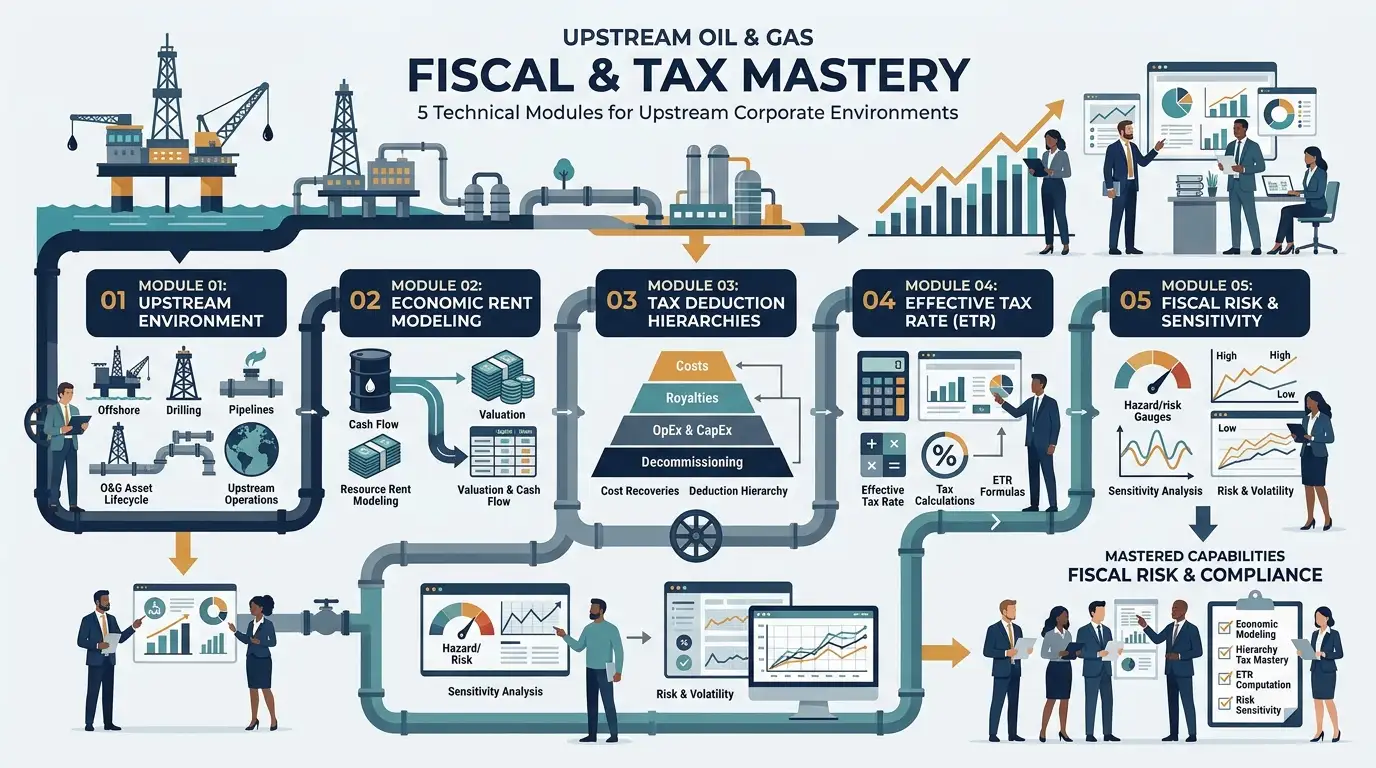
Module 1: Principles of Economic Rent and Sovereign Fiscal Policy
Definition and calculation of economic rent in finite natural resource extraction projects.
Comparison between neutrality-based fiscal regimes and progressive profit-sharing frameworks.
Structural design of excess profits tax frameworks and resource rent tax threshold rates.
Analysis of host government policy goals, sovereign take, and investor uplift mechanisms.
Module 2: Mechanics of Special Petroleum Taxes and Levies
Operational mechanics of an energy profits levy, supplementary charge, and temporary windfall tax.
Ring-fencing rules applied to exploration, field development, and post-production abandonment costs.
Treatment of carry-forward provisions, unrecovered capital balances, and uplift interest rates.
Analysis of indexation mechanisms and inflation adjustments within long-term concession agreements.
Module 3: Marginal Tax Rate Stacking and Deduction Hierarchies
Evaluation of marginal tax rate stacking across multi-tiered fiscal regimes.
Mathematical rules governing the deductibility of one tax against another within gross revenue calculations.
Impact of corporate income tax base adjustments resulting from field-level supplementary levies.
Identification and mitigation of fiscal drag caused by non-deductible financial expenses.
Module 4: Quantitative Effective Tax Rate Calculation and Financial Modeling
Step-by-step effective tax rate calculation methods for upstream project cash flow models.
Dynamic modeling of cash flows under progressive taxation triggers and tier-based thresholds.
Depreciation acceleration, capital allowance timing, and immediate expensing adjustments.
Net present value sensitivity modeling under fluctuating Brent and Henry Hub price assumptions.
Module 5: Corporate Tax Strategy, Compliance, and Commercial Risk Management
Assessing fiscal stability clauses and sovereign contract renegotiation risks in long-term concessions.
Integration of tax risk assessments into international joint venture operating agreements.
Audit trail preparation for host government petroleum tax assessments and revenue reviews.
Cross-functional alignment between corporate tax departments, treasury, and commercial planning teams.
How Is the Petroleum Taxation Course Delivered and Assessed?
Institute For Oil & Gas Training delivers this training course through interactive expert-led workshops, online modules, or tailored onsite corporate sessions, utilizing real-world financial datasets, continuous scenario simulation, and rigorous competency assessments.
Flexible Training Delivery Formats
To accommodate corporate schedules and global asset teams, Institute For Oil & Gas Training offers three primary instructional formats:
Instructor-Led Intensive Workshops: A 4-day classroom workshop combining direct expert lectures with collaborative financial modeling exercises.
Live Virtual Online Delivery: Spread over 2 weeks with eight 3-hour live online sessions designed for remote global finance and commercial teams.
Onsite Corporate Custom Programs: Customized internal delivery tailored specifically to an organization's active asset portfolio and operating fiscal contracts.
Practical Learning Methods and Applied Simulations
The instructional methodology prioritizes practical execution over passive theoretical instruction. Participants spend over half of the course duration working within structured financial spreadsheets, executing actual tax calculations using real-world petroleum contract parameters. Teams solve complex fiscal scenarios featuring overlapping tax tiers, statutory deduction limitations, and shifting commodity price curves.
Competency Assessment and Completion Standards
Knowledge acquisition is continuously monitored through structured evaluation checkpoints:
Module Baseline Diagnostics: Pre-module quizzes assessing core understanding of corporate income tax and financial modeling mechanics.
Applied Financial Modeling Assignments: Practical spreadsheet construction exercises focused on multi-tier petroleum tax modeling.
Capstone Fiscal Valuation Project: A comprehensive case study requiring participants to evaluate a complete upstream concession contract, build the fiscal model, calculate the effective tax rate, and present an audit-ready fiscal risk report.
What Measurable Results and Corporate Performance Improvement Can Organizations Expect?
Organizations achieve standardized financial modeling workflows, zero tax miscalculation errors in project valuations, optimized capital allocation decisions, and improved cross-functional coordination between finance, tax, and commercial departments.
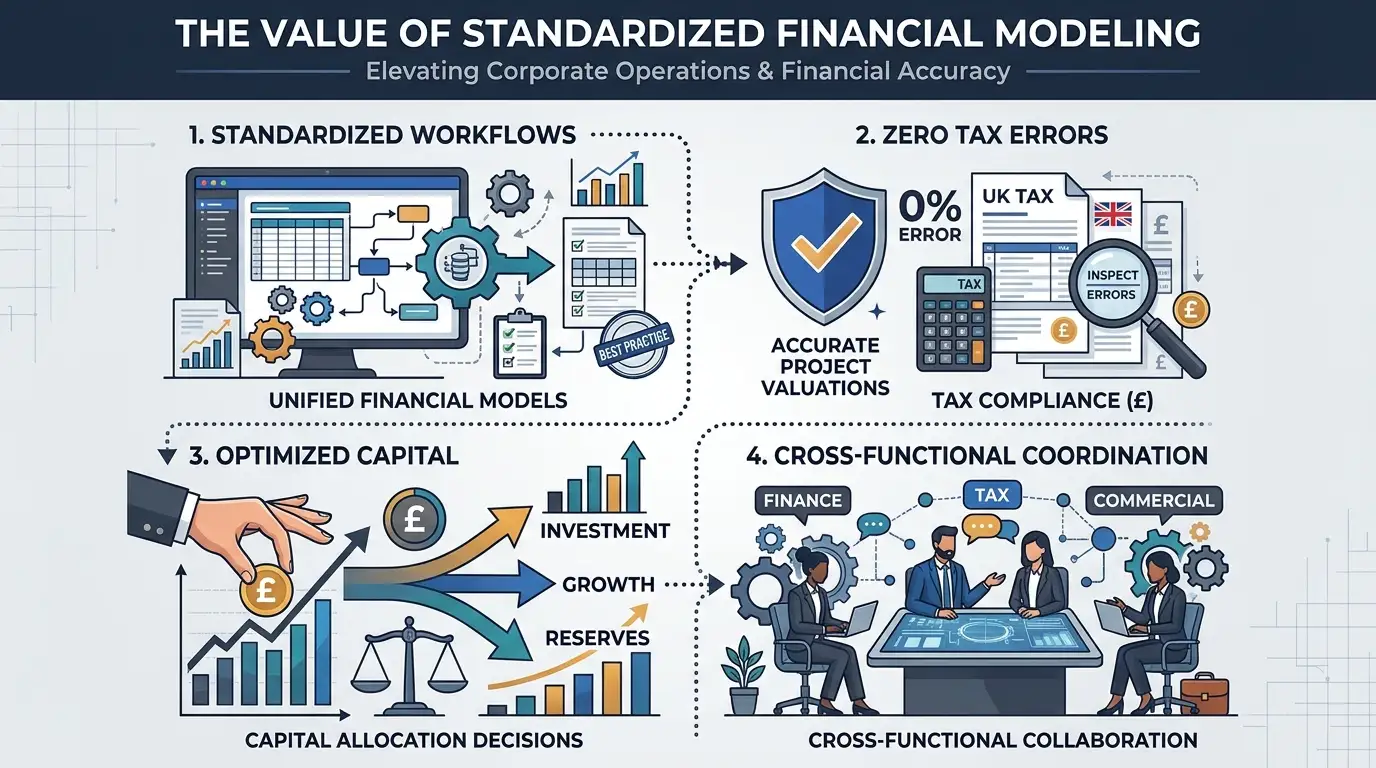
Quantitative Skill Improvements for Professionals
Upon completing the program, individual professionals gain direct technical mastery over upstream fiscal analysis:
Accurately calculate project-level effective tax rate outcomes across complex progressive fiscal regimes.
Build dynamic, error-free financial models that correctly account for marginal tax rate stacking.
Evaluate statutory fiscal terms quickly during concession bidding, asset acquisition, or farm-in negotiations.
Identify tax optimization opportunities within permissible legal frameworks and capital allowance rules.
Strategic Impact on HR Teams and Organizational Workforce Pipeline
Human resources leaders and corporate learning directors leverage this structured course to build repeatable technical capability across critical business units:
Talent Development Pipeline: Establishes a standardized training benchmark for junior and mid-level commercial analysts transitioning into upstream asset evaluation roles.
Interdisciplinary Alignment: Bridges knowledge gaps between engineering teams estimating capital expenditure and financial professionals modeling tax liabilities.
Risk Reduction: Minimizes corporate exposure to multi-million-dollar valuation errors caused by improper modeling of a resource rent tax or supplementary charge.
Organizational Role | Pre-Training Performance Benchmark | Post-Training Operational Capability |
Commercial Analyst | Relies on basic static tax templates; struggles with multi-tier tax stacking. | Builds dynamic fiscal models with precise progressive tax trigger logic. |
Tax Specialist | Understands legal tax text but lacks financial spreadsheet modeling skills. | Converts complex fiscal clauses directly into dynamic discounted cash flow algorithms. |
Finance Manager | Reviews high-level tax assumptions without verifying underlying calculation order. | Audits fiscal deduction hierarchies and validates host government sovereign take calculations. |
Institute For Oil & Gas Training aligns every module with measurable business performance key performance indicators, ensuring that corporate learning investments generate immediate operational improvements across commercial planning teams.
How Does the Enrollment and Participation Process Work?
Enrollment involves a formal candidate profile review, prerequisite verification, pre-course learning material assignment, guided course execution, and post-completion technical support provided by Institute For Oil & Gas Training.
Prerequisites and Participant Eligibility Criteria
This program is engineered for professionals involved in upstream project evaluation, financial management, tax policy, and commercial negotiation. Recommended roles include:
Commercial Analysts and Petroleum Economists
Corporate Tax Managers and Financial Controllers
Upstream Business Development and Asset Acquisition Teams
Government Relations and Fiscal Policy Advisors
HR Managers structuring specialized technical development programs
Participants should possess a foundational understanding of corporate finance, basic financial statements, and intermediate Microsoft Excel capabilities. Prior experience in petroleum accounting is helpful but not mandatory.
Step-by-Step Completion Pathway
To ensure maximum learning retention and operational application, the enrollment and training execution process follows four distinct steps:
Registration and Candidate Assessment: Corporate HR teams or individual applicants submit registration details. Institute For Oil & Gas Training reviews participant backgrounds to ensure appropriate cohort grouping.
Pre-Course Preparation: Enrolled candidates receive preparatory reading materials covering upstream fiscal terminology, rent theory concepts, and base modeling templates.
Active Course Execution: Participants complete the structured instruction, engaging in interactive lectures, group case studies, and spreadsheet modeling labs.
Capstone Evaluation and Certification: Candidates complete the final valuation project. Successful participants receive a professional certificate of completion verifying technical competency in resource rent taxation analysis.
To build rigorous corporate capability in evaluating fiscal terms and optimizing upstream project economics, enroll in this program today.
Frequently Asked Questions
What is oil & gas petroleum taxation training?
Oil & gas petroleum taxation training covers the fiscal regimes, tax structures, and revenue frameworks applicable to upstream, midstream, and downstream operations. Programs delivered by Institute For Oil & Gas Training focus on resource rent taxes, ring-fencing rules, marginal tax rates, and corporate income tax deductions. This training equips finance professionals and commercial analysts with the skills required to model project cash flows accurately under dynamic fiscal terms.
Why is petroleum taxation critical in oil and gas project economics?
Petroleum taxation directly affects host government take, project net present value, and overall investment feasibility in capital-intensive energy developments. Understanding complex tax instruments, such as supplementary charges and excess profits taxes, helps corporate planning teams evaluate fiscal exposure under fluctuating commodity prices. Specialist courses from Institute For Oil & Gas Training enable organizations to optimize capital allocation and prevent costly valuation errors.
Who should take an oil & gas petroleum taxation course?
An Oil & Gas Petroleum Taxation course is designed for petroleum economists, commercial analysts, tax managers, financial controllers, and HR teams structuring professional development pathways. It is equally valuable for corporate planning professionals and host government advisors who negotiate or audit concession agreements. Institute For Oil & Gas Training tailors these learning modules to bridge knowledge gaps between technical accounting and strategic field valuation.
What are the main components of a petroleum tax regime?
A standard petroleum tax regime comprises royalty payments, corporate income taxes, resource rent taxes, and special energy profit levies. It also includes specific operational rules such as capital allowance acceleration, ring-fencing restrictions, and tax deduction hierarchies. Through structured corporate instruction, Institute For Oil & Gas Training demonstrates how these elements interact to determine total fiscal drag and effective tax rates.
How does resource rent taxation differ from standard corporate income tax?
Resource rent taxation targets economic rents generated when project returns exceed a predetermined hurdle rate, whereas corporate income tax applies to general corporate accounting profits. Resource rent taxes are progressive and often feature unique carried-forward allowances and inflation adjustments. Corporate training programs offered by Institute For Oil & Gas Training provide practical modeling skills to evaluate how these distinct fiscal mechanisms impact overall project returns.
Related training courses
Hazardous Liquid Pipeline Inspection and Integrity Management Training Course
- Specialisation
- Oil & Gas Pipeline Integrity and Inspection
- Duration
- 5 days · 15 CPD hours
API 653 Storage Tank Inspection and Integrity Assessment Training Course
- Specialisation
- Oil & Gas Inspection and Non-Destructive Testing
- Duration
- 5 days · 15 CPD hours
Corrosion, Metallurgy and Failure Prevention Training Course
- Specialisation
- Oil & Gas Corrosion Management and Control
- Duration
- 5 days · 15 CPD hours
More articles

How to Evaluate Transfer Pricing Risks and Intercompany Transactions in Oil and Gas Groups
Evaluate transfer pricing risks in oil and gas intercompany transactions. Learn methods, functional analysis, and arm's length compliance strategies.
Read article →
Why Transfer Pricing Matters for Multinational Oil and Gas Groups
Learn why transfer pricing matters for multinational oil and gas groups, including compliance frameworks, risk management, and workforce development.
Read article →
Withholding Tax Compliance and Treaty Relief Training for Oil and Gas Tax Professionals
Master cross-border oil and gas tax compliance. Evaluate syllabus, delivery, and outcomes for the Institute For Oil & Gas Training course.
Read article →