

Resource rent tax structures directly alter the net present value and internal rate of return of upstream oil and gas investments by skimming surplus profits during high-price environments. Evaluating these fiscal regimes requires rigorous financial modelling, progressive rate analysis, and detailed cash flow forecasting.
Petroleum fiscal regimes across global jurisdictions frequently deploy progressive tax mechanisms to capture economic rent without discouraging initial exploration capital. Understanding the fundamental mechanics behind these revenue-sharing instruments is crucial, which is why financial analysts often explore why resource rent taxes matter in petroleum project economics before attempting complex cash flow modelling across volatile commodity price cycles. When evaluating multi-billion-pound upstream assets, corporate planning teams must distinguish between neutral rent-extraction mechanisms and traditional profit-based corporate taxes.
How Does a Resource Rent Tax Differ From Standard Petroleum Fiscal Regimes?
A resource rent tax applies exclusively to economic rent, targeting cash flows that exceed an investor's required threshold rate of return. Standard fiscal regimes levy levies on gross revenues or accounting net income regardless of overall project profitability.
Traditional concessionary and production-sharing arrangements typically rely on royalties, bonuses, and standard corporate income taxes to secure state revenue. Royalties function as a top-line extraction on gross production, raising the economic limit of a field and potentially forcing early abandonment. Standard corporate income tax measures accounting profit within a defined fiscal period, ignoring the cumulative capital recovery status of the asset.
In contrast, a pure resource rent tax system targets cash flows rather than accounting profits. The fiscal authority grants full immediate deductibility for capital expenditures, operating costs, and decommissioning liabilities. Tax liability triggers only after net cumulative cash flows turn positive and pass a specified benchmark rate of return. This design ensures that marginal fields remain commercially viable while state participation automatically scales up during period of surging energy prices.
Key Components of Resource Rent Regimes
Threshold Rate (Uplift Rate): The minimum internal rate of return or discount rate that project cash flows must achieve before the supplementary tax applies.
Immediate Expensing: The immediate write-off of 100% of capital investments, eliminating traditional multi-year depreciation schedules.
Ring-Fencing Rules: Boundaries determining whether tax losses from one exploration block can offset economic rent liabilities in another producing block.
Loss Carry-Forward Adjustments: Unused tax losses accumulate interest at the statutory benchmark rate to preserve their real time-value for capital recovery.
What Is the Impact of Marginal Tax Rate Stacking on Upstream Cash Flows?
Marginal tax rate stacking occurs when multiple fiscal instruments overlay the same cash flow stream, compound effective tax burdens, and erode net project returns. Uncoordinated multi-tiered tax layers drastically reduce net present value during high commodity price periods.
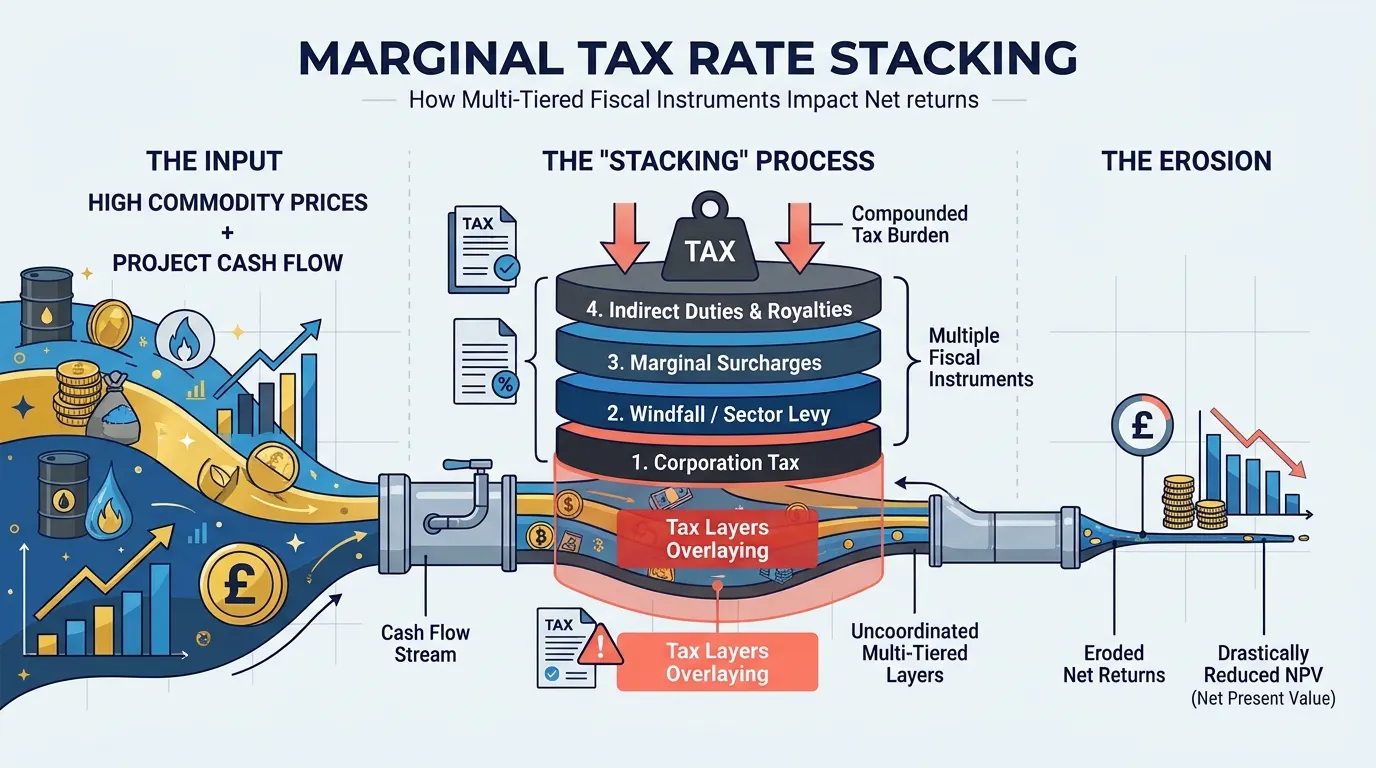
Governments rarely deploy a resource rent tax in complete isolation. Most petroleum fiscal frameworks combine a baseline corporate income tax with secondary levies such as a supplementary charge, an excess profits tax, a windfall tax, or a localized energy profits levy. When these fiscal tiers accumulate, the combined marginal rate can surpass 75% to 85% of incremental revenue.
The economic consequence of rate stacking depends on the deductibility of one tax against another. If a secondary windfall tax is non-deductible against standard corporate income tax, the investor experiences exponential margin compression. Commercial evaluation models must assess how these interacting layers affect free cash flows under various oil price scenarios.
Fiscal Instrument | Target Base | Deductibility Status | Impact on Cash Flow Uplift |
Basic Corporate Tax | Net Accounting Profit | Standard operational expenses deductible | Moderate reduction across all positive income periods |
Supplementary Charge | Adjusted Corporate Income | Usually non-deductible against standard corporate tax | Constant upward pressure on effective fiscal burden |
Windfall Tax / Energy Profits Levy | Supernormal Gross or Net Revenue | Varies by jurisdiction; often restricts interest deductions | Severe cash flow contraction during price spikes |
Resource Rent Tax | Cumulative Net Present Cash Flow | Applied after baseline tax deductions and threshold recovery | Highly targeted rent extraction; neutral on marginal assets |
Assessing Structural Interaction Effects
Evaluating stacked tax systems requires tracking structural interactions across the project lifecycle. A regime featuring high nominal rates with generous investment allowances can yield a lower effective tax rate than a simple regime with moderate rates and restrictive cost recovery rules.
Financial evaluators calculate the combined marginal rate across successive cash flow tranches. If an additional pound of revenue generates 30 pence of standard tax, 20 pence of supplementary charge, and 25 pence of resource rent tax, the cumulative marginal rate reaches 75%. If the resource rent tax calculation fails to allow deductibility for the supplementary charge, the effective tax burden rises further, distorting capital allocation decisions.
How Do Financial Analysts Compute Effective Tax Rates Across Varied Price Regimes?
Computing effective tax rates requires building multi-scenario cash flow models that incorporate progressive tax brackets, price-indexed triggers, and dynamic cost allowances. Static tax rates fail because effective tax burdens fluctuate sharply based on underlying commodity prices.
The effective tax rate represents the total fiscal take divided by pre-tax economic profit over the asset life cycle. Unlike statutory rates, the effective rate fluctuates in real time based on capital intensity, operating margins, and oil price levels. Standard static accounting models fail to capture these dynamics in progressive tax regimes.
To calculate the true fiscal burden, financial teams execute dynamic sensitivity analyses. The methodology follows three distinct analytical steps:
Baseline Net Cash Flow Projection: Establish pre-tax cash flow profiles including capital expenditure, operating costs, development timing, and abandonment costs.
Tiered Fiscal Overlay Application: Apply fiscal rules sequentially, calculating royalties, corporate tax, supplementary charges, and rent taxes according to statutory deductibility rules.
Discounted Take Metrics Calculation: Compute the government take and investor take on both a nominal cash basis and a discounted net present value basis across price sensitivity bands (£50, £75, £100 per barrel).
Scenario-Based Yield Distortions
During low-price regimes, investment allowances and loss carry-forwards suppress the effective tax rate, protecting investor downside. As prices rise above development thresholds, progressive tax structures engage, pushing the effective tax rate upward.
In complex frameworks featuring an energy profits levy or excess profits tax, rapid legislative amendments can introduce retroactive fiscal changes. Corporate evaluation models must account for potential sovereign risk by running sensitivity thresholds on tax rate increases, modified depreciation schedules, and altered ring-fencing boundaries.
What Evaluation Framework Best Determines Resource Rent Tax Impact on Project Economics?
An effective evaluation framework combines discounted cash flow metrics, fiscal regime neutrality checks, sovereign risk scoring, and structural sensitivity modeling. This multi-tiered approach identifies returns under changing legislative and market environments.
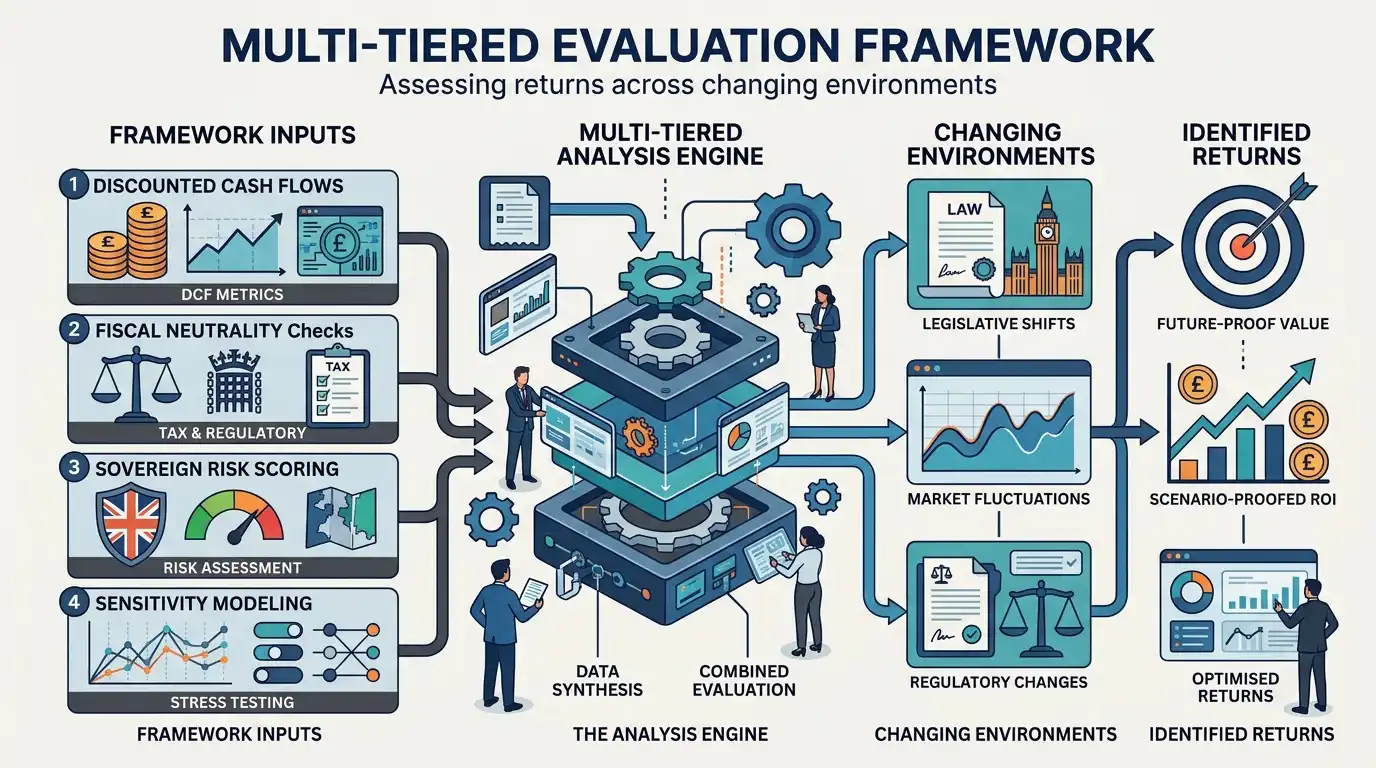
Commercial decision-makers require a robust framework to rank international capital allocation opportunities. Evaluating upstream projects under resource rent taxes demands analyzing financial returns alongside fiscal neutrality and structural stability.
1. Financial Return Metrics
The framework starts by measuring core financial indicators post-tax. Key performance indicators include discounted payback period, internal rate of return, and net present value per unit of capital invested. Because resource rent taxes alter cash flow timing, analysts evaluate returns at multiple discount rates.
2. Fiscal Regime Neutrality
A neutral tax regime does not alter the investment decision or the optimal extraction profile of an asset. Frameworks evaluate whether a rent tax alters the field's economic limit. A poorly designed excess profits tax or non-deductible supplementary charge can force early decommissioning by making late-life marginal production unprofitable.
3. Sovereign and Structural Risk Assessment
Upstream investments feature long gestation periods, often spanning decades. The evaluation framework must score jurisdictions based on fiscal stability, historical tax policy changes, and political risk. Unscheduled windfall taxes or modified ring-fencing rules directly alter long-term economic performance.
Commercial decision-makers must ensure their internal multidisciplinary teams possess the specialized technical capabilities needed to build and audit these complex fiscal models. Organizations frequently enroll mid-career commercial managers, tax specialists, and financial analysts in targeted external programs like the Petroleum Taxation Fundamentals for Resource Rent Taxes Training Course to standardize modeling frameworks, evaluate international tax structures, and build robust capital allocation tools.
How Can Corporate Teams Master Resource Rent Tax Evaluation and Financial Modelling?
Corporate teams master resource rent tax evaluation through practical, case-based training programs that align commercial analysis, fiscal law, and financial modeling. Structured professional development bridges technical skill gaps across commercial and planning departments.
Evaluating complex tax structures requires seamless collaboration among corporate finance, commercial operations, legal counsel, and tax departments. Skill gaps in understanding marginal tax rate stacking or loss carry-forward mechanics lead to mispriced assets, inaccurate asset valuations, and flawed bid strategies in licensing rounds.
Structured organizational capability building provides corporate teams with standardized evaluation methodologies. When corporate planning groups evaluate complex fiscal regimes, utilizing specialized corporate education like Petroleum Taxation Training for Resource Rent Taxes in the Oil and Gas Industry ensures that cross-functional teams apply consistent economic modeling criteria across all international assets.
Strategic Capability Building for Energy Enterprises
Human resource directors and commercial department heads must prioritize practical learning delivery models over abstract theoretical instruction. Corporate training initiatives generate measurable returns when structured around real-world asset evaluation scenarios.
Integrated Learning Delivery: Blended instructional models combining live financial modeling workshops, historical fiscal case studies, and jurisdiction-specific regulatory analysis.
Targeted Workforce Competencies: Training focused on effective tax rate calculation, ring-fencing compliance, uplift rate application, and contract negotiation dynamics.
Measurable Business Outcomes: Reduced asset evaluation lead times, enhanced valuation accuracy during M&A due diligence, and improved alignment between financial models and tax filings.
By formalizing resource rent tax evaluation capabilities across commercial and technical teams, energy organizations protect project margins, optimize capital deployment, and navigate complex petroleum fiscal regimes with precision.
Frequently Asked Questions
What does oil and gas petroleum taxation training cover?
Oil and gas petroleum taxation training covers the fiscal frameworks governing upstream and midstream energy operations, including royalties, corporate income taxes, production-sharing contracts, and resource rent taxes. Participants learn how to evaluate marginal tax rates, calculate effective tax burdens, and model the impact of fiscal policies on project returns. The Institute For Oil & Gas Training designs this curriculum to equip commercial managers, financial analysts, and tax professionals with practical asset valuation skills.
How do resource rent taxes impact petroleum project economics?
A resource rent tax targets excess profits above a baseline rate of return, directly altering an upstream asset's net present value and internal rate of return. Unlike standard royalties levied on gross production, rent taxes apply to cumulative net cash flows after capital expenditure recovery thresholds are met. Through specialized petroleum taxation instruction, the Institute For Oil & Gas Training helps corporate planning teams model these progressive fiscal mechanisms to accurately forecast cash flows across volatile commodity price cycles.
Why is specialized petroleum taxation training important for energy professionals?
Petroleum fiscal regimes involve complex mechanisms such as tax rate stacking, ring-fencing rules, and non-deductible supplementary charges that standard accounting courses do not address. Gaining targeted expertise in energy fiscal systems enables finance, legal, and commercial teams to evaluate cross-border investments and navigate complex tax legislation. The Institute For Oil & Gas Training provides industry-aligned instruction that bridges workforce skill gaps and improves corporate decision-making during asset acquisitions and licensing rounds.
What is the difference between corporate income tax and a windfall profits tax in energy?
Corporate income tax applies a standard statutory rate to net accounting profits across a defined financial period. In contrast, a windfall profits tax or energy profits levy is a supplementary charge designed to capture short-term excess gains during period of unusually high oil and gas prices. The Institute For Oil & Gas Training delivers comprehensive training on petroleum taxation to help organizations analyze how these overlapping tax layers interact and impact overall project profitability.
Who should enroll in petroleum taxation courses?
Petroleum taxation programs are designed for corporate finance executives, tax managers, commercial analysts, joint-venture accountants, and government relations specialists within the energy sector. HR teams and department heads partner with the Institute For Oil & Gas Training to upskill multidisciplinary teams, ensuring consistent financial modeling standards and strategic alignment during fiscal negotiations and M&A due diligence.
Related training courses
Oilfield Production Chemicals and Treatment Applications Training Course
- Specialisation
- Oil & Gas Process Engineering and Operations
- Duration
- 5 days · 15 CPD hours
API 653 Storage Tank Inspection and Integrity Assessment Training Course
- Specialisation
- Oil & Gas Inspection and Non-Destructive Testing
- Duration
- 5 days · 15 CPD hours
Microbiologically Influenced Corrosion (MIC) Training Course
- Specialisation
- Oil & Gas Corrosion Management and Control
- Duration
- 5 days · 15 CPD hours
More articles

How to Evaluate Transfer Pricing Risks and Intercompany Transactions in Oil and Gas Groups
Evaluate transfer pricing risks in oil and gas intercompany transactions. Learn methods, functional analysis, and arm's length compliance strategies.
Read article →
Why Transfer Pricing Matters for Multinational Oil and Gas Groups
Learn why transfer pricing matters for multinational oil and gas groups, including compliance frameworks, risk management, and workforce development.
Read article →
Withholding Tax Compliance and Treaty Relief Training for Oil and Gas Tax Professionals
Master cross-border oil and gas tax compliance. Evaluate syllabus, delivery, and outcomes for the Institute For Oil & Gas Training course.
Read article →