

Indirect tax management in upstream, midstream, and downstream petroleum operations requires structured risk evaluation and precise procedural controls. Energy sector finance teams, supply chain officers, and tax professionals regularly struggle with complex statutory frameworks, import tariffs, and local compliance demands. Understanding the baseline mechanics of upstream tax exposures remains essential for energy personnel who must navigate regulatory demands and operational audits. A thorough grasp of Why Indirect Taxes and Duties Matter in Oil and Gas Operations provides the operational clarity necessary to construct robust internal controls and avoid severe statutory penalties.
Evaluating petroleum tax obligations involves systematically auditing cross-border material movements, assessing contractor liabilities, and verifying statutory exemption eligibility. Petroleum projects operate under tight margins where unrecovered value-added taxes or unexpected customs assessments directly erode project profitability. Organizations must establish clear internal guidelines to manage Petroleum Taxation Training for Indirect Taxes and Duties in Oil and Gas across operating units, enabling finance and logistics personnel to identify non-compliance risks before regulatory authorities issue assessments.
How Do Upstream Operations Impact Value Added Tax on Petroleum Operations?
Upstream exploration and production operations generate extensive value added tax on petroleum operations through high-volume capital expenditure, complex contractor supply chains, cross-border equipment leasing, and delayed output revenue generation, which creates prolonged input tax accumulation and cash flow exposure.
Upstream oil and gas activities rely heavily on specialized capital equipment, offshore drilling rigs, seismic surveying services, and engineering consultancies. Each phase of exploration and field development incurs substantial value-added tax on goods and services acquired from domestic and international vendors. Because exploration ventures produce no immediate taxable revenue, operating companies accumulate significant input tax balances over multi-year development cycles.
Managing these liabilities requires precise alignment between procurement contracts, vendor invoicing, and tax accounting systems. Contracting entities must verify whether vendor services trigger local reverse-charge mechanisms or require direct tax withholding. Misclassifying upstream services results in improper tax reporting, delayed audit clearance, and substantial financial penalties from revenue authorities.
HR and finance leaders must ensure engineering and procurement teams understand statutory tax mechanics. Developing cross-functional awareness prevents procurement officers from signing contracts that contain unfavorable tax indemnity clauses or unrecoverable tax liabilities. Building structured competency across technical and financial divisions ensures consistent tax compliance throughout the asset lifecycle.
What Strategies Ensure Effective VAT Recovery and Refunds in Petroleum Projects?
Effective VAT recovery and refunds in petroleum projects depend on rigorous invoice documentation, timely statutory filings, thorough verification of vendor tax registration numbers, detailed reconciliation of input tax accounts, and proactive engagement with tax authorities during administrative audits.

Input tax recovery represents a primary financial objective for petroleum accounting units operating in high-tax jurisdictions. Revenue authorities impose stringent documentation standards before approving refund claims submitted by exploration and production entities. Missing vendor tax identification numbers, improper invoice formatting, or inconsistent descriptions of goods render tax credits void during official reviews.
Organizations must implement standardized accounting controls to validate input tax documentation upon invoice receipt. Finance teams should reconcile purchase orders, bill of lading documents, and tax invoices before entering transactions into corporate enterprise resource planning software. Unreconciled accounts increase audit friction and delay refund disbursements by several months or years.
Unrecovered tax balances tie up substantial working capital and reduce net operating margins. Corporate leaders must train accounting staff to execute structured audit preparation and maintain transparent transactional records. Upgrading internal review standards ensures tax units recover input tax balances within statutory processing windows.
How Do Customs Duty Exemptions Apply to Imported Equipment and Materials?
Customs duty exemptions apply to imported equipment and materials through statutory production sharing contracts, specific energy sector incentive legislation, official government approval letters, clear tariff classification codes, and strict adherence to end-use documentation protocols.
Petroleum exploration and development require importing highly specialized machinery, tubular goods, drilling bits, and subsea infrastructure. Host nations frequently grant customs duty exemptions under Production Sharing Agreements (PSAs) or general petroleum laws to attract foreign direct investment. However, qualifying for these relief mechanisms requires strict procedural compliance prior to material arrival at port facilities.
Importers must ensure every line item matches the exact descriptions approved in statutory master equipment lists. Discrepancies between shipping manifests, commercial invoices, and exemption certificates trigger immediate duty assessments, customs holds, and demurrage fees at border checkpoints. Customs brokers and logistics teams must work from synchronized database records to maintain operational compliance.
To maintain continuous operational readiness, personnel enrolled in the Petroleum Taxation Fundamentals for Indirect Taxes & Duties Training Course learn to review tariff codes, evaluate end-use documentation requirements, and execute compliant port clearances. Structured capability building across logistics divisions eliminates costly port delays and prevents unauthorized duty payments.
What Controls Manage Temporary Importation of Equipment and Machinery?
Managing temporary importation of equipment and machinery requires tracking re-exportation timelines, posting compliant bank guarantees, securing official extension permits from customs authorities, and maintaining audit-ready operational logs for all temporary items.
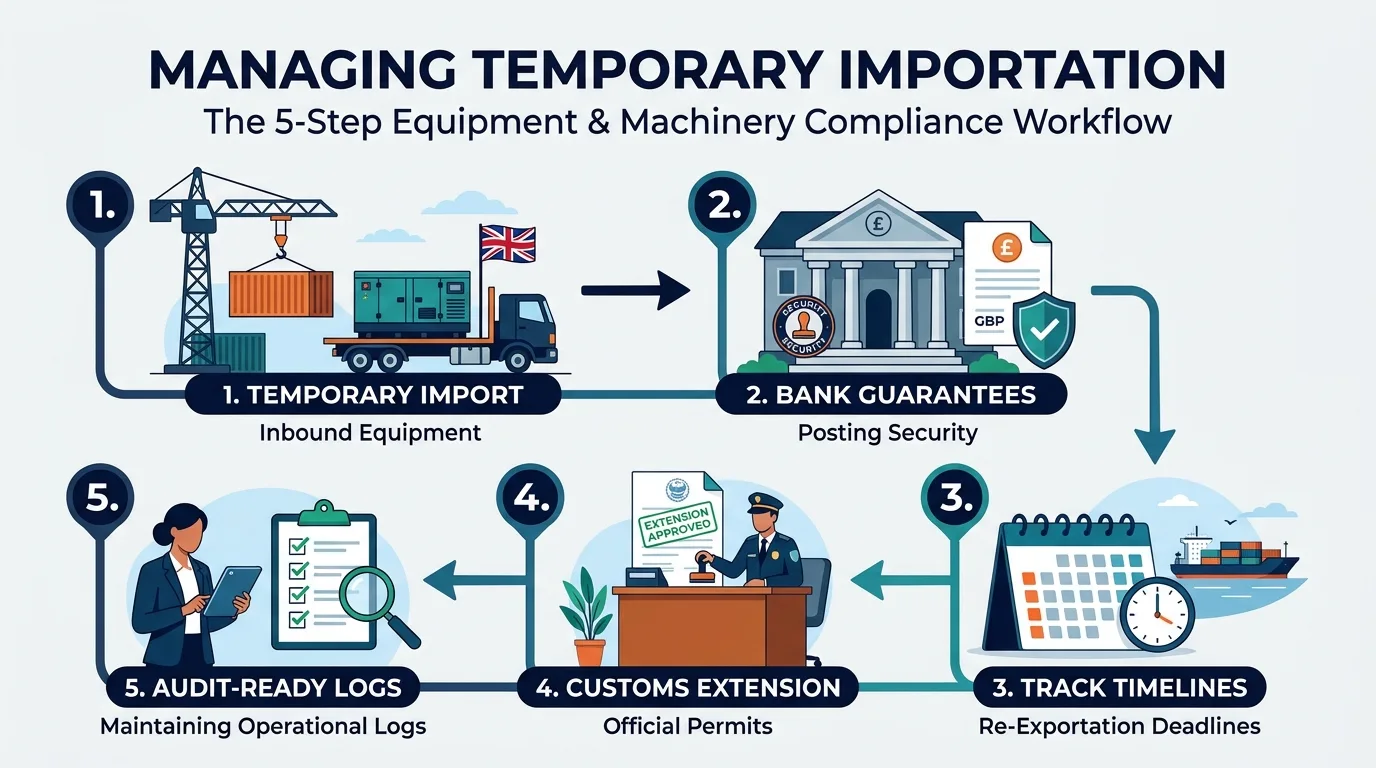
Oilfield service companies routinely bring specialized machinery, seismic survey vessels, and drilling rigs into operating countries on a temporary basis. The temporary importation regime allows operators to defer or eliminate import tariffs provided the equipment leaves the country within a legally designated timeframe. Failing to re-export equipment before permit expiration triggers retroactive customs assessments, high interest charges, and statutory fines.
Logistics officers must implement robust equipment tracking systems that record serial numbers, customs entry declarations, bond values, and permit expiration dates. Re-exportation paperwork must strictly align with original entry documentation to discharge posted bank guarantees successfully. Inadequate tracking system protocols lead to unexpected financial liabilities when temporary permits lapse unnoticed.
Workforce competence in temporary import control protects operating cash flow and maintains positive relations with national customs departments. Operational managers must enforce routine cross-checks between job-site equipment registries and corporate customs management files. Precise documentation controls ensure continuous compliance across complex field development campaigns.
How Should Petroleum Companies Evaluate Local Taxes and Levies, Excise Duty, Stamp Duty, and Tax Exemption Certificates?
Petroleum companies evaluate local taxes and levies, excise duty, stamp duty, and tax exemption certificates by conducting thorough legal reviews of municipal regulations, analyzing transaction documentation, tracking exemption validity periods, and calculating full tax liabilities during project budgeting.
Operating entities face a wide spectrum of sub-national and indirect fiscal burdens beyond standard value-added taxes and import tariffs. Municipal governments often levy local development charges, environmental assessments, and transit fees on petroleum transport. Excise duty applies to refined petroleum products and specific chemical inputs, requiring strict volume accounting and bonded warehouse management.
Stamp duty applies to corporate contracts, asset transfers, financing agreements, and joint operating covenants. Unstamped agreements lose legal enforceability in local courts, creating severe legal risk for project joint ventures. Tax teams must calculate required stamp duty payments during contract execution rather than deferring review until dispute resolution occurs.
Tax exemption certificates provide legal relief from specific fiscal obligations, but revenue agencies limit certificate validity periods and enforce strict scope restrictions. Subcontractors and operators must continuously review the validity of active certificates to avoid unexpected retroactive assessments during regulatory audits.
How Do Training Approaches Compare for Building Indirect Tax Competency in Energy Teams?
Comparing training approaches for building indirect tax competency requires evaluating structured classroom programs, real-world case studies, digital learning platforms, and customized corporate workshops against organizational skill gaps, compliance accuracy metrics, operational disruption levels, and overall return on investment.
Developing robust indirect tax management capabilities across energy organizations demands deliberate workforce learning strategies. HR managers, finance directors, and operational leaders must choose between multiple delivery models to bridge critical skill gaps across procurement, logistics, and accounting units. Selecting an appropriate learning structure determines how effectively employees apply tax rules during daily commercial operations.
In-Person Corporate Workshops
In-person corporate workshops deliver focused, interactive instruction centered on company-specific petroleum agreements, asset structures, and operational challenges. Participants work directly with expert facilitators to review actual operational contracts, import declarations, and tax filings. This approach builds immediate practical capabilities, allowing teams to resolve existing operational bottlenecks and streamline compliance protocols during the training sessions.
Self-Paced E-Learning Modules
Digital self-paced platforms offer flexibility for geographically dispersed workforces operating in remote fields or offshore locations. Learners complete instructional modules on general tax principles, tariff codes, and compliance frameworks at their own pace. While cost-effective for broad foundational awareness, self-paced learning lacks the detailed contextual application required to solve complex, asset-specific tax disputes or navigate custom regulatory environments.
Hybrid Industry Seminars
Hybrid industry seminars combine structured virtual lectures with collaborative peer group discussions involving professionals from multiple energy companies. Participants gain insights into broader market standards, regional tax trends, and regulatory updates across different jurisdictions. This model broadens strategic perspective but requires supplementary internal instruction to adapt general concepts to company-specific operating agreements.
HR and finance leaders must evaluate these training approaches based on workforce size, project complexity, and immediate compliance exposure. Investing in practical, industry-driven learning frameworks ensures energy teams execute indirect tax and customs processes with accuracy, safeguarding organizational profitability and regulatory standing.
Frequently Asked Questions
What Is the Scope of Oil & Gas Petroleum Taxation Training?
Oil & Gas Petroleum Taxation training covers corporate tax frameworks, indirect taxes, production sharing contracts, and cross-border customs duty obligations across energy operations. Participants analyze fiscal regimes, royalty structures, and tax compliance mechanics designed for upstream, midstream, and downstream sectors. Programs at the Institute For Oil & Gas Training focus on practical statutory applications, audit readiness, and corporate tax risk management.
How Does Oil & Gas Petroleum Taxation Impact Energy Operations?
Oil & Gas Petroleum Taxation directly influences field development profitability, asset valuation, cash flow forecasting, and supply chain logistics. Unmanaged tax exposures, unrecovered value-added tax balances, and improper customs duty classifications can delay port clearances and inflate operational expenditure. Establishing robust internal compliance controls helps energy companies manage statutory obligations and mitigate tax dispute risks.
Who Should Enroll in an Oil & Gas Petroleum Taxation Program?
Finance managers, corporate accountants, legal advisors, procurement officers, and tax specialists in the energy sector benefit from specialized taxation training. The curriculum provided by the Institute For Oil & Gas Training caters to professionals who manage financial reporting, joint venture accounting, or regulatory compliance. Developing these skills enables cross-functional teams to make tax-efficient decisions across complex asset lifecycles.
What Core Topics Are Covered in Oil & Gas Petroleum Taxation Courses?
Key modules include value-added tax (VAT) recovery, customs duty exemptions, temporary equipment import regimes, transfer pricing, and petroleum profit taxes. Learners evaluate production sharing agreement clauses, fiscal stability provisions, and sub-national levies like excise and stamp duties. Specialized instruction delivered by the Institute For Oil & Gas Training bridges theoretical tax law with real-world energy accounting practices.
How Do Energy Companies Evaluate Indirect Tax Risks in Petroleum Operations?
Energy companies evaluate indirect tax risks by reviewing supply chain contracts, auditing import tariff codes, verifying vendor tax identification numbers, and monitoring temporary importation timelines. Establishing structured internal controls prevents unexpected statutory penalties, non-recoverable VAT, and border delays during field development. Professional training in Oil & Gas Petroleum Taxation equips operational and finance teams to execute proactive tax risk assessments effectively.
Related training courses
Oilfield Production Chemicals and Treatment Applications Training Course
- Specialisation
- Oil & Gas Process Engineering and Operations
- Duration
- 5 days · 15 CPD hours
Hazardous Liquid Pipeline Inspection and Integrity Management Training Course
- Specialisation
- Oil & Gas Pipeline Integrity and Inspection
- Duration
- 5 days · 15 CPD hours
Microbiologically Influenced Corrosion (MIC) Training Course
- Specialisation
- Oil & Gas Corrosion Management and Control
- Duration
- 5 days · 15 CPD hours
More articles

How to Evaluate Transfer Pricing Risks and Intercompany Transactions in Oil and Gas Groups
Evaluate transfer pricing risks in oil and gas intercompany transactions. Learn methods, functional analysis, and arm's length compliance strategies.
Read article →
Why Transfer Pricing Matters for Multinational Oil and Gas Groups
Learn why transfer pricing matters for multinational oil and gas groups, including compliance frameworks, risk management, and workforce development.
Read article →
Withholding Tax Compliance and Treaty Relief Training for Oil and Gas Tax Professionals
Master cross-border oil and gas tax compliance. Evaluate syllabus, delivery, and outcomes for the Institute For Oil & Gas Training course.
Read article →