

Managing revenue stability in the energy sector requires a structured evaluation of financial instruments, market dynamics, and organizational risk tolerance. Physical producers, refiners, and corporate treasury teams face constant exposure to global supply shifts, geopolitical tensions, and macroeconomic shifts that directly disrupt cash flows. Evaluating financial instruments involves analyzing structural market conditions, counterparty exposures, and internal execution capabilities. Organizations must assess how individual derivatives align with specific physical exposures to prevent cash flow volatility and preserve balance sheet integrity.
Effective price risk management demands a comprehensive understanding of financial markets alongside internal capability building. As demonstrated in Why Commodity Price Volatility Creates Financial Risks for Oil and Gas Companies, unhedged market exposures directly undermine earnings stability, capital allocation, and debt service coverage ratios. Energy enterprises must systematically assess various derivative instruments—including futures, forwards, swaps, and options—to determine the optimal balance between downside protection and upside participation. Evaluating these tools requires evaluating pricing mechanics, liquidity, margin requirements, and internal risk governance frameworks.
What Financial Derivatives Are Most Effective for Petroleum Price Risk Management?
The most effective financial derivatives for petroleum price risk management are crude oil futures, forward contracts, commodity swaps, and options. Selection depends on liquidity needs, counterparty exposure, customized pricing structures, cash flow flexibility, and whether the firm requires absolute price certainty or market upside participation.
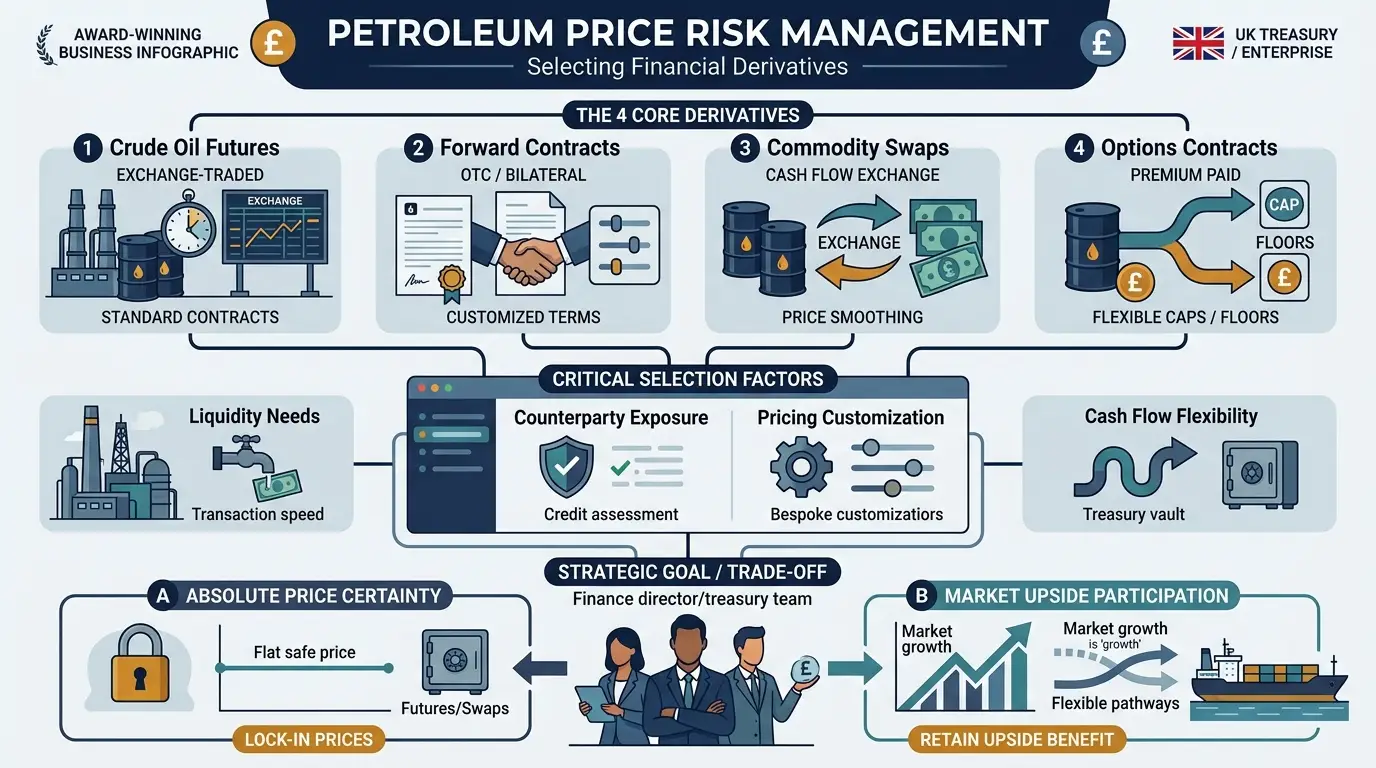
Financial derivatives operate as financial contracts that transfer price risk from physical asset owners to market counterparties or investors. Crude oil futures are standardized agreements traded on centralized exchanges like NYMEX and ICE. These contracts provide high liquidity, transparent pricing, and zero credit risk due to clearinghouse guarantees. Standardized specifications limit customization regarding delivery locations, timing, and specific crude grades.
Forward contracts offer customized Over-The-Counter (OTC) solutions tailored to specific physical volumes, delivery points, and settlement dates. They eliminate basis risk by matching exact physical requirements. Forwards introduce counterparty credit risk and lack the liquidity of exchange-traded instruments.
Commodity swaps enable companies to lock in a fixed price over an extended multi-month or multi-year horizon. In a swap agreement, one party pays a fixed price while receiving a floating market index price, settling net cash differences periodically. Swaps provide predictable cash flows for long-term budgeting without requiring daily margin management.
Put and call options establish asymmetric risk profiles. Buying a put option secures a price floor for producers while preserving upside participation if market prices rise. Purchasing a call option caps procurement costs for refiners while allowing them to benefit if market prices drop. Options require an upfront premium payment, which directly impacts initial transaction costs.
How Do Structural Market Dynamics Impact Hedging Strategy Evaluation?
Structural market dynamics impact hedging evaluation by altering basis risk, inventory carry costs, and rolling hedge profitability. Traders and treasury teams must continually evaluate whether the futures curve exhibits contango or backwardation, as well as localized physical price differentials.
Market structure dictates the financial performance and roll yield of long-term hedging programs. Contango and backwardation describe the relationship between spot prices and forward contract delivery dates across the price curve.
In a contango market, spot prices trade lower than futures prices. The forward curve slopes upward, reflecting storage costs, financing, and insurance. Producers hedging future production in contango lock in higher forward prices. Rolling short hedges forward in a contango market generates a negative roll yield, as expiring contracts settle lower than new contracts purchased further out the curve.
In a backwardation market, spot prices trade higher than forward prices, creating a downward-sloping curve. Backwardation signifies tight prompt physical supply. Producers rolling short positions in backwardation gain a positive roll yield. The spot price trades above forward contracts, allowing the firm to sell forward at higher prompt levels continuously.
Basis risk arises when the pricing index of the hedging instrument does not perfectly match the physical benchmark or pricing location of the physical commodity sold. A producer selling crude at a regional hub priced against West Texas Intermediate (WTI) faces basis risk if regional pipeline bottlenecks cause local prices to diverge from NYMEX WTI futures. Evaluating hedging strategies requires calculating the historical correlation between the physical asset and the derivative contract to establish a precise hedge ratio.
How Do Organizations Calculate Hedge Ratios and Manage Collateral Requirements?
Organizations calculate hedge ratios by applying regression analysis to determine the precise derivative volume needed to offset physical price volatility. Managing collateral requires maintaining adequate liquidity buffers to sustain mark to market valuation swings and ongoing exchange margin calls.
The optimal hedge ratio determines the proportion of physical exposure that must be covered using financial contracts. Calculating the hedge ratio prevents under-hedging, which leaves the balance sheet exposed, or over-hedging, which creates speculative market positions.
A hedge ratio of 0.85 indicates that 850,000 barrels of futures contracts are required to hedge 1,000,000 barrels of physical production to minimize portfolio variance.
Derivative positions require continuous monitoring through mark to market valuation. This accounting process revalues open derivative contracts daily based on current settlement prices. While mark to market adjustments reflect fair financial value, they trigger immediate liquidity demands for exchange-traded derivatives.
Exchanges mandate margin and collateral requirements to mitigate counterparty default risk. Companies must deposit initial margin upon opening exchange positions. If market movements decrease the contract's value, the clearinghouse issues variation margin calls. Treasury teams must maintain dedicated credit lines or cash reserves to fund daily variation margin without disrupting operational capital allocations.
How Do Options Strategies Like Collars Balance Downside Protection and Cost Management?
A collar strategy balances downside protection and cost management by combining a long put option with a short call option. This structure establishes a defined price band, eliminating or significantly reducing upfront option premium expenses for the enterprise.
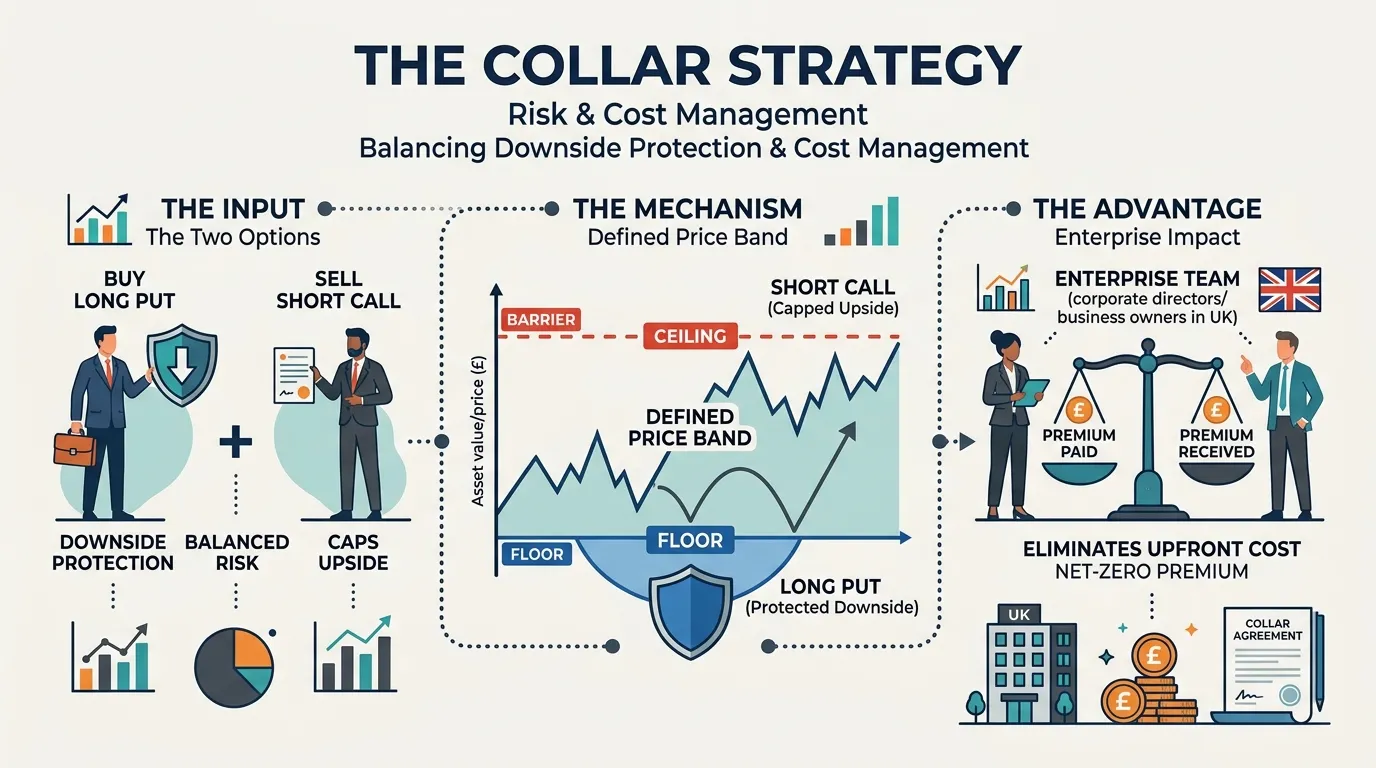
A collar strategy provides an effective structure for physical producers seeking price floors without incurring high net premium expenses. The firm purchases an out-of-the-money put option to set a floor price and simultaneously sells an out-of-the-money call option to establish a ceiling price.
The revenue generated from selling the call option offsets the premium paid for the put option, creating a zero-cost collar. The enterprise sacrifices potential upside gains above the call strike price in exchange for complete protection below the put strike price.
Structural Comparison of Primary Petroleum Hedging Strategies
Hedging Strategy | Primary Mechanics | Downside Protection | Upside Participation | Cash Flow / Margin Impact | Primary Risk Factor |
Futures Contracts | Standardized exchange commitment to buy/sell | Full protection at hedge price | Zero participation above lock | High daily variation margin calls | Basis risk between hub and exchange |
Commodity Swaps | Fixed-for-floating price exchange over time | Full protection at fixed rate | Zero participation above swap rate | Net periodic cash settlement; low daily liquidity pull | Counterparty credit risk (OTC) |
Purchased Puts | Right to sell at floor strike price | Complete floor protection | 100% participation above strike | Upfront premium cost; no margin calls | Premium drag in stable markets |
Zero-Cost Collar | Buy put floor, sell call cap | Complete protection below floor | Limited participation up to cap | Zero net upfront premium; potential opportunity cost | Opportunity loss in bull markets |
What Evaluation Framework Should Corporate Decision-Makers Use for Risk Strategy Selection?
Decision-makers should evaluate risk strategies by matching corporate risk appetite, liquidity reserves, physical market exposure, and institutional execution capabilities against derivative complexity and capital requirements.
Selecting the correct hedging approach requires evaluating internal organizational constraints alongside external market conditions. A corporate risk governance framework ensures that derivative execution aligns directly with operational cash flow requirements and long-term financial covenants.
Risk Strategy Evaluation Framework
Evaluation Criteria | High Priority Threshold | Recommended Instrument Class | Strategic Consideration |
Liquidity & Cash Availability | High daily working capital reserves | Exchange-traded Futures | Requires capacity to fund immediate variation margin calls |
Upside Retainment Requirement | High strategic need to capture market rallies | Purchased Options / Collars | Accepts premium expense or cap limits to preserve upside |
Custom Delivery Specification | Non-standard delivery dates or niche grades | OTC Forwards & Swaps | Requires strict counterparty credit risk assessment |
Budget Certainty Needs | Fixed revenue target for debt service | Fixed-for-Floating Swaps | Locks in exact cash flow streams; eliminates price variance |
Internal Capability Maturity | Sophisticated middle-office risk control | Complex Multi-Leg Options | Requires real-time risk tracking and quantitative modeling |
How Does Organizational Competency Impact the Success of Hedging Execution?
Organizational competency impacts hedging execution by ensuring that treasury, risk management, and trading teams correctly calculate hedge ratios, manage margin calls, evaluate counterparty credit, and maintain strict governance standards.
A properly designed hedging strategy can fail due to flawed internal execution, inadequate risk oversight, or improper operational processes. Miscalculating basis risk or failing to anticipate variation margin calls can force an enterprise to liquidate hedges prematurely at a loss.
Organizations building internal technical capacity must evaluate structural training approaches to ensure staff master financial mechanics and market analysis. When addressing organizational skill gaps, implementing structured corporate programs like Hedging and Derivatives Training for Commodity Price Risk Management in Oil and Gas ensures that trading, risk, and finance units operate under a unified risk management framework.
Workforce capability gaps directly increase operational and financial risk. Internal teams must understand the mechanics of hedge accounting under IFRS 9 or ASC 815 to avoid unnecessary earnings volatility caused by mark to market adjustments flowing directly through the income statement.
Comprehensive workforce development transforms derivative trading from a speculative activity into a structured risk management program. To establish professional technical capabilities, organizations enroll teams in targeted programs such as the Hedging & Derivatives for Commodity Price Risk Training Course, which provides practical modeling, derivative structuring, and risk control skills for corporate energy leaders.
When corporate teams develop strong quantitative evaluation capabilities, the organization can dynamically adjust its hedge ratios, evaluate collar parameters, and safeguard enterprise cash flows across all phases of the commodity price cycle.
Frequently Asked Questions
What is included in petroleum treasury, cash, and banking management?
Petroleum treasury management covers liquidity planning, foreign exchange risk mitigation, commodity cash flow forecasting, and enterprise banking operations tailored to energy companies. Institute For Oil & Gas Training provides specialized instruction on optimizing cross-border capital flows, working capital management, and transactional banking structures for upstream, midstream, and downstream operations. This ensures energy finance professionals can safeguard cash assets while maintaining operational liquidity across volatile market cycles.
How do energy companies manage multi-currency cash flows and FX exposure?
Oil and gas enterprises handle multi-currency cash flows by establishing centralized treasury pools, implementing cash pooling agreements, and utilizing currency hedging strategies. Through targeted professional development at the Institute For Oil & Gas Training, corporate treasury teams learn to evaluate foreign exchange risks, optimize global banking relationships, and deploy automated cash concentration mechanisms. These practical techniques help mitigate currency mismatch risks inherent in international petroleum trading and capital expenditure projects.
Why is specialized treasury and cash management essential in the oil and gas sector?
The oil and gas industry operates with extreme commodity price volatility, high capital intensity, and complex international banking requirements that standard corporate treasury frameworks cannot address. Programs focused on Oil & Gas Petroleum Treasury, Cash and Banking equip finance teams with the tools to forecast long-term cash requirements, manage letter of credit facilities, and maintain optimal liquidity buffers. Effective treasury governance protects firm solvency and supports seamless capital deployment for large-scale energy developments.
What are the key operational risks in petroleum treasury and banking systems?
Primary operational risks include counterparty bank credit exposure, transactional fraud, liquidity shortfalls, and settlement delays across foreign jurisdictions. Institute For Oil & Gas Training trains professionals to establish robust internal controls, set counterparty credit limits, and implement secure electronic bank payment protocols. Developing these core treasury competencies ensures corporate cash assets remain secure while complying with international banking regulations and trade sanctions.
How does treasury management support working capital optimization for energy firms?
Treasury management optimizes working capital by streamlining payables and receivables, managing short-term credit facilities, and refining daily liquidity forecasting models. Mastering Oil & Gas Petroleum Treasury, Cash and Banking practices enables financial managers to minimize unallocated cash balances, reduce short-term borrowing costs, and enhance interest yields on surplus funds. This disciplined capital management strengthens balance sheet resilience and maximizes cash flow efficiency across corporate energy operations.
Related training courses
Offshore Pipeline Inspection and Integrity Assessment Training Course
- Specialisation
- Oil & Gas Pipeline Integrity and Inspection
- Duration
- 5 days · 15 CPD hours
API RP 574 Inspection Practices for Piping System Components Training Course
- Specialisation
- Oil & Gas Inspection and Non-Destructive Testing
- Duration
- 5 days · 15 CPD hours
Fiscal Disputes, Cost Recovery and Contract Resolution Training Course
- Specialisation
- Oil & Gas Petroleum Fiscal Regime
- Duration
- 5 days · 15 CPD hours
More articles

Petroleum Taxation Fundamentals Training for Oil and Gas Tax Professionals
Master petroleum taxation fundamentals with Institute For Oil & Gas Training. Explore modules, outcomes, and enrollment paths for tax professionals.
Read article →
How to Evaluate Tax Obligations and Tax Risks Across Upstream Midstream and Downstream Operations
Master evaluation of upstream, midstream, and downstream petroleum tax obligations, ring fencing, capital allowances, and transfer pricing risks.
Read article →
Why Petroleum Taxation Matters Across the Oil and Gas Value Chain
Master petroleum taxation fundamentals across upstream midstream and downstream operations to mitigate tax risks and drive corporate profitability.
Read article →