

Commodity price volatility is the rapid, unpredictable fluctuation in crude oil, natural gas, and refined product prices driven by global supply disruptions, geopolitical instability, macroeconomic shifts, and speculative trading that directly impacts corporate cash flow stability and balance sheet integrity.
The global energy market operates under perpetual price uncertainty. Oil and gas organizations face extreme financial exposure when crude oil futures fluctuate unexpectedly over short time horizons. Uncontrolled price movements destabilize revenue forecasting, erode profit margins, and impede capital investment decisions for upstream, midstream, and downstream operations. Upstream producers face immediate revenue losses when spot prices drop below extraction costs, while downstream refiners experience severe margin compression when feedstock costs surge faster than refined product prices.
Managing this exposure requires structured technical capabilities across finance, treasury, and commercial operations teams. Organizations mitigate these structural financial risks through structured commercial frameworks and financial instruments. Corporate training programs in financial risk management equip commercial decision-makers, treasury teams, and risk officers with the analytical models necessary to measure price sensitivity, evaluate hedge efficiency, and execute risk-mitigation strategies across volatile market cycles.
How Does Price Volatility Impact Corporate Financial Stability?
Price volatility impairs cash flow predictability, increases debt-servicing burdens, lowers credit ratings, reduces project net present value, and triggers liquidity shortfalls when margin calls on existing financial positions require immediate cash allocations during sharp price swings.
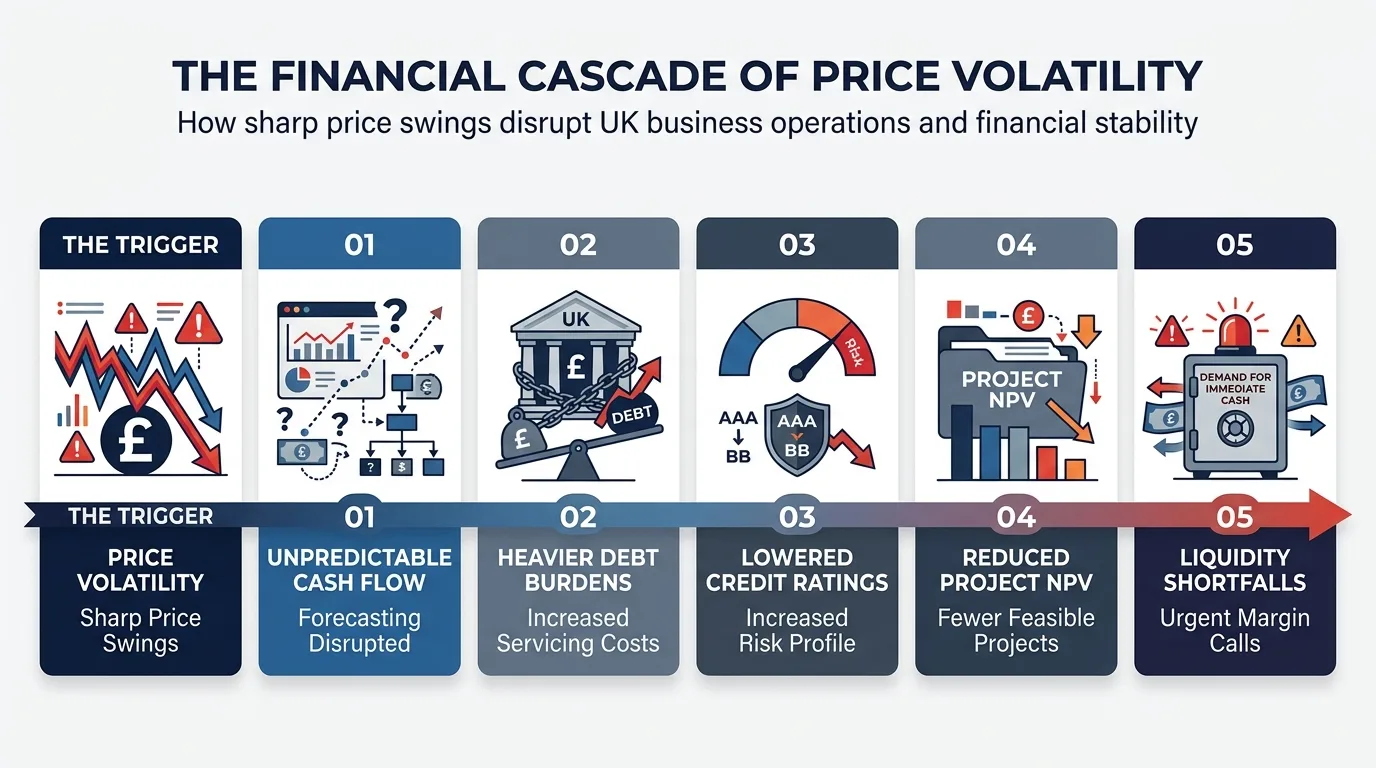
Unmanaged price shifts directly affect liquidity and debt covenants. Energy companies rely on consistent cash flows to service long-term capital investments, such as offshore drilling platforms, pipeline networks, and liquefied natural gas facilities. When market prices fall below budgeted baseline assumptions, capital expenditure programs suffer immediate disruption, forcing companies to defer maintenance or cancel long-term growth projects.
Price volatility creates severe working capital stress through mark to market valuation requirements on financial instruments. When derivative positions move out of the money, exchanges and financial counterparties demand immediate margin and collateral requirements. Treasury departments without adequate liquidity management protocols face sudden cash draining events that jeopardize daily operational capabilities.
What Key Financial Risks Arise from Market Volatility?
The key financial risks include market risk from price declines, basis risk from regional price discrepancies, liquidity risk from margin requirements, counterparty credit risk from contract defaults, and operational risk from uncoordinated trading execution.
Energy corporations face a complex matrix of interrelated financial exposures across their supply chains:
Market Price Risk
Direct exposure to absolute price movements in global benchmark contracts, such as Brent Crude and West Texas Intermediate, causes revenue instability across production portfolios.
Basis Risk
Discrepancies between local physical pricing points and standardized benchmark pricing hubs create unhedged pricing gaps during regional logistics bottlenecks.
Credit and Counterparty Risk
Financial distress at partner institutions or over-the-counter off-takers leads to contract default on long-term supply agreements and unfulfilled financial hedges.
Liquidity and Margin Risk
Sharp commodity spikes generate immediate variation margin calls on exchange-cleared positions, locking up corporate cash reserves in escrow accounts.
Market Structure Risk
Shifts between contango and backwardation market structures alter roll yields for long-term hedge portfolios, systematically increasing execution costs for risk managers.
To address these multi-faceted exposure vectors, corporate finance departments implement formal enterprise risk management policies, clear risk tolerance limits, and practical training frameworks to ensure systematic execution across commercial teams.
How Do Enterprise Training Programs Build Risk Management Competencies?
Enterprise training programs build competencies by teaching professionals to assess exposures, construct financial hedges, calculate optimal hedge ratios, evaluate derivative contracts, and enforce risk governance policies across physical and financial trading workflows.
Organisations implement structured workforce development initiatives to transform complex risk theory into daily commercial execution. Training begins with systematic diagnostic evaluations that identify skill gaps across treasury analysts, commercial traders, finance managers, and risk auditors. Corporate learning modules use real-world market datasets to teach teams how to structure custom risk management solutions.
Learning programs guide teams through hands-on scenario modeling using financial instruments. Commercial personnel learn to deploy forward contracts and commodity swaps to lock in fixed cash flows for future production volumes. Advanced workshops train teams to combine put and call options into structured protection mechanisms, such as a zero-cost collar strategy, enabling downside floor protection while maintaining participation in favorable price movements.
Professional learning programs incorporate case-based simulations where participants manage simulated multi-million-barrel physical portfolios under volatile market conditions. These practical scenarios reinforce accurate mathematical calculations of the optimal hedge ratio, ensuring teams do not over-hedge or under-hedge corporate assets.
What Core Skill Components Must a Corporate Risk Training Curriculum Include?
A comprehensive risk training curriculum includes quantitative risk modeling, derivative instrument mechanics, hedge accounting standards, regulatory compliance protocols, liquidity management practices, and enterprise risk governance framework execution.
Modern corporate risk development requires a cross-functional skill matrix spanning technical, analytical, and governance disciplines:
Skill Domain | Core Technical Capabilities | Business Outcome |
Risk Analytics | Cash Flow at Risk (CFaR), Value at Risk (VaR), Stress Testing | Quantified risk limits aligned with corporate risk appetite |
Derivative Structuring | Futures, Forward Contracts, Commodity Swaps, Options | Optimized cash flow stability and margin preservation |
Treasury & Liquidity | Margin requirements, MTM valuation, Collateral management | Elimination of liquidity shocks from trading margin calls |
Financial Accounting | IFRS 9 / FASB ASC 815 hedge accounting compliance | Reduced earnings volatility in published financial reports |
Commercial Governance | Credit limit enforcement, Trade execution audit trails | Elimination of unhedged commercial exposures and policy breaches |
Workforce development initiatives deliver these technical components through structured 3-day executive workshops, 6-week blended online modules, or interactive simulator labs. Participants analyze historical market crises, model option delta sensitivity, and evaluate real-life hedging structures. To evaluate operational approaches and derivative structures for managing commodity exposure, review How to Evaluate Hedging Strategies and Derivatives for Managing Petroleum Commodity Price Risk for an in-depth implementation framework.
Companies looking to systematically upskill their financial, commercial, and risk management teams often enroll mid-level and senior professionals in the Hedging & Derivatives for Commodity Price Risk Training Course to establish a standardized baseline of risk execution across global operational hubs.
How Do Organizations Implement Corporate Risk Management Frameworks?
Organizations implement frameworks by establishing clear risk limits, standardizing trading workflows, implementing risk technology platforms, conducting cross-departmental training programs, and continuously auditing commercial performance against defined corporate policies.
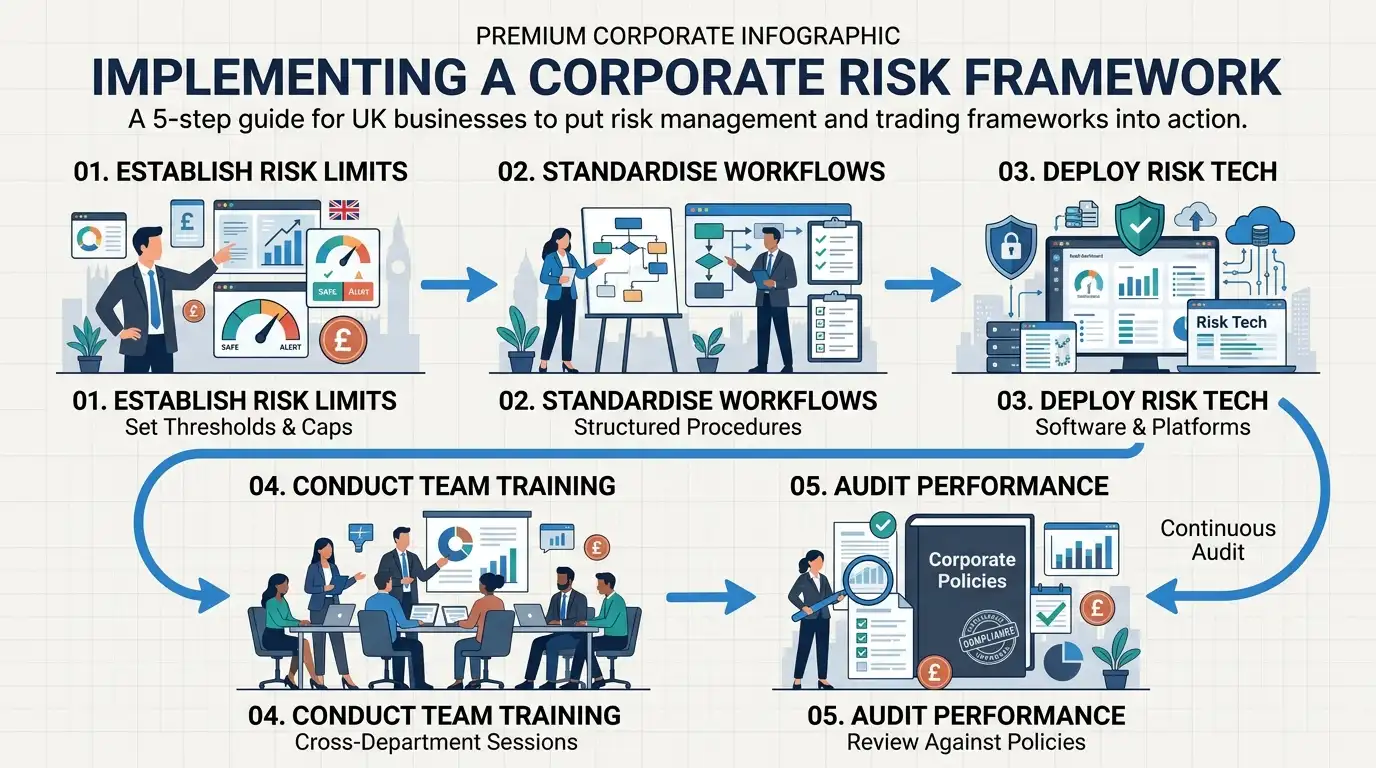
Framework implementation requires seamless coordination between executive leadership, treasury teams, commercial desks, and risk controllers. Enterprise-wide implementation follows a four-stage operational roadmap:
Organizations integrate Energy Trading and Risk Management (ETRM) platforms with corporate enterprise resource planning software to track real-time positions. However, software platforms require skilled personnel to interpret analytical outputs correctly.
Cross-functional training workshops ensure that physical operations teams communicate physical delivery schedule changes directly to financial risk desks, preventing dangerous basis risk alignment errors.
Clear governance structures require daily mark to market valuation updates, automated threshold alerts for margin calls, and strict counterparty credit approval workflows across all trading operations.
What Common Misconceptions Impair Corporate Commodity Risk Strategies?
Common misconceptions include viewing hedging as a profit center, assuming physical diversification eliminates price risk, relying on generic non-industry financial models, and treating risk management as an isolated treasury function.
Organizations frequently commit critical strategic errors when designing risk management programs:
Treating Hedging as Speculation: Viewing risk management as a profit-generating activity rather than a cash-flow stabilization mechanism leads commercial desks to take unhedged directional bets.
Neglecting Basis Risk: Assuming that standardized benchmark contracts, such as Brent Crude, perfectly track physical regional spot sales creates unexpected net cash losses during localized market disruptions.
Underestimating Liquidity Requirements: Focusing exclusively on long-term price protection while failing to model daily margin and collateral requirements causes severe liquidity freezes during sudden bull runs.
Operating in Departmental Silos: Separating physical supply chain teams from financial risk desks results in mismatched hedge ratios and uncoordinated trade executions.
Relying on Generic Training: Deploying generic corporate finance modules that lack energy-specific concepts, such as contango and backwardation or physical pipeline logistics, leaves teams unprepared for sector-specific market mechanics.
Addressing these structural errors requires practical, industry-specific professional education that aligns commercial trading teams, corporate auditors, and treasury managers around unified risk execution protocols.
What Measurable Business Outcomes Does Structured Risk Training Produce?
Structured risk training produces measurable outcomes, including reduced cash flow variance, lower capital costs, improved debt covenant compliance, optimized collateral usage, increased trading efficiency, and higher long-term corporate valuation.
Organizations measuring the ROI of enterprise risk training programs track specific financial, operational, and organizational performance metrics:
Structured professional development directly enhances organizational efficiency across operational metrics:
Financial Metrics
Companies achieve a 15% to 25% reduction in quarter-over-quarter earnings volatility after upskilling treasury and commercial teams in derivative structuring. Precise hedge execution lowers corporate default probability, improving credit ratings and lowering debt financing costs by 25 to 75 basis points across major debt issuances.
Operational Metrics
Trained risk teams optimize capital allocations by reducing excess cash reserved for potential margin calls by 10% to 20%. Automated trade compliance checks prevent unauthorized position limits, bringing risk limit breaches down to near-zero levels across active trading desks.
Workforce and Talent Metrics
Organizations delivering practical, outcome-based professional development record up to 30% higher retention rates among specialized risk analysts, commercial traders, and treasury professionals. Structured training shortens the onboarding timeline for new commercial personnel from 9 months down to 3 months, accelerating time-to-productivity for complex trading desks.
Frequently Asked Questions
What is oil and gas petroleum treasury, cash, and banking management?
Oil and gas petroleum treasury, cash, and banking management involves overseeing corporate liquidity, multi-currency cash flows, credit facilities, and financial risk mitigation tailored to the energy sector. Professionals learn to balance capital allocations, execute cash pooling strategies, and manage banking relationships across international petroleum operations. Institute For Oil & Gas Training provides specialized professional development in this discipline to ensure organizational financial stability and operational continuity.
Why is specialized treasury and cash management vital for energy companies?
The oil and gas industry operates under extreme commodity price volatility, high capital expenditure requirements, and complex foreign exchange exposures. Effective petroleum cash and banking management ensures energy firms maintain optimal liquidity levels, mitigate counterparty risks, and satisfy daily operational margin requirements. Undertaking practical training through the Institute For Oil & Gas Training enables treasury teams to establish robust cash forecasting frameworks and safeguard corporate balance sheets.
How does the Oil & Gas Petroleum Treasury, Cash and Banking program improve corporate liquidity?
The Oil & Gas Petroleum Treasury, Cash and Banking course equips finance professionals with advanced practical tools for real-time liquidity monitoring, cross-border payments optimization, and debt service management. Participants master automated cash concentration techniques and short-term investment strategies designed specifically for volatile commodity environments. This skill development directly enhances cash flow visibility and minimizes idle cash balances across global operational subsidiaries.
What key skills are covered in petroleum cash and banking training?
Key competencies include multi-currency liquidity management, financial risk modeling, bank relationship governance, working capital optimization, and letters of credit structuring. Learners also master automated payment systems and cash forecasting methodologies tailored to upstream, midstream, and downstream business models. The Institute For Oil & Gas Training integrates real-world case studies to ensure immediate workforce application and governance compliance.
Who should attend an oil and gas treasury and banking management course?
This professional development program is designed for treasury managers, corporate finance professionals, cash accountants, banking operations specialists, and financial risk officers in the energy sector. It also benefits decision-makers seeking to modernize corporate banking structures and optimize cash control processes. Attending this targeted training by the Institute For Oil & Gas Training builds organizational capacity for proactive financial decision-making and cross-functional efficiency.
Related training courses
Pipeline Inspection and Integrity Assessment Training Course
- Specialisation
- Oil & Gas Pipeline Integrity and Inspection
- Duration
- 5 days · 15 CPD hours
Offshore Pipeline Inspection and Integrity Assessment Training Course
- Specialisation
- Oil & Gas Pipeline Integrity and Inspection
- Duration
- 5 days · 15 CPD hours
Fiscal Disputes, Cost Recovery and Contract Resolution Training Course
- Specialisation
- Oil & Gas Petroleum Fiscal Regime
- Duration
- 5 days · 15 CPD hours
More articles

Petroleum Taxation Fundamentals Training for Oil and Gas Tax Professionals
Master petroleum taxation fundamentals with Institute For Oil & Gas Training. Explore modules, outcomes, and enrollment paths for tax professionals.
Read article →
How to Evaluate Tax Obligations and Tax Risks Across Upstream Midstream and Downstream Operations
Master evaluation of upstream, midstream, and downstream petroleum tax obligations, ring fencing, capital allowances, and transfer pricing risks.
Read article →
Why Petroleum Taxation Matters Across the Oil and Gas Value Chain
Master petroleum taxation fundamentals across upstream midstream and downstream operations to mitigate tax risks and drive corporate profitability.
Read article →