

Navigating fiscal obligations across the oil and gas value chain requires a granular understanding of how distinct operating models generate unique fiscal liabilities. Upstream activities focus on resource extraction and bear heavy exposure to resource rent taxes, while midstream and downstream segments contend with standard corporate income tax, indirect taxes, and transfer pricing scrutiny. Organizations that fail to establish robust cross-segment compliance frameworks face severe financial exposure, regulatory penalties, and misaligned commercial strategies.
Effective tax governance across integrated operations starts with understanding Why Petroleum Taxation Matters Across the Oil and Gas Value Chain, as each sector operates under fundamentally different fiscal regimes and contractual architectures. Upstream operations typically function under Production Sharing Contracts (PSCs) or concessionary systems featuring specialized cost recovery mechanisms. Midstream entities manage transportation, storage, and processing infrastructure governed by regulated tariffs or long-term tolling arrangements. Downstream enterprises focus on refining, distribution, and retail sales, operating within standard commercial tax systems dominated by excise duties, customs tariffs, and value-added taxes.
Evaluating tax risk across these operational tiers demands an analytical evaluation of regulatory frameworks, transaction structures, and accounting methods. Tax leaders and corporate planning teams must continuously assess how fiscal terms interact across organizational boundaries. The following evaluation framework provides corporate leaders, finance directors, and tax specialists with the structured methodology necessary to measure tax obligations, mitigate exposure, and align cross-segment fiscal strategy.
What Are the Primary Tax Obligations Across Upstream Midstream and Downstream Sectors?
Upstream tax obligations center on petroleum profits tax and royalty payments, midstream relies on corporate income tax and tariff regulations, while downstream focus is heavily anchored in excise duties, customs charges, and value-added tax compliance across physical sales network distribution channels.
Upstream operations operate under specialized fiscal regimes designed to capture economic rents from non-renewable resource extraction. Governments impose petroleum profits tax alongside royalties, production bonuses, and state equity participation. Taxable income computation in the upstream segment requires precise tracking of exploration costs, development expenditure, and operating expenses. Capital intensive upstream assets qualify for specialized capital allowances and statutory uplift and investment allowances designed to accelerate cost recovery prior to tax liability crystallization.
Midstream activities involve crude oil gathering, natural gas processing, pipeline transportation, and liquefied natural gas (LNG) liquefaction. Tax obligations in this segment shift away from resource extraction taxes toward standard corporate income tax frameworks. Tariff structures approved by utility regulators or established through arm’s length commercial contracts dictate revenue generation. Tax base determination relies heavily on depreciation schedules for long-term infrastructure assets, debt financing structures, and cross-border service fee arrangements.
Downstream operations encompass refining crude oil into finished petroleum products, wholesale marketing, and retail distribution networks. Fiscal obligations focus on product-level taxation, including excise taxes, environmental levies, import duties, and value-added taxes collected at the point of sale. Refining entities calculate net taxable revenue by balancing volatile crude feedstock acquisition costs against refined product slate revenues. Managing these distinct sectoral profiles requires targeted capability building, such as the Petroleum Taxation Fundamentals for the Value Chain Training Course, which equips finance teams with practical cross-segment technical skills.
How Do Ring Fencing Rules Impact Taxable Income Computation in Integrated Energy Companies?
Ring fencing rules prevent energy companies from offsetting tax losses incurred in one license area or operational sector against taxable profits generated in another, directly increasing aggregate corporate tax liabilities and restricting cross-segment capital allocation flexibility.
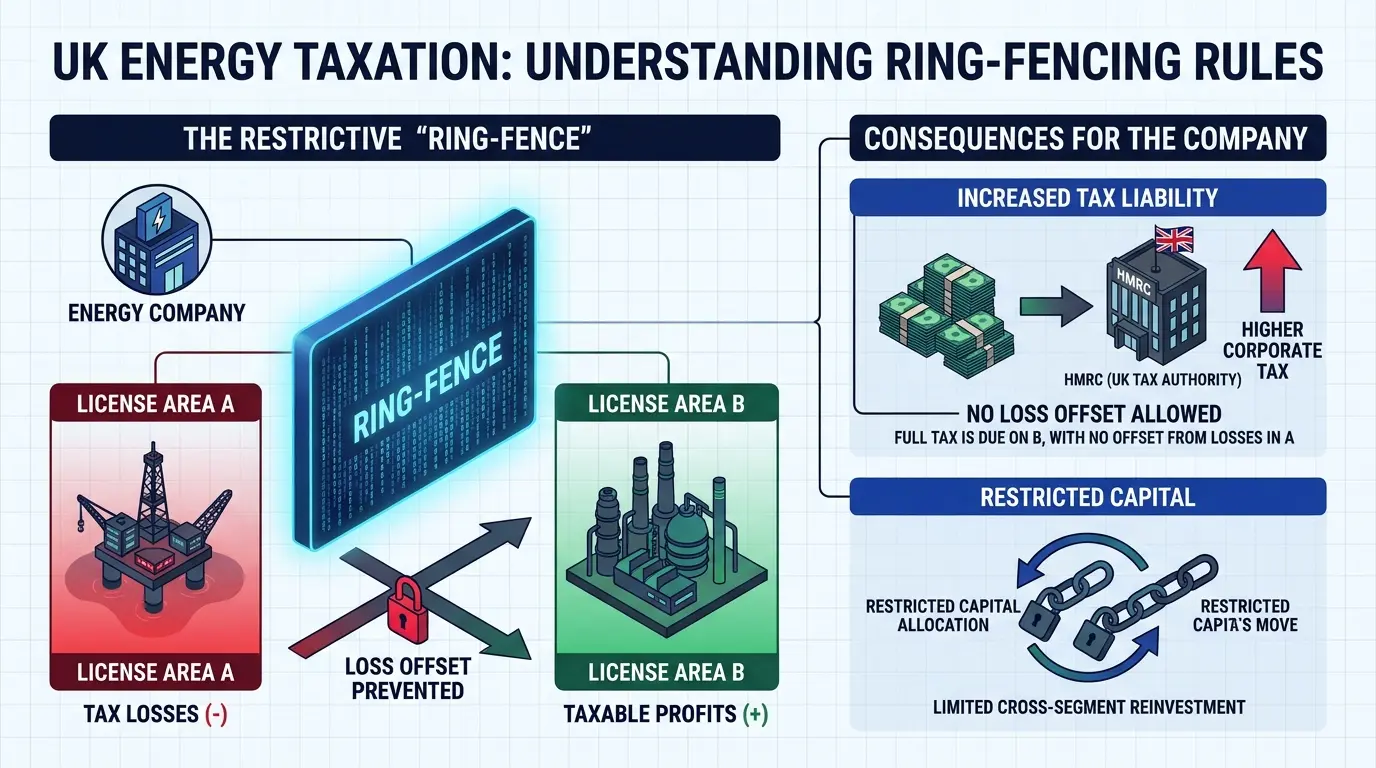
Ring fencing operates as a structural fiscal boundary imposed by host governments to protect their tax base. In upstream operations, ring fencing applies at the field, block, or contract level. Exploration expenditures incurred in an underperforming license area cannot reduce the taxable income derived from a mature, producing license area. This restriction forces corporate finance teams to calculate taxable profits independently for each designated fiscal unit.
When integrated energy enterprises operate across the entire value chain, ring fencing rules strictly isolate upstream production from midstream transportation and downstream refining activities. A midstream pipeline expansion loss cannot reduce an upstream petroleum profits tax liability. Similarly, downstream refining losses cannot offset high-margin upstream crude production profits. Tax professionals must compute allowable deductions strictly within the legal parameters of each ring-fenced entity.
Failing to account for ring fencing constraints leads to inaccurate project economics, overstated net present values, and unexpected cash tax liabilities. Corporate finance departments must maintain segregated accounting records and distinct asset ledgers for every ring-fenced license. Detailed tax modeling must account for restricted asset transfers, non-deductible corporate overhead allocations, and unutilised tax losses and carry forward balances constrained within specific operating boundaries.
How Do You Assess Tax Exposure from Cross-Segment Transfer Pricing and Intercompany Transactions?
Assessing transfer pricing exposure requires verifying that intercompany transactions across upstream, midstream, and downstream entities adhere strictly to arm’s length principles, supported by rigorous benchmark documentation and transparent pricing methodologies.
Intercompany transactions occur continuously within integrated energy corporations. Upstream divisions sell crude oil and natural gas to midstream processing units or downstream refining divisions. Midstream pipeline companies charge upstream producers transportation fees for shipping hydrocarbons to market terminals. Downstream marketing arms pay management fees, technical service charges, and intellectual property royalties to central corporate entities.
Tax authorities scrutinize these internal transactions to prevent artificial profit shifting from high-tax extraction jurisdictions to low-tax processing or trading hubs. Determining the arm's length price for unrefined crude, natural gas, or pipeline throughput requires robust transfer pricing benchmarking. Enterprises must apply comparable uncontrolled price methods, cost-plus frameworks, or transactional net margin methods that reflect real market conditions and operational risk allocations.
Transfer Pricing Area | Primary Intercompany Transaction | Fiscal Risk Factor | Benchmark Method |
Upstream to Midstream | Raw crude oil and natural gas sales | Mispricing raw commodity values | Comparable Uncontrolled Price (CUP) |
Midstream to Downstream | Pipeline transit and processing fees | Over/undercharging tariff fees | Cost Plus / Transactional Net Margin |
Corporate to All Segments | Management and IT service allocations | Non-deductible management overhead | Cost-benefit services analysis |
Trading Hub to Entities | Hedging and financial derivative fees | Profit shifting via financial risk | Operational risk alignment |
Evaluating transfer pricing risk involves reviewing intercompany service agreements, physical delivery terms, and financial settlement records. Tax managers must verify that internal transfer prices align with published market indices, adjusted for quality differentials, API gravity, sulfur content, and freight costs. Inadequate documentation exposes the business to retroactive tax audits, transfer pricing adjustments, secondary tax assessments, and severe non-compliance penalties.
What Capital Allowances, Deductions, and Uplifts Apply to Upstream Versus Downstream Assets?
Upstream fiscal regimes offer specialized capital allowances and investment uplifts to compensate for high exploration risk, whereas downstream regimes apply standard straight-line or declining-balance depreciation schedules.
Capital expenditure profiles differ radically across the oil and gas value chain. Upstream capital expenditure is highly speculative during exploration and capital-intensive during field development. Host governments provide targeted fiscal incentives to attract private capital into high-risk extraction projects. These incentives include accelerated capital allowances, immediate write-offs for unrecoverable exploration costs, and statutory uplifts and investment allowances that permit companies to deduct more than 100 percent of their qualifying capital expenditure from taxable income.
Downstream and midstream assets follow standard commercial fiscal treatment. Capital investments in refineries, storage tanks, retail stations, and natural gas distribution grids are written off over extended operational lifespans ranging from 10 to 25 years. Tax authorities restrict downstream asset write-offs to standard depreciation methods without supplemental investment uplifts.
Evaluating cost recovery rules requires tax teams to track qualifying asset classifications precisely. Finance leaders must establish capital expenditure tracking systems that distinguish between direct exploration costs, field development expenditure, environmental remediation reserves, and general administrative overhead. Proper classification ensures maximum tax efficiency while remaining compliant with statutory deduction caps.
How Should Energy Companies Structuralize Tax Loss Carry Forwards Across Capital Intensive Cycles?
Managing tax loss carry forwards requires tracking expiry periods, statutory utilization limits, and structural changes in ownership to protect deferred tax assets through extended capital investment periods.
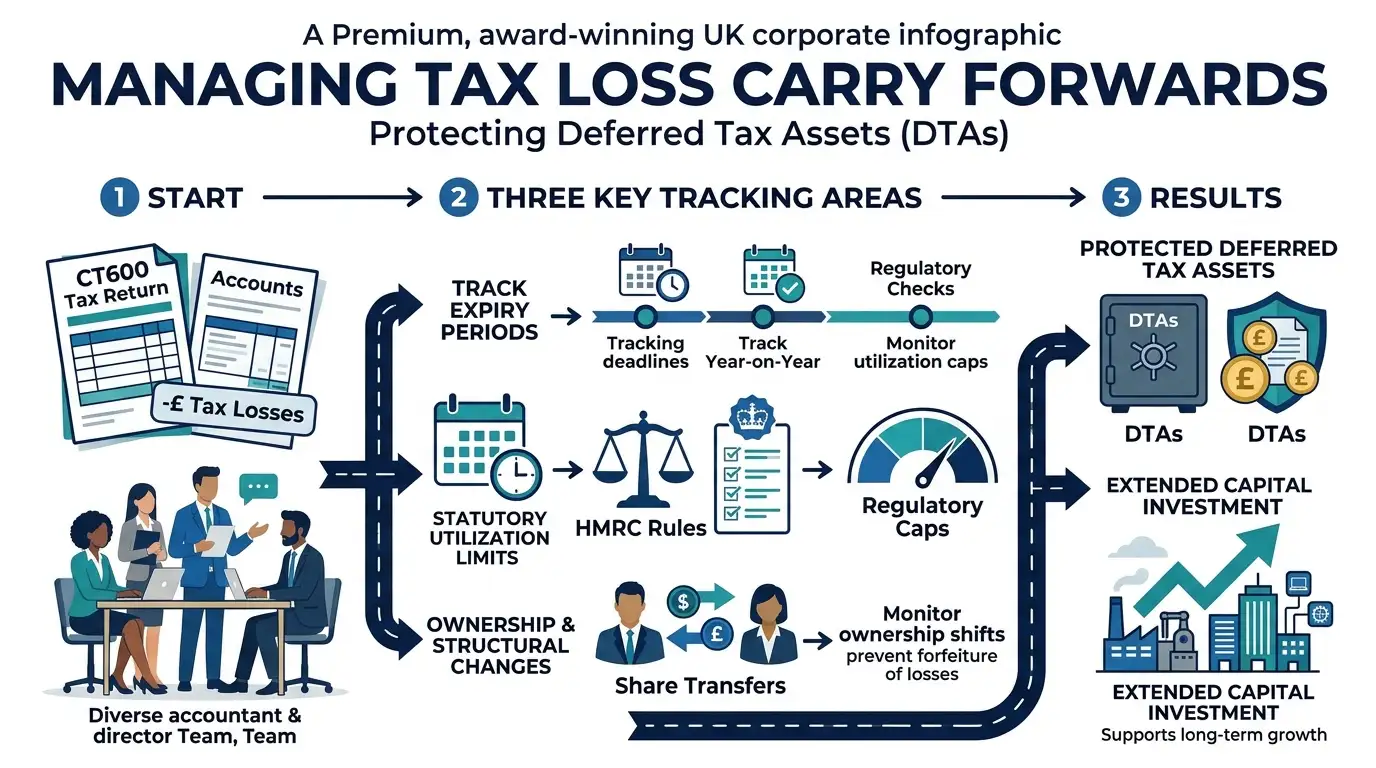
Energy projects require long gestation periods before generating positive cash flow. Large-scale development projects incur substantial tax losses during initial construction and commissioning phases. Effective corporate tax management ensures these accumulated losses are preserved and utilized efficiently against future operating profits once commercial production commences.
Tax codes impose strict conditions on tax losses and carry forward mechanics. Some jurisdictions permit indefinite loss carry forwards, while others limit loss utilization to a fixed number of years. Furthermore, many tax authorities impose annual statutory caps, restricting loss offsets to a maximum percentage of taxable income in any single assessment year. Corporate tax planners must monitor these constraints to prevent deferred tax assets from expiring unused.
Corporate restructuring, equity farm-ins, and asset sales introduce additional tax loss risks. Change-of-ownership rules in many petroleum-producing nations automatically forfeit accrued tax losses if controlling interest shifts above defined statutory thresholds. Organizations conducting strategic corporate restructuring or asset portfolio rebalancing must evaluate ownership thresholds carefully to avoid invalidating accumulated tax loss positions.
What Framework Evaluates Corporate Tax Training and Governance Approaches for Energy Enterprises?
Evaluating corporate tax training requires comparing internal technical workshops against structured external professional development programs to select the optimal capability model for workforce upskilling.
Managing petroleum taxation across the value chain demands specialized technical competence across finance, accounting, legal, and operational units. HR directors and corporate tax executives must choose between developing internal training initiatives or investing in specialized external industry training programs. The evaluation framework below outlines key parameters for selecting effective learning solutions.
Organizations seeking to build practical technical capability across multi-disciplinary teams frequently enroll professionals in the Petroleum Taxation Fundamentals Training for Oil and Gas Tax Professionals program. This structured delivery approach equips tax analysts, accounting managers, and finance leaders with real-world case study experience, legal framework interpretations, and fiscal calculation methodologies.
Evaluation Metric | Internal In-House Workshops | External Professional Training | Hybrid Capability Model |
Technical Depth | Limited to current internal assets | Broad industry case studies & trends | Custom content with industry standards |
Implementation Speed | Slow; requires internal SME time | Immediate deployment readiness | Moderate setup timeline |
Cost Efficiency | High fixed internal resource cost | Predictable per-participant cost | Optimized scale for corporate cohorts |
Cross-Segment Scope | Narrow focus on existing operations | Full value chain coverage | Targeted to specific operational gaps |
Regulatory Currency | Risk of internal bias or outdated info | Updated to current global tax legislation | Expert-led updates tailored to firm |
Selecting the right capability model depends on organizational complexity, workforce scale, and immediate compliance risks. While internal workshops suit company-specific administrative processes, external expert-led training delivers broader technical competence, cross-border fiscal knowledge, and updated regulatory insights necessary to manage complex value chain risk.
How Do You Select and Implement a Value Chain Tax Evaluation Model in Oil and Gas Organizations?
Selecting a value chain tax evaluation model requires establishing clear selection criteria, auditing technical workforce skills, and embedding automated fiscal calculations into enterprise resource planning software.
Implementing an effective tax evaluation framework requires a structured step-by-step approach:
Conduct a Value Chain Tax Audit: Map all physical hydrocarbon flows, intercompany contract structures, and legal entities across upstream, midstream, and downstream operations. Identify high-risk tax exposure areas, including transfer pricing nodes, ring-fenced losses, and unutilized capital allowances.
Evaluate Technical Capability Gaps: Assess the competence of internal finance, tax, and corporate planning personnel. Identify knowledge gaps regarding fiscal regimes, petroleum profits tax computations, and regulatory compliance requirements.
Deploy Targeted Capability Programs: Enroll key tax analysts, commercial managers, and finance leaders in specialized training programs covering cross-segment fiscal frameworks, ring fencing mechanics, and intercompany transfer pricing principles.
Standardize Tax Calculation Worksheets: Build automated, centralized tax accounting templates integrated with enterprise resource planning systems. Ensure templates account for distinct sectoral rules, statutory uplifts, and loss carry forward restrictions.
Establish Audit and Governance Protocols: Institute regular internal reviews of intercompany pricing benchmarks, capital allowance claims, and tax return filings. Maintain clear documentation trails to defend tax positions during statutory government audits.
By systematically applying this implementation model, oil and gas enterprises minimize tax non-compliance risks, protect operating cash flows, and ensure seamless commercial alignment across all segments of the energy value chain.
Frequently Asked Questions
What does the Oil & Gas Petroleum Taxation course cover?
The Oil & Gas Petroleum Taxation program delivered by the Institute For Oil & Gas Training covers fiscal regimes, petroleum profits tax, cost recovery mechanisms, and ring-fencing rules across energy value chains. Participants learn how to evaluate taxable income computations, capital allowances, and transfer pricing risks within Production Sharing Contracts and concessionary systems.
Who should enroll in an oil and gas petroleum taxation training program?
This professional training is designed for corporate tax specialists, finance managers, legal advisors, and HR learning leaders within national and international energy companies. Attending the Institute For Oil & Gas Training's Oil & Gas Petroleum Taxation course helps multidisciplinary teams build practical competencies to manage complex fiscal obligations, mitigate non-compliance risks, and align cross-segment financial strategy.
How do ring-fencing rules affect petroleum tax calculations?
Ring-fencing rules restrict energy enterprises from offsetting tax losses incurred in one license area or operational segment against taxable profits generated in another. Under the Oil & Gas Petroleum Taxation methodology taught by the Institute For Oil & Gas Training, practitioners learn to isolate upstream production from midstream and downstream activities to maintain accurate, audit-ready financial models.
What is the difference between upstream and downstream petroleum taxation?
Upstream taxation relies heavily on resource rent taxes, royalties, and specialized capital allowances to offset high exploration risks, whereas downstream taxation focuses on corporate income tax, excise duties, and value-added tax at the point of sale. The Institute For Oil & Gas Training addresses these structural differences in its Oil & Gas Petroleum Taxation curriculum to help organizations manage cross-border intercompany transactions and transfer pricing exposure effectively.
Why is petroleum taxation training critical for corporate tax compliance?
Petroleum tax legislation involves highly complex fiscal terms, statutory uplifts, and loss carry-forward provisions that vary significantly across host government jurisdictions. Completing Oil & Gas Petroleum Taxation training with the Institute For Oil & Gas Training provides finance departments with the technical expertise needed to optimize tax efficiency, conduct robust transfer pricing benchmarking, and prepare for statutory audits.
Related training courses
Amine Gas Treating and Regeneration Operations Training Course
- Specialisation
- Oil & Gas Process Engineering and Operations
- Duration
- 5 days · 15 CPD hours
Industrial Steam Boiler Systems and Operational Control Training Course
- Specialisation
- Oil & Gas Process Engineering and Operations
- Duration
- 5 days · 15 CPD hours
Offshore Pipeline Inspection and Integrity Assessment Training Course
- Specialisation
- Oil & Gas Pipeline Integrity and Inspection
- Duration
- 5 days · 15 CPD hours
More articles

Petroleum Taxation Fundamentals Training for Oil and Gas Tax Professionals
Master petroleum taxation fundamentals with Institute For Oil & Gas Training. Explore modules, outcomes, and enrollment paths for tax professionals.
Read article →
Why Petroleum Taxation Matters Across the Oil and Gas Value Chain
Master petroleum taxation fundamentals across upstream midstream and downstream operations to mitigate tax risks and drive corporate profitability.
Read article →
Payment Controls and Treasury Governance Training for Oil and Gas Joint Venture Disbursements
Evaluate and enroll in the Payment Controls & Treasury Governance for JV Disbursements Training Course by Institute For Oil & Gas Training.
Read article →