

Crude oil and refined product price fluctuations directly impact operating margins, cash flow stability, and capital allocation across up, mid, and downstream petroleum assets. Unhedged exposure to market volatility leaves corporate balance sheets vulnerable to swift shifts in global supply, geopolitical disruptions, and structural market imbalances. Organizations that lack structured risk management capabilities risk severe liquidity constraints and reduced enterprise value during market downturns. Understanding Why Commodity Price Volatility Creates Financial Risks for Oil and Gas Companies provides the foundation for recognizing these structural vulnerabilities within corporate balance sheets. The Institute For Oil & Gas Training delivers structured professional education to eliminate these financial vulnerabilities through rigorous practical instruction.
The Hedging & Derivatives for Commodity Price Risk Training Course bridges critical knowledge gaps by delivering applied, specification-driven instruction in physical and financial risk management strategies. Designed for corporate treasury teams, finance managers, risk officers, and commercial planners, this curriculum transforms theoretical derivative mechanics into operational risk mitigation strategies. Participants master the execution of exchange-traded instruments, over-the-counter contracts, and complex options strategies to stabilize corporate revenue streams under diverse market conditions.
What Is the Hedging & Derivatives Training Course and What Financial Problem Does It Solve?
This training course is an intensive corporate program designed to eliminate financial loss from unhedged oil and gas price volatility. It provides treasury and commercial teams with practical capabilities to quantify, hedge, and manage physical and financial energy exposures effectively.
Petroleum markets exhibit systemic price instability driven by macroeconomic shifts, supply-demand imbalances, and political events. Organizations without formal hedging frameworks face unpredictable cash flows, inflated capital costs, and compromised budget execution. When commercial teams cannot quantify price risk, physical sales and procurement strategies operate under unmitigated spot market exposure. This institutional vulnerability impedes long-term investment planning and degrades creditworthiness across global capital markets.
The Institute For Oil & Gas Training engineered this curriculum to resolve organizational skill deficits in risk identification, instrument selection, and hedge execution. Commercial and financial personnel frequently understand derivative instruments theoretically but struggle to implement applied risk management frameworks. This program addresses that capability gap by providing step-by-step methodologies for mapping physical product flows to corresponding financial contracts. Participants acquire the precision required to mitigate market risk without exposing the firm to unintended speculative losses.
Corporate finance departments require standardized analytical processes to evaluate counterparty risks, collateral commitments, and underlying physical commitments. Without structured education, companies often execute poorly matched hedges, leading to severe basis risk and liquidity shortfalls from margin calls. This course establishes a technical baseline across teams, enabling cross-functional coordination between treasury, accounting, legal, and trading desks. The resulting institutional alignment ensures risk management policies strictly comply with corporate governance guidelines and external regulatory frameworks.
Why Is This Commodity Price Risk Course Structured Around Practical Financial Execution?
The curriculum uses a practical, module-driven structure that progresses from fundamental exposure analysis to advanced derivative execution. This technical design ensures participants build actionable skills in financial engineering, valuation, and margin management directly applicable to daily risk operations.
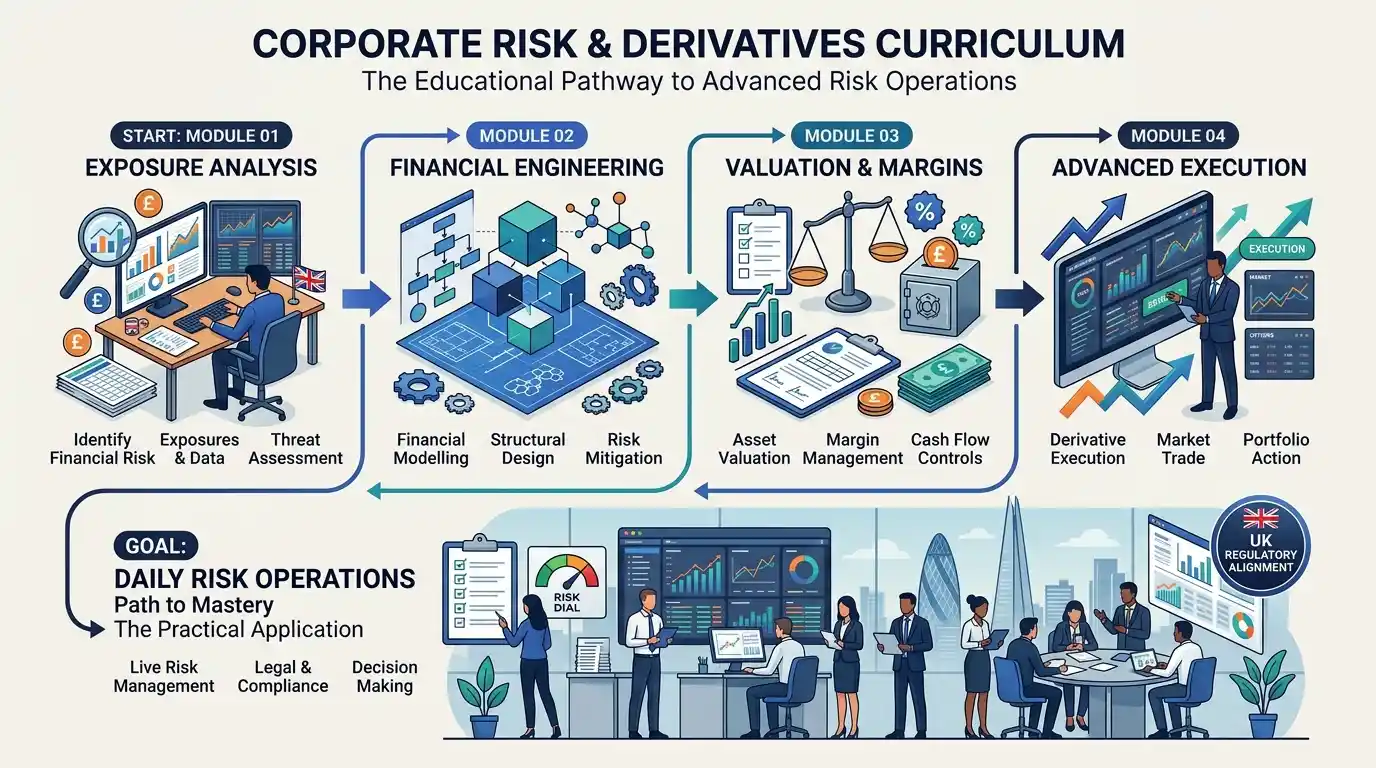
Effective risk management requires an integrated understanding of market dynamics, quantitative modeling, and regulatory compliance. The program avoids abstract academic theories in favour of applied financial workflows that match real-world trading and treasury desks. Learning progressions are structured to ensure every theoretical concept directly links to a practical hedging application. To effectively evaluate specific commercial strategies and execution frameworks, professionals can review How to Evaluate Hedging Strategies and Derivatives for Managing Petroleum Commodity Price Risk as a baseline reference.
The Institute For Oil & Gas Training incorporates linear skill progression into the course architecture to maximize corporate knowledge retention. Participants first analyze physical exposure metrics before evaluating financial derivative mechanics. Once core instrument mechanics are established, the syllabus advances into complex multi-leg option strategies, valuation techniques, and operational risk controls. This step-by-step methodology ensures professionals absorb practical capabilities without technical gaps, preparing them to execute commercial strategies immediately upon course completion.
Structured learning requires continuous practical validation through real-world corporate financial case studies. By reviewing actual historical price shocks, margin crises, and structural basis shifts, participants analyze structural successes and failures in historical corporate hedges. The curriculum forces learners to solve real corporate risk dilemmas under realistic market constraints, including liquidity limitations, credit caps, and strict board risk mandates. This simulation-driven structure builds critical decision-making confidence among commercial personnel and treasury leaders.
What Will Participants Learn in the Hedging & Derivatives Training Modules?
Participants learn to quantify physical price exposure, structure derivative hedges, analyze market structures, and calculate financial valuations. The core modules cover crude oil futures, forward contracts, commodity swaps, put and call options, collar strategies, and mark to market valuation.
Module 1: Physical Exposure Identification and Linear Futures Execution
This foundational module focuses on identifying, measuring, and categorizing physical price risk across oil and gas supply chains. Participants learn to map physical crude oil and refined product streams against exchange-traded benchmarks like Brent and WTI. Direct instruction covers the mechanics of crude oil futures, specifying contract terms, tick values, physical settlement rules, and daily clearing mechanisms. Learners gain practical proficiency in calculating open exposure positions and applying direct hedges to protect upstream production revenues and downstream refinery feedstock costs.
Module 2: Over-the-Counter Contracts and Fixed-for-Floating Swaps
Off-exchange derivatives offer tailored flexibility but introduce distinct counterparty and legal considerations. This module covers the structural terms, master documentation, and credit support annexes governing bilateral financial contracts. Participants evaluate tailored forward contracts for customized physical delivery windows and pricing points. The curriculum provides deep coverage of commodity swaps, instructing learners how to construct fixed-for-floating price exchanges to secure multi-year revenue stability, manage float exposure, and align corporate debt service requirements with operational cash flows.
Module 3: Non-Linear Instruments, Volatility, and Collar Strategies
When linear hedges eliminate upside price participation, non-linear option contracts provide asymmetric risk profiles. This module covers asymmetric hedging mechanics, examining the intrinsic and time value drivers of put and call options. Participants master practical strategy assembly, learning to combine long put options with short call options to build an effective collar strategy. Learners discover how to engineer zero-cost collars that establish guaranteed revenue floors while capping maximum price upside, preserving corporate liquidity without incurring substantial upfront premium expenses.
Module 4: Market Dynamics, Basis Risk, and Hedge Ratio Optimization
Financial derivatives rarely correlate perfectly with physical product sales locations or specific refined product grades. This module provides specialized analytical tools to measure, monitor, and mitigate underlying basis risk across regional delivery hubs. Participants analyze physical forward curve structures, identifying the commercial implications of contango and backwardation on hedge roll yield and inventory storage valuations. Learners apply quantitative models to determine the optimal hedge ratio, ensuring derivative position sizing precisely offsets physical market exposure without over-hedging.
Module 5: Financial Valuation, Margin Governance, and Collateral Management
Executing derivative strategies requires continuous financial control, daily reporting, and rigorous balance sheet oversight. This module teaches participants the exact mathematical procedures required for daily mark to market valuation of complex portfolios. Instruction covers liquidity risk management, detailing exchange-mandated margin and collateral requirements under volatile price conditions. Financial professionals learn to build stress-test models that project cash maintenance calls, ensuring corporate treasury departments maintain adequate credit lines to support open derivative positions through severe market swings.
How Is the Training Delivered by Institute For Oil & Gas Training?
The Institute For Oil & Gas Training delivers this program through intensive live workshops, interactive online sessions, hybrid formats, and customized onsite corporate programs. Delivery includes hands-on trading simulations, risk modeling spreadsheets, and real-time portfolio stress testing.
The Institute For Oil & Gas Training structures delivery around applied learning environments rather than traditional passive lectures. Every delivery format integrates financial simulation software that replicates live trading energy market conditions. Participants manage simulated physical production and refining assets, executing derivative orders in real time against moving price feeds. This hands-on method reinforces theoretical knowledge, transforming abstract financial rules into functional operational execution skills.
Corporate cohorts receive custom learning paths aligned with their firm's specific balance sheet exposures, asset profiles, and risk tolerances. Specialized instructors work directly with participant teams, guiding them through practical financial modeling exercises, contract analysis, and board reporting scenarios. Program materials include practical Excel financial templates, ISDA contract documentation frameworks, and mark-to-market auditing models. Organizations can deploy these standardized resources directly into their corporate risk management operations immediately following course completion.
What Measurable Performance Results Can Organizations Expect After Completion?
Organizations achieve measurable financial stability, standardized risk reporting, precise operational hedging, and reduced exposure to margin distress. Graduates demonstrate immediate capability in structuring protective hedges, auditing portfolio values, and executing corporate risk policies.
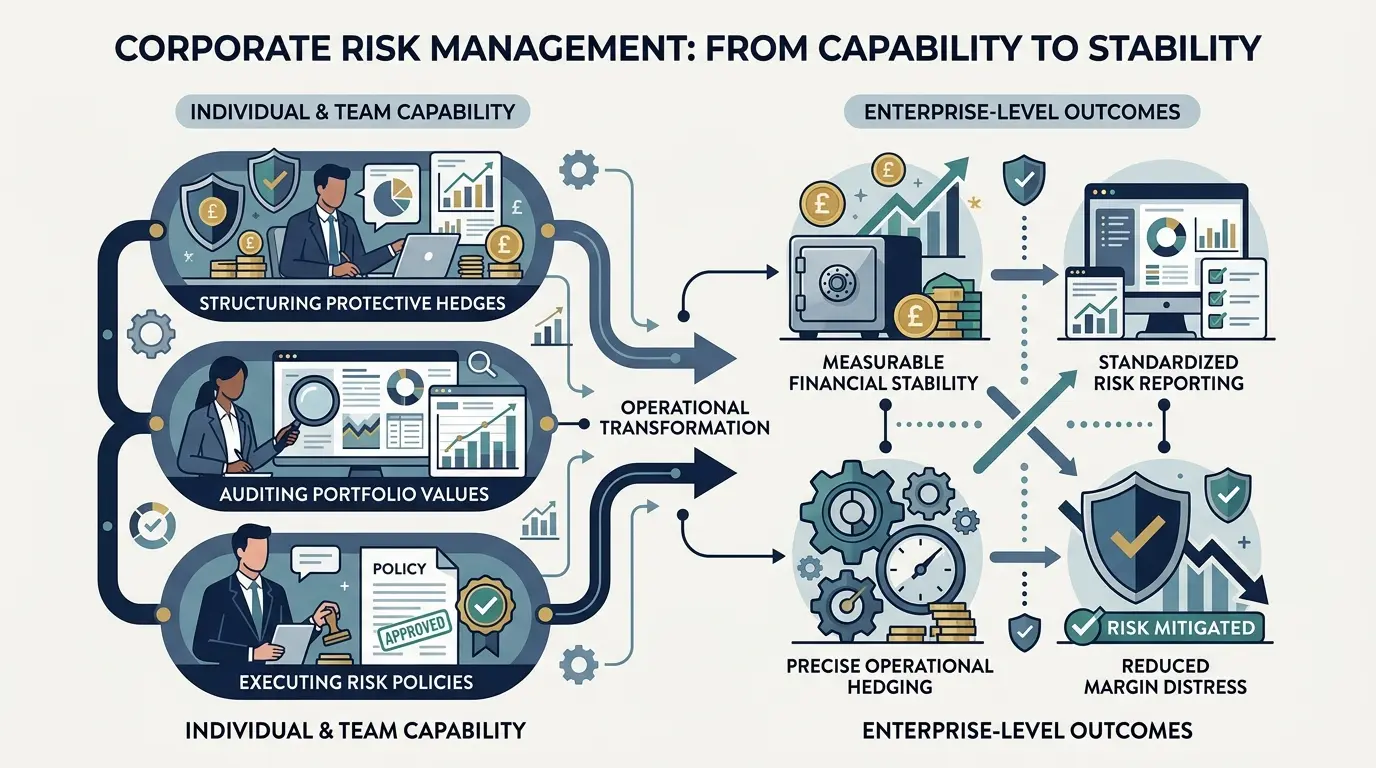
Enrolling corporate teams in this program creates immediate operational capabilities across finance, trading, and executive leadership functions. HR teams and department heads gain a reliable, structured path for building high-performing commercial risk units. Upon program completion, risk teams transition from reactive decision-making to proactive, systematic market hedging. The clear skill progression validated throughout the course ensures employees return to their roles ready to manage complex risk mandates effectively.
The Institute For Oil & Gas Training designs all training evaluations around practical performance metrics rather than simple theoretical recall. Participants undergo rigorous practical assessments, including financial modeling examinations, risk policy audits, and live simulation stress tests. Successful graduates demonstrate proven capability in calculating precise hedge ratios, executing multi-leg options, and managing collateral requirements. This verified baseline gives corporate leadership complete confidence in their team's ability to protect firm assets.
By establishing standardized financial risk management skills across corporate departments, companies build long-term institutional resilience. Cross-functional teams speak a common technical language, streamlining internal approvals for complex derivative transactions. Treasury units eliminate cash flow errors, while commercial units negotiate physical sales contracts with clear awareness of derivative hedging implications. This integrated capability lowers the firm's overall cost of capital and enhances long-term shareholder value.
How Does Enrollment Work for Corporate Teams and Individual Professionals?
Enrollment involves a formal candidate evaluation, pre-course skill assessment, registration confirmation, and preparatory background material distribution. Prerequisites require a foundational understanding of corporate finance, commercial contracts, or general petroleum industry operations.
The Institute For Oil & Gas Training enforces a structured enrollment process to ensure high-quality cohort interactions and optimal peer learning. Applicants submit an initial profile detailing their current professional responsibilities, prior finance experience, and corporate risk objectives. The institute's academic team reviews each candidate to confirm alignment with program rigor and technical depth. This screening process maintains high professional standards across all interactive training sessions.
Corporate HR departments and executive teams planning group enrollments can request tailored onboarding assessments to map course modules against internal job descriptions. Group enrollments include dedicated account coordination, progress tracking, and detailed post-course performance reports. Upon satisfying all attendance, modeling, and simulation assessment criteria, participants earn a formal certification validating their practical risk management skills. To secure team placements and access upcoming course schedules, organizations can apply for course access today.
Frequently Asked Questions
What does the Oil & Gas Petroleum Treasury, Cash and Banking training cover?
The Oil & Gas Petroleum Treasury, Cash and Banking course delivered by Institute For Oil & Gas Training provides comprehensive instruction on liquidity management, short-term cash forecasting, and working capital optimization across petroleum value chains. Participants learn to manage multi-currency cash pools, evaluate counterparty credit risk, oversee international banking relations, and structure trade finance mechanisms specific to upstream, midstream, and downstream energy operations.
Why is specialized petroleum treasury management critical for energy companies?
Energy sector cash flows face distinct volatility driven by commodity price fluctuations, long capital expenditure cycles, and complex international trade settlements. Through Institute For Oil & Gas Training, finance professionals learn specialized Oil & Gas Petroleum Treasury, Cash and Banking frameworks to protect corporate balance sheets, maintain sufficient operational liquidity during market downturns, and secure efficient banking credit lines.
Who should enroll in the Oil & Gas Petroleum Treasury, Cash and Banking course?
This program is designed for corporate treasurers, finance managers, cash controllers, risk analysts, and commercial banking executives who interact with energy sector clients. The Oil & Gas Petroleum Treasury, Cash and Banking curriculum from Institute For Oil & Gas Training builds actionable technical skills required to streamline corporate banking relationships, govern cash concentration structures, and mitigate foreign exchange exposure.
How does this program improve corporate banking and payment operations?
The training provides practical methodologies for implementing centralized treasury management systems, cash pooling, and automated payment clearing networks tailored to petroleum trading and joint venture accounting. Institute For Oil & Gas Training equips delegates with actionable strategies to optimize bank fee structures, enforce stringent internal controls, and streamline cross-border payment processing under international financial regulatory standards.
What learning outcomes do participants gain from Institute For Oil & Gas Training?
Graduates of the Oil & Gas Petroleum Treasury, Cash and Banking course gain practical proficiency in building robust rolling cash flow forecasts, executing foreign exchange hedging strategies, and optimizing short-term investment yields. Institute For Oil & Gas Training ensures participants can immediately establish sound treasury policies, audit counterparty exposure, and safeguard liquidity across international petroleum ventures.
Related training courses
Amine Gas Treating and Regeneration Operations Training Course
- Specialisation
- Oil & Gas Process Engineering and Operations
- Duration
- 5 days · 15 CPD hours
Offshore Pipeline Inspection and Integrity Assessment Training Course
- Specialisation
- Oil & Gas Pipeline Integrity and Inspection
- Duration
- 5 days · 15 CPD hours
Fiscal Disputes, Cost Recovery and Contract Resolution Training Course
- Specialisation
- Oil & Gas Petroleum Fiscal Regime
- Duration
- 5 days · 15 CPD hours
More articles

Petroleum Taxation Fundamentals Training for Oil and Gas Tax Professionals
Master petroleum taxation fundamentals with Institute For Oil & Gas Training. Explore modules, outcomes, and enrollment paths for tax professionals.
Read article →
How to Evaluate Tax Obligations and Tax Risks Across Upstream Midstream and Downstream Operations
Master evaluation of upstream, midstream, and downstream petroleum tax obligations, ring fencing, capital allowances, and transfer pricing risks.
Read article →
Why Petroleum Taxation Matters Across the Oil and Gas Value Chain
Master petroleum taxation fundamentals across upstream midstream and downstream operations to mitigate tax risks and drive corporate profitability.
Read article →