

Hedging policies and derivatives governance frameworks protect petroleum companies against extreme commodity price volatility, foreign exchange fluctuations, and interest rate exposure. Evaluating these internal controls requires a systematic assessment of board oversight mechanisms, delegation of authority limits, operational reporting channels, and risk mitigation procedures across treasury and trading desks.
Corporate treasury teams and financial risk managers must review operational compliance against internal mandates regularly. Understanding Why Hedging Governance Matters for Oil and Gas Financial Risk Management allows risk committees to establish baseline controls that prevent uncoordinated market positions and unauthorised trading activities. A robust evaluation framework confirms whether trading activity remains hedging in nature or strays into speculation, thereby safeguarding corporate liquidity and balance sheet stability.
How Do Petroleum Companies Establish a Hedging Policy and Mandate?
Petroleum companies establish a hedging policy and mandate by defining acceptable market risk tolerances, operational boundaries, approved derivative instruments, and strategic risk management objectives that align with long-term corporate cash flow requirements and capital allocation commitments.
A formal hedging policy and mandate serves as the foundational governance document for corporate risk management. The policy defines the explicit objectives of the risk management programme, such as cash flow stabilization, debt service protection, or capital expenditure coverage. It enumerates the list of approved derivative instruments, including plain-vanilla swaps, options, and collars, while explicitly banning complex or leveraged structures that introduce unmeasurable counterparty or liquidity risks.
The mandate specifies delegation of authority matrices. Senior management receives clear boundaries regarding maximum tenor, execution volumes, and total portfolio nominal values. Treasury personnel execute transactions only within these pre-approved operational boundaries. Regular policy reviews ensure that trading activities adapt to changing market conditions, capital structures, and production profiles without compromising the core risk management objectives of the organisation.
What Board Approved Limits Prevent Speculative Trading Risks?
Board approved limits prevent speculative trading risks by setting quantitative boundaries on position sizes, daily Value at Risk, maximum loss thresholds, and tenor length, which strictly restricts derivative transactions to underlying physical production and consumption volumes.
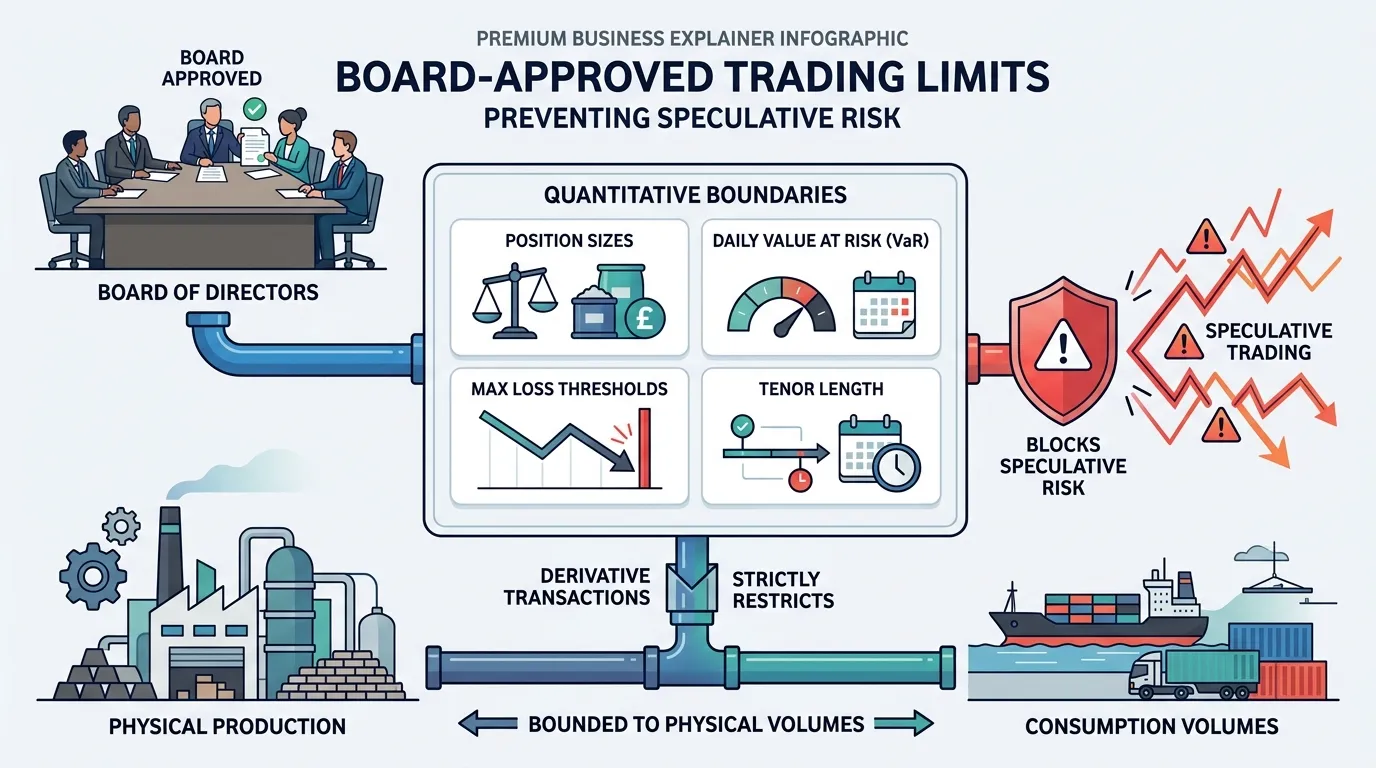
Board approved limits act as the primary operational constraint preventing treasury personnel from taking directional market bets. The board of directors establishes net position limits that directly correspond to projected physical hydrocarbon production or fuel consumption. Transaction approvals mandate direct linkage to verifiable physical exposure, thereby ensuring compliance with a strict speculative trading prohibition across all trading desks.
Risk management systems track compliance using quantitative metrics:
Value at Risk (VaR) Limits: Restrict the maximum statistical loss the derivative portfolio can suffer over a specific holding period at a defined confidence interval.
Stop-Loss Limits: Mandate immediate position liquidation or management escalation if cumulative mark-to-market losses cross pre-determined monetary thresholds.
Tenor Limits: Restrict transaction maturity dates to match visible physical hedging horizons, typically capped between twelve and thirty-six months.
Notional Volume Caps: Prevent aggregate derivative volumes from exceeding a specified percentage of total forecasted physical volume.
Risk control functions monitor these parameters daily. Any limit breach triggers an immediate, mandatory escalation protocol to the chief financial officer and the board risk committee.
How Should Counterparty Selection and ISDA Agreements Be Evaluated?
Counterparty selection and ISDA agreements are evaluated by analyzing counterparty credit ratings, setting dynamic exposure limits, negotiating standardized ISDA Master Agreements with Credit Support Annexes, and continuously monitoring credit risk profiles across financial institutions.
Petroleum companies face substantial credit exposure when derivative contracts move deep into positive mark-to-market valuations. Evaluating counterparty selection frameworks requires assessing the creditworthiness of participating financial institutions. Treasury departments maintain approved counterparty lists based on minimum long-term credit ratings from major international rating agencies. Credit limits scale according to each institution's balance sheet strength and credit rating.
Legal frameworks rely on standardized International Swaps and Derivatives Association (ISDA) Master Agreements. These legal contracts establish enforceable netting arrangements across multiple derivative transactions, significantly reducing gross credit exposure in the event of counterparty default. Evaluating governance strength requires verifying the presence of an active Credit Support Annex (CSA) alongside every ISDA agreement.
CSAs govern the bilateral exchange of collateral based on daily mark-to-market valuations. They specify threshold amounts, minimum transfer amounts, and eligible collateral types, such as cash or sovereign debt securities. Enforcing robust CSA terms mitigates counterparty default risk and ensures liquidity availability during prolonged market stress events.
Why Is Independent Valuation and Hedge Effectiveness Monitoring Essential?
Independent valuation and hedge effectiveness monitoring are essential because they ensure unbiased mark-to-market derivative pricing, provide early detection of structural hedge drift, and maintain strict compliance with corporate accounting standards.
Independent valuation requires the middle office or risk control group to calculate portfolio values using third-party market data sources separate from the front-office execution desk. Relying on execution broker quotes or internal trading desk pricing introduces conflict of interest. Independent pricing verification guarantees accurate financial reporting and validates collateral calls made under bilateral CSAs.
Hedge effectiveness monitoring evaluates whether the financial derivative successfully offsets commodity price movements in the underlying physical hydrocarbon market. Mismatches in pricing points, delivery locations, or timing introduce basis risk. Regular quantitative testing measures correlation and regression metrics between the derivative contract and physical exposure.
Ineffective hedges fail to qualify for hedge accounting treatment under international standards such as IFRS 9. When hedge effectiveness drops below required thresholds, mark-to-market gains or losses hit the income statement immediately, creating unwanted earnings volatility. Evaluating this control area involves reviewing historical hedge effectiveness records and verifying that basis risk remains within corporate tolerances.
How Do Position Reporting and Derivative Disclosure Requirements Standardise Control?
Position reporting and derivative disclosure requirements standardise control by delivering transparent daily risk metrics to executive management and ensuring accurate financial statement disclosures that satisfy statutory accounting and market regulators.
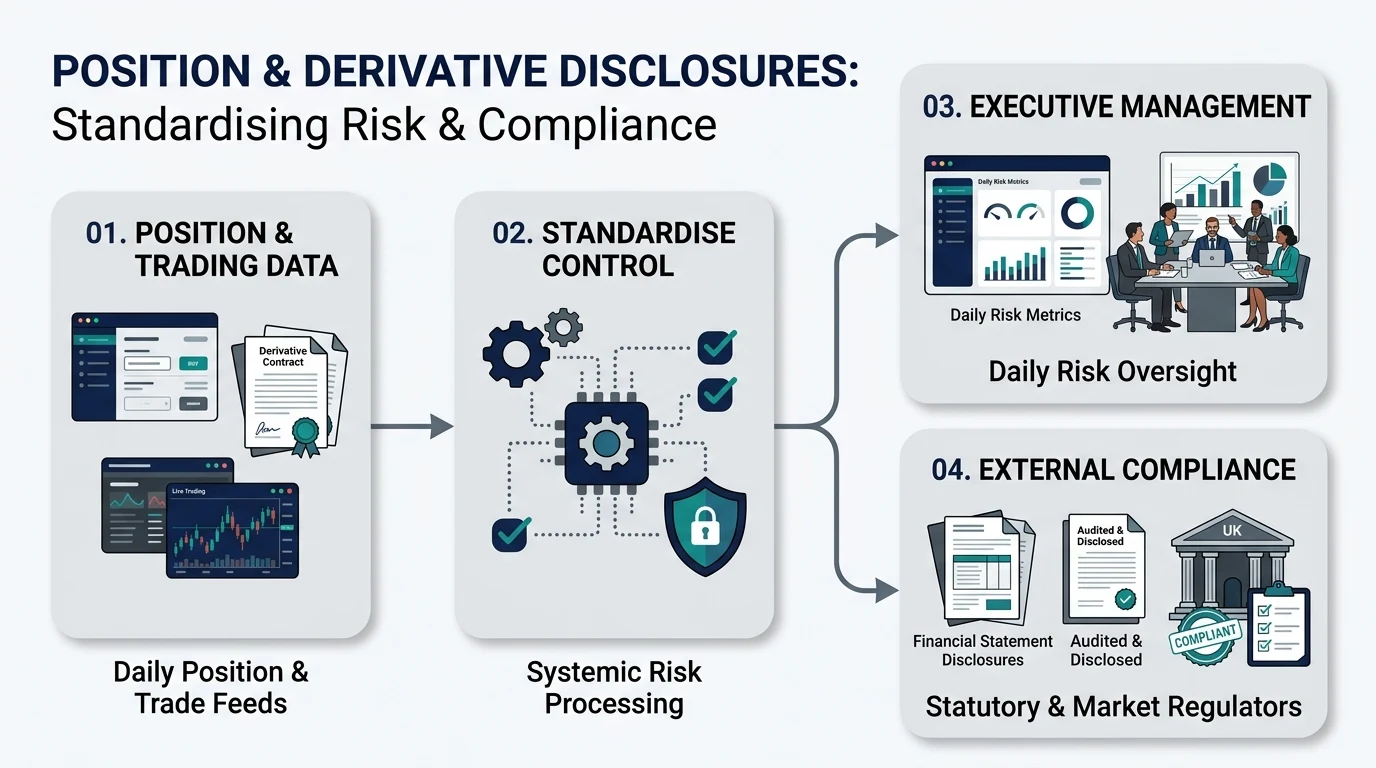
Timely position reporting provides executive leadership with visibility over total market exposures, unhedged physical volumes, counterparty concentrations, and collateral usage. Daily risk reports aggregate physical assets and derivative positions into a consolidated net market profile. Automated reporting infrastructure eliminates manual data manipulation, reducing operational error risks in high-volume trading environments.
Derivative disclosure requirements enforce external transparency. Financial regulations mandate explicit reporting of outstanding derivative positions, fair value calculations, credit-risk-related contingent features, and accounting classification details in annual financial statements. Auditing teams evaluate reporting workflows to confirm complete data integrity from transaction origination to final regulatory filing.
Evaluation Area | Key Focus Indicator | Audit Method | Risk Severity If Flawed |
Policy Mandate | Alignment with physical assets | Board document review | Critical (Unauthorised Trading) |
Trading Limits | Absolute position & VaR limits | System log inspection | High (Speculative Exposure) |
Credit Governance | ISDA / CSA execution status | Contract legal audit | High (Unfunded Counterparty Default) |
Valuation Controls | Independent pricing feeds | Price verification audit | Medium (Misstated Financial Statements) |
Reporting Systems | Real-time position aggregation | Workflow mapping test | Medium (Delayed Loss Visibility) |
What Framework Evaluates Corporate Training Delivery for Derivatives Governance?
A corporate training evaluation framework measures instructional design quality, practical industry alignment, scenario-based skill acquisition, and post-training operational performance improvements across middle-office, treasury, and internal audit teams.
Petroleum enterprises addressing skill deficits across treasury and risk control functions must evaluate external learning options against practical operational requirements. Technical training programmes must move beyond broad financial theory to deliver actionable frameworks covering transaction mechanics, legal negotiation, accounting standards, and regulatory compliance.
Organizations upgrading team capabilities should enroll key personnel in specialized professional development solutions like the Hedging & Derivatives Governance & Policy Design Training Course. Evaluating prospective training options requires analyzing structural curriculum design across key performance dimensions.
Evaluation Criteria | Weak Training Approach | High-Impact Enterprise Training |
Curriculum Context | Generic financial market theory | Petroleum-specific case studies and physical-market mechanics |
Practical Application | Passive lecture-based delivery | Interactive scenario modeling, limit design exercises, and CSA workshops |
Regulatory Alignment | Surface-level accounting overviews | In-depth application of IFRS 9, derivative disclosure, and compliance |
Skill Verification | Simple attendance metrics | Competency assessments, breach-handling simulations, and policy audits |
HR managers and treasury leaders must select training solutions that deliver measurable competency improvements. Effective learning interventions equip middle-office staff to detect policy non-compliance, verify complex valuation models, and maintain robust governance structures across volatile market cycles.
Frequently Asked Questions
How does the Institute For Oil & Gas Training address treasury and liquidity risks in petroleum companies?
The Institute For Oil & Gas Training provides executive professional development focused on mitigating cash flow volatility, commodity price exposures, and foreign exchange risks. The Oil & Gas Petroleum Treasury, Cash and Banking course equips finance teams with robust liquidity forecasting models and risk management frameworks tailored to capital-intensive energy projects.
What are the core components of the Oil & Gas Petroleum Treasury, Cash and Banking course?
The Oil & Gas Petroleum Treasury, Cash and Banking course covers short-term liquidity management, cash concentration, foreign exchange execution, and cross-border payment architecture. Developed by the Institute For Oil & Gas Training, the curriculum emphasizes working capital optimization, debt servicing mechanisms, and regulatory compliance across global banking networks.
How do petroleum companies optimize working capital and banking relationships?
Energy organizations optimize working capital by deploying automated cash pooling structures, minimizing idle cash balances, and establishing strategic credit facilities with global banking partners. Through practical frameworks from the Institute For Oil & Gas Training, professionals learn to align counterparty risk management with daily operational cash flows and petroleum trade settlement processes.
Who should attend the Oil & Gas Petroleum Treasury, Cash and Banking course?
This executive training program is designed for corporate treasurers, finance managers, cash accountants, and risk controllers operating within upstream, midstream, or downstream energy sectors. The Institute For Oil & Gas Training structures the Oil & Gas Petroleum Treasury, Cash and Banking curriculum to help finance leaders improve cash visibility, streamline operational banking, and strengthen internal financial controls.
What business outcomes do organizations achieve through this treasury training program?
Sponsoring finance teams for the Oil & Gas Petroleum Treasury, Cash and Banking course enables energy enterprises to reduce cross-border transaction costs, enhance short-term cash flow forecasting precision, and safeguard against FX fluctuations. The practical tools provided by the Institute For Oil & Gas Training ensure immediate workplace application and stronger governance across corporate treasury operations.
Related training courses
Industrial Steam Boiler Systems and Operational Control Training Course
- Specialisation
- Oil & Gas Process Engineering and Operations
- Duration
- 5 days · 15 CPD hours
Pipeline Inspection and Integrity Assessment Training Course
- Specialisation
- Oil & Gas Pipeline Integrity and Inspection
- Duration
- 5 days · 15 CPD hours
Offshore Pipeline Inspection and Integrity Assessment Training Course
- Specialisation
- Oil & Gas Pipeline Integrity and Inspection
- Duration
- 5 days · 15 CPD hours
More articles

How to Evaluate Transfer Pricing Risks and Intercompany Transactions in Oil and Gas Groups
Evaluate transfer pricing risks in oil and gas intercompany transactions. Learn methods, functional analysis, and arm's length compliance strategies.
Read article →
Why Transfer Pricing Matters for Multinational Oil and Gas Groups
Learn why transfer pricing matters for multinational oil and gas groups, including compliance frameworks, risk management, and workforce development.
Read article →
Withholding Tax Compliance and Treaty Relief Training for Oil and Gas Tax Professionals
Master cross-border oil and gas tax compliance. Evaluate syllabus, delivery, and outcomes for the Institute For Oil & Gas Training course.
Read article →