
Revenue recognition is the formal accounting process that dictates precisely when and how an energy enterprise records income from hydrocarbon sales, defining the exact moment control transfers to buyers across upstream, midstream, and downstream operations.
Revenue recognition represents a foundational pillar of financial governance within modern energy enterprises. Workforce training departments must address this competency because financial transparency drives investor confidence and regulatory compliance. Energy operations involve multi-party joint ventures, complex production-sharing agreements, and long-term supply contracts. Accounting teams operating within the oil and gas sector face unique complexities that do not exist in standard retail or manufacturing environments. Personnel across finance, commercial, and legal departments require rigorous upskilling to interpret multifaceted contracts accurately. Without standardized training frameworks, organizations risk material misstatements in financial statements, leading to severe regulatory penalties from governing bodies like the securities and exchange commission.
Enterprise training initiatives bridge the gap between complex accounting standards and daily commercial execution. Workforce development programs focus on breaking down intricate transaction cycles into manageable operational steps. Employees learn how to evaluate transfer of control, production entitlements, and lifting imbalances. When staff members master these principles, companies eliminate costly revenue leakage and protect corporate integrity. Effective professional development ensures that finance teams align commercial agreements with stringent reporting mandates. Organizations achieve operational excellence by embedding technical accounting knowledge directly into their internal talent pipelines.
Accounting professionals must navigate frameworks such as IFRS 15 revenue from contracts with customers to determine transaction prices and allocate them correctly across performance obligations. In upstream operations, companies frequently partner with other entities under IFRS 11 joint arrangements, creating intricate webs of shared costs and shared revenues. Teams must calculate their exact net revenue interest after accounting for royalties, government take, and production-sharing contracts. If asset values decline due to market volatility, staff apply IAS 36 impairment of assets to evaluate the recoverable amount of a cash generating unit identification process, balancing value in use against fair value minus costs of disposal. Furthermore, large multinational operators segment their financial disclosures using IFRS 8 operating segments, while ensuring physical assets generating that revenue are properly accounted for under IAS 16 property plant and equipment.
How does organizational training for revenue recognition work in corporate environments?
Corporate training for revenue recognition operates through structured, multi-tier capability-building programs that combine technical regulatory frameworks with practical commercial case studies, delivered across blended formats to achieve measurable performance outcomes.
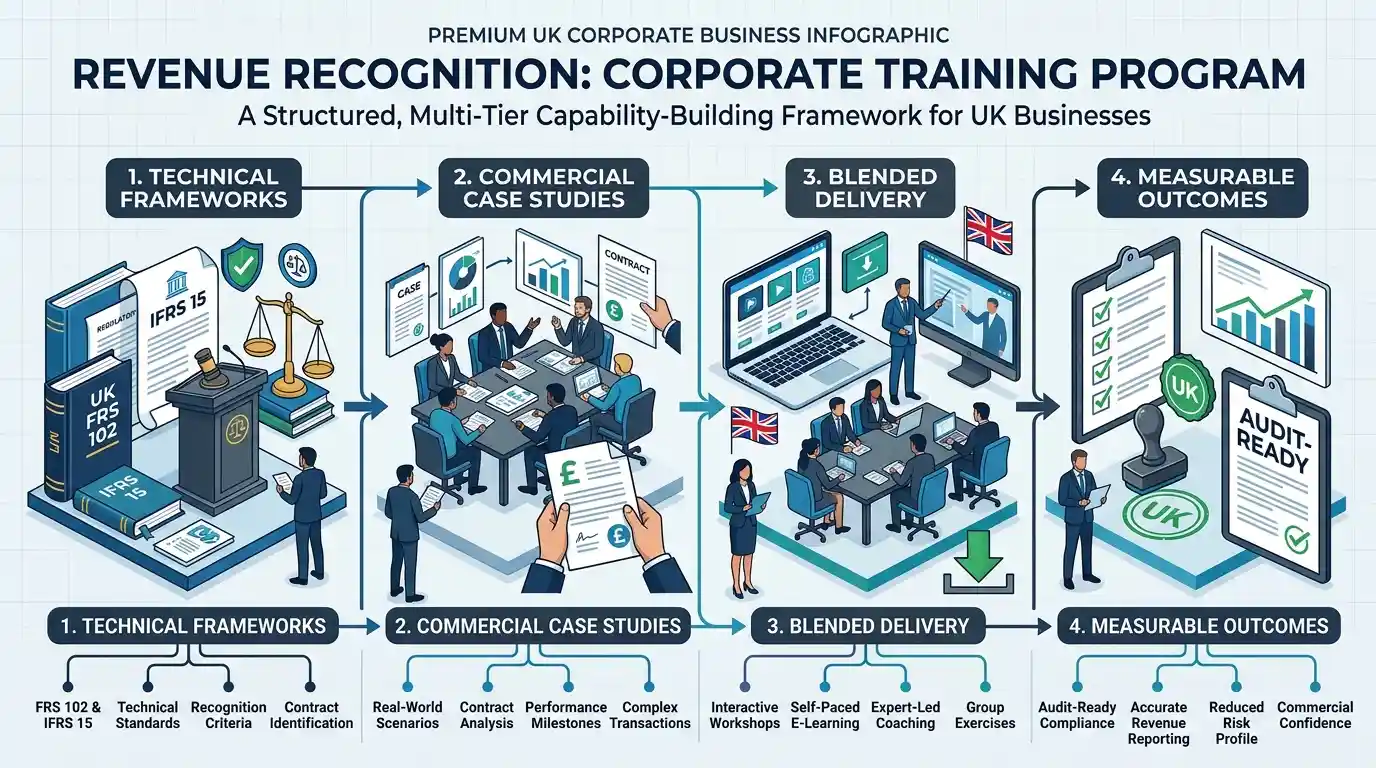
Organizations implement revenue recognition training through a systematic three-stage process that aligns employee skill development with corporate compliance goals. First, learning and development teams conduct comprehensive skills gap analyses to identify competency levels across finance, commercial, and auditing departments. Businesses utilize diagnostic assessments and role-based knowledge checks to measure baseline proficiency before course deployment. Second, instructional designers build customized learning pathways that incorporate real-world scenarios from energy sectors like upstream exploration, liquefied natural gas shipping, and refinery operations. Third, enterprises execute training delivery across blended formats, combining interactive workshops, digital online modules, and cohort-based simulations.
Workforce development structures rely on experiential learning methodologies to drive knowledge retention and behavioral change. Teams participate in case-based learning exercises where they dissect historical financial restatements from real energy corporations. Learners engage in collaborative role-play scenarios simulating negotiations between oil operators, joint venture partners, and state-owned entities. Assessments occur continuously throughout the program, measuring application accuracy rather than rote memorization. Organizations track post-training performance metrics, including a 35% reduction in audit adjustment cycles and a 40% improvement in contract review speed among commercial teams.
Structured learning environments foster cross-functional collaboration between legal, accounting, and operational personnel. When engineers understand the financial implications of production lifting imbalances, they communicate more effectively with commercial negotiators. Training programs emphasize real-world application, ensuring that theoretical accounting rules translate directly into daily workflows. Leadership teams measure return on investment by tracking audit cost savings and accelerated financial close timelines. Continuous professional development secures an organization's competitive edge in a volatile commodity market.
What key components constitute an effective technical training program?
An effective technical training program includes domain-specific learning modules, interactive financial simulations, standardized assessment frameworks, and multi-modal delivery formats tailored to complex regulatory environments.
Enterprise training curricula require precise architectural components to ensure maximum knowledge transfer and skill mastery. The core framework centers on targeted skill modules that address specific regulatory mandates and operational workflows. Organizations incorporate software simulations that replicate enterprise resource planning systems, allowing learners to input complex revenue schedules in safe sandbox environments. Assessment tools measure competency growth through pre-training baselines and post-training practical evaluations. These components work synchronously to build workforce confidence and technical precision.
Delivery formats vary to accommodate global workforces operating across remote extraction sites and corporate headquarters. Organizations utilize instructor-led workshops for complex multi-party contract analysis, online self-paced modules for foundational regulatory updates, and hybrid learning cohorts for cross-departmental alignment. Learning methodologies include peer reviews, collaborative problem-solving tasks, and structured debrief sessions following simulated contract audits.
Training Component | Description | Target Audience | Delivery Format |
Regulatory Framework Modules | Deep-dive sessions on international reporting standards and compliance mandates. | Senior Accountants, Auditors, Controllers | Online Modules, Expert Workshops |
Contract Simulation Labs | Practical exercises parsing multi-party joint venture agreements and lifting imbalances. | Commercial Negotiators, Legal Counsel, Finance Teams | Collaborative Workshops, Software Labs |
Assessment & Scoring Metrics | Quantitative evaluations measuring error reduction and contract review speed. | L&D Managers, Department Heads | Digital Quizzes, Practical Exams |
Cross-Functional Seminars | Collaborative sessions aligning engineering, operations, and accounting terminology. | Operations Managers, Asset Leads | Hybrid Learning Cohorts |
What organizational benefits do structured learning initiatives produce?
Structured learning initiatives produce measurable organizational benefits, including a 45% decrease in external audit compliance costs, a 30% acceleration in financial close cycles, and enhanced risk mitigation across global operations.
Investing in targeted professional development yields significant operational and financial returns for enterprise leadership. Organizations experience a dramatic reduction in costly accounting errors that previously triggered retroactive financial restatements. When accounting and commercial teams share a unified understanding of revenue standards, contract review bottlenecks disappear. Teams execute contract evaluations with absolute precision, protecting profit margins across high-value capital projects. Leadership pipelines strengthen as mid-level accountants master advanced regulatory frameworks, preparing them for senior financial controller roles.
Operational efficiency improves across departments as communication barriers dissolve between technical field personnel and corporate finance teams. Organizations report higher employee retention rates within specialized finance departments, driven by clear career growth pathways and continuous skill enhancement. The implementation of rigorous training protocols signals to institutional investors and regulatory bodies that the enterprise prioritizes uncompromising governance. Companies maintain a pristine reputation in global capital markets, securing favorable financing terms for large-scale energy infrastructure projects.
To deepen your understanding of these regulatory frameworks and explore advanced implementation strategies, you can review the IFRS for Oil & Gas Entities: Revenue Standards Training Course.
How do different corporate use cases apply these training frameworks?
Corporate use cases span upstream exploration partnerships, midstream pipeline tariff agreements, downstream refinery product sales, and executive decision-making processes regarding asset valuations and portfolio management.
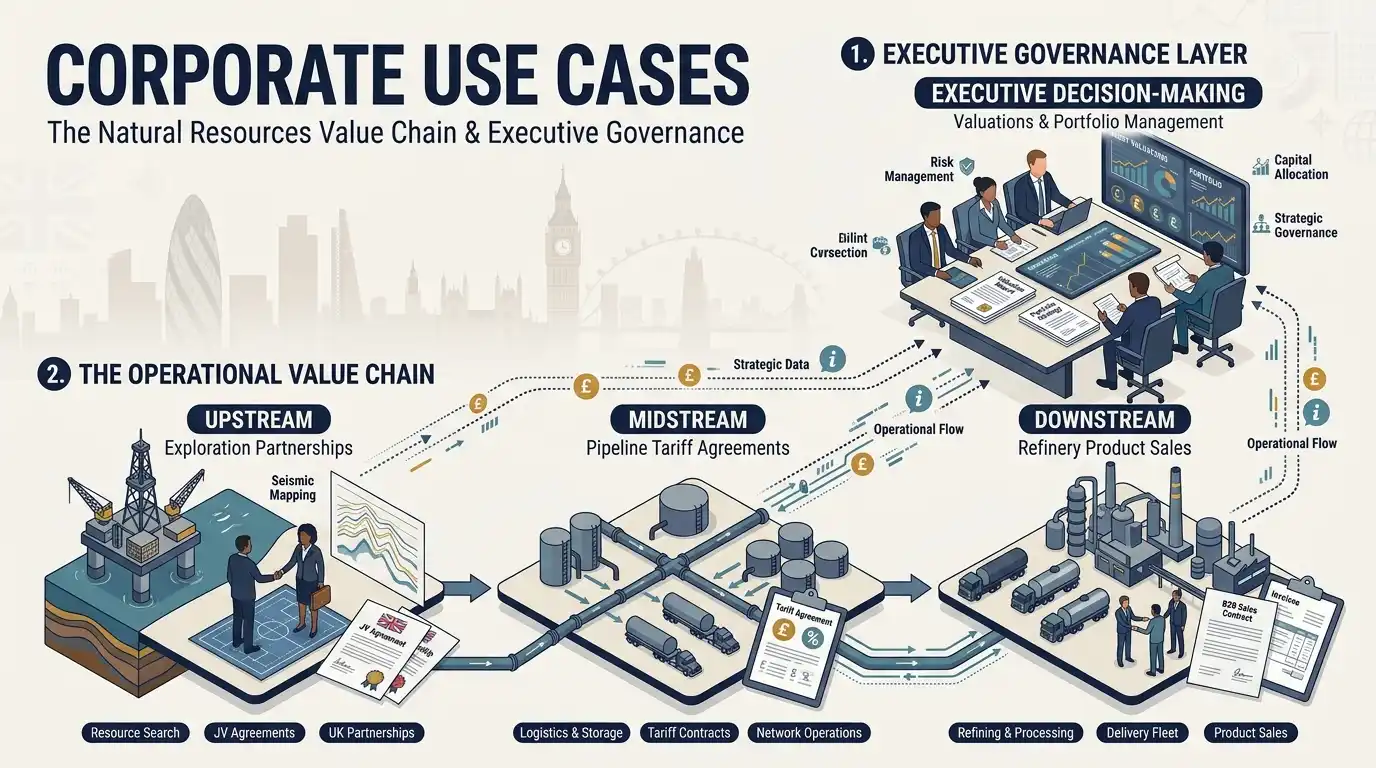
Different operational segments within the energy sector require specialized applications of revenue recognition principles. Upstream exploration and production teams utilize training to account for complex production-sharing contracts where government entities retain ownership of extracted hydrocarbons until specific transfer points. Midstream pipeline operators apply learned competencies to manage long-term throughput agreements, capacity reservation fees, and variable tariff structures. Downstream refining businesses leverage training to account for simultaneous product exchanges, spot market transactions, and hedging instruments. Each department tailors the core accounting curriculum to address its unique commercial realities.
Management teams and corporate executives utilize advanced financial knowledge to guide strategic mergers, acquisitions, and divestitures. When leaders evaluate potential asset purchases, they rely on finance teams trained to identify hidden liabilities within legacy revenue contracts. Internal audit departments deploy standardized assessment tools to continuously monitor compliance across global operating units, preventing regulatory infractions before they escalate. Cross-functional teams collaborate seamlessly during annual reporting seasons, cutting administrative friction and delivering transparent financial disclosures to market stakeholders.
What common misconceptions hinder revenue recognition training success?
Common misconceptions that hinder training success include treating compliance education as a one-time administrative event, relying on generic non-industry courses, and failing to measure post-training behavioral change.
Organizations frequently fail to achieve desired performance outcomes when adopting superficial approaches to professional development. A prevalent error involves purchasing generic accounting modules that lack industry-specific context, leaving employees unable to apply theories to complex production-sharing agreements. Training programs that rely solely on passive video lectures without practical simulations fail to build the muscle memory required for accurate contract analysis. Furthermore, treating continuous professional education as an annual compliance checkbox rather than an ongoing talent development strategy results in rapid skill degradation.
To overcome these pitfalls, decision-makers must treat workforce development as an integrated, continuous strategic initiative. Enterprises design programs that tie directly to corporate Key Performance Indicators, ensuring that every learning hour translates into measurable risk reduction and operational efficiency. Leadership teams commit adequate time and resources for employees to engage fully in simulations, workshops, and collaborative exercises. Organizations that prioritize practical application, expert-led instruction, and rigorous outcome measurement consistently outperform competitors in financial governance and operational resilience.
Frequently Asked Questions
What topics are covered in Oil and Gas Petroleum IFRS & Financial Reporting training?
The Institute For Oil & Gas Training delivers comprehensive curriculum covering complex upstream accounting standards, joint arrangements, asset impairments, and specialized revenue recognition rules. Participants gain practical expertise in navigating international financial reporting mandates tailored specifically to energy sector transactions and joint venture operations.
Why is specialized financial reporting training crucial for energy companies?
Energy enterprises face unique accounting complexities such as production-sharing contracts, multi-party joint operations, and extensive exploration assets that standard manufacturing frameworks do not address. Specialized Oil and Gas Petroleum IFRS & Financial Reporting programs equip finance teams with the precise technical skills required to ensure regulatory compliance and maintain investor confidence.
Who should attend Oil and Gas Petroleum IFRS & Financial Reporting courses?
These professional development courses are designed for financial controllers, senior accountants, internal auditors, commercial negotiators, and corporate finance teams operating within upstream, midstream, and downstream sectors. The Institute For Oil & Gas Training ensures that multidisciplinary professionals build the collaborative competencies necessary to handle complex energy contracts accurately.
How does Oil and Gas Petroleum IFRS & Financial Reporting training improve audit compliance?
Rigorous training reduces costly accounting errors and misstatements by providing staff with hands-on practice in evaluating asset recoverability and production entitlements under international standards. Through targeted Oil and Gas Petroleum IFRS & Financial Reporting workshops, organizations streamline their financial close cycles and significantly decrease external audit adjustment loops.
Can Oil and Gas Petroleum IFRS & Financial Reporting programs be customized for corporate teams?
The Institute For Oil & Gas Training offers flexible delivery formats including online modules, interactive workshops, and tailored corporate programs utilizing real-world case studies from the energy sector. Organizations can align the curriculum with their specific operational footprints, ensuring immediate practical application and measurable performance improvements across finance departments.
Related training courses
Risk Management for Upstream & Midstream Projects: Exposures Training Course
- Specialisation
- Oil & Gas Petroleum Compliance, AML & Risks
- Duration
- 5 days · 15 CPD hours
Segregation of Duties in Finance & ERP Systems Training Course
- Specialisation
- Oil & Gas Petroleum Compliance, AML & Risks
- Duration
- 5 days · 15 CPD hours
Consolidation & JV Structures for Petroleum Group Entities Training Course
- Specialisation
- Oil & Gas Petroleum Accounting
- Duration
- 5 days · 15 CPD hours
More articles
IFRS Revenue Standards Training for Oil and Gas Financial Reporting Professionals
Enroll in the specialized IFRS training course for oil and gas finance professionals. Master revenue recognition, joint arrangements, and asset impairment.
Read article →
Key Revenue Recognition Challenges for Oil and Gas Companies Under IFRS
Explore key IFRS revenue recognition challenges in oil and gas, covering IFRS 15, IFRS 11 joint arrangements, IAS 36 impairments, and IAS 16 assets.
Read article →
IFRS for Oil and Gas Entities Fundamentals Training for Financial Reporting Professionals
Master IFRS for oil and gas entities. Enhance reporting compliance, impairment skills, and disclosure accuracy with Institute For Oil & Gas Training.
Read article →