
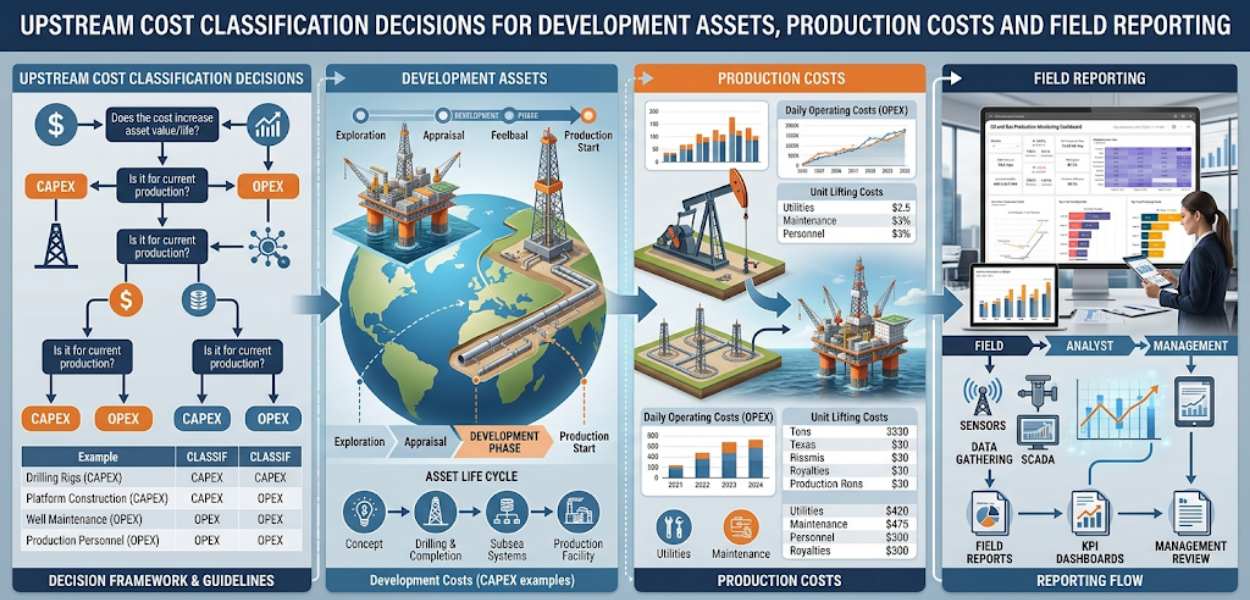
Correct upstream cost classification depends on separating development assets, production expenditure and field reporting costs according to their economic purpose, accounting treatment, contractual basis and reporting requirement. Consistent classification supports accurate asset values, production performance, partner reporting and corporate financial statements.
Upstream petroleum accounting becomes complex when one expenditure supports several activities across the field lifecycle. Development drilling, production operations, facilities, maintenance, exploration support and field administration generate different accounting consequences. The classification decision therefore starts with the economic substance of the expenditure rather than the invoice description.
The financial impact becomes significant when classification errors move costs between capital and operating categories. A development cost recorded as production expenditure changes current-period results. A production cost capitalised into an asset changes depreciation and asset carrying values. These effects also influence joint venture reporting, management information and statutory reporting.
For a broader explanation of how classification errors affect petroleum businesses, The Financial Impact of Misclassifying Upstream Petroleum Expenditure provides the awareness-stage context needed before evaluating specific classification decisions.
What determines whether an upstream cost becomes a development asset or production expense?
A development asset normally represents expenditure incurred to establish or prepare productive capacity, while production expenditure relates to operating an established asset and extracting hydrocarbons. The decisive factors are purpose, timing, economic benefit, asset creation, accounting policy and applicable contractual requirements.
Development expenditure typically occurs before or during the construction and preparation of infrastructure required for commercial production. Examples include development wells, production facilities, gathering systems and other field infrastructure that creates or enhances productive capacity.
Production costs arise from activities required to operate an existing producing field. These include routine operations, field personnel, consumables, equipment servicing, utilities and other expenditure associated with extracting and processing hydrocarbons.
The distinction is not determined solely by whether expenditure occurs before or after first production. A producing field continues to receive capital expenditure when an organisation develops additional capacity, replaces qualifying infrastructure or undertakes a project that creates a separately identifiable future economic benefit.
This makes the asset lifecycle important. Accounting teams should establish whether expenditure relates to exploration, development, production, abandonment or another defined activity before assigning its accounting treatment.
The same supplier invoice can contain several cost components. A project involving facility modifications can include qualifying capital expenditure alongside routine maintenance. Effective classification therefore requires transaction-level review rather than automatic classification based on the project name.
How should development assets be assessed before costs are capitalised?
Development asset assessment should establish whether expenditure creates, acquires or significantly enhances an asset that provides future economic benefits. Accounting teams should examine project purpose, technical scope, field status, expenditure category and approved accounting policies before capitalisation.
Development assets often involve substantial expenditure distributed across several accounting periods. Development wells provide a clear example because drilling expenditure supports access to reserves and production capacity. Production facilities create another category because construction establishes infrastructure used to generate future operating benefits.
The accounting assessment should document:
Purpose of expenditure
The purpose identifies whether the expenditure creates productive capacity or supports routine operations. A new processing facility has a different economic purpose from repairing an existing pump.
Asset creation or enhancement
The team should determine whether expenditure creates a new asset or materially enhances an existing asset. Replacement of a major component requires a different assessment from ordinary repair expenditure.
Future economic benefits
Capitalisation requires a connection between the expenditure and future economic benefits. The assessment should therefore consider the expected role of the asset within field operations.
Project stage
Development projects move through planning, construction, commissioning and production. The accounting treatment should remain consistent with the stage and nature of the underlying expenditure.
Supporting evidence
Invoices alone do not establish classification. Purchase orders, work orders, engineering documentation, project approvals, contracts and field records provide stronger evidence for the accounting decision.
This assessment forms part of Petroleum Industry Accounting Fundamentals, where professionals need to understand how technical field activity translates into financial classification and reporting.
How should production costs be separated from capital expenditure?
Production costs should represent expenditure required to operate producing assets rather than expenditure that creates additional productive capacity. The separation requires analysis of maintenance, repairs, consumables, labour, utilities and operational services against the underlying economic purpose of each transaction.
Routine maintenance normally supports the continued operation of an existing asset. It does not necessarily create a new asset. Examples include scheduled servicing, ordinary equipment repairs and replacement of consumable components.
Capital expenditure has a different economic function. It creates or significantly improves an asset and provides benefits beyond routine maintenance.
A practical classification review asks three questions:
What activity generated the expenditure?
What economic benefit does the expenditure create?
Does the expenditure create or materially improve an identifiable asset?
These questions help accounting teams avoid classifications based purely on departmental codes.
Field operations often produce borderline transactions. For example, replacing a worn component with an equivalent component generally supports existing production. Installing a substantially improved system that increases capacity requires a different assessment.
The organisation's group accounting policies should provide consistent treatment for these recurring decisions. Where policy thresholds or componentisation rules apply, the accounting team should document how those rules affect the transaction.
How do NOC and IOC reporting requirements affect cost classification?
NOC accounting often requires consistent treatment across government interests, joint ventures and operating assets, while IOC reporting requirements add group accounting, consolidation and corporate policy considerations. Classification therefore needs to satisfy field-level, statutory and group reporting requirements simultaneously.
National oil companies and international oil companies often operate through different ownership structures and contractual arrangements. These structures affect how costs are accumulated, allocated and reported.
An NOC may need detailed cost information for government reporting, partner accounting and internal field management. An IOC operating across several jurisdictions also needs classifications that align with corporate accounting policies and consolidated reporting.
This creates several reporting layers:
Field-level cost reporting
Operator reporting
Partner reporting
Statutory financial reporting
Group financial reporting
Management performance reporting
A classification decision that works for one reporting layer does not automatically satisfy every other layer.
For example, a joint operation can require costs to be recorded according to the operator's accounting process while also being allocated to participating interests. The underlying expenditure classification therefore needs to remain traceable from the source transaction through field reporting and corporate reporting.
How do operator and non-operator roles change upstream cost reporting?
Operators generally record and report expenditure incurred for joint operations, while non-operators rely on information received from the operator to recognise their participating interests. Clear classification therefore supports accurate cost recovery, partner statements, allocations and financial reporting across the joint arrangement.
The operator performs the operational and administrative role for the joint activity. It typically processes supplier invoices, maintains field records, prepares expenditure reports and distributes information to participating parties.
The non-operator does not control the daily field accounting process in the same way. It relies on operator statements, supporting schedules and contractual information to record its share of expenditure.
Classification errors at operator level therefore propagate through the joint arrangement.
Consider a development project involving several participating interests. If the operator incorrectly treats qualifying development expenditure as production cost, participating companies receive incorrect expenditure information. Their own accounting records then require adjustment.
This makes operator accounting controls particularly important. Cost classifications should be supported by consistent coding structures, approval processes and documentation.
Training also needs to reflect both perspectives. Professionals responsible for operator accounting need detailed field reporting knowledge. Non-operator teams require sufficient understanding to review operator statements, challenge unusual classifications and reconcile reported expenditure with contractual interests.
How do licence agreements and concession accounting influence classification decisions?
Licence agreements and concession accounting establish contractual and jurisdictional conditions that influence how petroleum expenditure is recognised, allocated and reported. Accounting teams must therefore interpret cost classification alongside ownership rights, obligations, cost recovery mechanisms and applicable statutory requirements.
A petroleum asset does not operate within an accounting structure alone. Licence agreements define rights and obligations associated with exploration, development and production.
Production-sharing arrangements, concession structures and other contractual models can establish different approaches to expenditure recovery and reporting.
This makes contractual analysis part of the classification process.
Relevant considerations include:
Cost recovery provisions
Where contracts permit recovery of specified costs, expenditure classifications affect recoverable-cost reporting. The accounting classification must therefore align with contractual definitions.
Participating interests
Joint arrangements require expenditure to be allocated according to contractual interests. Classification must remain sufficiently detailed to support these allocations.
Government reporting
Contracts can impose specific reporting requirements for expenditure, production and field activities. These requirements can operate alongside financial reporting standards.
Asset ownership
The economic ownership and control structure influences how assets and expenditure are reflected in the accounts.
Abandonment obligations
Certain development and production activities create future decommissioning or abandonment obligations. These require separate accounting consideration and should not be absorbed into routine production costs.
The key principle is that contractual reporting categories and financial accounting categories should be reconciled rather than treated as interchangeable.
What role does field reporting play in accurate upstream cost classification?
Field reporting converts operational expenditure into structured financial information that supports asset accounting, production analysis, partner reporting and management decisions. Accurate field reporting requires consistent coding, supporting documentation, cost allocation rules and reconciliation between operational and financial records.
Field reporting sits between operational activity and corporate accounting. Engineers, procurement teams, project managers and finance professionals generate different forms of information about the same expenditure.
A development project, for example, generates technical progress records, procurement transactions, contractor invoices and project budgets. Accounting teams use these records to determine how expenditure should be classified.
Strong field reporting connects these information streams.
A useful reporting structure identifies:
Field and asset
Project or activity
Cost category
Operator or participating interest
Capital or operating classification
Reporting period
Supporting documentation
Contractual treatment
This structure makes unusual transactions easier to investigate.
It also improves month-end close processes. Finance teams can identify unexpected movements in development assets, production costs and project expenditure before final reporting.
The objective is not simply faster reporting. It is traceable reporting in which each significant cost can be connected to the operational activity that generated it.
How should organisations evaluate different approaches to upstream cost classification?
Organisations should evaluate classification approaches according to consistency, technical accuracy, auditability, contractual alignment and reporting usefulness. The appropriate approach combines accounting policy with transaction-level evidence rather than relying solely on automated coding or individual judgement.
Three common approaches appear in upstream environments.
Policy-driven classification
This approach establishes detailed accounting policies and predefined treatment for recurring expenditure types.
It provides consistency across fields and reporting periods. Its limitation is that unusual transactions still require professional assessment.
Transaction-level professional review
This approach relies heavily on accountants reviewing individual transactions and project documentation.
It provides stronger analysis for complex expenditure. It also requires more specialist knowledge and can increase review time when transaction volumes are high.
System-supported classification
Enterprise resource planning systems and field accounting platforms can apply predefined rules to transactions.
Automation improves consistency for routine transactions. It does not remove the need for professional review because project scope, contractual terms and asset characteristics can change the appropriate classification.
For most complex upstream environments, these approaches work together. Policy defines the framework, professional judgement addresses exceptions and systems enforce repeatable processing.
What skills should finance teams develop to improve upstream cost classification?
Finance teams need integrated knowledge of petroleum operations, accounting principles, contracts, field reporting and corporate reporting. Effective professional development connects technical accounting concepts with real expenditure scenarios so employees can classify costs consistently across development and production environments.
A training programme should address the relationship between operational activity and financial reporting.
Key competencies include:
Development and production cost classification
Petroleum asset accounting
Joint venture accounting
Operator and non-operator reporting
Licence and concession structures
Cost allocation
Statutory reporting
Group reporting
Field expenditure analysis
Accounting policy application
Reconciliation and reporting controls
The learning delivery model also matters.
Classroom-based training provides structured discussion and immediate interpretation of complex scenarios. Online instructor-led delivery supports distributed finance teams. In-house corporate training allows organisations to use internal policies, field structures and reporting examples.
Case-based learning is particularly relevant because classification decisions often depend on facts rather than terminology. A realistic scenario can require participants to distinguish development expenditure from maintenance, assess supporting evidence and determine the appropriate reporting treatment.
For organisations assessing specialist development options, Petroleum Industry Accounting Fundamentals: Key Competencies Covered in Specialist Oil & Gas Training fits the point where the discussion moves from understanding classification problems towards evaluating structured professional learning.
How can organisations measure whether classification training improves business performance?
Training effectiveness should be measured through classification accuracy, review exceptions, reporting adjustments, close-cycle performance, audit findings and employee assessment results. These indicators connect learning activity with operational accounting performance and provide evidence for workforce development decisions.
HR and finance leaders can establish a baseline before training.
Useful measures include:
Number of classification adjustments per reporting period
Value of corrected expenditure
Number of audit findings related to classification
Percentage of employees passing competency assessments
Month-end close duration
Frequency of partner reporting corrections
Number of recurring classification queries
Time required to resolve accounting exceptions
A six-month measurement period provides enough reporting cycles to identify recurring patterns.
Training evaluation should also distinguish knowledge acquisition from workplace application. Employees can achieve strong assessment results while continuing to make errors in complex field situations.
Managers therefore need operational indicators alongside learning metrics.
For example, a finance function can compare the number and value of classification adjustments before and after training. It can also review whether fewer transactions require senior-accountant escalation.
This provides a more direct connection between workforce capability and reporting quality.
When should organisations use specialist Oil & Gas Petroleum Accounting training?
Specialist training is appropriate when finance teams handle upstream expenditure, joint operations, petroleum assets or industry-specific reporting requirements that general accounting programmes do not address in sufficient operational detail. The training should reflect actual organisational reporting structures and accounting responsibilities.
General accounting knowledge establishes the foundation. Petroleum accounting adds the industry-specific layer.
Professionals working with upstream expenditure need to understand why development wells, production facilities, field services and operational expenditure receive different accounting treatment.
The same applies to professionals reviewing operator statements. They need enough technical knowledge to understand how field activities translate into reported costs.
The Oil & Gas Petroleum Accounting course can be positioned within this capability framework where organisations need structured development around upstream accounting principles, cost classification, reporting and petroleum-sector financial processes.
Course selection should consider:
Employee responsibilities
Existing accounting knowledge
Exposure to upstream operations
Operator or non-operator role
Reporting jurisdictions
Joint venture structures
Group accounting requirements
Internal accounting policies
Required competency level
The decision should therefore be based on the gap between current workforce capability and the accounting complexity employees handle in their roles.
Related training courses
Upstream Cost Classification for Recoverability & JV Chargeability Training Course
- Specialisation
- Oil & Gas Petroleum Accounting
- Duration
- 5 days · 15 CPD hours
Inventory & Materials Accounting: Drilling Consumables & Stock Training Course
- Specialisation
- Oil & Gas Petroleum Accounting
- Duration
- 5 days · 15 CPD hours
Inventory & Materials Accounting for Hydrocarbon Stock Valuation Training Course
- Specialisation
- Oil & Gas Petroleum Accounting
- Duration
- 5 days · 15 CPD hours
More articles

Oilfield Economics & Project Evaluation: Specialist Training for Petroleum Economics and Commercial Roles
Master petroleum economics and project evaluation with specialized training. Learn cash flow modeling, risk analysis, and fiscal contracts for upstream roles.
Read article →
NPV and IRR Analysis for Comparing Alternative Oilfield Development Cases
Master net present value and internal rate of return methods to compare alternative oilfield development cases and optimize upstream capital allocation.
Read article →
How Petroleum Companies Assess the Commercial Viability of New Field Developments
Discover how petroleum companies train teams to assess field development commercial viability, optimize capital allocation, and drive project returns.
Read article →