
Applying IFRS standards across complex energy portfolios exposes organizations to significant financial reporting friction, particularly when multi-party extraction agreements intersect with volatile commodity markets. Finance leaders face intricate accounting hurdles that demand precision, deep technical capability, and structured operational alignment.
Understanding these reporting complexities starts with foundational educational concepts, which you can explore further in this guide on Why Revenue Recognition Matters for Oil and Gas Companies. Addressing these hurdles requires navigating intricate contractual obligations, joint venture structures, and asset impairments that directly influence corporate balance sheets and stakeholder trust.
What are the core accounting hurdles of applying IFRS 15 revenue from contracts with customers in energy portfolios?
Applying IFRS 15 requires energy enterprises to identify distinct performance obligations across long-term production-sharing contracts, multi-party lifting arrangements, and complex pricing mechanisms while managing variable consideration tied to fluctuating global commodity prices.
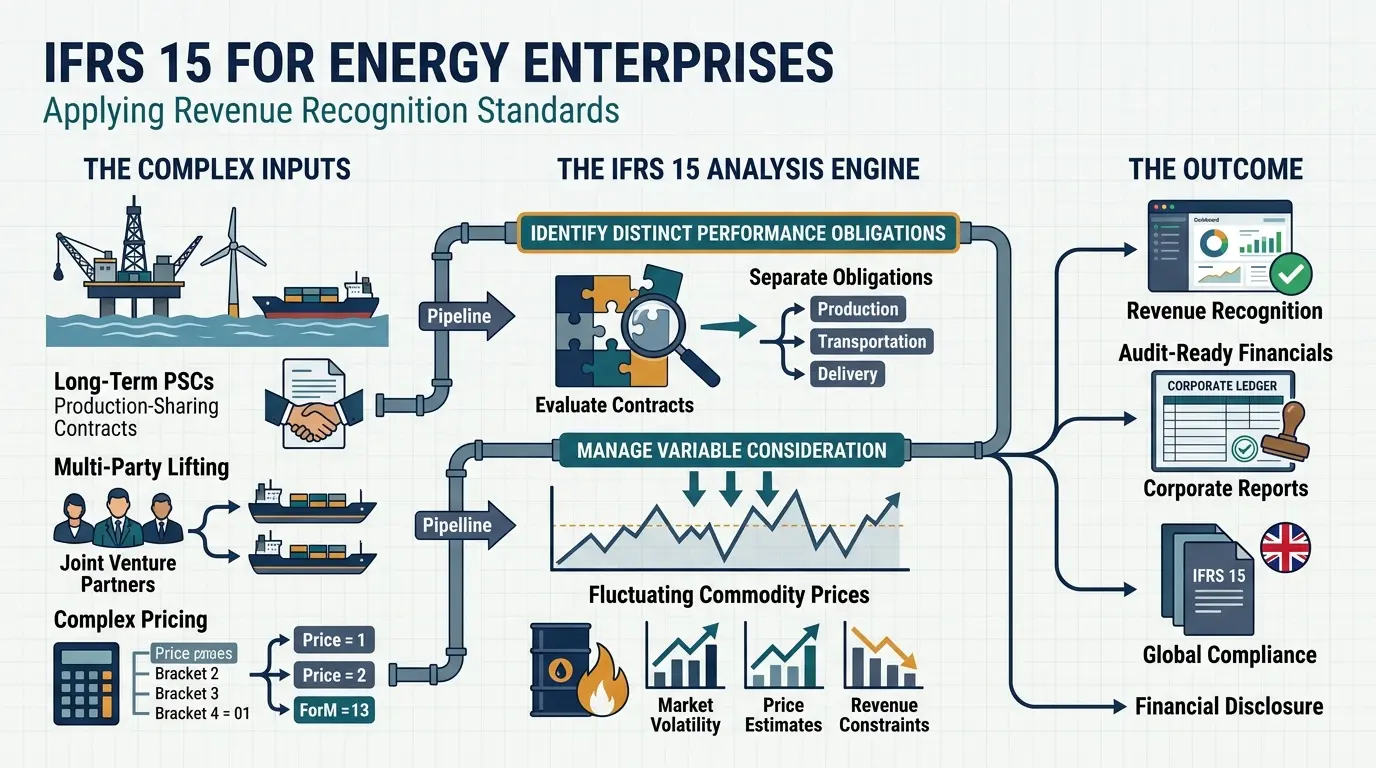
Upstream and downstream operations involve multi-faceted agreements where goods transfer at distinct points along the supply chain. Determining the exact timing of control transfer presents a primary compliance hurdle. Contracts often include take-or-pay clauses, volume-based rebates, and provisional pricing adjustments. Finance teams must estimate variable consideration carefully. Under IFRS 15, entities constrain variable revenue amounts to ensure that significant reversals do not occur when uncertainties resolve.
Production-sharing contracts complicate revenue allocation among host governments, national oil companies, and private operators. Each party holds specific entitlement shares that fluctuate based on cost recovery pools and cumulative production milestones. Accountants must deconstruct these agreements into distinct performance obligations. Delivering crude oil, natural gas, and liquefied natural gas under separate delivery schedules requires precise valuation for each transferred bundle. Joint operating agreements compound this complexity. Over-lifting and under-lifting positions demand monthly balance reconciliations. Companies account for these imbalances either as receivables and payables or through inventory adjustments, depending on prevailing market pricing versus contract pricing definitions.
Furthermore, transfer of control often aligns with marine delivery terms like Free on Board or Cost, Insurance, and Freight. Logistics bottlenecks, pipeline custody transfers, and terminal storage allocations obscure the precise timestamp when legal title and physical control shift to the customer. Financial reporting teams must implement rigorous data capture systems at every custody transfer meter. Without automated data feeds from field operations to central ledger systems, revenue recognition errors multiply across quarterly reporting periods, risking restatements and regulatory scrutiny.
How do IFRS 11 joint arrangements and IFRS 8 operating segments alter financial disclosure requirements?
IFRS 11 forces operators to classify joint ventures and joint operations based on rights and obligations rather than legal form, while IFRS 8 demands granular segment reporting that mirrors how chief operating decision makers allocate resources across diverse geographical basins.
Joint operations require participants to recognize their specific share of assets, liabilities, revenues, and expenses directly within their financial statements. This treatment contrasts sharply with equity-accounted joint ventures. Energy companies frequently participate in consortiums spanning multiple jurisdictions. Misclassifying an operating agreement distorts balance sheet leverage metrics and EBITDA calculations. Technical accounting teams must scrutinize operating agreements clause by clause to determine whether parties hold direct rights to asset output or merely rights to net assets.
Operating segment disclosures under IFRS 8 rely heavily on the internal management approach. Energy enterprises organize operations by geographical regions, asset classes such as unconventional shale versus deepwater offshore, or value chain segments like upstream exploration versus downstream refining. Chief operating decision makers review discrete financial information for these segments to make capital allocation decisions.
Transparency failures in segment reporting trigger regulatory penalties and confuse institutional investors. Financial controllers must ensure that internal Key Performance Indicators align perfectly with external footnote disclosures. Capital expenditure allocations, segment revenues, and depreciation schedules reported to the executive board must match the figures published in annual financial statements. Reconciling internal management reporting packages with statutory IFRS reporting standards requires robust cross-functional coordination between operational engineers and corporate accountants.
Why is managing IAS 36 impairment of assets and cash generating unit identification critical for capital-intensive extraction projects?
IAS 36 requires energy firms to assess property, plant, and equipment alongside intangible exploration assets for impairment triggers annually, grouping assets into the smallest identifiable cash generating units that generate largely independent cash inflows.
Oil and gas assets suffer from severe valuation volatility driven by long-term commodity price curves, regulatory changes, and reserve downgrades. When indicators of impairment emerge, such as a sharp drop in benchmark crude prices or increased environmental remediation liabilities, companies must calculate the recoverable amount of the asset or cash generating unit. The recoverable amount represents the higher of fair value less costs of disposal and value in use. Estimating value in use involves complex discounted cash flow models incorporating multi-decade production forecasts, operational expenditure projections, and discount rates reflecting specific country and asset risks.
Identifying cash generating units creates severe operational friction for diversified energy producers. A single offshore platform may feed a shared pipeline network connected to multiple onshore processing facilities. Determining whether each well acts as an independent cash generating unit or whether entire fields constitute a single unit dictates whether impairment losses are recognized or masked.
If an upstream field relies entirely on shared infrastructure, independent cash inflows do not exist at the individual wellhead level. Accountants must aggregate assets into broader units. However, excessive aggregation can shield underperforming assets from timely write-downs. Conversely, overly granular unit identification creates artificial impairment volatility during temporary market downturns. Establishing defensible cash generating unit boundaries requires deep technical insight into reservoir engineering reports, pipeline capacity constraints, and long-term commercial off-take commitments.
How do IAS 16 property plant and equipment rules govern exploration, evaluation, and decommissioning provisions?
IAS 16 governs the capitalization and subsequent depreciation of property, plant, and equipment, requiring energy firms to capitalize initial development costs and future decommissioning obligations while separating assets into distinct depreciable components based on useful lives.
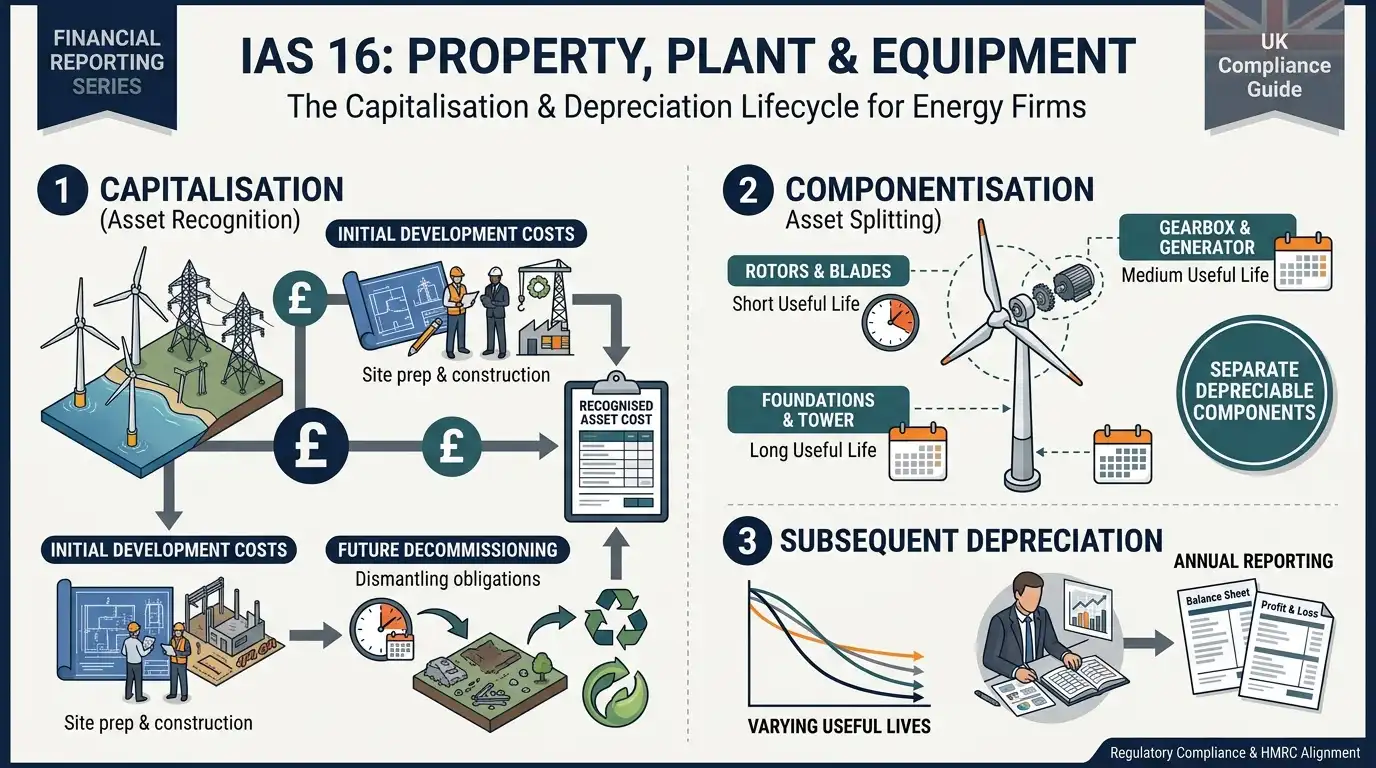
Extraction infrastructure comprises diverse components with vastly differing operational lifespans. Subsea wellheads, floating production storage and offloading vessels, and trunk pipelines wear out at different rates. IAS 16 mandates component depreciation. Accountants cannot apply a single blanket depreciation rate to an entire upstream facility. Instead, they must segregate capital expenditures into distinct components, tracking the cost and accumulated depreciation of each element separately. This practice ensures that major overhauls and replacement costs are capitalized correctly while old component book values are derecognized.
Decommissioning and site restoration provisions represent another major accounting challenge. Under IAS 16 and IAS 37, the estimated cost of dismantling platforms, plugging wells, and restoring environmental sites must be capitalized as part of the initial cost of the asset. This inclusion creates a corresponding long-term liability on the balance sheet. Calculating this obligation requires engineering estimates of future cash outflows discounted to present value using risk-adjusted rates.
Any subsequent revisions to dismantling cost estimates or discount rates adjust both the asset carrying amount and the liability balance. For professional financial teams seeking to master these complex asset valuation frameworks, the IFRS for Oil & Gas Entities: Revenue Standards Training Course provides comprehensive, practical modules designed to bridge regulatory theory and operational reporting realities. Finance professionals must continuously update their competence to manage these capital-intensive adjustments without distorting periodic earnings or violating loan covenants.
Frequently Asked Questions
What are the main revenue recognition challenges under IFRS for oil and gas companies?
Energy enterprises face complex compliance hurdles when applying IFRS 15 to long-term production-sharing contracts, take-or-pay clauses, and multi-party lifting arrangements. Institute For Oil & Gas Training addresses these hurdles through specialized Oil and Gas Petroleum IFRS & Financial Reporting programs that help finance teams accurately measure variable consideration and control transfers.
How do IFRS 11 joint arrangements affect financial reporting in the petroleum sector?
IFRS 11 requires operators to classify joint ventures and joint operations based on substantive rights and obligations rather than legal form alone. Through professional training in Oil and Gas Petroleum IFRS & Financial Reporting, the Institute For Oil & Gas Training equips accounting professionals to correctly recognize proportional assets, liabilities, and revenues on their balance sheets.
Why is IAS 36 asset impairment critical for oil and gas capital projects?
Fluctuating commodity benchmark prices and reserve downgrades necessitate rigorous annual impairment testing for property, plant, and equipment within defined cash generating units. Programs focusing on Oil and Gas Petroleum IFRS & Financial Reporting provided by the Institute For Oil & Gas Training guide finance teams through calculating recoverable amounts and value-in-use models.
How does IAS 16 govern exploration and decommissioning provisions in energy accounting?
IAS 16 mandates component depreciation across extraction infrastructure while requiring companies to capitalize future site restoration and decommissioning liabilities as part of asset costs. Institute For Oil & Gas Training incorporates these intricate asset valuation rules into its Oil and Gas Petroleum IFRS & Financial Reporting curriculum to prevent earnings distortions.
What is the role of IFRS 8 operating segments in petroleum financial disclosures?
IFRS 8 requires segment reporting to align strictly with internal management approaches used by chief operating decision makers to allocate capital across regional basins. The Oil and Gas Petroleum IFRS & Financial Reporting courses from the Institute For Oil & Gas Training ensure reporting teams reconcile internal key performance indicators with external statutory disclosures seamlessly.
Related training courses
Risk Management for Upstream & Midstream Projects: Exposures Training Course
- Specialisation
- Oil & Gas Petroleum Compliance, AML & Risks
- Duration
- 5 days · 15 CPD hours
Management Reporting Design for JV & Partner Audiences Training Course
- Specialisation
- Oil & Gas Petroleum IFRS & Financial Reporting
- Duration
- 5 days · 15 CPD hours
Consolidation & JV Structures for Multi-Country Groups Training Course
- Specialisation
- Oil & Gas Petroleum Accounting
- Duration
- 5 days · 15 CPD hours
More articles

IFRS Revenue Standards Training for Oil and Gas Financial Reporting Professionals
Enroll in the specialized IFRS training course for oil and gas finance professionals. Master revenue recognition, joint arrangements, and asset impairment.
Read article →
Why Revenue Recognition Matters for Oil and Gas Companies
Discover how oil and gas companies master revenue recognition through targeted B2B workforce training, improving compliance and financial accuracy.
Read article →
IFRS for Oil and Gas Entities Fundamentals Training for Financial Reporting Professionals
Master IFRS for oil and gas entities. Enhance reporting compliance, impairment skills, and disclosure accuracy with Institute For Oil & Gas Training.
Read article →