

Production forecasting and decline curve analysis is a technical estimation methodology that predicts future oil and gas reservoir output to project revenue, manage capital allocation, and establish accurate corporate financial plans across energy organization portfolios and financial management teams.
Oil and gas organizations rely on accurate hydrocarbon volume projections to build annual operating budgets, evaluate asset acquisitions, and meet debt service requirements. Production forecasting uses historical production data to establish future reservoir performance parameters. Decline curve analysis applies mathematical curve-fitting models to these performance metrics to estimate total recoverable reserves over the lifecycle of an extraction asset.
When upstream technical teams lack proficiency in these analytical methods, organizations face variance between projected cash flows and realized revenues. Mid-career reservoir engineers, financial analysts, and asset managers require structured training to model reserve depletion rates accurately. Developing this technical competency across multidisciplinary asset teams eliminates cross-departmental miscommunication and aligns subsurface engineering data with corporate financial models.
Corporate learning programs focus on standardizing how technical professionals convert well pressure, fluid properties, and historical flow rates into actionable financial forecasts. Organizations that establish formal technical training frameworks ensure that asset managers, corporate planning units, and finance executives evaluate operational risks using standardized, verifiable metrics.
How Does Decline Curve Analysis Function Within Petroleum Financial Workflows?
Decline curve analysis functions by analyzing past production trends, selecting appropriate decline models, calculating reserve depletion schedules, and translating raw hydrocarbon volume forecasts into corporate revenue projections, valuation metrics, and long-term financial reporting frameworks.
Financial evaluation workflows require precise inputs to establish asset net present value and internal rates of return. Technical teams begin the decline curve analysis process by extracting high-frequency well performance history from operational databases. Professionals evaluate initial production rate data alongside flowing tubing pressures to establish baseline performance metrics.
Analysts classify production lifecycles into distinct operational stages. The initial flow period transitions into plateau and decline phases as reservoir pressure decreases over time. Upstream teams fit empirical mathematical models to this historical data to calculate future production profiles. The primary mathematical models utilized in reservoir evaluation include:
Exponential Decline: Applied when reservoir pressure remains constant and fluid flow encounters constant boundary conditions, resulting in a constant percentage drop in production over uniform time intervals.
Hyperbolic Decline: Utilized in unconventional shale formations where transient fluid flow causes the fractional decline rate to decrease over time according to a specific parameter value.
Harmonic Decline: Applied in specialized drive mechanisms such as gravity drainage, where the fractional decline rate changes in direct proportion to the current production rate.
Once engineers establish the decline model, they generate a representative type curve to estimate the total recoverable volume over time. This calculation yields the ultimate recovery estimate, which serves as the primary operational volume baseline for corporate accounting. Financial departments integrate these production curves into discounted cash flow models to forecast quarterly earnings, determine impairment charges, and establish capital expenditure schedules across energy assets.
What Key Components and Technical Frameworks Comprise Effective Corporate Training?
Effective corporate training incorporates empirical mathematical models, diagnostic reservoir tools, software simulations, case-based learning, and hands-on financial evaluation frameworks designed to build immediate operational capability across technical and finance personnel.
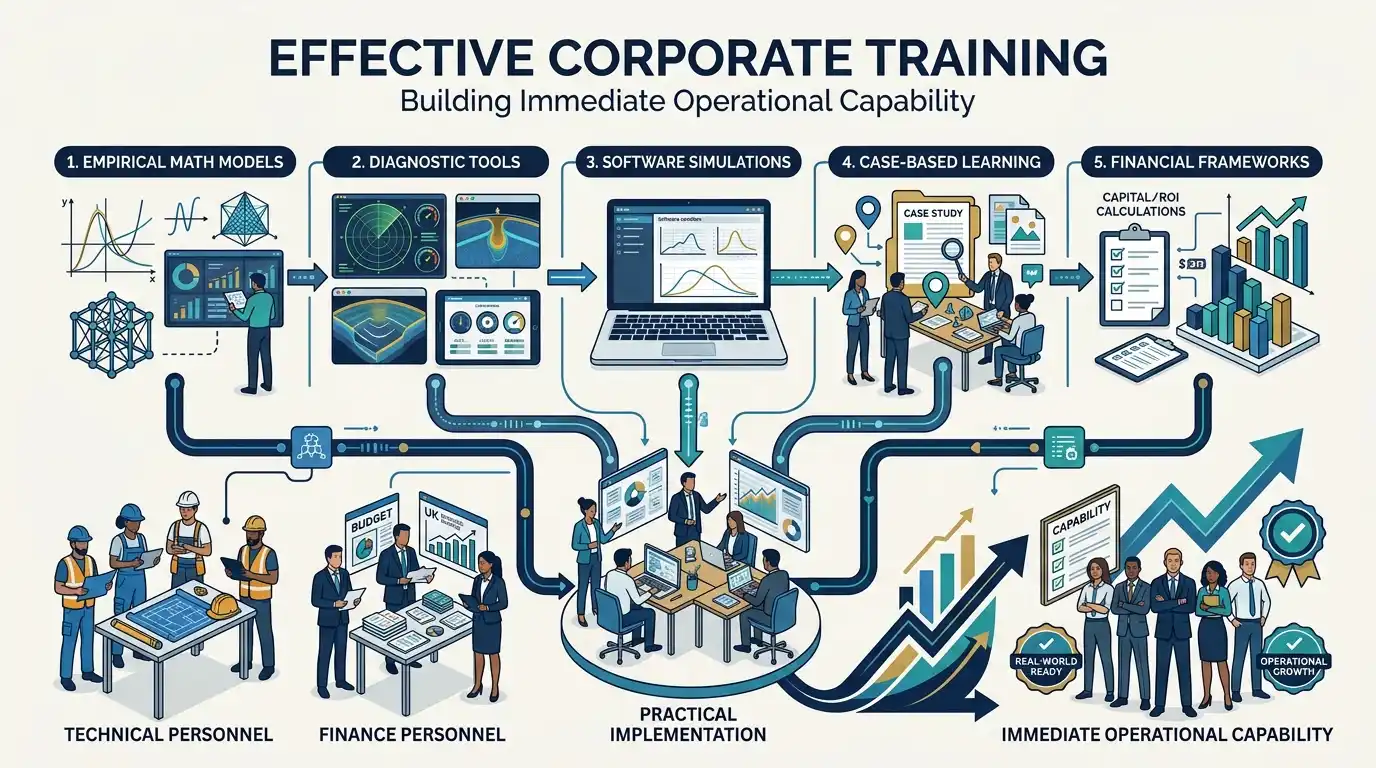
Professional development programs in petroleum financial analysis must bridge the gap between subsurface engineering concepts and financial governance. Technical curriculum structures focus on core competencies that allow professionals to interpret reservoir depletion behaviors accurately.
Corporate learning programs deliver structured instruction across several key technical skill areas:
Empirical Decline Models and Calculations
Participants master the mathematical foundations governing reservoir depletion. Training covers decline rate estimation techniques, differential equations for transient flow, and parameter fitting methods. Engineers and analysts learn to calculate initial production rate limits, operational boundary conditions, and terminal decline rates to prevent overestimating long-term asset reserves.
Diagnostic Tools and Type Curve Analysis
Learners practice developing standardized type curves for single wells and multi-well development projects. Coursework covers diagnostic plots, pressure transient integration, and rate-transient analysis methods. Professionals learn to account for operational downtime, artificial lift conversions, and well stimulation impacts when establishing baseline decline curves.
Integration with Financial Modeling Tools
Training links reservoir volume outputs directly to corporate financial valuation tools. Participants practice exporting ultimate recovery estimate data into financial software to construct cash flow projections, debt coverage ratios, and asset retirement obligation schedules.
Structured corporate development combines classroom instruction with practical software application. Training formats utilize real-world production datasets from producing basins, allowing professionals to model decline behaviors under realistic operating constraints. Multi-day workshops, hybrid learning modules, and hands-on case studies ensure that team members apply theoretical formulas directly to active corporate asset portfolios.
How Do Organizations Implement Decline Curve Analysis Development Programs?
Organizations implement these programs by identifying employee skill gaps, deploying structured multi-phase learning pathways, utilizing case-based simulations, conducting performance assessments, and establishing post-training execution standards across operational and financial divisions.
Enterprise implementation begins with a systematic assessment of technical skill gaps across engineering and financial management units. HR leaders and line-of-business managers evaluate existing team capabilities against industry benchmarks to identify specific weaknesses in forecast accuracy or financial model integration.
Once leadership establishes baseline capability metrics, organizations deploy targeted learning interventions through structured delivery formats. Enterprise implementation follows a four-part framework:
Technical Skill Gap Assessment: Learning administrators evaluate individual proficiency in reservoir engineering fundamentals, statistical analysis, and corporate finance software.
Structured Curriculum Delivery: Professionals participate in intensive 3-day to 5-day workshops or 6-week hybrid learning programs combining self-paced technical modules with instructor-led application sessions.
Case-Based Simulation: Learners work with anonymized, historical corporate production data. Teams perform decline rate estimation, build type curves, and present integrated asset valuations to mock investment committees.
Competency Evaluation and Standardization: Organizational leaders measure skill acquisition through standardized practical assessments. Successful completion establishes uniform forecasting standards across all asset teams.
Organizations evaluating structured development programs often require frameworks to measure technical competency across cross-functional asset teams. Decision-makers must review specific program structures, delivery methodologies, and technical depth when choosing external learning interventions. To select structured educational frameworks that address complex valuation workflows, business leaders learn How to Evaluate Production Forecasts and Decline Curves for Reliable Financial Analysis to establish consistent, defensible corporate evaluation standards across their enterprise divisions.
What Common Misconceptions and Training Mistakes Impair Production Forecasting Competency?
Common mistakes include relying on generic academic courses, ignoring cross-functional workflow integration, failing to practice on real operational datasets, and treating technical forecasting as an isolated engineering task rather than an enterprise financial governance process.
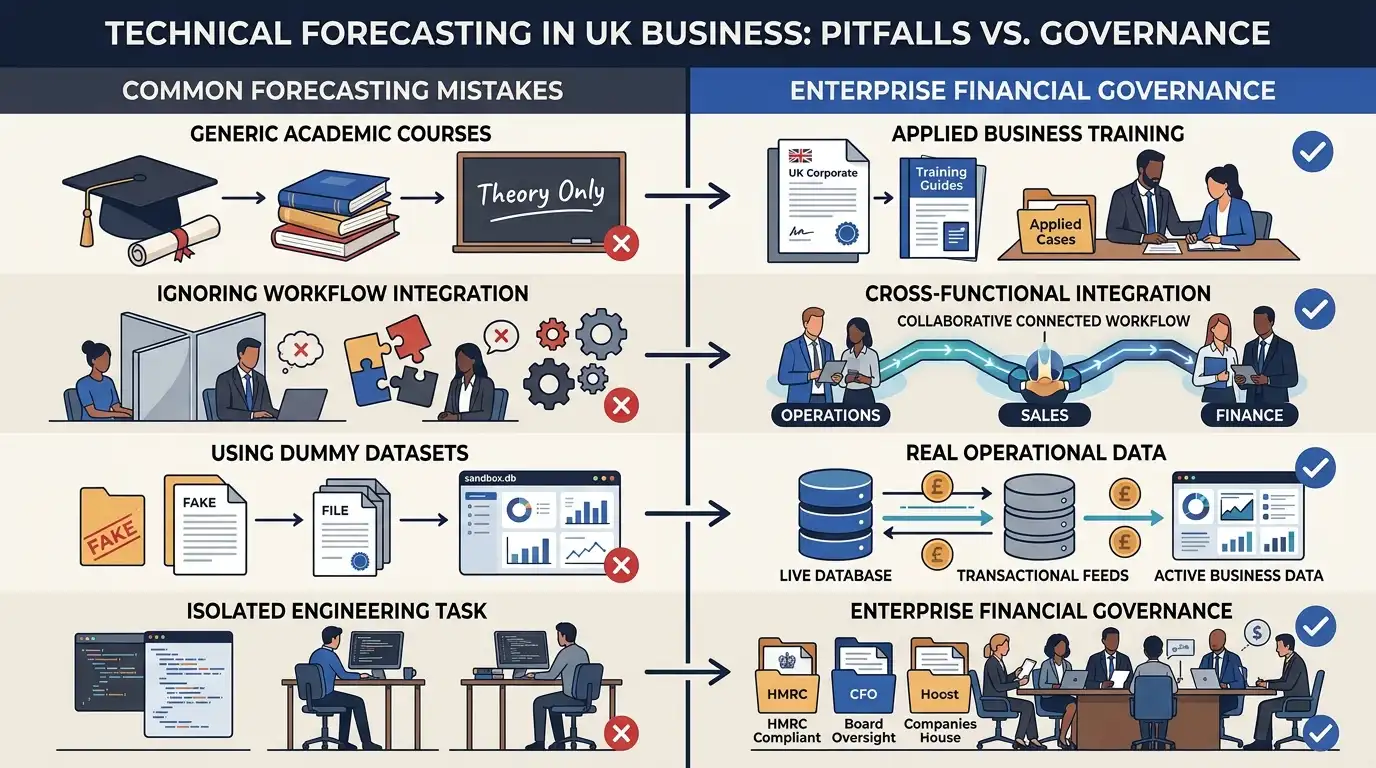
Enterprise training initiatives frequently fail to produce measurable performance improvements due to structural design flaws in learning delivery. Misconceptions regarding technical education prevent workforce development managers from achieving full return on training investment.
Key operational mistakes in enterprise technical development include:
Deploying Generic Educational Content: Off-the-shelf academic courses teach theoretical equations without addressing operational realities such as well shut-ins, compressor failures, or artificial lift changes.
Isolating Engineering and Financial Disciplines: Training reservoir engineers without financial context—or training financial analysts without subsurface context—maintains functional siloing and causes misaligned asset valuations.
Over-relying on Automated Software Outputs: Teaching staff to input data into commercial software without understanding underlying mathematical assumptions leads to uncritical acceptance of flawed decline curves.
Omitting Post-Training Performance Verification: Organizations that fail to evaluate employee work products 60 to 90 days after training cannot verify skill retention or process standardization.
Organizations eliminate these execution errors by selecting workforce development programs tailored to corporate operational contexts. Practical exercises must incorporate realistic production anomalies, forced downtime events, and variable operating expense structures to mirror actual field environments.
What Measurable Business Outcomes and Performance Metrics Does Technical Training Produce?
Technical training produces measurable business outcomes including reduced financial variance, improved capital allocation efficiency, accelerated project execution timelines, heightened forecast accuracy, and increased employee retention across critical engineering and finance roles.
Investing in specialized capability building yields direct financial and operational returns across energy enterprises. By standardizing decline curve analysis and production forecasting workflows, organizations eliminate costly estimation errors that distort corporate planning.
Structured technical training programs deliver quantifiable improvements across four primary enterprise key performance indicators:
1. Reduced Volume Forecast Variance
Standardized application of exponential decline, hyperbolic decline, and harmonic decline models reduces quarterly production volume variance from historical levels of 15% down to under 3%. Precise type curve fitting ensures corporate accounting teams project revenue baselines that match actual physical sales volumes.
2. Capital Allocation Efficiency
Energy organizations allocate capital expenditure budgets with greater precision when ultimate recovery estimates accurately reflect well performance history. Training equips asset teams to identify underperforming wells early, reallocate drilling capital to high-return plays, and optimize portfolio net present value.
3. Accelerated Valuation Workflows
Cross-functional alignment speeds up the delivery of annual reserve audits and financial reporting packages. Teams that complete standardized training reduce asset valuation cycle times by 30%, allowing corporate leaders to respond faster to market acquisitions and divestment opportunities.
4. Workforce Retention and Leadership Pipeline
Targeted skill development increases employee engagement and reduces turnover among specialized engineers and financial analysts. Standardized technical training pathways prepare mid-level technical professionals for senior asset management and executive leadership roles, securing the organizational knowledge base.
Organizations that enroll technical and financial teams in comprehensive professional development programs like the Oil and Gas Petroleum Financial Analysis course establish a baseline of operational capability. Aligning engineering methodology with financial governance ensures long-term asset profitability and resilient enterprise strategy.
Frequently Asked Questions
What is covered in an Oil and Gas Petroleum Financial Analysis course?
An Oil and Gas Petroleum Financial Analysis course delivered by the Institute For Oil & Gas Training covers economic evaluation techniques, discounted cash flow modeling, net present value calculations, and risk analysis for upstream assets. Participants learn to integrate decline curve forecasts, capital expenditure structures, operating costs, and fiscal regimes into enterprise financial models. This training equips professionals to assess asset profitability, estimate recoverable reserves value, and support corporate capital allocation decisions.
Who should take Oil and Gas Petroleum Financial Analysis training?
This professional development program is designed for petroleum engineers, financial analysts, corporate planners, asset managers, and L&D teams within energy organizations. Professionals seeking to bridge the gap between subsurface technical data and corporate financial management benefit directly from standardizing their valuation methodologies. The Institute For Oil & Gas Training structures this curriculum to help cross-functional teams make defensible, data-driven investment decisions.
How does decline curve analysis impact petroleum financial evaluation?
Decline curve analysis establishes the production volume baseline required to project cash flows, asset retirement obligations, and revenue schedules over a reservoir's lifecycle. By accurately estimating initial production rates and depletion trends through exponential, hyperbolic, or harmonic decline models, financial analysts prevent overestimating net present value. Training in Oil and Gas Petroleum Financial Analysis at the Institute For Oil & Gas Training ensures technical teams feed reliable reserve estimates into corporate financial plans.
Why is specialized financial analysis important for energy sector decision-making?
The oil and gas industry operates under unique capital intensity, price volatility, tax structures, and long asset lifecycles that standard corporate accounting frameworks do not fully address. Specialized financial training enables decision-makers to evaluate project economics, joint venture accounting, and impairment risks under variable operational scenarios. The Institute For Oil & Gas Training delivers practical, outcome-based instruction that aligns technical field performance with executive-level financial strategy.
How does this course improve team productivity and corporate performance?
Structured training standardizes cash flow modeling and reserve valuation workflows across engineering, finance, and asset management departments. This cross-functional alignment reduces volume forecast variance, accelerates annual reserve auditing cycles, and improves capital expenditure efficiency. Enrolling workforce teams in Oil and Gas Petroleum Financial Analysis with the Institute For Oil & Gas Training builds organizational capability and eliminates communication barriers between technical and financial units.
Related training courses
Petroleum Refinery Processes & Operations Training Course
- Specialisation
- Oil & Gas Process Engineering and Operations
- Duration
- 5 days · 15 CPD hours
API RP 1188 Hazardous Liquid Pipeline Facilities Integrity Training Course
- Specialisation
- Oil & Gas Pipeline Integrity and Inspection
- Duration
- 5 days · 15 CPD hours
Corrosion Control in Petroleum Refineries Training Course
- Specialisation
- Oil & Gas Corrosion Management and Control
- Duration
- 5 days
More articles

Production Forecasting and Decline Curve Analysis Training for Oil and Gas Finance Professionals
Master production forecasting and decline curve analysis. Evaluate reservoir performance for oil and gas financial planning.
Read article →
How to Evaluate Production Forecasts and Decline Curves for Reliable Financial Analysis
Learn how to evaluate production forecasts and decline curves to improve financial modeling, risk assessments, and asset valuations in oil and gas.
Read article →
Break Even Oil Price Analysis Under Fiscal Terms Training for Oil and Gas Finance Professionals
Master economic modeling and fiscal terms with the Break Even Oil Price Analysis Under Fiscal Terms Training Course. Enroll today.
Read article →