

Oil and gas financial professionals often struggle to validate hydrocarbon production forecasts provided by reservoir engineering teams, leading to inaccurate cash flow projections and misaligned capital allocation strategies. The Production Forecasting & Decline Curve Analysis for Finance Training Course bridges the technical-financial gap by providing non-engineers with the mathematical frameworks, empirical models, and diagnostic tools required to independently evaluate well performance histories and decline parameters. Understanding these underlying technical variables is essential for robust valuation, as explored in our educational guide on Why Production Forecasting and Decline Curve Analysis Matter in Oil and Gas Financial Planning.
Through structured corporate learning modules offered by Institute For Oil & Gas Training, finance professionals, investment analysts, and corporate planning teams acquire the quantitative capabilities needed to stress-test production profiles, verify asset reserve valuations, and improve capital efficiency across complex upstream portfolios.
What Is the Course and What Problem Does It Solve?
This training course is a specialized professional development program designed to bridge the gap between petroleum engineering data and financial valuation models by teaching finance specialists how to interpret, verify, and project hydrocarbon decline curves independently.
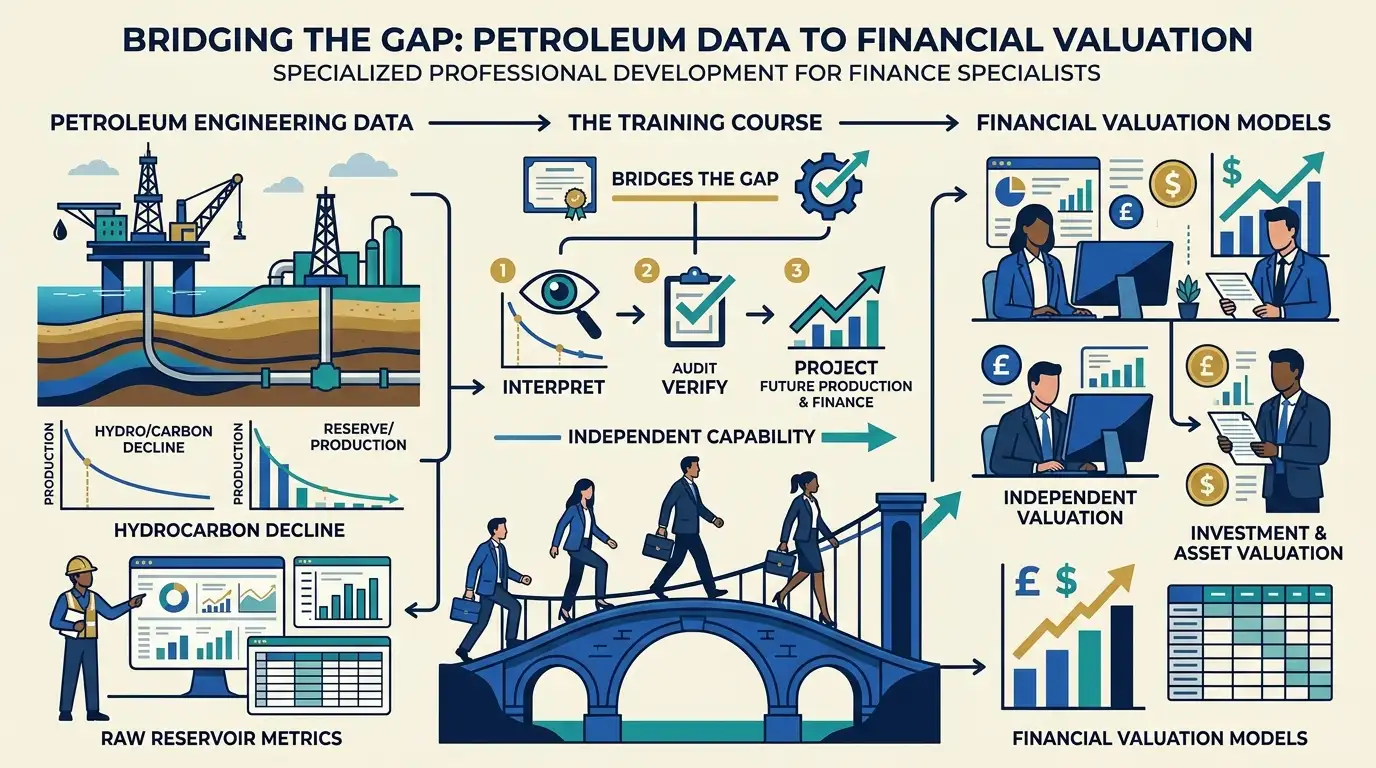
Upstream oil and gas financial planning relies heavily on estimated ultimate recovery forecasts and decline rates provided by technical engineering teams. However, financial managers and corporate analysts frequently lack the diagnostic methodology required to audit these technical inputs. When financial models accept raw technical forecasts without scrutinising the underlying empirical assumptions, corporate planning becomes vulnerable to sudden reserve write-downs, miscalculated net present values, and cash flow shortfalls.
The course resolves this organizational friction by equipping financial personnel with a direct understanding of well depletion dynamics. Participants learn how reservoir energy mechanisms influence production rates over time, enabling them to evaluate the validity of engineering assumptions before committing corporate capital to acquisitions, field developments, or debt refinancing.
By implementing this curriculum across financial departments, Institute For Oil & Gas Training enables organizations to establish a standardized internal audit process for asset performance evaluation, reducing reliance on unverified external technical reports.
Why Is This Training Course Structured This Way?
The curriculum is structured sequentially from foundational fluid mechanics to advanced empirical decline modeling, ensuring financial professionals build technical intuition alongside computational rigor to make accurate asset evaluations and capital allocation decisions.
The pedagogical architecture follows a progressive technical structure designed specifically for professionals without formal engineering degrees. Initial modules establish the physical principles governing hydrocarbon recovery, transitioning quickly into practical mathematical applications.
Foundational Physical Dynamics: Participants analyze the operational phases of a producing well, learning how reservoir pressure depletion directly drives surface rate drops.
Mathematical Curve Fitting: Training focuses on empirical decline equations, detailing how variation in key parameters alters medium-term volume expectations.
Diagnostic Analysis: Learners apply log-log and semi-log diagnostic plots to distinguish between boundary-dominated flow and transient flow regimes, preventing premature extrapolation errors.
Financial Integration: Technical outputs are integrated into corporate cash flow forecasts, discount rate selection framework, and capital budgeting scenarios.
This structured progression ensures that learners move beyond basic spreadsheet calculation into active technical auditing. Detailed methodologies for comparing corporate training frameworks are covered in our guide on How to Evaluate Production Forecasts and Decline Curves for Reliable Financial Analysis.
Through this syllabus, Institute For Oil & Gas Training provides a structured learning environment where complex reservoir behavior is converted into clear, quantifiable financial risk metrics.
What Will Participants Learn in the Curriculum?
Participants will master empirical decline curve equations, type curve matching, production data diagnostic plotting, and reserve forecasting techniques to convert complex well histories into audited cash flow projections.
The syllabus is divided into four core technical modules, each addressing a specific operational requirement in upstream financial analysis.
Module 1: Reservoir Depletion & Arps Fundamentals
This module establishes the core mathematical formulas used in decline curve analysis. Participants learn the physical drive mechanisms that dictate reservoir behavior, including solution gas drive, water drive, and gas cap expansion. Training covers the specific derivation and application of Arps empirical equations:
Exponential decline: Applied when reservoir pressure remains constant or under specific fluid drive conditions ($b = 0$).
Hyperbolic decline: Utilized for transient and boundary-dominated flow regimes where the decline rate changes over time ($0 < b < 1$).
Harmonic decline: Applied in specific gravity-drainage or high-water-cut production environments ($b = 1$).
Module 2: Production Data Diagnostics & Curve Fitting
Participants analyze real-world well performance history data to identify reliable trend lines. The module teaches techniques for filtering operational noise, such as facility downtime, choke adjustments, and artificial lift installations, from underlying reservoir depletion signals.
Determining initial production rate ($q_i$) and decline rate estimation ($d_i$) parameters from historical production logs.
Utilizing log-log diagnostic plots to confirm when a well reaches boundary-dominated flow.
Normalizing historical production rates against flowing tubing pressure variations.
Module 3: Type Curve Generation & Unconventional Asset Analysis
Focusing on multi-well developments and shale plays, this module covers the construction and application of standardized type curve profiles. Participants learn how to group historical well data by completion design, lateral length, and fluid intensity to build predictive baseline curves for undeveloped acreage.
Distinguishing between long-term transient flow and true boundary-dominated decline in tight-oil wells.
Calculating reliable ultimate recovery estimate profiles for individual wells and multi-well drilling pads.
Evaluating the plateau and decline phases of field development plans to assess facility utilization and cash flow timing.
Module 4: Financial Integration & Valuation Sensitivity
The final module links technical production profiles directly to corporate financial models. Learners translate mathematical decline profiles into monthly revenue streams, factoring in variable operating costs, royalties, and severance taxes to establish accurate economic limits.
Determining the exact economic limit where operating expenses equal gross revenue.
Modeling sensitivity analysis on $b$-factor assumptions to quantify financial exposure to steep early-life decline rates.
Auditing third-party reserve reports during corporate M&A due diligence processes.
Through practical spreadsheet exercises and technical case studies delivered by Institute For Oil & Gas Training, participants gain direct competence in converting raw operational data into defensible financial forecasts.
How Is the Course Delivered?
The course is delivered through interactive hands-on workshops, live online interactive cohorts, hybrid learning structures, or customized onsite corporate sessions tailored to organizational asset portfolios.
To accommodate diverse corporate schedules and learning preferences, Institute For Oil & Gas Training offers flexible delivery formats designed around practical software application and direct dataset analysis.
Delivery Format | Duration | Structure & Methodology | Best Suited For |
Intensive Workshop | 3 Days (In-Person) | Immersive classroom instruction with live computer lab modeling, daily case studies, and instructor feedback. | Individuals and small teams seeking rapid skill acquisition. |
Live Virtual Cohort | 4 Weeks (2 sessions/week) | Interactive online lectures, breakout exercise rooms, recorded sessions, and guided home assignments. | Remote teams and geographically dispersed corporate departments. |
Hybrid Corporate Program | 6 Weeks (Self-paced + Live) | Asynchronous core module completion combined with weekly instructor-led application clinics and asset reviews. | Mid-to-large enterprises seeking flexible execution with minimal work disruption. |
Onsite Custom Training | Customized (3–5 Days) | Fully tailored delivery at client headquarters utilizing the organization's proprietary well datasets and financial models. | Corporate finance departments, M&A units, and reservoir management groups. |
Every delivery format incorporates practical problem-solving methods. Participants do not simply absorb theoretical lectures; they work directly with raw well history files, fitting decline curves, setting economic limits, and calculating net present values in real-time spreadsheet environments.
What Measurable Results Can Organizations Expect?
Organizations achieve measurable risk reduction in capital allocation, improved cross-functional efficiency between finance and engineering teams, and enhanced accuracy in corporate asset valuations.
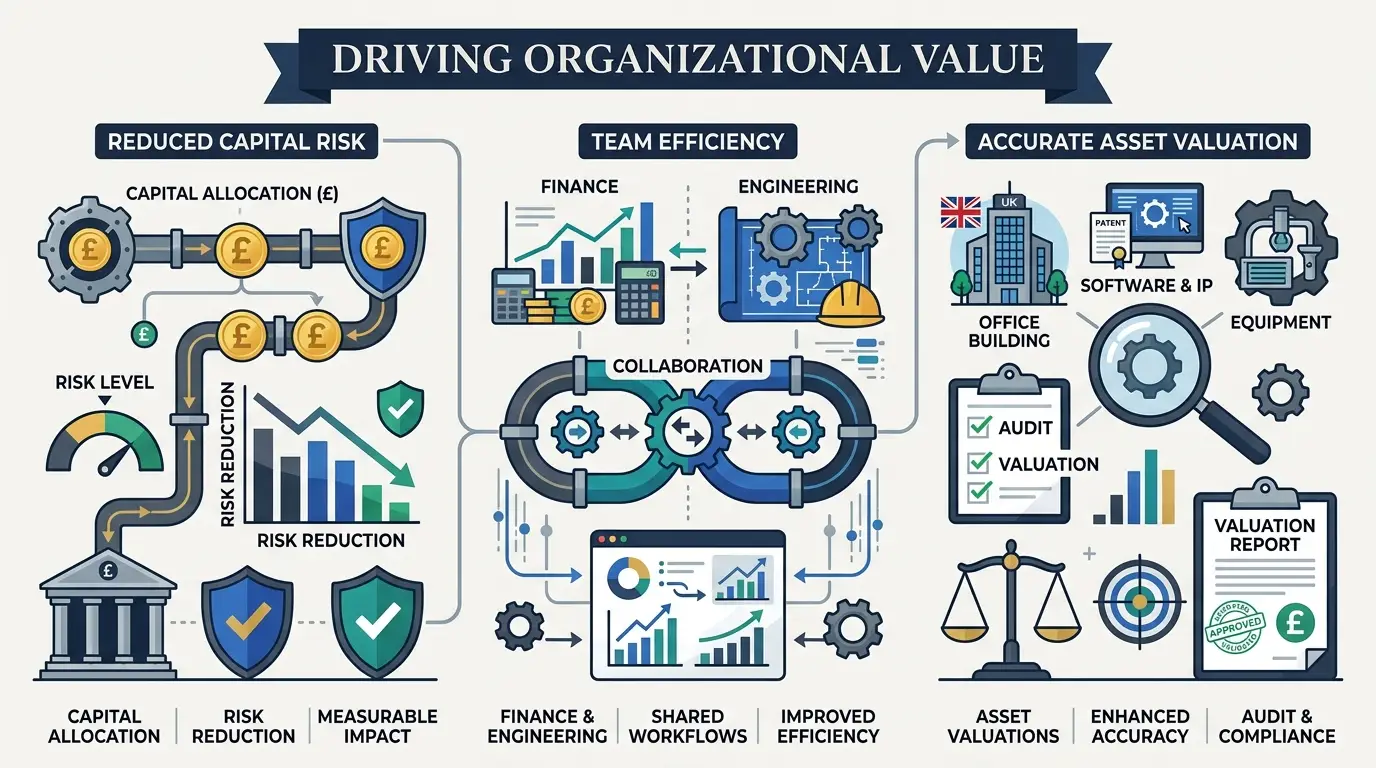
Implementing this training program across corporate finance, planning, and business development units generates immediate improvements in institutional decision-making.
Enhanced Financial Auditing Accuracy
Financial teams trained by Institute For Oil & Gas Training possess the technical capability to independently audit incoming reservoir production forecasts. This eliminates the risk of accepting over-optimistic decline parameters that artificially inflate net present values and asset purchase prices.
Improved Cross-Functional Collaboration
By standardizing technical vocabulary across departments, the course removes communication barriers between reservoir engineers and financial analysts. Finance professionals can engage in rigorous technical discussions, ask targeted questions regarding well performance history, and challenge line-item assumptions during annual budget reviews.
HR and Talent Pipeline Development
Human Resource directors and learning officers utilize this program to build clear career progression pathways within corporate finance departments. Training junior and mid-level analysts in technical decline curve auditing creates a resilient talent pipeline capable of stepping into senior asset management and corporate development roles.
Programs delivered by Institute For Oil & Gas Training ensure that technical skills translate directly into measurable workforce performance gains and defensive risk management for the enterprise.
How Does Course Enrollment Work?
Enrollment involves a streamlined three-step evaluation and onboarding process, requiring a foundational background in finance, accounting, or business analysis, followed by cohort placement and prerequisite preparation.
The program is structured for working professionals and corporate teams seeking immediate skill application.
Eligibility Requirements
Applicants should possess a working knowledge of corporate finance concepts, financial statement analysis, and basic Microsoft Excel modeling. Formal engineering background is not required; the curriculum is specifically designed to teach non-engineers how to interpret and evaluate technical reservoir data accurately.
Onboarding and Prerequisites
Once accepted, participants receive access to pre-course reading materials covering basic petroleum geology, fluid properties, and reservoir drive mechanisms. This foundational material ensures that all learners enter the live instruction sessions with a shared understanding of core industry terms.
Completion Certification
To earn the professional credential issued by Institute For Oil & Gas Training, participants must complete all module exercises, participate in live case study evaluations, and pass a final practical assessment involving the audit and financial modeling of an active well dataset.
To register your corporate team or secure an individual seat in the upcoming cohort, you can enroll in this program to access full curriculum details and scheduling options.
Frequently Asked Questions
What is oil and gas petroleum financial analysis?
Oil and gas petroleum financial analysis is the practice of evaluating upstream and midstream asset valuations, cash flow projections, and reserve economics to support capital allocation decisions. Through specialized corporate training programs, Institute For Oil & Gas Training equips finance teams with the analytical methods required to stress-test decline curves, assess economic limits, and audit technical engineering reports. This financial discipline helps energy organizations minimize capital risk and enhance portfolio profitability.
Why is petroleum financial analysis critical for energy investment decisions?
Accurate petroleum financial analysis bridges the gap between technical reservoir data and corporate financial modeling during asset acquisitions, divestitures, and debt financing. By enrolling in targeted instruction from Institute For Oil & Gas Training, professionals learn how to translate production rates and decline parameters into audited net present value calculations. This structured evaluation process prevents overestimating reserve valuations and ensures realistic return expectations for high-capital energy projects.
What core skills are covered in oil and gas petroleum financial analysis training?
A comprehensive course in Oil and Gas Petroleum Financial Analysis covers empirical decline curve models, type curve normalization, operating expense thresholds, and risk-adjusted cash flow forecasting. Participants trained by Institute For Oil & Gas Training gain practical experience in evaluating historical well performance, auditing empirical Arps equations, and calculating project economic limits using industry-standard spreadsheet models. These competencies enable financial analysts to perform robust due diligence across conventional and unconventional assets.
Who should undertake training in oil and gas petroleum financial analysis?
Training in Oil and Gas Petroleum Financial Analysis is designed for corporate finance specialists, investment bankers, portfolio managers, corporate planning teams, and HR professionals seeking structured capability development for their departments. The curriculum offered by Institute For Oil & Gas Training caters specifically to non-engineering professionals who require a deep, functional understanding of petroleum accounting and reservoir economics to evaluate upstream investment opportunities effectively.
How does oil and gas petroleum financial analysis improve M&A due diligence?
During corporate mergers and asset acquisitions, Oil and Gas Petroleum Financial Analysis allows deal teams to independently verify third-party reserve estimates and identify underlying operational risks before finalizing transaction terms. Professionals certified through Institute For Oil & Gas Training apply standardized diagnostic techniques to detect exaggerated initial production rates or aggressive decline assumptions. This rigorous auditing capability protects organizations from overpaying for producing wells or undeveloped acreage.
Related training courses
API RP 1188 Hazardous Liquid Pipeline Facilities Integrity Training Course
- Specialisation
- Oil & Gas Pipeline Integrity and Inspection
- Duration
- 5 days · 15 CPD hours
Corrosion Control in Petroleum Refineries Training Course
- Specialisation
- Oil & Gas Corrosion Management and Control
- Duration
- 5 days
Internal Audit, Risk Management and Compliance Training Course
- Specialisation
- Oil & Gas Petroleum Compliance, AML & Risks
- Duration
- 5 days · 15 CPD hours
More articles

How to Evaluate Production Forecasts and Decline Curves for Reliable Financial Analysis
Learn how to evaluate production forecasts and decline curves to improve financial modeling, risk assessments, and asset valuations in oil and gas.
Read article →
Why Production Forecasting and Decline Curve Analysis Matter in Oil and Gas Financial Planning
Discover why production forecasting and decline curve analysis drive oil and gas financial planning, workforce capability, and corporate capital allocation.
Read article →
Break Even Oil Price Analysis Under Fiscal Terms Training for Oil and Gas Finance Professionals
Master economic modeling and fiscal terms with the Break Even Oil Price Analysis Under Fiscal Terms Training Course. Enroll today.
Read article →