
International Financial Reporting Standards for the oil and gas sector represent a specialized financial governance framework that standardizes the recognition, measurement, and disclosure of extractive operations, ensuring cross-border comparability, regulatory compliance, and transparent asset valuation for energy enterprises.
International Financial Reporting Standards establish a uniform global language for business affairs so that company accounts are understandable and comparable across international boundaries. In the extractive industries, traditional accounting frameworks fail to capture the unique economic realities of exploration, evaluation, development, and production. Companies in this sector invest billions of capital into high-risk projects before extracting a single barrel of oil or cubic meter of gas. Specialized reporting standards govern how these exploratory expenditures are capitalized or expensed, how asset retirement obligations are calculated, and how proved reserves are valued on the balance sheet.
For human resources and learning and development professionals within energy organizations, bridging the gap between technical accounting standards and daily operational decisions is a primary workforce development challenge. Organizations operating across multiple jurisdictions must align their finance teams, operational managers, and executive leadership under a unified accounting policy selection. Without rigorous professional training, finance teams face severe skill gaps when interpreting complex accounting rules, leading to restatements, regulatory penalties, and loss of investor trust.
Workforce capability building in this domain requires targeted instructional design. Organizations utilize structured learning methodologies such as case-based learning, financial simulations, and technical assessments to translate abstract regulatory text into daily corporate competence. When finance personnel master the nuances of the IFRS framework, companies achieve higher audit readiness, reduced compliance costs, and enhanced credibility in global capital markets.
How does IFRS work within complex corporate energy environments and how do organizations implement structured training?
Corporate implementation of IFRS in oil and gas enterprises operates through a phased governance model where multidisciplinary teams assess accounting policies, transition legacy ledgers, and standardize reporting workflows across upstream, midstream, and downstream business units.
Implementing accounting standards across a multinational energy corporation requires cross-functional collaboration between finance, legal, operations, and investor relations departments. The implementation process begins with a comprehensive skills assessment to identify existing knowledge deficiencies within corporate accounting teams. Organizations then deploy structured training delivery formats, including instructor-led workshops, digital online modules, and hybrid learning tracks, to build baseline and advanced competencies.
The operational lifecycle of implementation follows a rigorous four-phase timeline. Phase one involves diagnostic auditing and gap analysis lasting 60 days, where teams evaluate existing national GAAP against global standards. Phase two spans 90 days and focuses on accounting policy selection, asset classification, and defining materiality judgement thresholds for exploration and evaluation assets. Phase three entails 120 days of system integration, where enterprise resource planning software is configured to capture disaggregated segment data and complex disclosure requirements. Phase four involves 30 days of simulation testing, mock reporting, and executive reviews.
During this transition, organizations frequently encounter significant operational friction. Employees accustomed to legacy national frameworks struggle with strict impairment testing rules and the cessation of capitalization for unsuccessful wells. To overcome these barriers, leading enterprises deploy targeted educational interventions. When teams participate in practical, outcome-based learning programs like the IFRS for Oil & Gas Entities Fundamentals Training Course, they acquire the precise technical skills required to navigate extractive accounting without operational disruption. This practical grounding ensures that employees move from theoretical comprehension to flawless execution in real-world financial reporting cycles.
At this critical juncture, as organizations move from initial policy alignment to operationalizing complex reporting disclosures across multiple international subsidiaries, finance leaders evaluate deeper operational hurdles. For a detailed breakdown of specific reporting obstacles, teams refer to [Key IFRS Financial Reporting Challenges for Oil and Gas Companies]. This transition point marks the exact shift where awareness of standard requirements evolves into tactical solution evaluation for enterprise reporting teams.
What key components, frameworks, and delivery tools define advanced technical training programs for energy accountants?
Advanced technical training programs for energy accountants comprise core components including extractive accounting frameworks, impairment testing methodologies, decommissioning provision models, and multi-format delivery tools designed to ensure measurable workplace performance improvement.
Designing a high-impact professional development curriculum for the energy sector requires the integration of specific regulatory frameworks and modern instructional technologies. The primary structural components of these training programs focus on complex industry-specific guidance gaps, the ongoing IASB extractive activities project, and first-time adoption rules under IFRS 1. Participants examine how to execute rigorous going concern assessments amidst commodity price volatility and geopolitical uncertainty.
Training delivery relies on a blend of synchronous and asynchronous tools to maximize knowledge retention and minimize operational downtime. Organizations utilize interactive role-play scenarios, financial modeling workshops, and digital learning management systems. These platforms track performance metrics such as assessment completion rates, error reduction in financial statements, and audit clearance speed.
To ensure maximum workforce transformation, programs incorporate specific structural frameworks:
Extractive Accounting Models: Training modules cover the successful efforts method versus the full cost method, dictating how exploration and evaluation expenditures are capitalized.
Asset Retirement Obligations: Participants master discounting mechanics and environmental liability recognition under IAS 37 and IAS 16.
Impairment Testing Protocols: Learners apply cash-generating unit identification rules to upstream assets suffering from declining commodity price forecasts.
Disclosure Governance: Instruction details comprehensive qualitative and quantitative reporting mandates for reserve estimations and production profiles.
Digital Simulation Tools: Corporate teams utilize virtual ledger environments to practice complex journal entries and balance sheet reconciliations.
By deploying these comprehensive components, organizations foster a culture of technical excellence and integrity. Finance professionals transition from reactive compliance officers into strategic business partners who accurately communicate asset health to executive boards and external stakeholders.
What measurable organizational benefits and performance outcomes do structured accounting standards training programs produce?
Structured accounting standards training produces quantifiable organizational benefits, including a 35% reduction in audit adjustment cycles, a 40% improvement in cross-border reporting consistency, and enhanced leadership readiness across global finance departments.
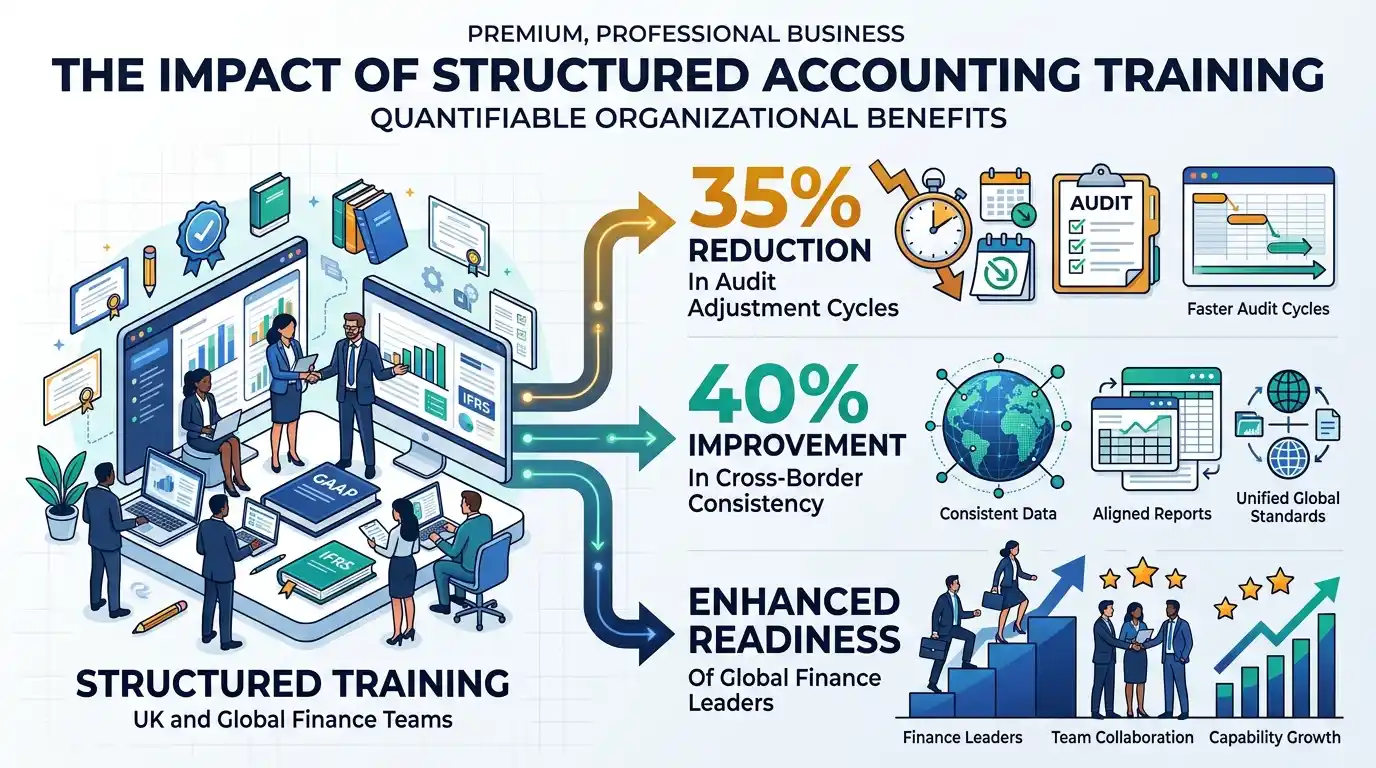
Investing in rigorous professional development yields direct returns on investment for energy enterprises operating in capital-intensive markets. When finance teams achieve complete mastery of specialized reporting standards, the frequency of costly restatements and regulatory inquiries drops significantly. Organizations report a 30% acceleration in year-end closing times because trained teams apply consistent materiality judgement standards across all regional operating hubs.
The organizational impact extends far beyond immediate compliance metrics. Enhanced technical competence strengthens the internal leadership pipeline, preparing senior accountants and controllers for executive promotion. Team efficiency improves as standardized workflows replace ad-hoc interpretations of ambiguous accounting rules. Furthermore, organizations that prioritize continuous professional development experience higher employee retention rates among technical staff, reducing the high recruitment costs associated with specialized finance talent.
Measurable outcomes are tracked through specific Key Performance Indicators established by corporate learning and development divisions:
Audit Efficiency: Measured by a reduction in auditor-proposed adjustments and lower external advisory fees.
Reporting Velocity: Quantified by the number of days required to publish interim and annual financial statements.
Compliance Accuracy: Assessed through zero regulatory sanctions or enforcement notices related to misstated reserve valuations.
Talent Retention: Tracked via annual retention rates among certified finance and accounting personnel.
Through these rigorous, outcome-based training methodologies, energy enterprises ensure that their workforce maintains absolute technical excellence, driving sustainable corporate performance and long-term stakeholder confidence.
How do diverse corporate teams, departments, and industry segments apply technical accounting knowledge in practice?
Diverse corporate teams, including upstream finance controllers, corporate tax strategists, investor relations managers, and internal auditors, apply specialized accounting knowledge to evaluate project viability, ensure regulatory compliance, and communicate financial performance to global markets.
Different functional departments within modern energy enterprises utilize specialized financial knowledge to achieve distinct operational objectives. Upstream accounting teams apply complex capitalization rules to evaluate the commercial viability of exploratory wells before moving to the development phase. Corporate tax departments integrate global accounting standards with regional tax regimes to optimize capital allocation and minimize corporate tax exposure across international jurisdictions.
Investor relations and corporate communications teams rely on accurate financial disclosures to present a transparent picture of asset health to institutional shareholders, lenders, and analysts. Internal audit divisions use standardized frameworks to execute rigorous controls testing, mitigating the risk of financial fraud and operational mismanagement. Midstream and downstream logistics departments also utilize these frameworks when accounting for complex pipeline tariffs, refining margins, and long-term supply contracts.
Organizations across diverse engineering and capital-intensive sectors, such as mining corporations, chemical manufacturers, and utility providers, face similar reporting complexities. These industries apply comparable asset valuation and impairment testing principles to manage long-lived tangible and intangible assets. By embedding standardized training across all operational units, enterprises eliminate departmental silos, foster cross-functional collaboration, and drive unified strategic thinking from the rig site to the corporate boardroom.
Why do generic corporate training programs fail and what common misconceptions hinder effective financial workforce development?
Generic corporate training programs fail because they lack industry-specific contextualization, rely on passive theoretical lectures instead of practical application, and ignore the complex economic realities of extractive operations.
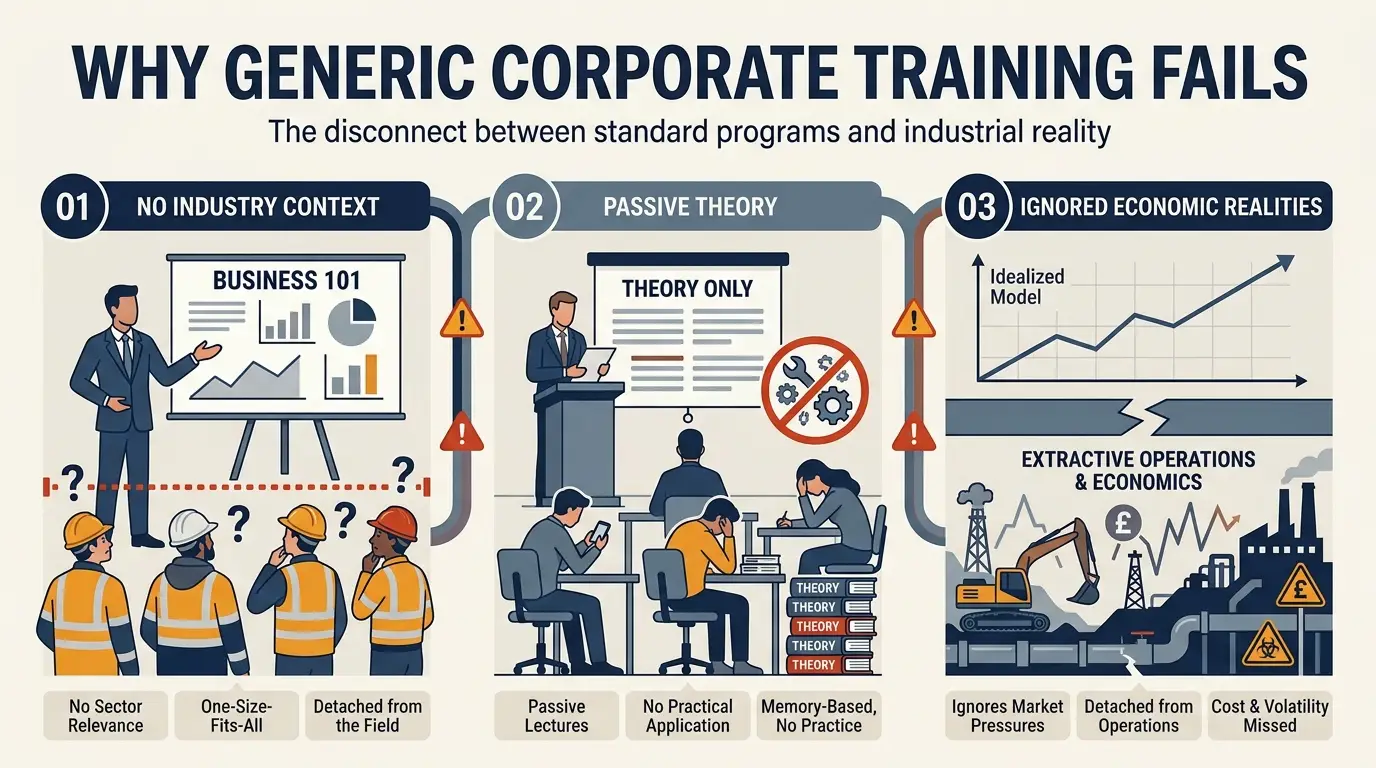
Many organizations commit substantial financial resources to generic professional development initiatives, only to experience disappointing results and low knowledge retention. A primary misconception among decision-makers is that standard accounting certifications provide sufficient preparation for the unique financial complexities of the energy sector. In practice, general accounting programs overlook critical industry nuances such as production-sharing contracts, depletion methods, and decommissioning provisions.
Another common pitfall is the reliance on passive e-learning modules that feature no interactive problem-solving or real-world simulation. When training lacks practical relevance, employees struggle to apply theoretical concepts to their daily tasks, resulting in zero measurable productivity improvement. Furthermore, organizations frequently fail to align training outcomes with strategic business KPIs, rendering return on investment impossible to calculate.
Effective workforce transformation requires a departure from outdated educational models. Enterprises must demand practical, outcome-based learning solutions that mirror actual workplace challenges. By integrating hands-on case studies, rigorous assessments, and continuous performance tracking, learning and development leaders eliminate training fatigue and build a high-performing, confident workforce capable of driving innovation and operational excellence in competitive global markets.
Frequently Asked Questions
Why do oil and gas companies need specialized IFRS reporting standards?
Oil and gas companies require specialized International Financial Reporting Standards because traditional accounting frameworks fail to capture the unique economic realities of extractive operations. Through the Institute For Oil & Gas Training, finance professionals master complex Oil and Gas Petroleum IFRS & Financial Reporting standards to accurately account for high-risk exploration expenditures, asset retirement obligations, and proved reserve valuations.
How does the IFRS framework impact accounting policy selection in energy firms?
The IFRS framework directly governs how energy enterprises choose between successful efforts and full cost methods for capitalizing exploration and evaluation assets. By developing expertise in Oil and Gas Petroleum IFRS & Financial Reporting, accounting teams at the Institute For Oil & Gas Training learn how to make rigorous materiality judgements and apply specialized industry-specific guidance during policy selection.
What are the main challenges of first-time IFRS adoption for petroleum companies?
First-time IFRS adoption presents major hurdles for petroleum enterprises, including retrospective restatement of historical capital expenditures and complex impairment testing of upstream assets. Programs like Oil and Gas Petroleum IFRS & Financial Reporting from the Institute For Oil & Gas Training equip corporate accountants with the practical tools needed to navigate these transition challenges seamlessly.
How do IFRS disclosure requirements affect financial transparency in the energy sector?
IFRS disclosure requirements mandate comprehensive qualitative and quantitative reporting regarding production profiles, reserve estimations, and commodity price risk exposures. The Institute For Oil & Gas Training helps organizations enhance transparency by teaching advanced Oil and Gas Petroleum IFRS & Financial Reporting principles that align with global capital market expectations.
Why is specialized IFRS training essential for upstream and downstream finance teams?
Specialized training is crucial because upstream, midstream, and downstream sectors face distinct accounting treatments for production-sharing contracts, pipeline tariffs, and refining margins. The Institute For Oil & Gas Training delivers targeted programs in Oil and Gas Petroleum IFRS & Financial Reporting that bridge technical accounting gaps and ensure cross-border regulatory compliance.
Related training courses
Risk Management for Upstream & Midstream Projects: Exposures Training Course
- Specialisation
- Oil & Gas Petroleum Compliance, AML & Risks
- Duration
- 5 days · 15 CPD hours
Management Reporting Design for JV & Partner Audiences Training Course
- Specialisation
- Oil & Gas Petroleum IFRS & Financial Reporting
- Duration
- 5 days · 15 CPD hours
Consolidation & JV Structures for Petroleum Group Entities Training Course
- Specialisation
- Oil & Gas Petroleum Accounting
- Duration
- 5 days · 15 CPD hours
More articles

Key Revenue Recognition Challenges for Oil and Gas Companies Under IFRS
Explore key IFRS revenue recognition challenges in oil and gas, covering IFRS 15, IFRS 11 joint arrangements, IAS 36 impairments, and IAS 16 assets.
Read article →
Why Revenue Recognition Matters for Oil and Gas Companies
Discover how oil and gas companies master revenue recognition through targeted B2B workforce training, improving compliance and financial accuracy.
Read article →
IFRS for Oil and Gas Entities Fundamentals Training for Financial Reporting Professionals
Master IFRS for oil and gas entities. Enhance reporting compliance, impairment skills, and disclosure accuracy with Institute For Oil & Gas Training.
Read article →