

Fiscal terms integration in break even oil price analysis evaluates how government take, taxes, royalties, and production sharing arrangements alter the minimum oil price required for upstream projects to cover all costs and achieve target investment returns.
Upstream petroleum projects operate under complex legal contracts. These contracts govern how project cash flows split between commercial investors and host governments. Simple pre-tax break-even calculations fail to reflect the true commercial viability of capital investments. Host government instruments extract revenue through fixed royalties, progressive tax regimes, bonuses, state participation rights, and production sharing mechanisms.
Organisations use fiscal terms integration to calculate the post-tax break-even oil price. This metric establishes the precise market oil price necessary to yield a net present value ($NPV$) of zero or meet internal hurdle rates. Corporate financial analysts evaluate host country contractual terms to determine how cost recovery ceilings and tax deduction schedules impact capital expenditure recovery timing.
In corporate decision-making environments, this analysis forms the primary foundation for capital allocation. Upstream operators review fiscal terms during asset acquisition, exploration bidding rounds, and field development planning. Miscalculating fiscal impacts results in capital deployment toward projects that show theoretical pre-tax profitability but deliver negative post-tax cash flows under volatile oil price conditions.
Professional development programs build employee competency in modelling these fiscal dynamics. Teams learn to structure petroleum economics models that adjust for country-specific fiscal frameworks, ensuring accurate project risk assessments and robust financial governance.
How Does Fiscal Terms Training Function in Upstream Organisations?
Fiscal terms training functions as a structured skill-building process that aligns cross-functional oil and gas teams on petroleum fiscal regimes, corporate financial modelling standards, price risk sensitivity testing, and strategic project assessment methods.
Organizations implement petroleum fiscal training through a 4-stage corporate learning workflow over 8 to 12 weeks:
Stage 1: Skill Gap Diagnostic
L&D professionals evaluate baseline financial competencies across exploration, engineering, and commercial departments. Diagnostic assessments identify gaps in contractual comprehension, tax modelling, and risk evaluation standards.
Stage 2: Technical Skill Workshops
Subject matter experts deliver 3-day intensive workshops covering concessionary systems, production sharing contracts ($PSCs$), and risk service agreements. Learners analyze real fiscal contracts from producing regions like North America, West Africa, the North Sea, and Southeast Asia.
Stage 3: Applied Scenario Modelling
Participants construct dynamic financial models using Microsoft Excel. Teams run cost escalation sensitivities, service cost inflation adjustments, and resilience testing against market price drops.
Stage 4: Enterprise Integration and Review
Organizations embed standard petroleum fiscal evaluation templates into corporate governance frameworks. Management audits project proposals 90 days post-training to verify accuracy in investment decision documentation.
Training delivery utilizes hybrid models combining self-paced online modules with interactive corporate workshops. Online components provide theoretical foundations in concessionary tax systems and production sharing arrangements. In-person or virtual instructor-led sessions focus on complex petroleum economic simulations, role-play contract negotiations, and peer-reviewed financial model audits.
Upstream enterprise teams evaluate project risk using quantitative frameworks. Training programs incorporate standardized project evaluation frameworks that guide analysts from initial revenue estimations to post-tax cash flow distribution modeling:
$$\text{Break-Even Price} = \frac{\text{CAPEX} + \text{OPEX} + \text{Government Royalty} + \text{Tax Liabilities}}{\text{Total Production Volume} \times (1 - \text{Government Take Share})}$$
Through hands-on application of these formulas, cross-functional teams learn how regressive tax systems increase project break-even thresholds relative to progressive tax structures during low-commodity-price periods.
What Components Form a Complete Petroleum Fiscal Evaluation Training Program?
A complete petroleum fiscal evaluation program comprises core financial modules, dynamic cash flow tools, contractual analysis frameworks, scenario analysis methodologies, and standardized competency assessment rubrics for energy professionals.
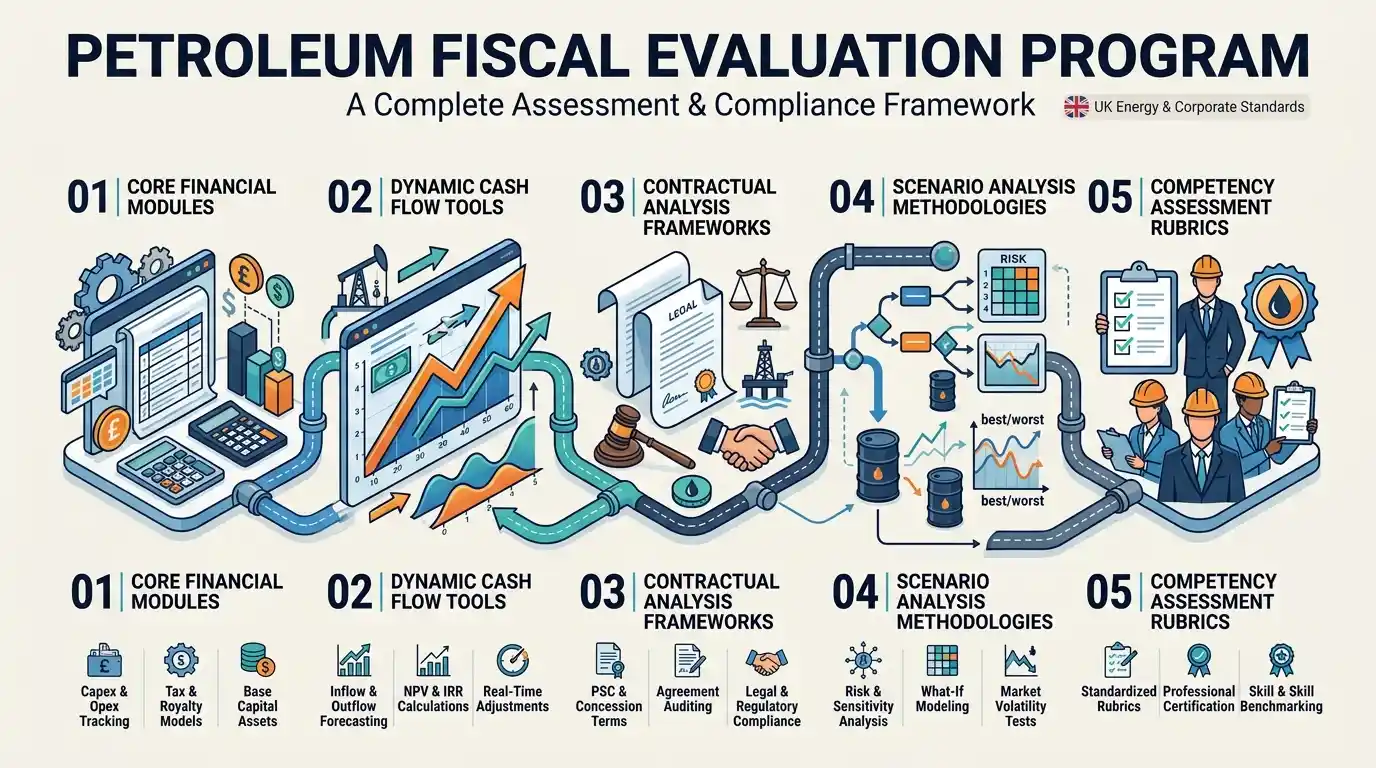
A robust corporate training program covers essential technical components to develop job-ready financial expertise across commercial and technical business units:
Petroleum Fiscal Regimes Architecture
Instruction covers concessionary royalty/tax systems, production sharing agreements, risk service contracts, and joint operating agreements. Analysts learn how state participation rights and signature bonuses impact initial capital requirements.
Cost Recovery and Tax Depreciation Mechanisms
Modules detail cost oil ceilings, ring-fencing provisions, capital allowance schedules, and unrecovered cost carry-forwards. Participants examine how cost escalation sensitivity alters cost recovery timelines under varying crude oil price scenarios.
Cash Flow Metrics and Capital Allocation Indices
Curriculum focuses on post-tax break-even calculations, corporate cash break-even points, dividend covering oil price requirements, and net present value neutrality thresholds. Learners evaluate how government take impact on break-even shifts capital deployment priorities.
Sensitivity and Resilience Testing
Teams build models incorporating service cost inflation, capital expenditure overruns, discount rate variances, and hedged versus unhedged price floor scenarios. Analysts practice stress-testing field economics against historical price crashes.
Training Component | Focus Area | Technical Deliverable | Enterprise Outcome |
Fiscal System Design | PSCs vs Concessions | Fiscal contract mapping matrix | Enhanced contractual compliance |
Cost Oil Mechanics | Recovery ceilings & ring-fencing | Capital recovery schedule model | Accurate capital exposure tracking |
Tax & Royalty Dynamics | Progressive vs regressive taxes | Government take calculation tool | Precise post-tax break-even figures |
Price Risk Analysis | Hedging & floor price protection | Price sensitivity dashboard | Reduced portfolio downside risk |
Corporate learning frameworks incorporate dynamic financial modelling software, petroleum industry case studies, and practical project reviews. Learners work with anonymized upstream data sets to replicate real-world asset evaluations, ensuring immediate transfer of skills to daily operations.
Why Do Petroleum Fiscal Terms Directly Alter Upstream Project Economics?
Petroleum fiscal terms alter project economics because host government fiscal instruments determine the proportion of project revenue allocated to cost recovery, state take, tax obligations, and commercial net cash flows.
Fiscal terms create significant differences between pre-tax and post-tax asset economics. In concessionary regimes, fixed royalties apply to gross production regardless of prevailing oil prices or operational expenditure levels. Fixed royalties elevate the baseline break-even oil price by treating government take as an unyielding operating cost. Projects subject to 12% to 18% gross royalties require substantially higher market crude prices to achieve cash neutrality than projects operating under tax-only systems.
Production sharing contracts apply cost oil ceilings, frequently limiting annual cost recovery to 40% to 60% of gross production revenue. When market oil prices fall, the monetary value of production within the cost ceiling decreases. Upstream operators cannot fully recover operational expenditures and capital investments within the planned timeframe. The unrecovered costs carry forward into subsequent production years, extending project payback timelines and elevating the post-tax break-even oil price.
Government take adjustments dynamically change under progressive tax structures like petroleum revenue taxes or price-tier windfall profit levies. Highly progressive fiscal terms capture higher revenue shares during high crude oil price cycles while providing partial tax relief during low-price environments. Regressive fiscal terms maintain heavy royalty or tax burdens despite falling oil prices, raising project downside exposure.
Financial analysts must evaluate How to Assess the Impact of Petroleum Fiscal Terms on Break Even Oil Prices to quantify how specific contractual clauses change corporate investment thresholds. Understanding these dynamics enables commercial teams to accurately model government take impact on break-even thresholds and structure risk mitigation strategies during initial contract negotiations.
How Do Enterprise Teams Apply Break Even Analysis in Strategic Decision-Making?
Enterprise teams apply break even analysis to allocate capital, negotiate petroleum contracts, screen asset acquisitions, manage commodity price risk, and protect corporate dividend distribution capacity across multi-asset portfolios.
Upstream energy corporations utilize post-tax break-even metrics across four critical operational functions:
Portfolio Capital Allocation
Executive committees compare the corporate cash break-even of competing assets across global basins. Capital flows toward assets maintaining low break-even thresholds under stringent fiscal terms, ensuring corporate resilience during sustained market downturns.
Asset Mergers, Acquisitions, and Bidding Round Evaluations
Commercial teams analyze target assets using integrated fiscal models. Analysts establish maximum bid valuations by calculating how local tax rules, abandonment liabilities, and cost recovery carry-forwards alter long-term cash flow generation.
Price Risk Management and Hedging Strategies
Treasury departments compare hedged versus unhedged price floor scenarios against operational cash flow commitments. Analysts evaluate hedge ratios required to protect debt service capabilities and capital expenditure programs when spot prices drop below asset break-even points.
Corporate Cash Flow and Dividend Protection
Finance leaders compute the exact dividend covering oil price for the corporate entity. This calculation aggregates field-level operating costs, country-specific fiscal obligations, corporate overheads, debt servicing costs, and planned shareholder payouts into a single enterprise-level price floor metric.
Structured training through the Break-even Oil Price Analysis Under Fiscal Terms Training Course prepares technical and financial professionals to execute these calculations with precision. Cross-functional teams learn to align engineering field production profiles with complex contractual mechanisms, supporting accurate long-term corporate strategic planning.
What Measurable Business Outcomes Does Petroleum Fiscal Training Produce?
Petroleum fiscal training produces measurable business outcomes, including reduced financial modelling error rates, improved capital allocation accuracy, faster project evaluation cycles, enhanced risk mitigation, and increased asset portfolio profitability.
Organizations that invest in technical training for commercial, engineering, and finance professionals observe quantifiable improvements across financial and operational key performance indicators ($KPIs$):
Financial Modelling Accuracy
Upstream operators achieve up to an 85% reduction in fiscal calculation errors in project proposal documents. Standardized training eliminates incorrect tax depreciation assumptions, ring-fencing errors, and misapplied royalty formulas in cash flow projections.
Capital Allocation Efficiency
Corporate planning teams optimize capital deployment, improving average portfolio internal rate of return ($IRR$) by 8% to 12%. Clear comprehension of post-tax metrics prevents over-investment in high-royalty assets that show false economic viability on a pre-tax basis.
Project Evaluation Velocity
Cross-functional teams reduce asset screening and field development plan review times by 30% to 40%. Shared technical terminology and unified economic evaluation frameworks eliminate communication friction between petroleum engineers and commercial analysts.
Downside Risk Protection
Energy firms improve resilience testing procedures against market volatility. Organizations systematically test portfolios against service cost inflation, cost escalation sensitivity, and sudden crude price drops, ensuring assets maintain positive net cash flows during market downturns.
By establishing clear competency benchmarks, enterprise learning initiatives convert complex technical concepts into standardized organizational capabilities that protect capital and enhance shareholder value.
What Challenges and Misconceptions Surround Petroleum Fiscal Terms Analysis?
Petroleum fiscal analysis faces challenges from misapplying pre-tax metrics, neglecting non-tax fiscal burdens, utilizing static financial models, and delivering isolated technical training without cross-functional integration.
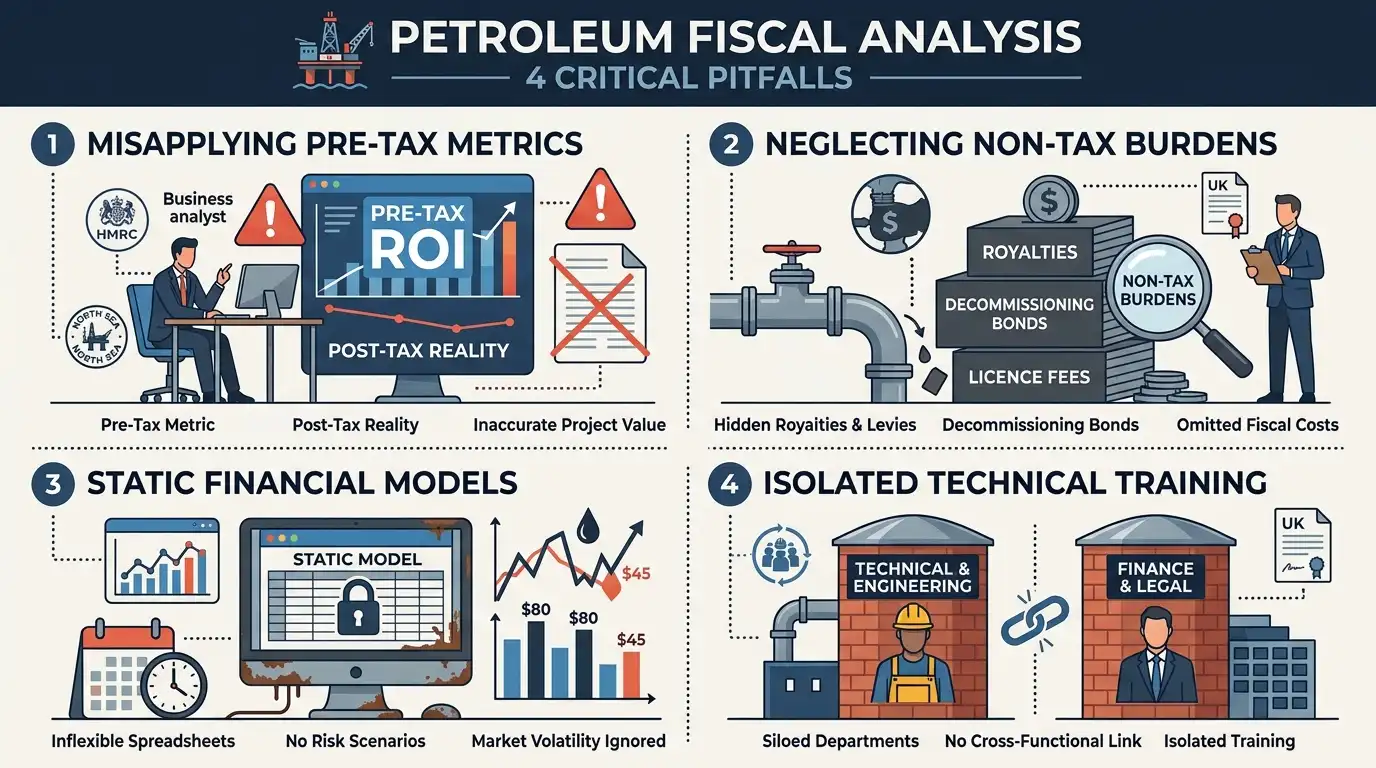
Upstream organizations frequently encounter structural errors when evaluating asset economics under complex government contracts:
Relying on Pre-Tax Break-Even Metrics
A common industry mistake involves using pre-tax operational break-even prices to screen capital projects. Pre-tax calculations ignore royalties, profit oil splits, and state participation costs. This oversimplification leads to underestimating real project price floors by $10 to $25 per barrel.
Treating Government Take as Static
Unskilled analysts often treat host country tax regimes as fixed percentages across all price environments. Real-world contracts contain sliding-scale royalties, progressive tax brackets, and price-sensitive profit oil splits. Static economic models fail to forecast net cash flows accurately when crude prices fluctuate significantly.
Ignoring Non-Tax Fiscal Burdens
Evaluations frequently overlook local content requirements, mandatory host government infrastructure carry obligations, signature bonuses, and de-commissioning fund contributions. These non-tax contractual terms increase upfront capital expenditure and elevate the effective break-even price.
Delivering Isolated Functional Training
Training petroleum engineers separately from commercial analysts creates organizational silos. Technical personnel design field development plans without understanding how cost recovery ceilings restrict capital recovery, while financial teams build economic models that neglect physical reservoir production constraints.
Effective workforce development programs resolve these issues by integrating petroleum engineering, tax accounting, and commercial strategy into a unified, case-based learning framework.
How Should Organizations Implement Fiscal Analysis Training for Maximum Impact?
Organizations should implement fiscal analysis training through a phased execution strategy involving skill gap audits, customized case studies, cross-functional team workshops, and ongoing post-training economic governance audits.
To maximize returns on corporate training investments, business leaders, HR managers, and L&D professionals should execute a structured 5-step implementation roadmap:
Step 1: Conduct a Technical Skill Gap Diagnostic
Audit existing project evaluation templates and financial models across exploration, development, and finance teams. Identify specific knowledge gaps in local fiscal regime mechanics, tax calculations, and price risk modeling.
Step 2: Develop Customized Learning Materials
Utilize actual or peer-group asset data, local contract templates, and regional fiscal regimes to build relevant learning assets. Replace generic finance exercises with real-world upstream project scenarios from industries like offshore energy, unconventional resource development, and LNG infrastructure.
Step 3: Execute Cross-Functional Team Workshops
Enroll mixed cohorts comprising reservoir engineers, geoscientists, commercial managers, tax accountants, and finance professionals. Utilize case-based learning, dynamic simulations, and peer-led model audits to encourage cross-departmental collaboration.
Step 4: Standardize Corporate Evaluation Tools
Provide participants with standardized Excel financial modeling templates, standardized cash flow reporting formats, and guidelines for resilience testing against cost escalation sensitivity. Ensure all business units adopt uniform economic evaluation methodologies.
Step 5: Establish Post-Training Governance Audits
Evaluate project proposals submitted 60, 90, and 180 days after training completion. Measure model accuracy, adherence to post-tax break-even reporting guidelines, and reduction in governance review cycle times to confirm long-term skill retention.
Organizations that implement structured, industry-aligned training programs build resilient commercial capabilities, optimize capital allocation strategies, and maintain strong corporate cash flows across changing market cycles.
Frequently Asked Questions
What is oil and gas petroleum financial analysis?
Oil and gas petroleum financial analysis evaluates the economic viability, cash flow generation, and risk profile of upstream energy projects. At the Institute For Oil & Gas Training, professionals examine project economics by integrating fiscal regimes, operating expenses, capital expenditures, and commodity price sensitivities. This analytical framework enables corporate decision-makers to determine post-tax break-even oil prices and allocate capital effectively.
How do petroleum fiscal terms affect financial analysis in the energy sector?
Petroleum fiscal terms govern how revenues and profits are shared between host governments and commercial operators through royalties, production sharing arrangements, and tax liabilities. Accurate financial modelling must account for these terms to accurately calculate net present value ($NPV$) and corporate cash break-even levels. Programs at the Institute For Oil & Gas Training build competency in assessing how dynamic fiscal structures alter asset risk and investment returns.
What key metrics are used in petroleum financial modelling and evaluation?
Standard metrics in petroleum financial evaluation include net present value ($NPV$), internal rate of return ($IRR$), post-tax break-even price, cost oil recovery limits, and government take share. Analyzing these indicators helps upstream companies compare competing international projects and protect corporate dividend capacity. Training provided by the Institute For Oil & Gas Training equips finance and engineering teams with standardized methodologies to model these critical key performance indicators ($KPIs$).
Why is post-tax break-even oil price analysis critical for corporate planning?
Post-tax break-even oil price analysis establishes the exact market crude price required for a project to cover all operating costs, capital investments, host government taxes, and royalties. Pre-tax break-even figures frequently underestimate downside risk by ignoring mandatory fiscal obligations. The Institute For Oil & Gas Training instructs commercial teams on incorporating country-specific tax rules to evaluate true portfolio resilience during market price downturns.
Who should take a corporate training course in oil and gas financial analysis?
Oil and gas petroleum financial analysis training benefits petroleum engineers, commercial analysts, finance managers, business development leaders, and L&D professionals in the energy sector. Developing these financial capabilities across technical and commercial teams eliminates cross-departmental silos and improves project screening accuracy. The Institute For Oil & Gas Training delivers practical, case-based instruction designed to strengthen strategic decision-making and project evaluation velocity across energy enterprises.
Related training courses
Petroleum Refinery Processes & Operations Training Course
- Specialisation
- Oil & Gas Process Engineering and Operations
- Duration
- 5 days · 15 CPD hours
API RP 1188 Hazardous Liquid Pipeline Facilities Integrity Training Course
- Specialisation
- Oil & Gas Pipeline Integrity and Inspection
- Duration
- 5 days · 15 CPD hours
Corrosion Control in Petroleum Refineries Training Course
- Specialisation
- Oil & Gas Corrosion Management and Control
- Duration
- 5 days
More articles

Production Forecasting and Decline Curve Analysis Training for Oil and Gas Finance Professionals
Master production forecasting and decline curve analysis. Evaluate reservoir performance for oil and gas financial planning.
Read article →
How to Evaluate Production Forecasts and Decline Curves for Reliable Financial Analysis
Learn how to evaluate production forecasts and decline curves to improve financial modeling, risk assessments, and asset valuations in oil and gas.
Read article →
Why Production Forecasting and Decline Curve Analysis Matter in Oil and Gas Financial Planning
Discover why production forecasting and decline curve analysis drive oil and gas financial planning, workforce capability, and corporate capital allocation.
Read article →