
Petroleum fraud investigation is a specialized financial, internal audit, and legal examination process that detects, isolates, and measures illicit monetary losses, inventory discrepancies, and regulatory non-compliance within upstream, midstream, and downstream energy supply chains.
Organizations operating within the global energy sector face multi-layered financial threats originating from complex vendor networks, vast geographical assets, and high-volume commodity transactions. Corporate leadership teams and internal audit committees deploy rigorous diagnostic methods to intercept financial leakage before operational stability collapses. This investigative discipline requires finance professionals to cross-reference physical production metrics, meter ticket readings, and refinery throughput logs against general ledger entries and accounts payable disbursements. Uncovering illicit schemes protects profit margins, maintains shareholder confidence, and preserves institutional integrity across international operations.
Workforce capability gaps often hinder early detection because general accounting personnel lack specialized instruction in industry-specific commodities tracking. To bridge this competency gap, corporate human resources and learning and development departments establish structured capability frameworks. Personnel participate in blended learning programs combining intensive classroom workshops, asynchronous online modules, and live simulation labs. Training curricula focus heavily on identifying subtle transactional anomalies, such as inventory shrinkage, phantom deliveries, and suspicious pricing variances across upstream exploration blocks and downstream distribution terminals.
Measurable outcomes drive continuous improvement in corporate anti-fraud frameworks. Organizations utilizing comprehensive professional development programs report a 40% reduction in time-to-detection for unauthorized transactions and a 25% decrease in recurring vendor payment errors within the first fiscal year. Human resource leaders track performance metrics through post-training diagnostic evaluations, qualitative workplace assessments, and quarterly audit remediation speed benchmarks. These initiatives cultivate an ethical corporate culture anchored in operational excellence, rigorous accountability, and strict compliance with global anti-money laundering legislation.
How do organizations implement petroleum fraud detection training across internal audit and finance teams?
Organizations implement petroleum fraud detection training by conducting baseline competency assessments, deploying multi-tier instructional roadmaps, integrating case-based simulations, and evaluating post-training audit performance against established corporate risk benchmarks.
Enterprise deployment begins with a comprehensive skills audit conducted by human resource directors and chief audit executives. This diagnostic phase identifies knowledge deficits across finance, procurement, and internal audit divisions, ensuring customized learning pathways target specific vulnerabilities. L&D professionals curate hybrid learning journeys that merge self-paced digital modules with intensive instructor-led workshops and peer-to-peer role-playing sessions. Participants engage directly with realistic data sets derived from historical industry cases, analyzing complex supply chain anomalies and untangling shell company networks.
Instructional frameworks incorporate immersive learning methodologies, including interactive group simulations, scenario-based assessments, and root-cause analysis labs. Teams evaluate sophisticated deceptive practices, such as split purchase orders designed to bypass internal authorization thresholds and unjustified change orders that inflate project engineering costs. When evaluating complex transactional webs, specialists frequently encounter schemes like bid rigging among supposedly competing engineering contractors, where participants coordinate tender submissions to artificially inflate capital expenditure budgets. Another persistent vulnerability involves collusive tendering, where internal procurement officers share proprietary bidding limits with preferred suppliers to secure illegal kickbacks.
Corporate leadership evaluates the return on investment through clear operational metrics rather than subjective participant satisfaction scores. Key performance indicators include the frequency of self-reported control failures, the speed of internal audit cycle closures, and the financial recovery rate of misallocated capital. Workforce transformation initiatives rely on sustained collaboration between compliance officers, data analysts, and executive leadership to embed anti-fraud behaviors into daily workflows. Organizations seeking deeper operational insights often transition personnel from foundational awareness courses to advanced frameworks such as the Contract Fraud & Procurement Irregularities in Tendering Training Course, where teams master sophisticated investigation protocols and evidentiary documentation standards.
What key components and methodologies comprise an effective anti-fraud workforce development program?
An effective anti-fraud workforce development program comprises forensic accounting frameworks, automated data analytics tools, procurement control components, and practical skill development formats tailored for multidisciplinary energy sector teams.
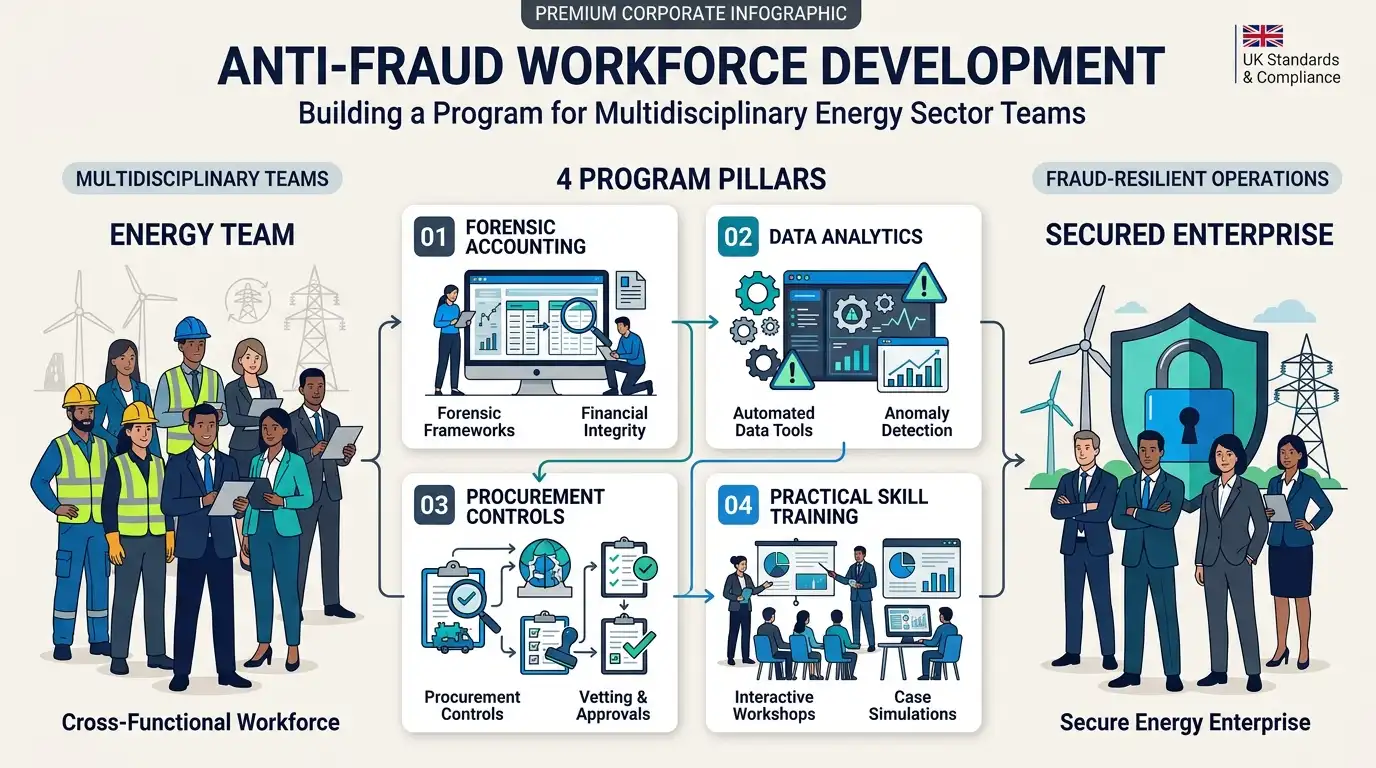
Designing a robust capability framework requires integrating technical accounting standards with investigative interviewing techniques and digital forensics tools. Learning programs utilize case-based learning, structured role play, and quantitative diagnostic assessments to evaluate employee comprehension. Training cohorts examine classic red flags of supply chain corruption, including kickbacks and bribery disguised as consulting fees or technical advisory services. Participants also investigate complex governance failures, such as an undisclosed conflict of interest where procurement managers award lucrative pipeline maintenance contracts to family-owned entities without competitive bidding.
Instructional modules address administrative loopholes exploited by fraudulent actors within large-scale capital projects. Auditors learn to identify split purchase orders utilized by rogue personnel to circumvent mandatory dual-authorization controls and supervisory approval limits. Technical teams examine vulnerabilities surrounding unjustified change orders on engineering, procurement, and construction contracts, where contractors artificially inflate material and labor expenses after winning competitive tenders. Furthermore, programs train inventory controllers to spot cost inflation schemes embedded within equipment lease agreements and logistics billing statements.
Operationalizing these concepts requires mastering advanced auditing techniques that uncover hidden liabilities. Investigators analyze logistics schedules to detect phantom deliveries where crude oil or refined products are billed to operating accounts without physical movement across custody transfer meters. Finance teams scrutinize vendor master files to eradicate supplier favouritism, analyzing invoice approval velocities and payment clustering patterns. These technical competencies form the foundation of internal control systems within industries like oil and gas exploration, maritime logistics, power generation, and heavy manufacturing.
What organizational benefits and performance outcomes emerge from structured anti-fraud training investments?
Structured anti-fraud training investments produce measurable organizational benefits, including accelerated audit completion times, reduced financial leakage from procurement fraud, enhanced cross-departmental collaboration, and stronger regulatory compliance postures.
Deploying targeted professional development initiatives transforms organizational risk profiles by equipping employees with proactive detection capabilities. When finance, legal, and internal audit teams train together, communication silos dissolve, resulting in a 35% improvement in cross-departmental incident escalation speeds. Team leaders observe heightened critical thinking and strategic problem-solving during routine ledger reviews and supplier audits. Workforce retention rates among mid-level financial analysts increase by 18% following structured capability building, as employees recognize institutional commitment to professional growth and career advancement.
Organizations measure the direct impact of training through rigorous key performance indicators tied to corporate governance and financial performance. Quantitative tracking reveals a 50% decrease in undetected billing discrepancies and a significant reduction in external forensic investigation expenses. Leadership pipelines strengthen as high-performing auditors and finance specialists transition into senior compliance and risk management roles. These outcomes validate the strategic importance of continuous workforce education in safeguarding corporate assets against sophisticated financial crimes.
Corporate governance structures benefit from enhanced reporting clarity, enabling executives to present transparent financial positions to institutional investors and regulatory bodies. By embedding principles of integrity, accountability, and technical excellence into daily operations, companies protect their market capitalization and brand reputation. When organizations experience seamless alignment between training investments and risk management outcomes, they establish a sustainable competitive advantage within highly regulated global markets.
Which corporate departments, management roles, and industrial sectors utilize petroleum fraud detection methodologies?
Petroleum fraud detection methodologies are utilized across corporate internal audit departments, forensic accounting units, procurement divisions, and executive leadership teams operating within energy, maritime, chemical, and heavy manufacturing sectors.
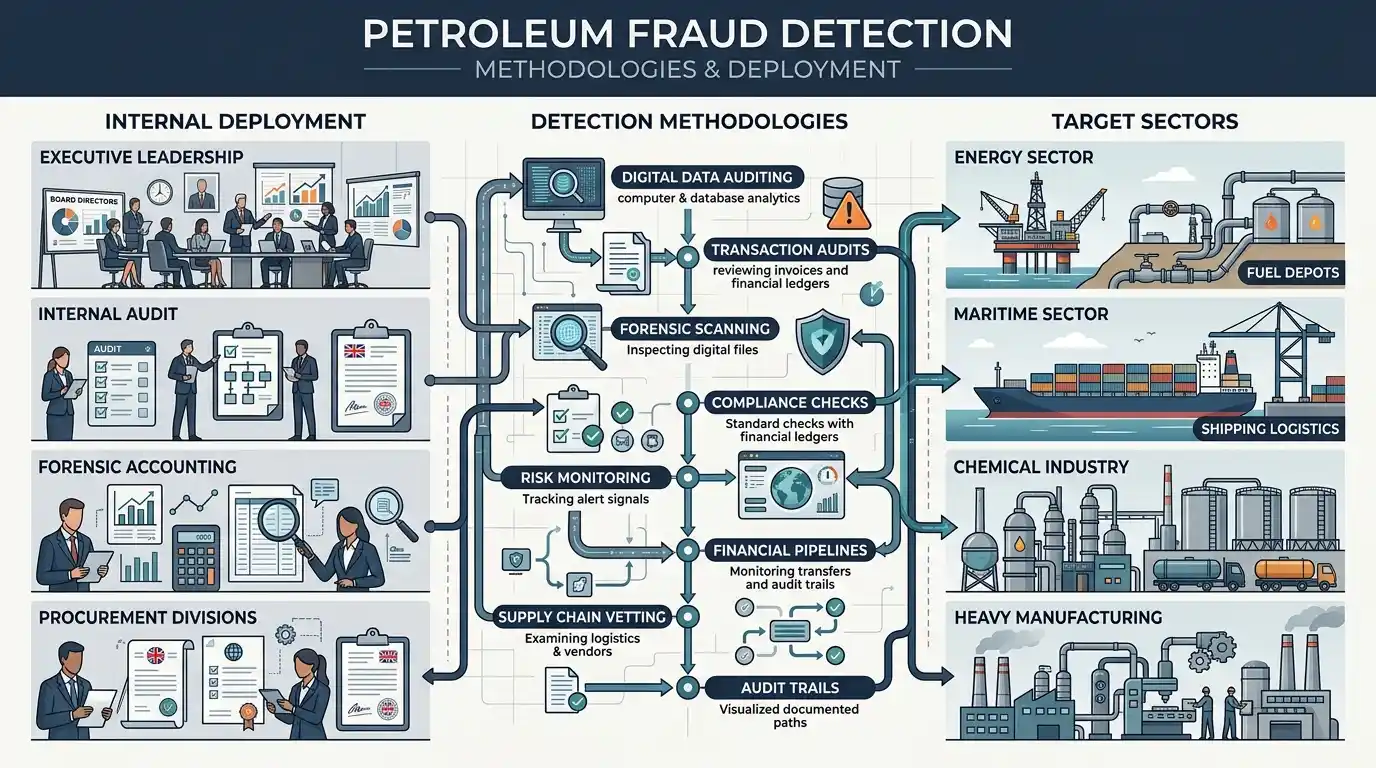
Enterprise deployment of financial investigative frameworks involves distinct responsibilities across multiple organizational tiers. Chief financial officers, internal audit directors, and compliance officers rely on accurate data analytics to evaluate enterprise risk exposure. Procurement managers and contract administrators utilize detection protocols to vet vendor credentials, analyze pricing benchmarks, and monitor tender execution phases. Mid-level supervisors and operational engineers participate in educational programs to recognize physical anomalies that signal administrative malfeasance, bridging the gap between field operations and corporate headquarters.
Sector-specific applications extend far beyond upstream exploration and production companies. Midstream pipeline operators, downstream refining enterprises, liquefied natural gas terminals, and international commodity trading houses implement these analytical frameworks to protect complex supply chains. In these environments, even minor discrepancies in volume accounting or transport billing compound rapidly into multimillion-dollar financial losses. Organizations operating in related heavy industries, such as petrochemical manufacturing, international shipping, and commercial mining, adopt parallel detection models to secure their procurement pipelines.
Cross-functional alignment ensures that every department contributes to a unified defense against financial crime. Human resource managers collaborate with business unit leaders to design continuous professional development pathways that address emerging regulatory requirements and technological advancements in fraud schemes. By embedding specialized investigative training into corporate academies, organizations foster a resilient workforce capable of maintaining operational integrity across global jurisdictions.
What common problems and misconceptions hinder corporate anti-fraud training initiatives?
Common problems hindering corporate anti-fraud training initiatives include reliance on generic compliance modules, lack of measurable performance metrics, inadequate reinforcement of practical skills, and failure to align programs with real-world industry risks.
Many organizations struggle with low training efficacy because human resource departments deploy generic, one-size-fits-all compliance videos that fail to address the specific financial mechanisms of energy sector fraud. Employees frequently view these passive modules as check-the-box exercises rather than vital professional development opportunities. Another widespread misconception assumes that financial fraud is exclusively an external threat, leading companies to neglect internal collusion risks between procurement officers and third-party vendors. Furthermore, organizations often neglect post-training reinforcement, resulting in rapid knowledge decay and zero behavioral change in daily operational workflows.
To eliminate these inefficiencies, learning and development leaders must replace abstract lectures with active learning methodologies, such as [Insert Link to MOFU Article] to guide teams from initial awareness into deep forensic evaluation. Training programs must incorporate localized case studies, realistic transactional datasets, and interactive simulations that mirror actual corporate investigations. Organizations that tie training completion to verifiable audit performance metrics and continuous professional certification achieve superior workforce transformation results. Prioritizing practical application, cross-functional collaboration, and measurable business outcomes ensures that anti-fraud investments deliver enduring value for the enterprise.
Frequently Asked Questions
How do finance teams detect petroleum fraud in supply chains?
Finance teams detect petroleum fraud by cross-referencing physical production metrics, meter ticket readings, and refinery throughput logs against accounts payable disbursements and general ledger entries. Utilizing specialized Oil and Gas Petroleum Compliance, AML & Risks frameworks provided by the Institute For Oil & Gas Training, analysts identify transactional anomalies such as phantom deliveries and invoice discrepancies. These rigorous investigative procedures prevent substantial monetary losses across upstream and downstream energy operations.
What are the primary indicators of procurement irregularities in the energy sector?
Primary indicators of procurement irregularities include split purchase orders designed to bypass authorization thresholds, unjustified engineering change orders, and suspicious pricing variances among competing vendors. Internal audit professionals trained through the Institute For Oil & Gas Training recognize red flags like collusive tendering and hidden conflicts of interest during routine ledger reviews. Spotting these warning signs early safeguards corporate capital project budgets and maintains strict regulatory compliance.
Why is anti-money laundering training critical for corporate internal auditors?
Anti-money laundering training equips internal auditors with the technical competencies required to trace illicit financial flows, identify shell company networks, and uncover hidden vendor kickbacks. Programs offered by the Institute For Oil & Gas Training bridge industry-specific knowledge gaps through case-based learning and forensic accounting methodologies. This specialized instruction enables finance personnel to mitigate regulatory penalties and strengthen organizational governance across global energy markets.
What role do internal audit departments play in petroleum compliance monitoring?
Internal audit departments act as the primary defense against financial leakage by reviewing vendor master files, monitoring invoice approval velocities, and evaluating procurement controls. Through structured capability building from the Institute For Oil & Gas Training, audit professionals master advanced analytics tools to detect supplier favouritism and cost inflation. These proactive monitoring activities ensure transparent financial reporting and protect institutional integrity for energy corporations.
How do organizations measure the return on investment for anti-fraud training?
Organizations measure the return on investment for anti-fraud training by tracking key performance indicators such as reduced audit cycle times, lower forensic investigation expenses, and decreased payment error rates. Workforce transformation initiatives from the Institute For Oil & Gas Training produce measurable operational improvements, including accelerated incident escalation speeds and higher anomaly detection rates. These quantitative metrics validate the long-term financial impact of continuous professional development in corporate risk management.
Related training courses
Management Reporting Design for JV & Partner Audiences Training Course
- Specialisation
- Oil & Gas Petroleum IFRS & Financial Reporting
- Duration
- 5 days · 15 CPD hours
Consolidation & JV Structures for Petroleum Group Entities Training Course
- Specialisation
- Oil & Gas Petroleum Accounting
- Duration
- 5 days · 15 CPD hours
Consolidation & JV Structures for Multi-Country Groups Training Course
- Specialisation
- Oil & Gas Petroleum Accounting
- Duration
- 5 days · 15 CPD hours
More articles

Specialist Fraud Risk Training for Petroleum Finance, Audit and Compliance Professionals
Master petroleum fraud detection, forensic accounting, and compliance risk mitigation with expert training for finance and audit professionals.
Read article →
Investigating Suspicious Petroleum Transactions Through Forensic Accounting and AML Procedures
Discover how forensic accounting and AML procedures detect bid rigging, kickbacks, split purchase orders, and cost inflation in petroleum transactions.
Read article →
Fraud Risks in Petroleum Operations: What to Look for in Specialist Professional Training
Master petroleum financial crime detection with the Institute For Oil & Gas Training. Enroll in our specialized AML and crude trading compliance course.
Read article →