
Forensic accounting frameworks detect irregularities in petroleum transactions by reconciling physical volume movements with financial ledgers, isolating inventory variances, and cross-referencing complex supply chain invoices against benchmark market indices. These analytical mechanisms expose hidden margin manipulation and unearth anomalous ledger entries within complex corporate structures.
Petroleum accounting involves high-value multi-tier transactions spanning exploration, production, refining, and distribution. Internal audit and finance teams face unique challenges due to volatile commodity pricing, intricate joint venture billing arrangements, and multi-jurisdictional trade routes. When organizations detect early indicators of financial discrepancies, they rely on structured investigative methods rather than superficial audits. Readers seeking a foundational overview of foundational detection metrics should review What Finance and Internal Audit Teams Examine When Petroleum Fraud Is Suspected. That resource details baseline warning signs before moving into rigorous investigative frameworks.
Examiners deploy three-way matching systems to verify that physical bill-of-lading quantities correspond exactly with refinery intake logs and accounts payable disbursements. Discrepancies between physical metering data and financial records highlight potential leakage points. For example, crude oil pipeline transport contracts often involve volumetric shrinkage allowances. Forensic accountants audit these shrinkage allowances against historical engineering benchmarks to ensure suppliers do not exploit contractual tolerances to conceal diversion or theft.
Data analytics engines process millions of journal entries to identify suspicious posting patterns. Investigators flag manual journal entries posted outside standard operational hours, postings executed by unauthorized personnel, and transactions routed through suspense accounts without accompanying business justifications. Furthermore, Benford's Law analyses are applied to accounts payable ledgers to detect artificially generated invoice amounts designed to bypass internal authorization thresholds.
What Methods Identify Bid Rigging and Collusive Tendering in Upstream Procurement?
Bid rigging and collusive tendering in upstream procurement are identified through statistical screening of tender submissions, pattern analysis of pricing behavior, and the detection of rotating winning bidders across identical geographical service lots. These analytical procedures reveal hidden agreements among suppliers that artificially inflate project capital expenditures.
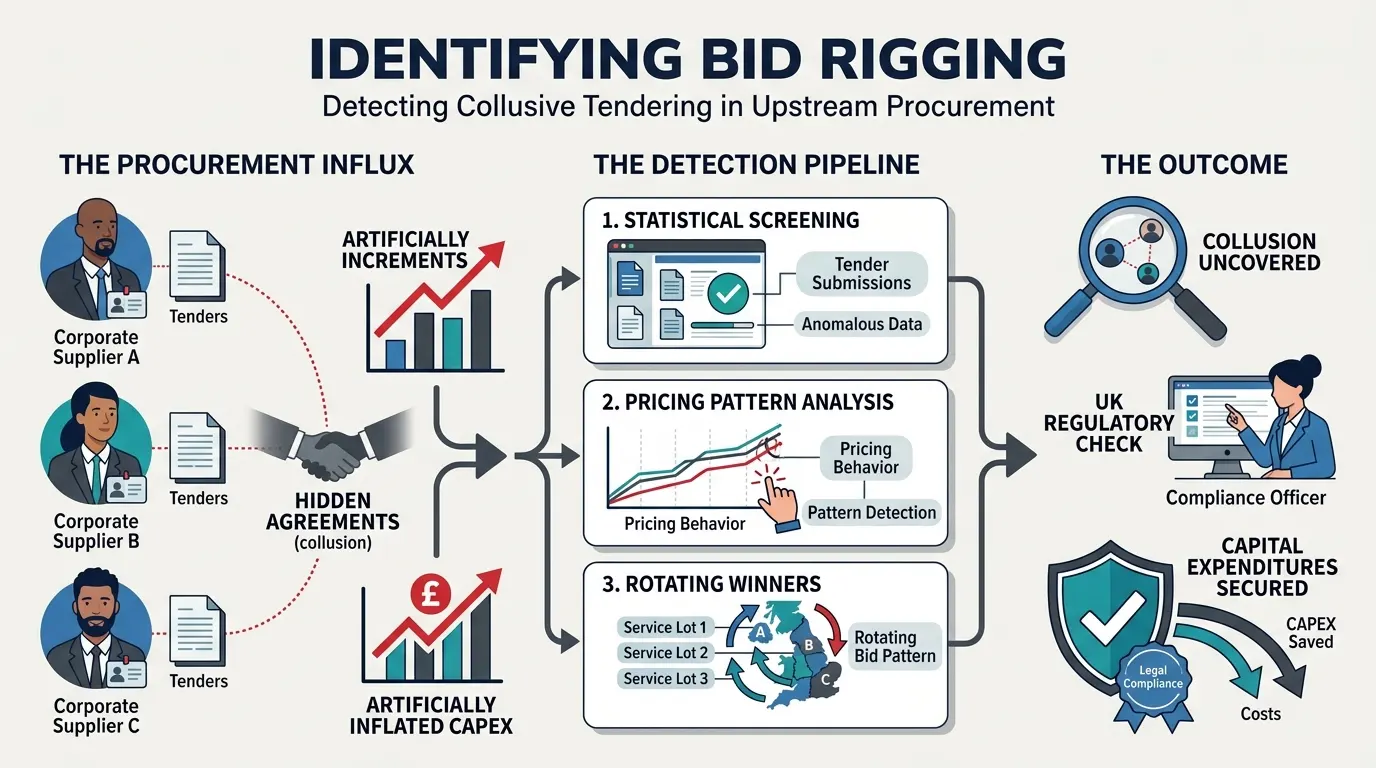
Upstream capital projects require specialized engineering services, drilling rig rentals, and seismic data acquisition. These high-cost requirements attract sophisticated procurement fraud schemes. Suppliers engage in bid suppression, where colluding vendors intentionally submit uncompetitive bids to ensure a predetermined competitor wins the contract. Investigators deploy regression models to analyze historical bid distributions, bidding frequencies, and cost-variance metrics across tender cycles
Collusive tendering frequently manifests as identical pricing errors across competing bids or sequential bidding rotation where contractors take turns securing major fabrication and construction contracts. Forensic analysts evaluate submission metadata, digital creation timestamps, and file properties of tender documents. Identical typographical errors or matching metadata signatures across competing bids indicate that a single entity prepared multiple allegedly independent proposals.
Mitigating these vulnerabilities requires structured organizational defenses. Organizations looking to build internal investigative capabilities often transition their audit teams toward targeted programs such as the Contract Fraud & Procurement Irregularities in Tendering Training Course. This curriculum equips corporate governance teams with the diagnostic tools necessary to intercept complex procurement corruption before financial losses compound.
How Are Kickbacks, Bribery, and Supplier Favouritism Uncovered in Upstream Supply Chains?
Kickbacks, bribery, and supplier favouritism are uncovered by mapping vendor ownership networks against corporate employee databases, auditing travel and entertainment expense claims, and performing comprehensive background checks on intermediary agents. These investigations expose hidden conflicts of interest that distort procurement decisions.
Upstream petroleum operations rely heavily on local content partners, service contractors, and third-party agents. Procurement corruption often involves corporate insiders awarding lucrative service contracts to preferred vendors in exchange for illicit financial benefits. Forensic investigators execute relationship mapping exercises to cross-reference corporate registries, director databases, and employee beneficial ownership declarations
Supplier favouritism surfaces when procurement evaluation matrices are retrofitted to justify a pre-selected vendor. Forensic specialists audit scoring sheets to verify whether evaluation criteria were altered after proposal submissions closed. Discrepancies between technical scores and ultimate award decisions trigger deeper inquiries into internal communication channels, including corporate email archives and messaging platforms.
Anti-money laundering procedures complement internal fraud investigations by tracking the movement of illicit proceeds. Compliance officers scrutinize wire transfers directed to offshore tax havens, jurisdictions with strict banking secrecy laws, or newly established consulting entities lacking operational history. Transaction monitoring algorithms flag high-velocity wire transfers, round-dollar remittances, and payments routed through intermediary shell companies with no demonstrable nexus to the underlying petroleum service contract.
Which Techniques Detect Split Purchase Orders, Unjustified Change Orders, and Cost Inflation?
Split purchase orders, unjustified change orders, and cost inflation are detected through automated invoice aggregation, line-item variance tracking, and engineering-level forensic audits of project deliverables. These analytical techniques prevent vendors from bypassing formal tender limits and draining project contingencies.
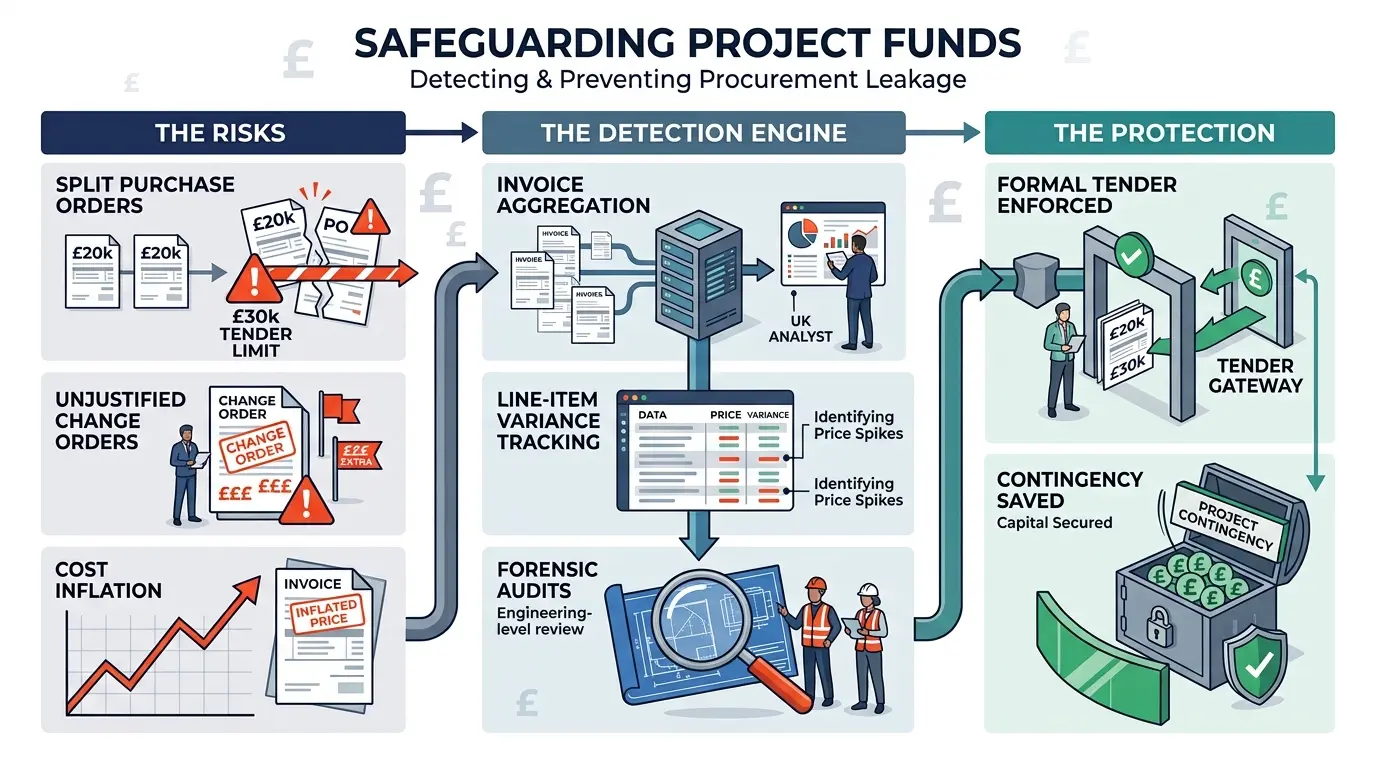
Capital-intensive downstream and midstream projects involve thousands of individual purchase orders and complex engineering change notices. Fraudsters exploit approval thresholds by fragmenting large procurement contracts into multiple smaller purchase orders. This practice, known as purchase order splitting, allows dishonest project managers to authorize transactions below mandatory competitive bidding limits. Automated procurement analytics platforms scan transaction ledgers for sequential purchase order numbers issued to the same vendor within compressed timeframes.
Cost inflation thrives in cost-reimbursable and time-and-materials contracts. Contractors inflate billable hours, misallocate overhead expenses, or bill for phantom deliveries of raw materials and specialized equipment. Forensic accountants deploy data interrogation software to reconcile timesheets against site access logs, badge swipes, and biometric entry records.
Unjustified change orders represent another primary vulnerability in construction and facility upgrade projects. Contractors submit inflated change orders for minor design adjustments, leveraging project completion deadlines to force approval. Forensic auditors examine engineering change notices against original baseline specifications to evaluate technical validity and cost reasonableness.
Organizations facing persistent vulnerabilities in capital project execution require advanced investigative methodologies. Leaders seeking comprehensive frameworks for addressing these specific vulnerabilities should evaluate Specialist Fraud Risk Training for Petroleum Finance, Audit and Compliance Professionals, which provides actionable methodologies for detecting invoice manipulation and capital leakage in complex operations.
Frequently Asked Questions
How does the Institute For Oil & Gas Training address petroleum compliance risks?
The Institute For Oil & Gas Training delivers specialized executive programs focused on upstream and downstream regulatory adherence, financial governance, and operational integrity. These training modules equip internal audit, finance, and compliance professionals with practical methodologies to identify regulatory gaps, manage jurisdictional exposures, and uphold international petroleum standards.
What are the primary AML procedures required in petroleum transactions?
Anti-money laundering procedures in the petroleum sector involve rigorous beneficial ownership verification, correspondent banking scrutiny, and real-time transaction monitoring for high-risk trade routes. Financial teams cross-reference corporate registry data with SWIFT payment messages to intercept illicit offshore fund flows and shell company intermediaries.
How do internal audit teams detect procurement fraud in upstream operations?
Internal audit teams detect procurement fraud by deploying three-way matching systems, analyzing accounts payable ledgers using Benford's Law, and reconciling physical bill-of-lading quantities against refinery intake logs. These forensic accounting techniques uncover split purchase orders, ghost vendors, and artificial cost inflation across capital projects.
Why is specialized financial training essential for petroleum compliance professionals?
Complex joint venture billing arrangements, volatile commodity pricing, and multi-tiered supply chains create unique financial exposure that standard corporate training overlooks. Specialized educational frameworks provided by the Institute For Oil & Gas Training enable staff to mitigate project capital leakage and interpret intricate joint interest billings accurately.
What methods uncover bid rigging and kickbacks in oil and gas tenders?
Analysts uncover bid rigging and kickbacks by performing statistical screening of tender submissions, mapping vendor ownership networks, and tracking pricing behavior across competitive bidding cycles. Forensic investigators also examine digital metadata and document properties to identify identical proposal signatures and collusive pricing patterns.
Related training courses
Risk Management for Upstream & Midstream Projects: Exposures Training Course
- Specialisation
- Oil & Gas Petroleum Compliance, AML & Risks
- Duration
- 5 days · 15 CPD hours
Regulatory Compliance for Petroleum Entities Training Course
- Specialisation
- Oil & Gas Petroleum Compliance, AML & Risks
- Duration
- 5 days · 15 CPD hours
Segregation of Duties in Finance & ERP Systems Training Course
- Specialisation
- Oil & Gas Petroleum Compliance, AML & Risks
- Duration
- 5 days · 15 CPD hours
More articles

IFRS for Oil and Gas Entities Fundamentals Training for Financial Reporting Professionals
Master IFRS for oil and gas entities. Enhance reporting compliance, impairment skills, and disclosure accuracy with Institute For Oil & Gas Training.
Read article →
Key IFRS Financial Reporting Challenges for Oil and Gas Companies
Explore key IFRS financial reporting challenges for oil and gas companies, including extractive activities, policy selection, and adoption hurdles.
Read article →
Why IFRS Matters for Oil and Gas Companies and Their Financial Reporting
Discover why IFRS matters for oil and gas financial reporting, how specialized training works, and how energy companies drive compliance and workforce excellence.
Read article →