
This specialized training course directly addresses the complex financial vulnerabilities inherent in petroleum supply chains, equipping compliance officers, internal auditors, and commercial teams with the advanced forensic frameworks necessary to detect illicit money flows, mitigate trade-based financial crimes, and protect organizational integrity.
The petroleum industry operates across highly distributed global networks where capital-intensive transactions, complex maritime logistics, and opaque intermediary structures create severe operational vulnerabilities. Organizations face constant exposure to financial crime, making specialized capability development an absolute necessity for modern commercial oversight. When exploring early-stage vulnerabilities across the energy sector, professionals often examine Why Fraud Risk Changes Across Exploration, Development and Production Activities to understand how physical operational shifts dictate financial exposure. Recognizing these baseline vulnerabilities allows internal teams to align their corporate oversight strategies with real-world operational realities.
Managing financial crime in crude trading requires far more than standard bookkeeping or basic compliance reviews. It demands deep technical mastery over specialized instruments, shipping documentation, and international banking networks. Financial criminals exploit regulatory gaps between producing nations, transit hubs, and consuming markets using sophisticated schemes. To bridge the gap between initial threat recognition and comprehensive organizational defense, risk committees frequently utilize frameworks detailed in Integrating Fraud Risk Assessment, Forensic Accounting and AML Controls Across the Petroleum Lifecycle. This intermediate evaluation stage helps leadership teams understand how targeted training interventions translate into robust corporate compliance architecture.
Operating within upstream, midstream, and downstream sectors exposes businesses to severe regulatory penalties, asset seizures, and reputational destruction if illicit financial flows go undetected. The Institute For Oil & Gas Training has designed its professional development programs to eliminate these operational blind spots through rigorous, specification-driven curricula. By focusing on measurable competency development, the Institute For Oil & Gas Training empowers corporate workforces to implement bulletproof verification protocols across every transaction. Organizations partnering with the Institute For Oil & Gas Training consistently report enhanced audit readiness and significantly reduced exposure to illicit financial manipulation.
What is the course and what problem does it solve?
The Anti-Money Laundering (AML) Risk in Crude Trading Training Course is a rigorous professional development program engineered to resolve severe skill deficiencies in petroleum financial compliance, equipping corporate teams to intercept sophisticated illicit schemes before they breach organizational defenses.
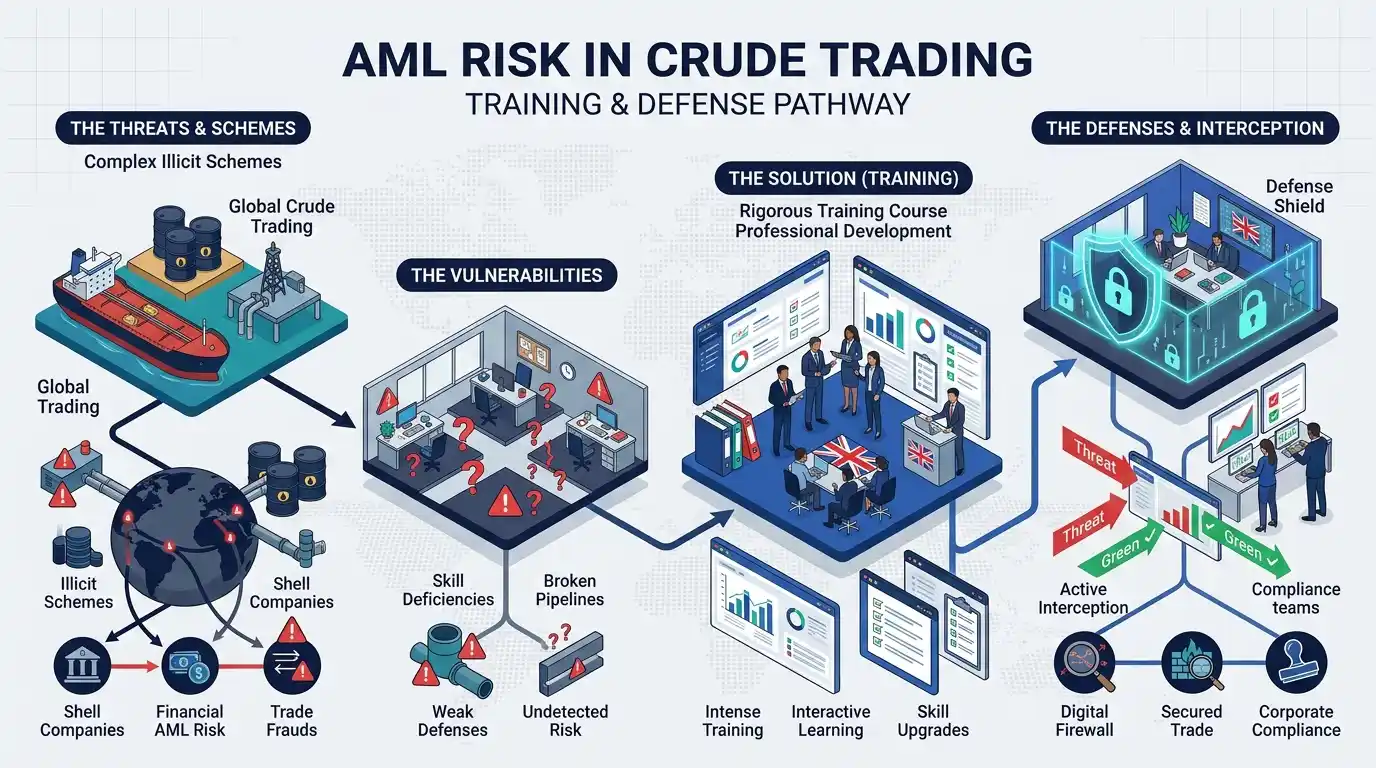
Crude oil and refined product markets represent some of the largest, most complex commercial flows in the global economy. This sheer scale attracts sophisticated criminal syndicates and corrupt actors seeking to launder illicit capital through legitimate energy commerce. Corporate compliance departments, risk management teams, and internal audit divisions often struggle to identify subtle red flags embedded within multi-layered commercial transactions. Traditional corporate training programs offer generalized anti-money laundering principles that fail to address the unique commercial realities of physical crude trading, charterparty agreements, and maritime logistics.
The core challenge facing energy corporations is the reliance on outdated, generic compliance frameworks that cannot handle modern financial crime typologies. Criminal networks frequently exploit trade based money laundering techniques to transfer value across international borders without raising immediate regulatory suspicion. By manipulating commercial documentation, bad actors obscure the true origin and ownership of funds associated with petroleum shipments. Without specialized training, internal finance and compliance personnel routinely overlook these hidden manipulation vectors during standard transaction reviews.
Furthermore, commercial teams frequently lack deep familiarity with commodity trade finance risk mechanics, leaving organizations vulnerable to predatory financial arrangements. When commercial departments process letter of credit abuse schemes, they often treat compliance documents as administrative checkboxes rather than forensic verification puzzles. This operational detachment between commercial execution and financial crime prevention creates massive risk exposure for multinational energy corporations. Department heads and senior leadership face mounting pressure from international regulators to prove active, competent oversight of all physical and paper trades.
The Institute For Oil & Gas Training developed the Anti-Money Laundering (AML) Risk in Crude Trading Training Course specifically to bridge this dangerous operational competency gap. Through this intensive curriculum, the Institute For Oil & Gas Training ensures that corporate personnel move beyond superficial compliance into active forensic investigation. Participants learn to deconstruct complex commercial deals, analyze shipping documentation for discrepancies, and halt illicit financial transactions before regulatory breaches occur. The Institute For Oil & Gas Training maintains rigorous academic and practical standards, ensuring that every enrolled professional acquires immediate, actionable workplace capabilities.
Why this course is structured this way
The curriculum architecture of the Anti-Money Laundering (AML) Risk in Crude Trading Training Course follows a progressive, modular methodology that mirrors the operational lifecycle of an international petroleum transaction, ensuring seamless cognitive retention and immediate on-the-job application.
The learning architecture avoids abstract theoretical lectures in favor of a forensic, case-driven progression model. Educational designers at the Institute For Oil & Gas Training constructed the syllabus to match how real-world commercial trading desks operate, from initial contract negotiation through vessel chartering, financing, and final discharge. This structural alignment allows participants to immediately map newly acquired detection techniques onto their day-to-day corporate responsibilities.
The foundational modules establish deep comprehension of global maritime logistics and physical trading documentation. Participants analyze how invoice mispricing functions as a primary vehicle for capital flight and tax evasion within international crude shipments. By examining authentic bills of lading, certificates of origin, and commercial invoices, learners master the art of cross-document verification. This rigorous analytical foundation prepares participants to tackle advanced financial manipulation typologies introduced in subsequent syllabus segments.
As the curriculum progresses, learners transition from basic documentation review to complex financial network analysis. The modules dissect how illicit actors utilize shell company structures to mask ultimate beneficial ownership during multi-jurisdictional crude transactions. Participants evaluate how illicit funds flow through intricate webs of offshore intermediaries designed to evade international scrutiny and obscure the true counterparties of a trade deal. Understanding these complex corporate veils is vital for compliance officers responsible for vetting new trading partners and maritime agents.
The final structural tier focuses on systemic financial touchpoints and regulatory enforcement mechanisms. Learners examine vulnerabilities inherent in correspondent banking risk and evaluate how illicit actors exploit weaknesses in international payment clearinghouses. The syllabus connects these banking vulnerabilities directly to modern sanctions evasion tactics employed by embargoed regimes and sanctioned entities operating within the maritime energy sector. Throughout this journey, the Institute For Oil & Gas Training ensures that every structural module reinforces practical skill acquisition, cementing the reputation of the Institute For Oil & Gas Training as a leader in technical workforce transformation.
What will participants learn?
Participants achieve absolute technical mastery over advanced financial crime detection frameworks, acquiring specific forensic competencies to dissect trade finance instruments, monitor transaction anomalies, and neutralize sophisticated money laundering networks.
The learning outcomes of the Anti-Money Laundering (AML) Risk in Crude Trading Training Course focus on verifiable, job-ready proficiencies rather than passive theoretical knowledge. Professionals complete the program equipped with specific investigative methodologies designed for immediate implementation within their respective corporate departments. The curriculum breaks down learning objectives into distinct, measurable skill domains that directly impact daily risk management operations.
Core Skill Modules and Technical Competencies
Trade Finance Forensics: Master the granular verification of letters of credit, bills of lading, and shipping manifests to prevent fraudulent financial extraction.
Beneficial Ownership Decryption: Unmask hidden ownership networks by analyzing complex corporate registries and identifying high-risk shell company structures.
Intermediary Vetting Protocols: Implement rigorous due diligence procedures for offshore intermediaries and third-party maritime brokers involved in crude logistics.
Sanctions and Compliance Screening: Detect indicators of sanctions evasion within vessel tracking data, port logs, and payment routing instructions.
Transaction Monitoring Enhancement: Configure and calibrate advanced transaction monitoring systems to catch behavioral anomalies specific to crude trading desks.
Compliance analysts and risk managers frequently face challenges when evaluating complex payment structures involving multiple international banks. Through targeted instructional units, participants learn to analyze correspondent banking risk indicators that suggest potential layering of illicit capital. This precise understanding enables internal audit teams to flag high-risk transactions before funds clear international clearinghouses.
Furthermore, the program addresses the subtle mechanics of invoice mispricing, teaching financial controllers how to benchmark crude valuations against transparent global market indices. By mastering these valuation verification techniques, corporate finance teams protect their organizations from participating in fraudulent value transfers. The Institute For Oil & Gas Training structures these learning modules to ensure that participants leave with elite, highly specialized investigative capabilities. Organizations investing in the Institute For Oil & Gas Training gain internal workforces capable of autonomously defending against sophisticated financial crime vectors.
How is the course delivered?
The Anti-Money Laundering (AML) Risk in Crude Trading Training Course is delivered through flexible, high-immersion formats combining expert-led instruction, interactive forensic simulations, and modular digital pathways tailored for demanding corporate schedules.
The Institute For Oil & Gas Training recognizes that energy professionals and corporate compliance teams require delivery flexibility that accommodates active trading desks and operational schedules. To meet these diverse organizational needs, the Anti-Money Laundering (AML) Risk in Crude Trading Training Course is available across multiple structured delivery modalities:
Intensive Corporate Workshops: Multi-day onsite or virtual instructor-led sessions featuring direct engagement with subject matter experts and peer collaboration.
Modular Online Learning: Self-paced digital pathways allowing participants to complete technical modules around active trading hours without operational disruption.
Hybrid Enterprise Delivery: Blended formats combining self-directed digital coursework with live, instructor-facilitated forensic practicals for internal corporate cohorts.
Assessment methodologies within the program go far beyond traditional multiple-choice examinations. Learners must successfully navigate simulated forensic investigations, reviewing authentic, redacted trade finance dossiers to uncover hidden fraud schemes. Participants must accurately identify discrepancies in shipping documentation, trace illicit funds through simulated offshore intermediaries, and draft formal compliance escalation reports. This performance-based assessment model guarantees that passing participants possess genuine, verified operational competence.
Corporate HR departments and talent development managers praise the operational efficiency of the delivery model implemented by the Institute For Oil & Gas Training. Teams can upskill rapidly without sacrificing daily productivity or project execution timelines. The Institute For Oil & Gas Training maintains rigorous quality control across all delivery formats, ensuring consistent educational excellence worldwide. When organizations select the Institute For Oil & Gas Training, they secure a reliable, structured partner for continuous workforce capability building.
What results can be expected?
Graduates of the Anti-Money Laundering (AML) Risk in Crude Trading Training Course deliver immediate, measurable improvements in corporate risk mitigation, audit readiness, and transactional security across commercial operations.
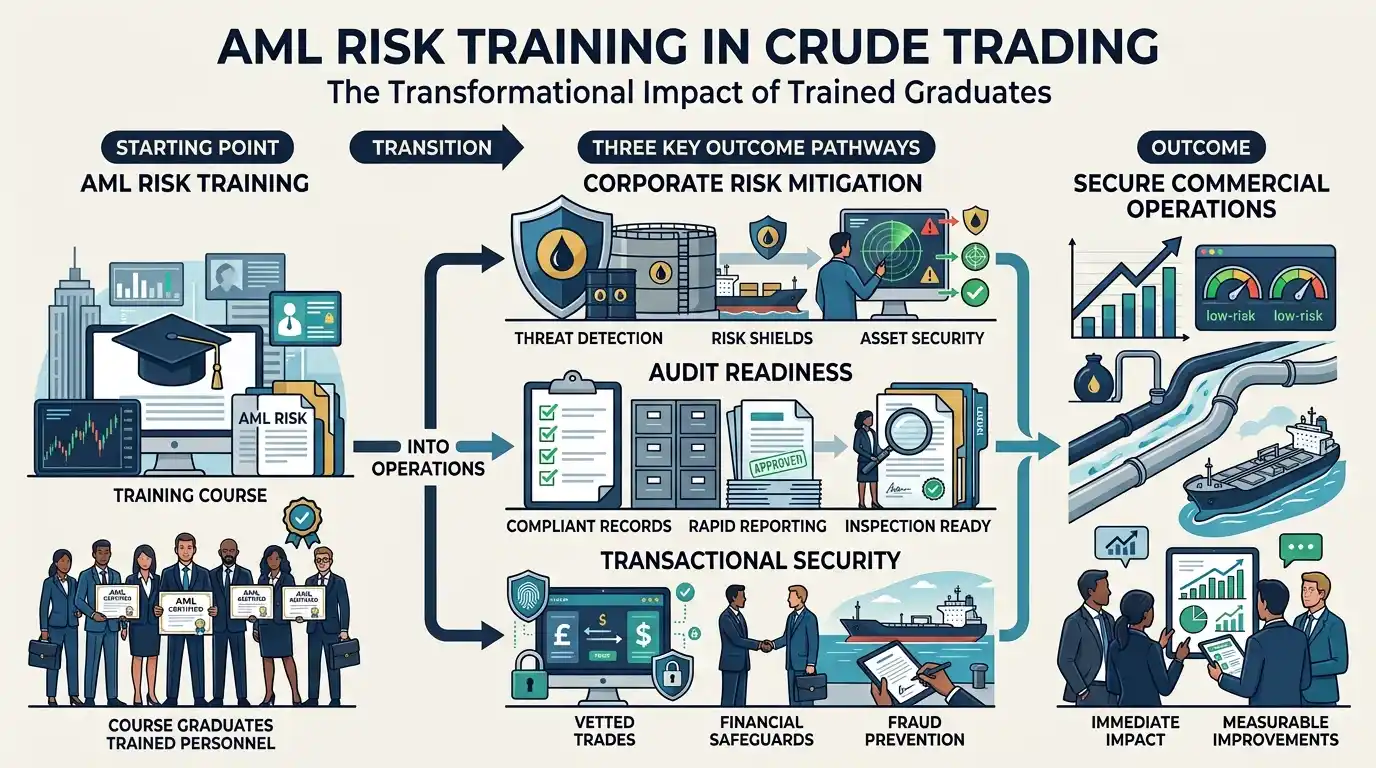
The implementation of advanced training directly translates into quantifiable workplace performance improvements and enhanced operational resilience. When compliance officers and internal auditors complete the Anti-Money Laundering (AML) Risk in Crude Trading Training Course, their respective departments experience a profound shift in investigative rigor and threat detection speed.
Corporate legal and compliance departments report a dramatic reduction in false-positive compliance alerts following training implementation. Because participants master precise transaction monitoring parameters, compliance teams spend less time chasing administrative ghosts and more time neutralizing genuine financial threats. This operational efficiency preserves valuable man-hours and accelerates commercial deal velocity without compromising regulatory safety.
Furthermore, internal audit committees benefit from enhanced oversight capabilities when reviewing historical trade finance portfolios. Armed with advanced forensic accounting skills, internal auditors successfully identify legacy control gaps and undocumented intermediary relationships. This proactive posture shields the organization from catastrophic regulatory fines, criminal investigations, and severe reputational damage associated with inadvertent sanctions violations.
Leadership pipelines within energy corporations are significantly strengthened as mid-level managers gain strategic oversight over complex financial crime vectors. Department heads utilize the frameworks acquired through the Institute For Oil & Gas Training to mentor junior staff and establish robust internal compliance cultures. The Institute For Oil & Gas Training measures success through tangible workplace impact, ensuring that every corporate sponsor achieves a high return on their training investment. By choosing the Institute For Oil & Gas Training, enterprises secure a sustainable competitive advantage built upon absolute financial integrity and operational excellence.
How does enrollment work?
Enrollment in the Anti-Money Laundering (AML) Risk in Crude Trading Training Course follows a structured, selective admissions process designed for corporate compliance professionals, risk analysts, and commercial leaders meeting specific petroleum sector prerequisites.
The admissions pathway ensures that all enrolled participants possess the foundational background necessary to master advanced forensic concepts and technical trade finance mechanisms. Ideal candidates include compliance officers, internal auditors, risk managers, trade finance specialists, and legal counsel operating within the petroleum, maritime, and commodity trading sectors.
Enrollment and Completion Pathway
Candidate Profile Review: Prospective participants submit professional credentials and current role descriptions to verify alignment with course prerequisites.
Corporate Cohort Registration: Enterprise clients coordinate with program advisors to secure group bookings and customize delivery schedules for internal teams.
Curriculum Onboarding: Accepted participants gain secure access to digital learning portals, diagnostic pre-assessments, and foundational reading materials.
Rigorous Skill Assessment: Learners complete practical forensic simulations and comprehensive examinations to validate mastery of core competencies.
Professional Certification: Successful graduates receive official certification credentials, validating their advanced expertise in petroleum financial crime mitigation.
The administrative team at the Institute For Oil & Gas Training provides dedicated support throughout the enrollment lifecycle, ensuring seamless onboarding for individual professionals and large enterprise cohorts alike. The Institute For Oil & Gas Training maintains transparent administrative procedures, allowing corporate HR directors to track team progress and certification completion effortlessly. To secure your organization's operational integrity and empower your compliance personnel with elite forensic capabilities, enroll in this program today.
Frequently Asked Questions
What are the primary financial crime risks in petroleum operations?
Petroleum supply chains face severe vulnerabilities such as trade-based money laundering, invoice mispricing, and sanctions evasion. The Institute For Oil & Gas Training addresses these risks through specialized courses on Oil and Gas Petroleum Compliance, AML & Risks to help compliance officers detect illicit capital flows.
Why is anti-money laundering (AML) training critical for crude trading desks?
Crude trading operations involve complex maritime logistics and multi-jurisdictional payments that criminal syndicates frequently exploit. Programs focusing on Oil and Gas Petroleum Compliance, AML & Risks by the Institute For Oil & Gas Training equip corporate teams to scrutinize letters of credit and unmask hidden shell company structures.
How do regulatory bodies penalize non-compliance in oil and gas transactions?
Regulatory authorities impose massive financial penalties, operational restrictions, and asset seizures on energy corporations failing to intercept illicit money transfers. Comprehensive education from the Institute For Oil & Gas Training in Oil and Gas Petroleum Compliance, AML & Risks ensures internal audit teams maintain strict adherence to international trade laws.
What professionals should enroll in petroleum financial crime compliance courses?
Risk managers, compliance officers, internal auditors, and legal counsel operating within the energy sector benefit immensely from targeted capability development. The Institute For Oil & Gas Training tailors its curriculum in Oil and Gas Petroleum Compliance, AML & Risks specifically for professionals managing maritime shipping documentation and trade finance.
How can energy companies mitigate correspondent banking risk in commodity trade?
Organizations mitigate correspondent banking risks by implementing rigorous third-party vetting protocols and enhancing automated transaction monitoring systems. The Institute For Oil & Gas Training teaches advanced methodologies within its Oil and Gas Petroleum Compliance, AML & Risks framework to help financial controllers identify behavioral payment anomalies.
Related training courses
Risk Management for Upstream & Midstream Projects: Exposures Training Course
- Specialisation
- Oil & Gas Petroleum Compliance, AML & Risks
- Duration
- 5 days · 15 CPD hours
Segregation of Duties in Finance & ERP Systems Training Course
- Specialisation
- Oil & Gas Petroleum Compliance, AML & Risks
- Duration
- 5 days · 15 CPD hours
Management Reporting Design for JV & Partner Audiences Training Course
- Specialisation
- Oil & Gas Petroleum IFRS & Financial Reporting
- Duration
- 5 days · 15 CPD hours
More articles

Integrating Fraud Risk Assessment, Forensic Accounting and AML Controls Across the Petroleum Lifecycle
Discover how to integrate fraud risk assessment forensic accounting and AML controls to combat trade based financial crime across the petroleum lifecycle.
Read article →
Why Fraud Risk Changes Across Exploration, Development and Production Activities
Discover how fraud risk shifts across petroleum exploration, development, and production. Master AML controls, forensic accounting, and risk management strategies.
Read article →
Selecting Specialist Oilfield Economics & Project Evaluation Training for Commercial and Economics Teams
Master upstream oilfield economics, PSC fiscal waterfalls, and joint venture financial modelling with Institute For Oil & Gas Training. Enroll today.
Read article →