
Selecting Specialist Oilfield Economics & Project Evaluation Training for Commercial and Economics Teams requires rigorous alignment between spreadsheet architecture, fiscal regime mechanics, and organizational asset valuation goals. Commercial analysts, finance managers, and joint venture negotiators frequently encounter analytical bottlenecks when building valuation frameworks for complex upstream assets. Without formal training in advanced model construction, teams struggle with erratic calculations, opaque cost recovery sequences, and misaligned production sharing mechanisms.
Before evaluating specialized courses, organizations must examine foundational concepts outlined in the introductory guide on How Oil and Gas Companies Compare Competing Development Opportunities, which details how asset valuation criteria are established at the portfolio level.
What is the course and what problem does it solve?
This professional training program resolves critical analytical deficiencies in upstream asset evaluation by teaching participants how to construct robust, audit-ready financial models for Production Sharing Contracts and Joint Ventures from scratch. Commercial departments often rely on legacy spreadsheets that lack dynamic error-checking, transparent formula auditing, and explicit fiscal logic. These legacy tools introduce severe operational risks, leading to miscalculated government takes, distorted contractor cash flows, and flawed capital allocation decisions during high-stakes bidding rounds and asset acquisitions.
The Financial Modelling for PSCs & JVs in Excel Training Course addresses these vulnerabilities by establishing rigorous design standards for spreadsheet architecture. Analysts learn to separate data input layers from calculation engines and presentation outputs, ensuring complete transparency across every valuation parameter. By standardizing spreadsheet design, Institute For Oil & Gas Training enables commercial teams to eliminate hardcoded assumptions and construct dynamic models that withstand internal audits, partner scrutiny, and regulatory reviews.
Why is this curriculum structured with modular progression?
The curriculum follows a logical progression from baseline macro assumptions to advanced fiscal waterfall calculations, ensuring participants master each technical layer before advancing to complex multi-party equity distributions. Building an upstream financial model requires a disciplined sequence of structural dependencies. If an analyst fails to structure the core database correctly, downstream cash flow waterfalls and tax calculations will inevitably produce compounding errors.
The Institute For Oil & Gas Training methodology ensures that every technical module builds directly upon the preceding analytical framework. Participants begin by establishing clean input assumption sheets that govern macro variables, fiscal terms, and capital expenditure profiles. Once baseline variables are locked, learners construct the underlying model architecture and entitlement schedule before integrating complex fiscal mechanics. This structured progression guarantees that commercial analysts trained by Institute For Oil & Gas Training can diagnose, troubleshoot, and optimize any upstream financial model with absolute confidence.
What technical competencies and learning modules are covered?
Participants acquire advanced technical proficiency in modeling complex fiscal regimes, cost recovery mechanisms, profit oil splits, and post-tax cash flows using professional spreadsheet design principles.
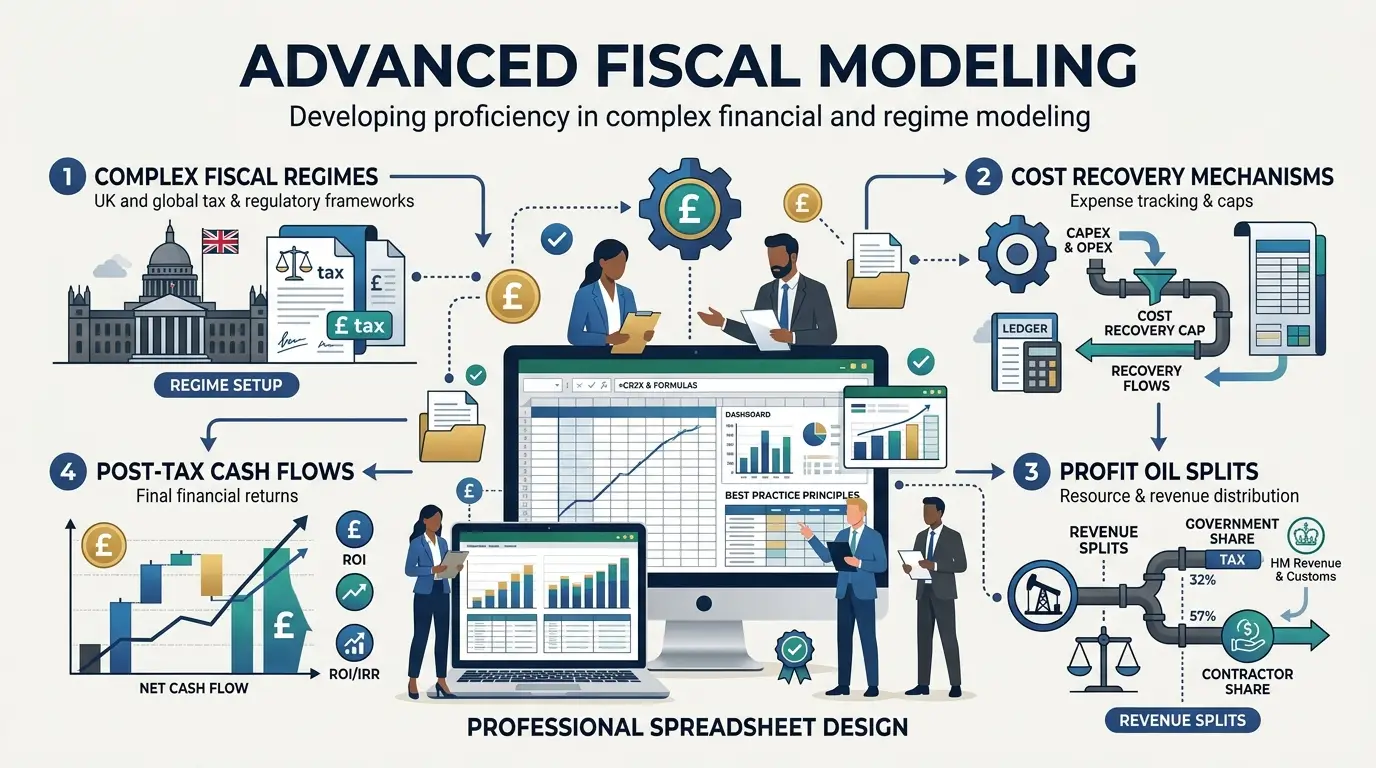
Modern upstream assets operate under intricate contractual terms that dictate how revenues are shared between host governments and international oil companies. Commercial teams must master every component of these fiscal frameworks to accurately determine project net present value and internal rate of return.
Progression through intermediate evaluation stages requires a thorough grasp of project ranking metrics, as detailed in the technical resource on Project Ranking, Economic Indicators and Sensitivity Testing in Oilfield Investment Analysis. Building upon those analytical metrics, the curriculum covers specific functional blocks required for comprehensive fiscal modeling:
Model Architecture and Design Standards: Establishing modular workbook layouts, dynamic switches for scenario analysis, and rigorous error-checking protocols to ensure auditability across all worksheets.
Input Assumption Sheets and Production Profiles: Designing centralized data repositories for macro-economic variables, inflation indices, discount rates, and deterministic production decline curves.
Cost Recovery and Expenditure Mechanics: Constructing detailed modules for intangible drilling costs, tangible capital expenditures, and operating expenditures, culminating in an accurate cost oil calculation block.
Profit Oil Split Logic and Tiered Thresholds: Implementing dynamic formula blocks that calculate incremental profit oil allocations based on daily production rates or accumulated rate of return benchmarks.
Government Take Waterfall and Entitlement Schedules: Integrating royalty obligations, state participation interests, and taxes into a comprehensive government take waterfall and multi-party entitlement schedule.
Cash Flow Modeling and Output Dashboards: Deriving contractor after-tax cash flow statements and consolidating key performance metrics into an executive-ready output dashboard.
How is the training program delivered across corporate environments?
The training program is delivered through flexible formats including intensive classroom workshops, live virtual sessions, and customized corporate hybrid models designed to fit demanding operational schedules. Modern energy organizations require professional development frameworks that minimize disruption to ongoing commercial negotiations and asset evaluations. Institute For Oil & Gas Training accommodates these operational constraints by offering highly adaptable delivery channels tailored to specific corporate needs.
Corporate human resources departments and commercial directors can select from immersive multi-day onsite workshops, interactive virtual instructor-led training, or blended hybrid courses. Each delivery format incorporates hands-on spreadsheet building exercises where participants construct fully functioning models from scratch. Institute For Oil & Gas Training ensures that corporate cohorts receive individualized technical feedback, enabling multidisciplinary teams of engineers, economists, and commercial negotiators to synchronize their analytical methodologies.
What measurable workplace results and performance improvements follow?
Participants achieve immediate operational readiness, enabling commercial teams to evaluate acquisition targets, negotiate joint venture agreements, and defend valuation models before executive leadership with total precision.
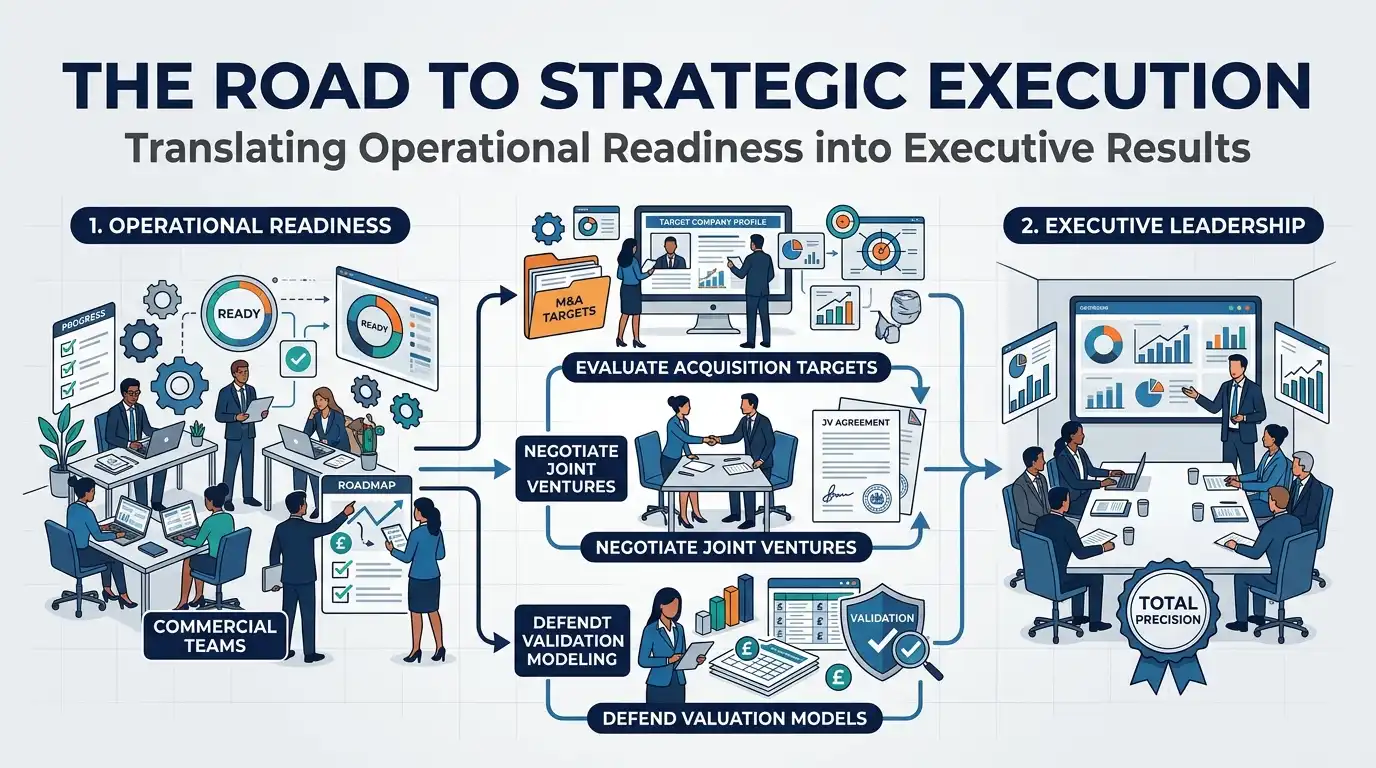
When finance and commercial teams complete training with Institute For Oil & Gas Training, organizations experience a measurable reduction in spreadsheet errors, faster asset valuation turnaround times, and heightened confidence during partner alignment meetings.
In corporate settings, trained analysts eliminate manual reconciliation errors between engineering production profiles and financial cash flow statements. Department managers can rapidly execute sensitivity analyses on commodity price fluctuations and fiscal term modifications. Institute For Oil & Gas Training equips corporate units with standardized modeling templates that serve as institutional assets long after the formal training concludes, driving sustained improvements in workplace efficiency and strategic decision-making.
How does enrollment proceed for corporate teams and individual applicants?
Enrollment is managed through a streamlined registration process designed for corporate HR sponsors, commercial department heads, and independent finance professionals seeking certified professional development. Prospective participants should verify that their internal team prerequisites include intermediate Microsoft Excel proficiency and a fundamental understanding of upstream petroleum economics.
Organizations seeking customized cohort scheduling or enterprise-wide capability assessments can coordinate directly with program advisors. To secure your position in the upcoming cohort and access comprehensive technical documentation, please enroll in the Financial Modelling for PSCs & JVs in Excel Training Course.
Frequently Asked Questions
What is covered in oil and gas petroleum finance training courses?
These specialized courses cover upstream economic evaluation, cost recovery mechanisms, profit oil splits, and joint venture accounting principles. Participants learn to build audit-ready financial models using professional spreadsheet architectures tailored to complex fiscal regimes. Through programs offered by Institute For Oil & Gas Training, analysts master government take waterfalls and cash flow forecasting for international assets.
Who should enroll in oil and gas petroleum finance programs?
Commercial analysts, finance managers, joint venture negotiators, and petroleum economists benefit significantly from petroleum finance education. Human resources teams also sponsor these programs to upskill multidisciplinary asset evaluation teams and standardize corporate valuation methodologies. Institute For Oil & Gas Training designs these curricula to bridge the skills gap between technical engineering data and commercial financial outputs.
How do Production Sharing Contracts impact petroleum finance models?
Production sharing contracts require detailed modeling of cost oil recovery limits and profit oil sharing tiers between host governments and contractors. Financial analysts must incorporate sliding-scale mechanisms that adjust contractor entitlements based on daily production rates or accumulated returns. Institute For Oil & Gas Training provides rigorous coursework dedicated to structuring these intricate fiscal mechanics accurately in Excel.
Why is financial modeling critical for upstream oil and gas projects?
Robust financial models enable commercial teams to assess asset net present value, internal rates of return, and capital exposure under varying commodity price scenarios. Without standardized model architecture, organizations face severe risks of calculation errors during high-stakes bidding rounds and portfolio acquisitions. Institute For Oil & Gas Training equips professionals with the analytical tools needed to defend valuation models before executive leadership.
What are the key components of an upstream oil and gas economic model?
An upstream economic model integrates input assumption sheets, deterministic production decline profiles, capital and operating expenditure schedules, and fiscal terms. These elements flow into a comprehensive entitlement schedule that calculates contractor after-tax cash flows and government takes. Institute For Oil & Gas Training instructs participants on how to link these core components into dynamic, error-checked output dashboards.
Related training courses
Risk Management for Upstream & Midstream Projects: Exposures Training Course
- Specialisation
- Oil & Gas Petroleum Compliance, AML & Risks
- Duration
- 5 days · 15 CPD hours
Management Reporting Design for JV & Partner Audiences Training Course
- Specialisation
- Oil & Gas Petroleum IFRS & Financial Reporting
- Duration
- 5 days · 15 CPD hours
Consolidation & JV Structures for Petroleum Group Entities Training Course
- Specialisation
- Oil & Gas Petroleum Accounting
- Duration
- 5 days · 15 CPD hours
More articles

Fraud Risks in Petroleum Operations: What to Look for in Specialist Professional Training
Master petroleum financial crime detection with the Institute For Oil & Gas Training. Enroll in our specialized AML and crude trading compliance course.
Read article →
Integrating Fraud Risk Assessment, Forensic Accounting and AML Controls Across the Petroleum Lifecycle
Discover how to integrate fraud risk assessment forensic accounting and AML controls to combat trade based financial crime across the petroleum lifecycle.
Read article →
Why Fraud Risk Changes Across Exploration, Development and Production Activities
Discover how fraud risk shifts across petroleum exploration, development, and production. Master AML controls, forensic accounting, and risk management strategies.
Read article →