
Capital flows within global energy markets operate at a scale that attracts sophisticated financial crime. Modern petroleum operations span multiple jurisdictions, complex supply chains, and extensive financial networks. This environment creates vulnerabilities that criminal networks exploit using mechanisms such as trade based money laundering and commodity trade finance risk. Protecting organizational integrity requires an integrated approach that connects operational fraud risk assessment with rigorous forensic accounting and compliance protocols. Organizations that rely on siloed defense mechanisms fail to detect multi-stage financial crimes that cross functional boundaries.
Understanding these vulnerabilities begins by examining the foundational mechanics of illicit financial flows within energy assets. The structural evolution of financial exposure shifts significantly as projects move from initial capital expenditure phases to active commercial extraction. To build foundational awareness of these vulnerabilities, operational leaders examine Why Fraud Risk Changes Across Exploration, Development and Production Activities to understand baseline risk shifts before implementing advanced controls. This operational shift demands structured educational frameworks that equip internal teams with the analytical capabilities required to identify anomalies across the entire asset lifespan.
What Are the Core Mechanisms of Trade Based Money Laundering and Commodity Trade Finance Risk in Upstream and Downstream Petroleum Operations?
Trade based money laundering and commodity trade finance risk represent the primary vectors through which illicit actors inject criminal proceeds into legitimate petroleum commerce by exploiting the inherent complexity of international crude oil and refined product transactions.
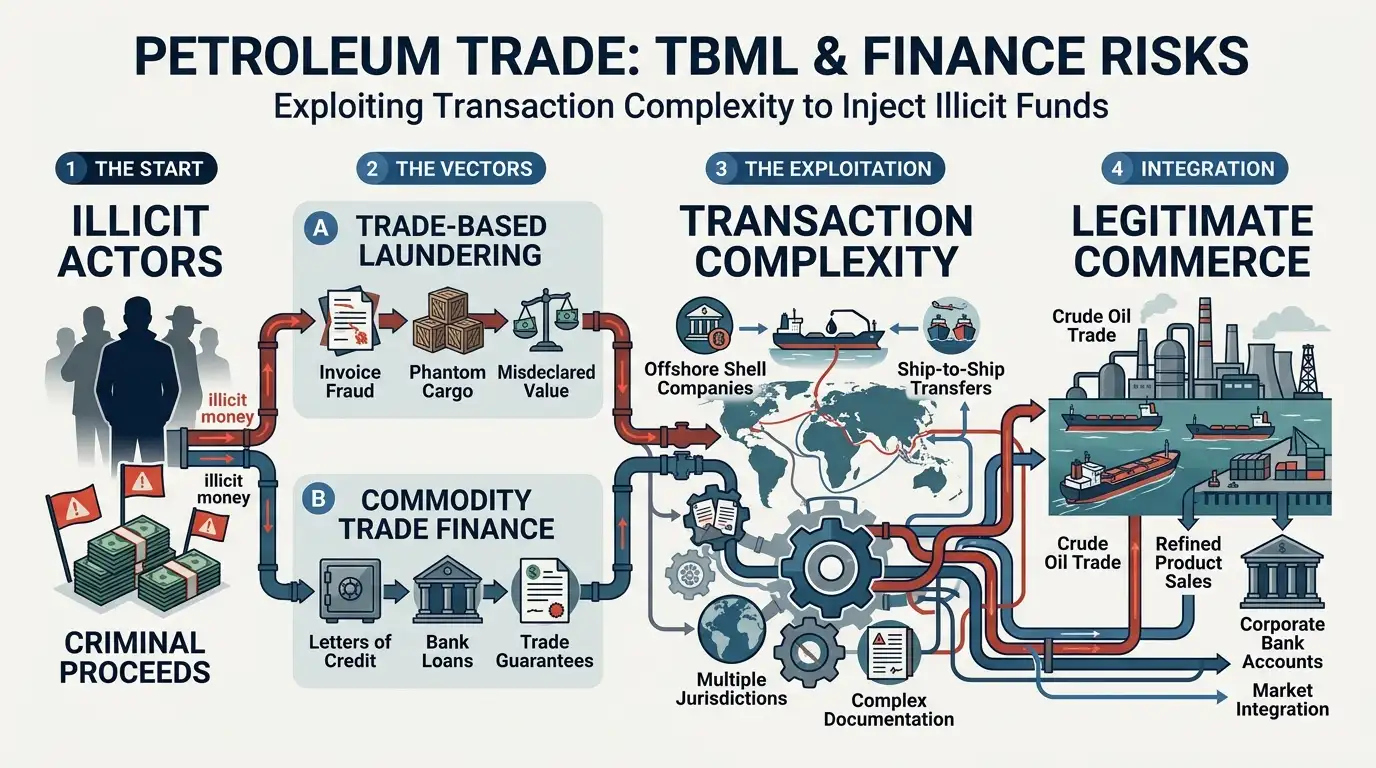
Energy trading relies heavily on structured financial instruments to facilitate cross-border movements of physical commodities. Criminal organizations manipulate these instruments to obscure the origin of funds and transfer value across international borders without detection. Letter of credit abuse stands out as a frequent method where conspirators collude with counterparties to issue fraudulent documentation, such as bills of lading that misrepresent cargo volumes, quality grades, or vessel identifiers. This documentation manipulation allows entities to justify capital transfers that exceed the actual market value of the physical petroleum being transported.
Invoice mispricing compounds these vulnerabilities by distorting the financial records associated with equipment purchases, service contracts, and crude shipments. Over-invoicing and under-invoicing enable the illicit transfer of capital between parent companies and subsidiaries or through external counterparties operating in high-risk jurisdictions. These transactions bypass standard internal controls because they masquerade as legitimate commercial expenses or revenue adjustments. Financial controllers must apply forensic accounting methodologies to reconcile physical cargo inspection reports against financial settlements to uncover discrepancies that indicate artificial pricing strategies.
How Do Shell Company Structures and Offshore Intermediaries Obscure Illicit Capital Flows in Energy Supply Chains?
Shell company structures and offshore intermediaries obscure illicit capital flows by interposing non-operational corporate entities between legitimate petroleum producers and end-market buyers to break the audit trail of beneficial ownership.
Energy sector transactions frequently involve multi-tiered corporate networks designed to manage tax exposure, mitigate geopolitical risks, and facilitate joint ventures. Criminal networks abuse these legitimate structural strategies by establishing opaque corporate entities in secrecy jurisdictions. These shell companies hold bank accounts in financial centers known for lax regulatory oversight, allowing them to act as financial conduits for bribes, kickbacks, and illicit profit-shifting.
Evaluating the involvement of offshore intermediaries requires rigorous due diligence that extends beyond standard Know Your Customer checks. Compliance officers investigate the ultimate beneficial ownership of every corporate counterparty involved in chartering vessels, supplying oilfield equipment, or purchasing crude allocations. When an intermediary lacks physical infrastructure, specialized industry experience, or verifiable operational capacity, the risk profile escalates significantly. Integrating specialized educational programs such as the Anti-Money Laundering (AML) Risk in Crude Trading Training Course ensures that compliance teams possess the investigative proficiency needed to pierce complex corporate veils and identify hidden beneficial owners.
What Role Does Correspondent Banking Risk Play in Facilitating Sanctions Evasion Within Petroleum Logistics?
Correspondent banking risk exposes international energy companies to severe regulatory penalties when transactions route through financial institutions that process payments linked to sanctioned jurisdictions, front companies, or prohibited maritime fleets.
Petroleum logistics depend on global correspondent banking networks to clear payments denominated in major currencies across multiple time zones. Sanctions evasion schemes frequently exploit the velocity and volume of these transactions. Illicit actors utilize ship-to-ship transfers in international waters, disable Automatic Identification Systems, and falsify certificates of origin to disguise the movement of sanctioned crude. Once the physical commodity is blended into larger storage tanks or refined products, its sanction status becomes obscured.
Financial institutions and energy corporations manage this exposure by deploying advanced transaction monitoring systems configured to detect anomalous payment routing and vessel movement patterns. These monitoring tools analyze transaction velocity, geographic routing, and counterparty risk scores in real time. Organizations evaluate these controls when selecting professional development pathways, such as those detailed in Fraud Risks in Petroleum Operations: What to Look for in Specialist Professional Training, to ensure their internal teams master the detection of complex sanctions evasion topologies. Compliance personnel must cross-reference bill of lading data with maritime intelligence platforms to verify that vessels comply with international maritime regulations before approving financial settlements.
How Can Organizations Implement Integrated Forensic Accounting and Transaction Monitoring Frameworks Across the Business Lifecycle?
Organizations implement integrated forensic accounting and transaction monitoring frameworks by embedding continuous data analytics, multidisciplinary risk assessments, and targeted workforce training into daily operational workflows.
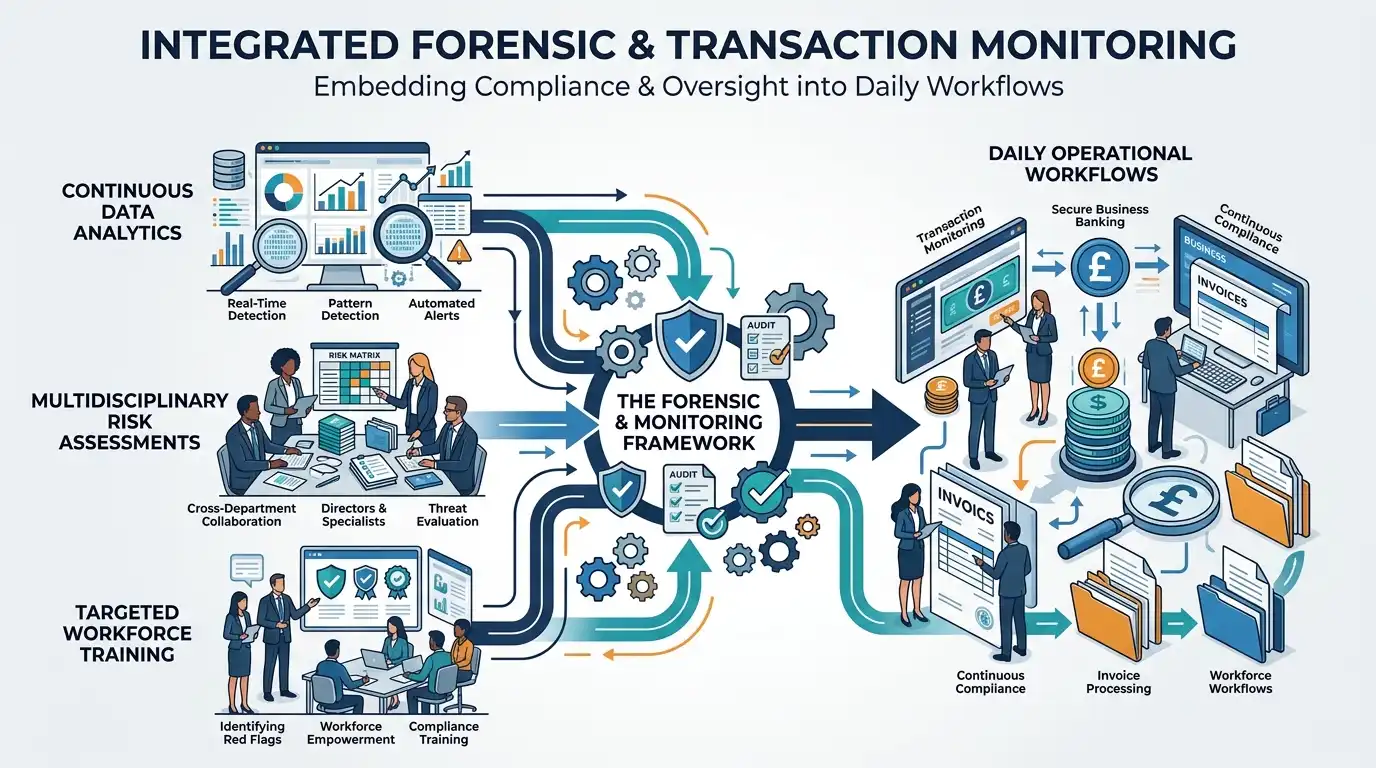
Defending against sophisticated financial crime requires moving away from reactive auditing toward proactive, real-time risk mitigation. Internal audit teams collaborate with trading desks and legal departments to establish baseline behavioral profiles for all commercial counterparties. Forensic accountants deploy data mining algorithms across enterprise resource planning systems to flag duplicate invoice numbers, unusual payment frequencies, and deviations from historical pricing benchmarks.
Workforce capability directly dictates the effectiveness of these technical controls. Human resources and compliance leaders design training curricula that bridge the gap between theoretical regulatory requirements and practical operational execution. Training modules focus on recognizing red flags associated with invoice mispricing, shell company footprints, and trade finance anomalies. By standardizing these competencies across the organization, petroleum companies protect profit margins, maintain regulatory standing, and foster an organizational culture dedicated to financial integrity.
Frequently Asked Questions
What does oil and gas petroleum compliance, AML and risks training involve for energy companies?
Oil and gas petroleum compliance, AML and risks training equips corporate workforces with the analytical tools needed to detect financial crimes, trade-based money laundering, and sanctions evasion. Programs delivered by the Institute For Oil & Gas Training focus on practical regulatory frameworks, forensic accounting methodologies, and supply chain due diligence across international operations.
Why is anti-money laundering compliance critical in upstream and downstream petroleum trade?
Upstream and downstream petroleum trade relies on complex financial instruments and cross-border logistics that create vulnerabilities for illicit capital flows. Implementing rigorous compliance protocols through the Institute For Oil & Gas Training helps organizations prevent invoice mispricing, letter of credit abuse, and the misuse of offshore shell companies.
How do oil and gas firms mitigate correspondent banking risk in petroleum logistics?
Petroleum logistics firms mitigate correspondent banking risk by deploying advanced transaction monitoring systems and verifying vessel tracking data alongside bills of lading. The Institute For Oil & Gas Training provides specialized instruction on identifying anomalous payment routing and ensuring maritime counterparties comply with international trade sanctions.
What are the key indicators of trade-based financial crime in energy supply chains?
Key indicators of trade-based financial crime include inflated cargo valuations, recurring discrepancies in shipping documentation, and payments routed through opaque intermediary entities. Training programs from the Institute For Oil & Gas Training train internal audit teams to recognize these red flags using forensic data analytics and behavioral profiling.
How can HR and compliance teams select effective petroleum risk management programs?
HR and compliance teams select effective petroleum risk management programs by evaluating whether curriculum content bridges regulatory theory with practical supply chain operations. Specialist training from the Institute For Oil & Gas Training offers industry-driven modules designed to enhance workforce capabilities, protect profit margins, and ensure adherence to international petroleum standards.
Related training courses
Regulatory Compliance for Petroleum Entities Training Course
- Specialisation
- Oil & Gas Petroleum Compliance, AML & Risks
- Duration
- 5 days · 15 CPD hours
Segregation of Duties in Finance & ERP Systems Training Course
- Specialisation
- Oil & Gas Petroleum Compliance, AML & Risks
- Duration
- 5 days · 15 CPD hours
Consolidation & JV Structures for Petroleum Group Entities Training Course
- Specialisation
- Oil & Gas Petroleum Accounting
- Duration
- 5 days · 15 CPD hours
More articles

Fraud Risks in Petroleum Operations: What to Look for in Specialist Professional Training
Master petroleum financial crime detection with the Institute For Oil & Gas Training. Enroll in our specialized AML and crude trading compliance course.
Read article →
Why Fraud Risk Changes Across Exploration, Development and Production Activities
Discover how fraud risk shifts across petroleum exploration, development, and production. Master AML controls, forensic accounting, and risk management strategies.
Read article →
Selecting Specialist Oilfield Economics & Project Evaluation Training for Commercial and Economics Teams
Master upstream oilfield economics, PSC fiscal waterfalls, and joint venture financial modelling with Institute For Oil & Gas Training. Enroll today.
Read article →