
Project ranking in upstream petroleum economics is the systematic evaluation and sequencing of diverse exploration and production assets to maximize corporate net present value under capital constraints.
Asset evaluation teams face capital allocation dilemmas when multiple oilfield opportunities compete for finite corporate funds. To resolve this, petroleum economists deploy rigorous standardized metrics such as Net Present Value, Internal Rate of Return, and Profit Investment Ratio. These metrics establish an objective hierarchy, ensuring that high-yielding assets advance ahead of marginal plays.
For a foundational exploration of how evaluation workflows operate before capital commitment, review how oil and gas companies compare competing development opportunities. This ranking process directly influences corporate growth trajectories, guiding strategic portfolio balancing across diverse geological basins and fiscal regimes.
Which economic indicators dictate the commercial viability of upstream oil and gas investments?
Commercial viability in upstream investments relies on Net Present Value at a specific discount rate, Internal Rate of Return, and Profit Investment Ratio to quantify profitability and capital efficiency.
Evaluating upstream assets requires a granular understanding of core financial indicators. Net Present Value discounts future net cash flows back to present day value, capturing the absolute wealth generated by the asset. Internal Rate of Return identifies the discount rate that equates cumulative discounted cash flows to zero, highlighting the percentage return generated per dollar invested. Profit Investment Ratio measures capital efficiency by dividing the present value of future cash flows by initial capital expenditure.
When building these financial evaluations, professionals rely heavily on detailed input assumption sheets to model capital expenditures, operating expenditures, and abandonment liabilities. These input schedules drive the entire computational engine, linking geological profiles with commercial reality.
How do fiscal terms and government take mechanisms shape contractor cash flows in international petroleum contracts?
Contractor cash flows are governed by complex fiscal frameworks where cost oil recovery mechanisms and profit oil split logic determine host government take and contractor entitlements.
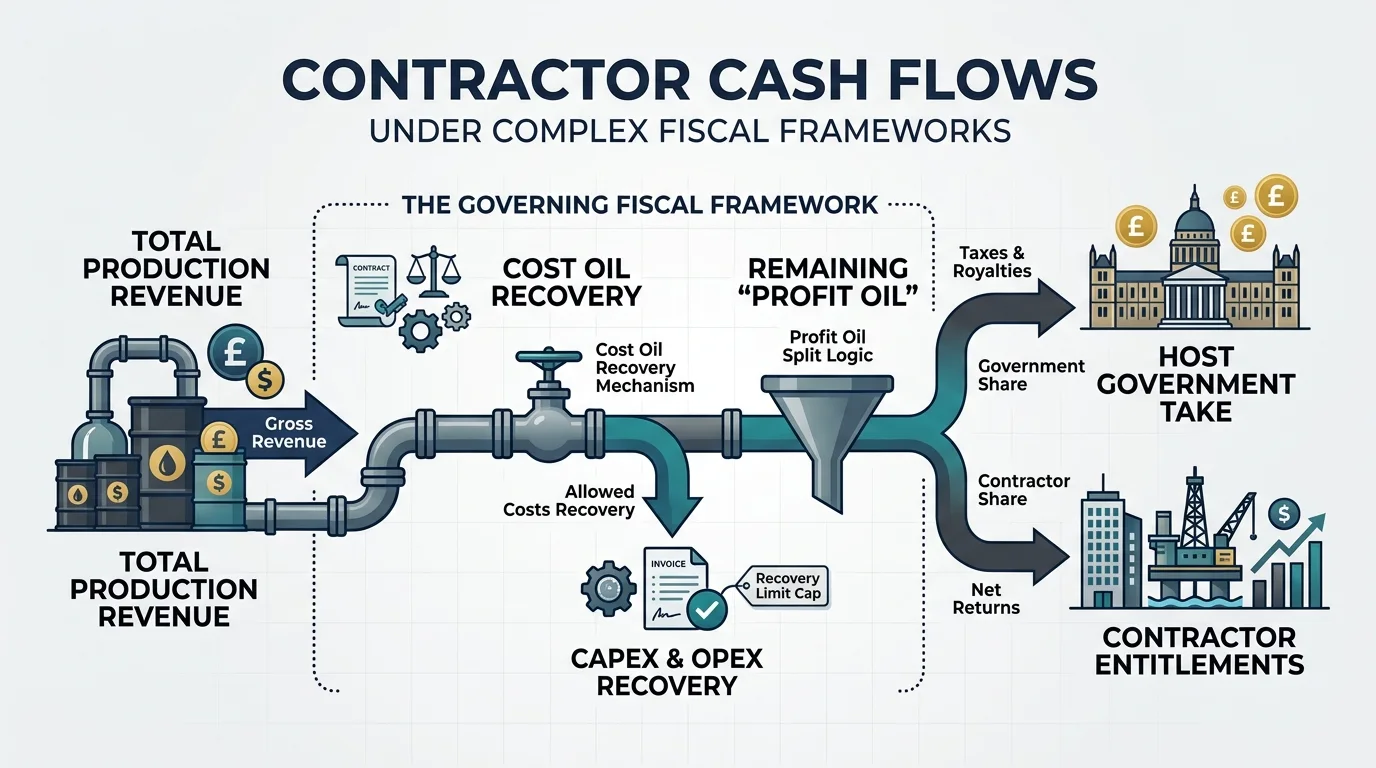
International petroleum agreements split economic rents between host governments and international oil companies through distinct mechanisms. Under Production Sharing Contracts, the calculation begins by establishing the entitlement schedule. Gross revenues first cover allowable expenditures via the cost oil calculation block, reimbursing capital and operating costs incurred by the contractor.
Remaining revenues, classified as profit oil, are distributed according to sliding-scale profit oil split logic that shifts dynamically with production rates or cumulative cash flows. The government take waterfall captures royalties, bonuses, and state equity shares, ultimately defining the contractor after-tax cash flow available for corporate distribution.
How does sensitivity testing isolate project risk under volatile commodity price and cost environments?
Sensitivity testing isolates project risk by systematically varying key commercial and technical drivers to measure their individual impact on Net Present Value and project returns.
Upstream investments operate in high-uncertainty environments characterized by volatile commodity prices, fluctuating capital expenditures, and reservoir performance variances. Sensitivity analysis constructs deterministic variations around baseline assumptions, testing variables such as Brent crude pricing, reservoir decline rates, initial production volumes, and capital expenditure overruns.
The resulting outputs populate an output dashboard, providing executive decision-makers with tornado charts and spider diagrams. These visualizations highlight which variables exert the most dominant influence on asset profitability, guiding risk mitigation strategies before final investment decisions occur.
How do HR teams and technical departments select advanced training solutions for commercial and economics teams?
Selecting specialist training solutions requires HR teams and technical managers to evaluate curriculum depth, practical modeling rigor, and alignment with real-world fiscal mechanics.

Corporate capability building in petroleum economics requires targeted educational frameworks that bridge theoretical finance with operational reality. Selecting Specialist Oilfield Economics & Project Evaluation Training for Commercial and Economics Teams ensures that evaluation personnel master complex fiscal regimes, cash flow modeling, and risk quantification.
To achieve complete proficiency in constructing integrated financial models from scratch, organizations rely on targeted upskilling programs such as the Financial Modelling for PSCs & JVs in Excel Training Course. This curriculum equips commercial teams to build robust model architectures that seamlessly integrate production profiles, fiscal terms, and sensitivity modules.
Frequently Asked Questions
What is oil and gas petroleum finance and why is it critical for upstream energy projects?
Oil and gas petroleum finance encompasses the specialized economic evaluation, capital budgeting, and fiscal modeling required to fund and manage upstream exploration and production assets. At the Institute For Oil & Gas Training, professional programs ensure commercial teams accurately project cash flows, manage capital expenditure risks, and navigate complex international fiscal regimes.
How do petroleum economists evaluate the profitability of upstream oilfield investments?
Petroleum economists evaluate upstream profitability by deploying key financial metrics such as Net Present Value, Internal Rate of Return, and Profit Investment Ratio under varying commodity price scenarios. Programs delivered by the Institute For Oil & Gas Training equip financial analysts with the skills to build robust Excel models that integrate production profiles and fiscal schedules.
What role do production sharing contracts play in oil and gas petroleum finance?
Production sharing contracts govern how revenues from upstream oilfields are split between host governments and international contractor companies through cost recovery and profit oil mechanisms. Understanding these legal and fiscal mechanics is a core component of oil and gas petroleum finance training provided by the Institute For Oil & Gas Training.
How do companies manage financial risk in oil and gas capital projects?
Companies manage financial risk in capital-intensive energy projects by conducting rigorous sensitivity testing, economic modeling, and portfolio risk assessments against volatile oil price benchmarks. Specialized courses from the Institute For Oil & Gas Training train finance professionals to isolate key cost and revenue variables to protect project profitability.
Who should undertake professional training in oil and gas petroleum finance?
Professional training in oil and gas petroleum finance is essential for commercial analysts, financial controllers, joint venture accountants, and asset evaluation managers operating within the upstream energy sector. The Institute For Oil & Gas Training designs industry-driven programs that bridge technical engineering data with measurable business and financial outcomes.
Related training courses
Risk Management for Upstream & Midstream Projects: Exposures Training Course
- Specialisation
- Oil & Gas Petroleum Compliance, AML & Risks
- Duration
- 5 days · 15 CPD hours
Segregation of Duties in Finance & ERP Systems Training Course
- Specialisation
- Oil & Gas Petroleum Compliance, AML & Risks
- Duration
- 5 days · 15 CPD hours
Consolidation & JV Structures for Petroleum Group Entities Training Course
- Specialisation
- Oil & Gas Petroleum Accounting
- Duration
- 5 days · 15 CPD hours
More articles

Fraud Risks in Petroleum Operations: What to Look for in Specialist Professional Training
Master petroleum financial crime detection with the Institute For Oil & Gas Training. Enroll in our specialized AML and crude trading compliance course.
Read article →
Integrating Fraud Risk Assessment, Forensic Accounting and AML Controls Across the Petroleum Lifecycle
Discover how to integrate fraud risk assessment forensic accounting and AML controls to combat trade based financial crime across the petroleum lifecycle.
Read article →
Why Fraud Risk Changes Across Exploration, Development and Production Activities
Discover how fraud risk shifts across petroleum exploration, development, and production. Master AML controls, forensic accounting, and risk management strategies.
Read article →