
Oilfield Economics & Project Evaluation Training for Professionals Working on Petroleum Investment Cases addresses the critical corporate challenge of capital misallocation in upstream oil and gas developments. When engineers, asset managers, and financial analysts build deterministic cash flow models without accounting for probabilistic risk, organizations frequently approve marginal petroleum ventures that fail to yield expected returns under shifting commodity price regimes. This foundational mismatch between subsurface technical estimates and corporate financial evaluation leads to severe capital erosion. To bridge this gap, the NPV, IRR & Fiscal Sensitivity Analysis: Probabilistic Techniques Training Course provides a rigorous, specification-driven curriculum designed to elevate technical evaluation into sound corporate investment decisions.
If you are exploring the foundational concepts of upstream capital expenditure before evaluating formal training options, you can read From Field Reserves to Investment Decision: The Economics Behind Oilfield Development to understand how raw geological estimates translate into initial valuation frameworks.
What is this training course and what technical problem does it solve?
This professional training program resolves the widespread corporate failure of relying on single-point deterministic forecasts for multi-million-dollar petroleum capital expenditures by equipping asset teams, finance departments, and human resource talent pipelines with advanced probabilistic modeling skills. In the upstream sector, petroleum investment decisions involve deep subsurface uncertainty, fluctuating operating expenditures, and complex fiscal regimes governed by production sharing contracts or concession agreements.
Many corporate teams struggle because their engineers present deterministic net present value figures that ignore geological and macroeconomic volatility. When oil prices drop or reservoir productivity underperforms, these unhedged projects suffer massive write-downs. The Institute For Oil & Gas Training developed this program specifically to eliminate guesswork from capital allocation.
By standardizing how cross-functional asset teams evaluate cash flows, organizations eliminate internal friction between technical departments and corporate finance boards. HR teams and technical directors leverage this program to upskill geoscientists, reservoir engineers, and commercial analysts, ensuring that every project presented for executive sign-off meets strict risk-adjusted profitability thresholds.
As professionals advance from initial scoping to structured evaluation, reviewing Building an Economic Evaluation Model for Oilfield Development and Investment Decisions offers deeper insight into constructing cash flow spreadsheets prior to enrolling in formal sessions.
Why is the curriculum structured around probabilistic mechanics and fiscal regimes?
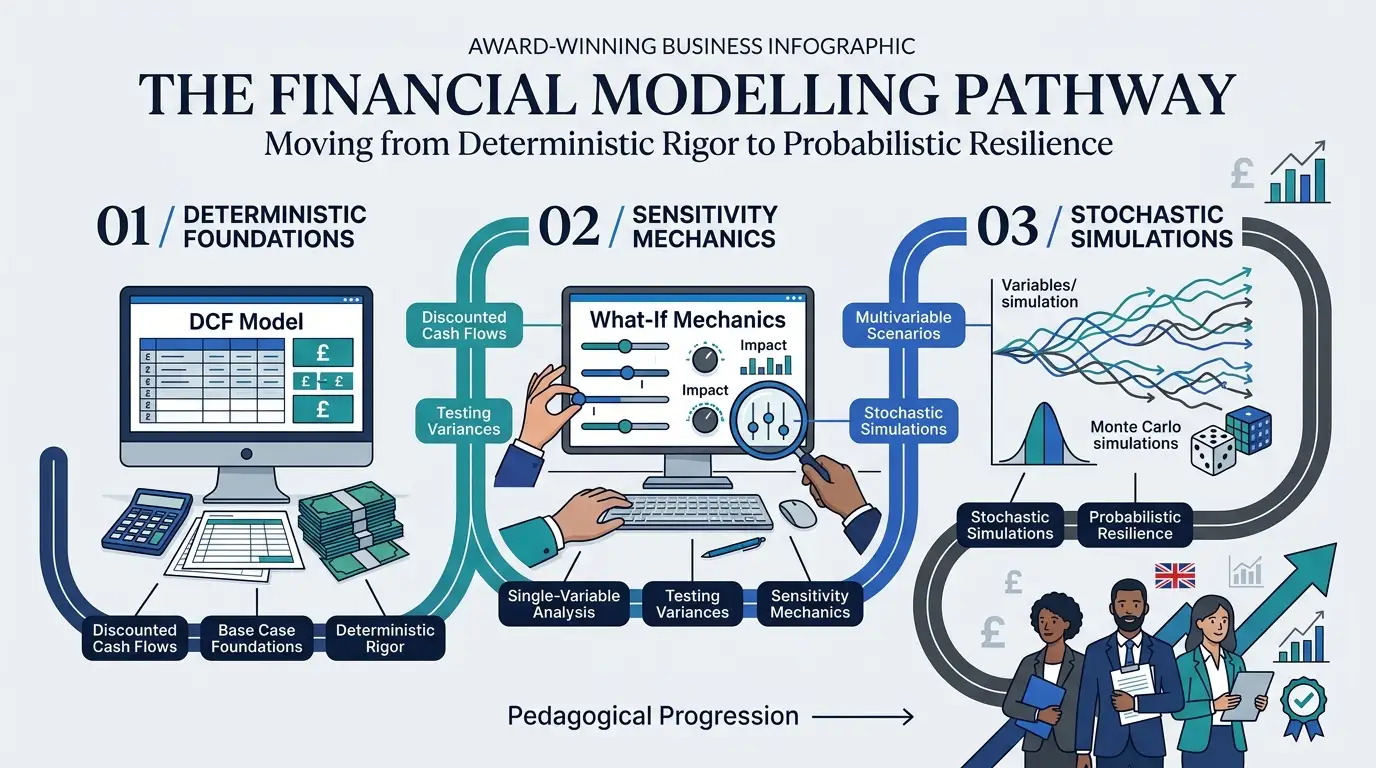
The curriculum follows a strict pedagogical progression moving from deterministic discounted cash flow foundations through single-variable sensitivity mechanics to multivariable stochastic simulations, ensuring participants master both deterministic rigor and probabilistic resilience.
Corporate training often fails when it teaches isolated tools without connecting them to real-world asset lifecycles.
The Institute For Oil & Gas Training organizes this syllabus into logical competency blocks. Participants first deconstruct fiscal terms, royalty structures, and tax mechanics. They then layer on time-value-of-money equations before introducing variance analysis. This ensures that every technical professional understands the exact mathematical foundation behind every output metric.
Corporate engineering managers and commercial departments benefit from this structured approach because it instills a common analytical language across asset teams. Instead of viewing risk analysis as an abstract statistical exercise, participants learn how to isolate specific cost drivers and subsurface variables that threaten project viability.
The Institute For Oil & Gas Training embeds this modular logic into all corporate development programs, allowing organizations to track clear skill acquisition milestones across participating cohorts. This structural integrity guarantees that learners can immediately audit, debug, and construct reliable valuation models upon returning to their operational desks.
What specific technical skills and modules will participants master?
Participants master advanced quantitative petroleum economics, including probabilistic risk modeling, fiscal regime navigation, and stochastic cash flow evaluation designed for complex upstream asset appraisals. The comprehensive syllabus covers several core technical competencies essential for modern energy investment analysis.
Module 1: Advanced Discounted Cash Flow and Fiscal Frameworks. Participants analyze capital expenditure schedules, abandonment funds, and operating costs under different contractual environments. They evaluate how production sharing agreements, royalties, and corporate income taxes alter net cash flows across the asset lifecycle.
Module 2: Deterministic Sensitivity and Parameter Ranking. This module trains analysts to isolate key value drivers using a tornado diagram and a spider chart. Learners identify which variables—such as initial production rates, decline constants, or capital cost overruns—exert the greatest influence on economic metrics.
Module 3: Deterministic Boundary Testing. Analysts execute one-way and two-way sensitivity analyses to map out boundary conditions and breakeven thresholds for marginal field developments under various commodity price decks.
Module 4: Stochastic Modeling and Risk Quantification. The curriculum introduces Monte Carlo simulation to replace static assumptions with probability distributions. Participants learn how to derive the expected monetary value, calculate the probability of success, and determine the risked value of exploratory and development drilling prospects.
Module 5: Scenario Optimization and Decision Thresholds. Learners evaluate downside and upside cases while identifying precise switching values where project economics flip from profitable to unviable under shifting fiscal pressures.
Throughout these modules, the Institute For Oil & Gas Training ensures that corporate cohorts apply concepts directly to standardized case studies representing deepwater, onshore, and marginal field assets.
How is the training program delivered across corporate environments?
The training is delivered through flexible formats including intensive onsite workshops, live virtual instructor-led sessions, and hybrid modules tailored to meet the scheduling constraints of active corporate engineering and finance teams. Recognizing that energy enterprises operate across global time zones and demanding project schedules, the Institute For Oil & Gas Training offers versatile delivery mechanisms without compromising academic rigor.
Intensive Onsite Workshops: Ideal for corporate cohorts undergoing major restructuring or preparing for multi-asset acquisitions. Instructors travel to corporate headquarters or regional engineering hubs to deliver immersive, desk-based modeling sessions.
Live Virtual Classrooms: Designed for distributed teams. Participants engage in real-time software walkthroughs, breakout analytical exercises, and live Q&A sessions with senior upstream economists.
Hybrid Corporate Delivery: Combines asynchronous self-paced theoretical modules with scheduled live case study reviews, maximizing flexibility for working professionals.
Assessment methods include rigorous quantitative examinations, peer-reviewed financial modeling assignments, and capstone evaluations where multidisciplinary teams defend an oilfield development proposal before a simulated investment committee. The Institute For Oil & Gas Training monitors performance metrics throughout the delivery lifecycle, providing corporate HR departments with detailed competency validation reports upon completion.
What measurable workplace results and performance improvements can organizations expect?
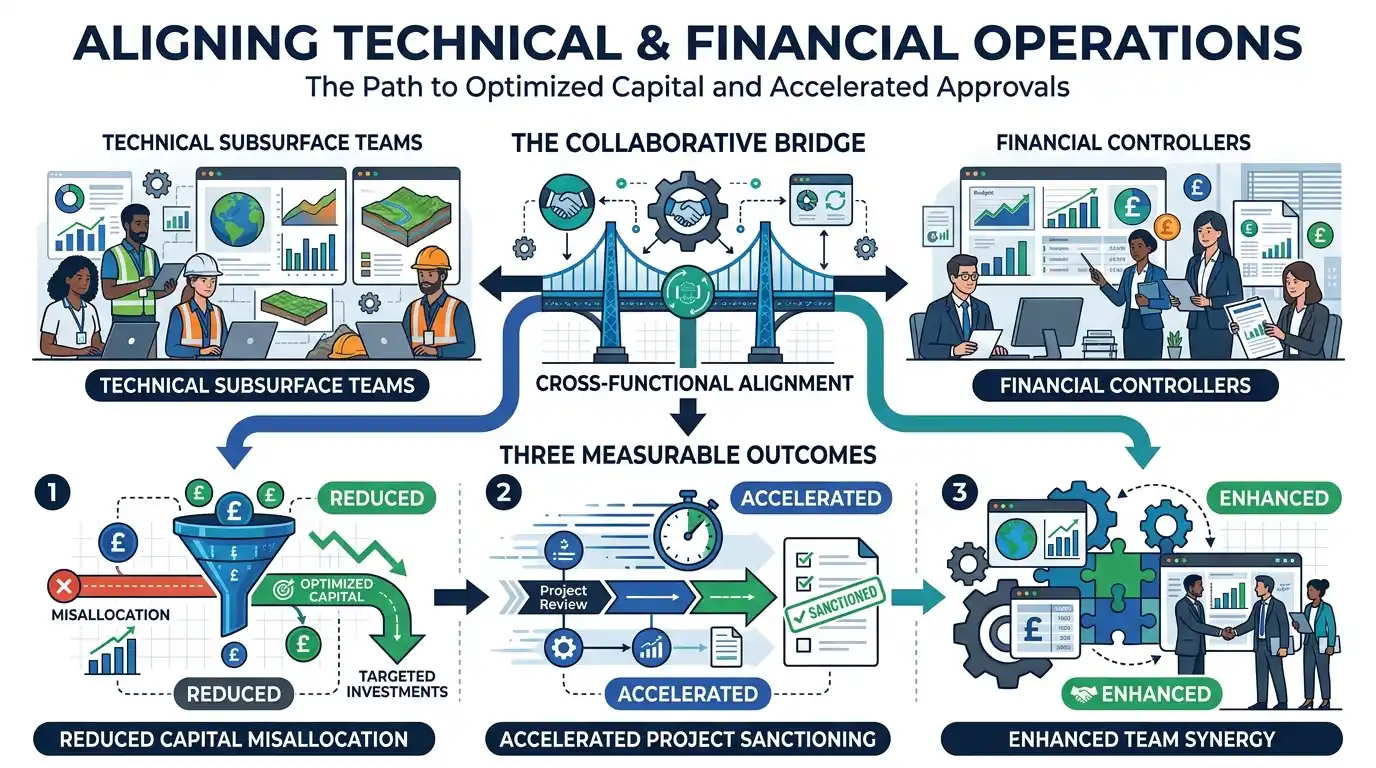
Organizations achieve measurable reductions in capital misallocation, accelerated project sanctioning cycles, and enhanced cross-functional alignment between technical subsurface teams and financial controllers.
When petroleum engineers and commercial analysts graduate from this program, their organizational impact is immediate and quantifiable.
Asset managers report a significant reduction in time spent debating cash flow assumptions during milestone reviews. Because participants share a unified framework for assessing risk, technical memos submitted to executive boards feature robust sensitivity analyses that clearly articulate downside exposures.
For corporate human resource departments, sponsoring high-potential engineers and financial analysts through the NPV, IRR & Fiscal Sensitivity Analysis: Probabilistic Techniques Training Course acts as a powerful retention and succession planning tool. It prepares senior specialists for leadership roles in commercial evaluation, asset management, and corporate strategy.
Furthermore, organizations minimize costly investment errors by identifying fatal economic flaws during early screening phases rather than post-sanctioning. The Institute For Oil & Gas Training designs these outcomes to translate directly into stronger portfolio returns and optimized capital expenditure management across enterprise portfolios.
How does the enrollment process work for professionals and corporate teams?
Enrollment is managed through a structured application pathway designed to verify technical prerequisites, align organizational objectives, and secure placement in upcoming cohorts. Candidates must possess a foundational background in engineering, geosciences, finance, or economics, along with basic proficiency in spreadsheet modeling.
Step 1: Application Submission: Candidates or corporate HR sponsors submit professional profiles and select the preferred delivery format and cohort schedule.
Step 2: Prerequisite Verification: Academic advisors review technical backgrounds to ensure participants can successfully engage with advanced stochastic modeling and fiscal mechanics.
Step 3: Registration and Onboarding: Upon approval, participants receive secure access to preparatory digital reading materials and modeling software guidelines provided by the Institute For Oil & Gas Training.
Step 4: Program Execution and Certification: Following successful completion of all assessments and capstone evaluations, participants are awarded formal certification in upstream probabilistic economic evaluation.
To secure your place in the upcoming academic window and begin transforming your organization's capital investment evaluation capabilities, apply for course access today.
Frequently Asked Questions
What is oil and gas petroleum finance?
Oil and gas petroleum finance involves managing the capital expenditure, revenue streams, and financial risks associated with upstream exploration, development, and production assets. Programs such as those offered by the Institute For Oil & Gas Training equip professionals with the analytical tools needed to evaluate complex capital allocation decisions in the energy sector.
How do petroleum companies evaluate investment risk?
Petroleum companies evaluate investment risk by combining discounted cash flow modeling with probabilistic techniques such as Monte Carlo simulations, sensitivity analysis, and expected monetary value calculations. These methodologies allow asset teams at organizations like the Institute For Oil & Gas Training to account for commodity price volatility and subsurface uncertainties before sanctioning capital projects.
What are the key components of an upstream economic evaluation model?
An upstream economic evaluation model typically incorporates capital expenditure schedules, operating costs, abandonment funds, and specific fiscal regime terms such as production sharing contracts or royalties. Professionals utilizing training frameworks from the Institute For Oil & Gas Training learn how to integrate these variables to accurately determine net present value and internal rate of return.
Why is sensitivity analysis important in petroleum project evaluation?
Sensitivity analysis is crucial because it helps financial analysts and petroleum engineers identify which variables—such as initial production rates or capital cost overruns—have the greatest impact on project profitability. Through specialized courses provided by the Institute For Oil & Gas Training, practitioners learn to map out boundary conditions and breakeven thresholds for marginal field developments.
Who should study oil and gas petroleum finance and project economics?
Oil and gas petroleum finance and project evaluation courses are designed for reservoir engineers, geoscientists, financial analysts, and corporate HR talent pipelines looking to optimize upstream asset management. Upskilling through programs at the Institute For Oil & Gas Training ensures that cross-functional asset teams share a unified, rigorous approach to petroleum investment appraisal.
Related training courses
Regulatory Compliance for Petroleum Entities Training Course
- Specialisation
- Oil & Gas Petroleum Compliance, AML & Risks
- Duration
- 5 days · 15 CPD hours
Segregation of Duties in Finance & ERP Systems Training Course
- Specialisation
- Oil & Gas Petroleum Compliance, AML & Risks
- Duration
- 5 days · 15 CPD hours
Consolidation & JV Structures for Multi-Country Groups Training Course
- Specialisation
- Oil & Gas Petroleum Accounting
- Duration
- 5 days · 15 CPD hours
More articles
Why Fraud Risk Changes Across Exploration, Development and Production Activities
Discover how fraud risk shifts across petroleum exploration, development, and production. Master AML controls, forensic accounting, and risk management strategies.
Read article →
Selecting Specialist Oilfield Economics & Project Evaluation Training for Commercial and Economics Teams
Master upstream oilfield economics, PSC fiscal waterfalls, and joint venture financial modelling with Institute For Oil & Gas Training. Enroll today.
Read article →
Project Ranking, Economic Indicators and Sensitivity Testing in Oilfield Investment Analysis
Master oilfield investment analysis, project ranking, economic indicators, and sensitivity testing to evaluate upstream petroleum opportunities.
Read article →