
Financial reporting in the petroleum sector requires navigating complex asset lifecycles, volatile commodity markets, and specialized accounting standards. Organizations transition from national regulatory frameworks to international standards under unique constraints. Finance teams evaluate reporting adjustments for exploration expenditures, asset retirement obligations, and joint venture arrangements. Stakeholders demand clarity on performance metrics despite ongoing gaps in international standard-setting bodies.
Managing these financial complexities starts with understanding the core regulatory landscape. Finance professionals explore foundational standards by reviewing Why IFRS Matters for Oil and Gas Companies and Their Financial Reporting, establishing how global transparency influences capital allocation and investor confidence. Decision-makers face distinct compliance hurdles that test existing financial systems and reporting governance.
What are the primary hurdles in applying the IFRS framework to extractive activities?
Applying the IFRS framework to extractive activities presents significant challenges because existing standards contain specific scope exemptions for mineral resources. Entities navigate the absence of a comprehensive international standard by developing accounting policies under IAS 8, balancing historical cost models with fair value adjustments across exploration, evaluation, and production phases.
Extractive operations span decades, involving multiple joint operators and complex production-sharing contracts. The International Accounting Standards Board defers comprehensive guidance on upstream activities, leaving finance teams to interpret generalized principles. Companies establish accounting policies that dictate whether exploration and evaluation expenditures are capitalized or expensed immediately. This policy choice directly impacts EBITDA, asset values, and debt-to-equity ratios.
Finance leaders evaluate different policy options based on asset maturity and risk appetite. The choice between the successful efforts method and the full cost method alters balance sheet visibility. Teams must document these choices meticulously to satisfy external auditors and regulatory bodies. Consistency in policy application remains paramount when operations span multiple tax jurisdictions and regulatory regimes.
How do companies manage accounting policy selection and industry-specific guidance gaps?
Companies manage accounting policy selection and industry-specific guidance gaps by establishing rigorous hierarchies under IAS 8 to analogize from existing standards. Finance executives draft customized accounting manuals that interpret general principles for specialized transactions like production-sharing agreements and farm-out arrangements.
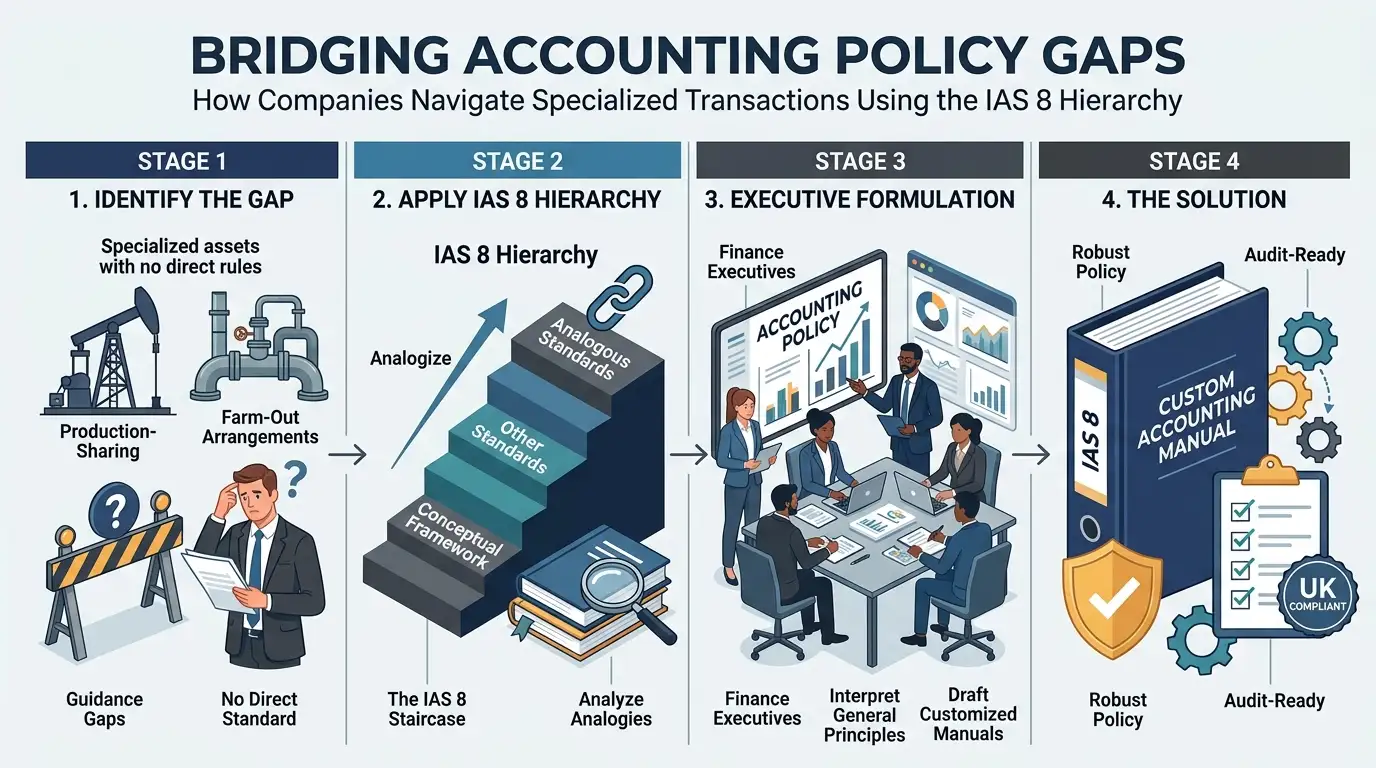
The absence of explicit rules for upstream transactions forces accounting committees to exercise significant professional judgment. Teams look to US GAAP guidance as a secondary reference point when IFRS remains silent on specific operational arrangements. This practice requires careful alignment to ensure compliance with the overarching conceptual framework of international reporting standards.
Organizations invest in specialized competency development to bridge these knowledge gaps. Professionals deepen their operational understanding by enrolling in the IFRS for Oil & Gas Entities Fundamentals Training Course to master policy formulation and risk management. Structured learning interventions ensure that finance staff members apply consistent methodologies across complex joint venture accounting and volumetric production payments.
What complexities arise during first-time adoption of IFRS versus national GAAP?
First-time adoption of IFRS versus national GAAP introduces extensive retrospective adjustments, restatement of historical asset values, and complex reconciliation statements. Entities recalculate property, plant, and equipment carrying amounts, reassess functional currencies, and evaluate embedded derivatives within long-term gas sales agreements.
Transitioning to international standards requires an opening balance sheet date that serves as the baseline for all subsequent reporting. Finance teams recalculate depreciation using component depreciation methods rather than aggregate asset pools. Asset impairment tests under IAS 36 demand granular cash-generating unit definitions that often do not align with historical national GAAP reporting structures.
Historical cost records for legacy oilfields frequently lack the detailed component data required for retrospective application. Companies apply statutory exemptions under IFRS 1 to use fair value as deemed cost for specific upstream assets upon transition. This pragmatic approach mitigates data retrieval barriers while establishing a reliable foundation for future reporting cycles.
How do entities address complex disclosure requirements and materiality judgements?
Entities address complex disclosure requirements and materiality judgements by implementing risk-based disclosure matrices that filter immaterial items while highlighting critical estimates. Finance teams balance voluminous note disclosures with clear explanations of sensitivities related to commodity price volatility and reserve estimations.
Regulatory bodies increase scrutiny over transparency in financial statements, demanding comprehensive disclosures regarding judgements and estimates. Oil and gas reporting requires detailed breakdowns of proved reserves, production volumes, and capital expenditure commitments. Finance departments establish quantitative and qualitative thresholds to determine which operational risks warrant explicit disclosure in the notes to the financial statements.
Materiality assessments require continuous review as market conditions shift and capital projects evolve. Teams evaluate whether climate-related risks and energy transition targets impact financial statement disclosures under existing standards. Clear communication prevents stakeholder confusion while satisfying stringent regulatory expectations across international exchanges.
What factors influence going concern assessments in volatile commodity markets?
Going concern assessments in volatile commodity markets depend on liquidity forecasts, debt covenant compliance, and projected cash flows derived from benchmark crude prices. Finance directors model severe downside stress scenarios to evaluate operational continuity over a mandatory twelve-month outlook period.
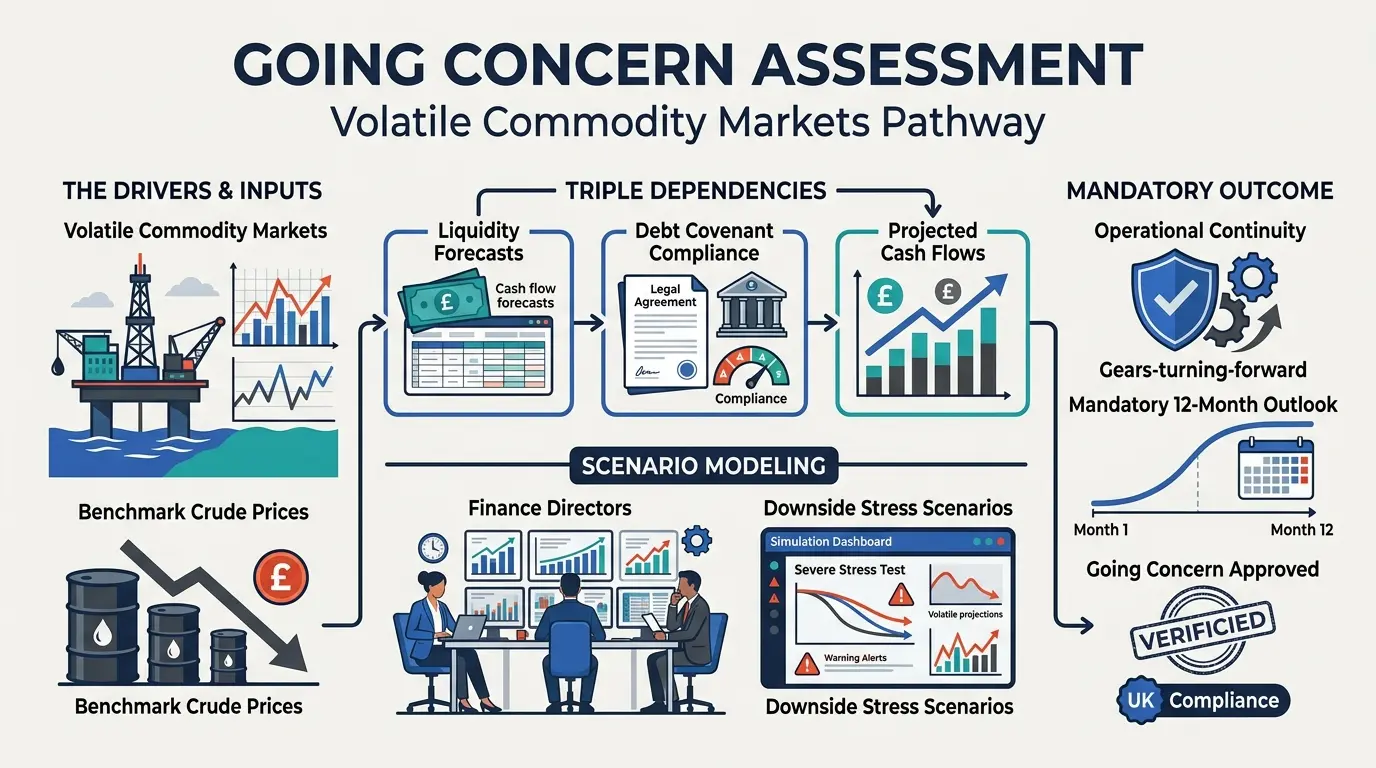
Commodity price fluctuations directly threaten operational viability for upstream producers with high debt burdens. Accountants evaluate financial resilience by stress-testing cash flow projections against sustained low-price environments. Compliance with financial covenants tied to EBITDA and net debt ratios becomes precarious when asset impairments reduce borrowing bases.
Management teams document mitigating strategies, including asset divestments, capital expenditure curtailments, and credit facility extensions. These documented assumptions form the core of disclosures regarding material uncertainties related to going concern. Auditors demand robust evidence and sensitivity analyses to support clean audit opinions in cyclical operating environments.
Strategic Alignment and Workforce Readiness
Addressing these financial reporting challenges requires more than technical compliance; it demands organizational alignment and continuous skill development. Finance leadership teams assess internal capabilities to identify knowledge gaps surrounding complex accounting treatments. Structured training initiatives bridge the divide between theoretical accounting standards and practical field-level transactions.
Organizations maximize reporting accuracy by embedding standardized learning pathways into their professional development frameworks. Upskilling financial controllers and reporting managers reduces restatement risks and improves audit efficiency. Enterprises that invest in targeted technical education maintain resilient reporting systems capable of withstanding regulatory scrutiny and market volatility.
Frequently Asked Questions
What are the main challenges in IFRS financial reporting for oil and gas companies?
Oil and gas companies face complex reporting challenges due to the lack of a comprehensive international standard for extractive activities. The Institute For Oil & Gas Training helps finance professionals navigate these hurdles by focusing on specialised accounting policy selection, asset retirement obligations, and impairment testing under Oil and Gas Petroleum IFRS & Financial Reporting frameworks.
How does IFRS impact exploration and evaluation accounting in the petroleum sector?
Under the IFRS framework, companies must establish robust accounting policies under IAS 8 to determine whether exploration and evaluation expenditures are capitalized or expensed. Programs provided by the Institute For Oil & Gas Training equip accounting teams with the practical methodologies needed to manage these complex extractive asset lifecycles effectively.
What should be considered during the first-time adoption of IFRS for energy firms?
First-time adoption requires extensive retrospective adjustments, recalculation of property, plant, and equipment carrying amounts, and the reassessment of functional currencies. The Institute For Oil & Gas Training addresses these transition hurdles through structured Oil and Gas Petroleum IFRS & Financial Reporting education, ensuring compliance with statutory exemptions and IFRS 1 guidelines.
Why is going concern assessment critical for oil and gas financial reporting?
Commodity price volatility and high debt burdens make going concern evaluations essential for determining operational continuity over a twelve-month outlook period. Through targeted learning pathways, the Institute For Oil & Gas Training prepares finance directors to model severe downside stress scenarios and maintain covenant compliance.
How do finance teams handle specialized disclosures in upstream petroleum accounting?
Finance teams must balance voluminous note disclosures with clear explanations regarding commodity price sensitivities, reserve estimations, and joint venture arrangements. The Institute For Oil & Gas Training enhances workforce readiness in Oil and Gas Petroleum IFRS & Financial Reporting, enabling professionals to apply precise materiality judgements across international exchanges.
Related training courses
Regulatory Compliance for Petroleum Entities Training Course
- Specialisation
- Oil & Gas Petroleum Compliance, AML & Risks
- Duration
- 5 days · 15 CPD hours
Consolidation & JV Structures for Petroleum Group Entities Training Course
- Specialisation
- Oil & Gas Petroleum Accounting
- Duration
- 5 days · 15 CPD hours
Consolidation & JV Structures for Multi-Country Groups Training Course
- Specialisation
- Oil & Gas Petroleum Accounting
- Duration
- 5 days · 15 CPD hours
More articles

Key Revenue Recognition Challenges for Oil and Gas Companies Under IFRS
Explore key IFRS revenue recognition challenges in oil and gas, covering IFRS 15, IFRS 11 joint arrangements, IAS 36 impairments, and IAS 16 assets.
Read article →
Why Revenue Recognition Matters for Oil and Gas Companies
Discover how oil and gas companies master revenue recognition through targeted B2B workforce training, improving compliance and financial accuracy.
Read article →
IFRS for Oil and Gas Entities Fundamentals Training for Financial Reporting Professionals
Master IFRS for oil and gas entities. Enhance reporting compliance, impairment skills, and disclosure accuracy with Institute For Oil & Gas Training.
Read article →