

Determining the commercial viability of an upstream oil and gas asset requires evaluating how fiscal regimes alter project economics. A pre-tax break-even price indicates technical extraction efficiency, but government take ultimately dictates corporate profitability. Upstream commercial teams must evaluate production sharing contracts, concessionary tax-royalty models, and service agreements to establish accurate revenue thresholds.
Establishing robust financial models is necessary to navigate shifting fiscal policies, inflationary pressures, and field decline curves. A complete evaluation requires understanding Why Fiscal Terms Matter in Break Even Oil Price Analysis for Oil and Gas Projects to ensure capital allocation aligns with long-term portfolio resilience. Corporate planning units use these assessments to compare asset performance across diverse international jurisdictions before making capital commitments.
How Do Government Take Metrics Alter Post-Tax Break-Even Points?
Government take directly increases post-tax break-even oil prices by reducing the net cash flow available to asset operators. Higher tax rates, sliding-scale royalties, and stringent cost recovery caps raise the minimum crude price needed to achieve a zero net present value.
Fiscal regimes determine the distribution of cash flows between national oil companies and international operators. A pure tax-and-royalty system applies fixed percentage deductions directly to gross revenue regardless of operational expenses. High initial royalty rates elevate the upfront cash flow barrier, shifting the post-tax break-even threshold significantly higher than the technical extraction cost.
Production sharing contracts introduce cost oil and profit oil mechanisms that alter cash timing. Cost recovery ceilings cap the percentage of annual production allocated to reimburse capital and operating expenditures. When development costs exceed these caps, cost recovery delays reduce early-year cash flows, driving up the discount-adjusted break-even price.
Upstream analysts measure the total government take impact on break-even metrics across multi-decade concession periods. Tax allowances, ring-fencing provisions, and depreciation schedules offset high nominal tax rates. Effective financial modeling isolates these fiscal instruments to reveal how progressive fiscal terms adjust automatically to rising crude prices while regressive terms penalize low-margin developments.
What Role Does Cost Inflation Play in Fiscal Break-Even Calculations?
Cost inflation inflates operational and capital expenditure baselines, forcing fiscal break-even prices higher. Escalating service rates and material expenses erode operator margins, requiring higher benchmark crude prices to satisfy cost recovery mechanisms and statutory tax obligations.
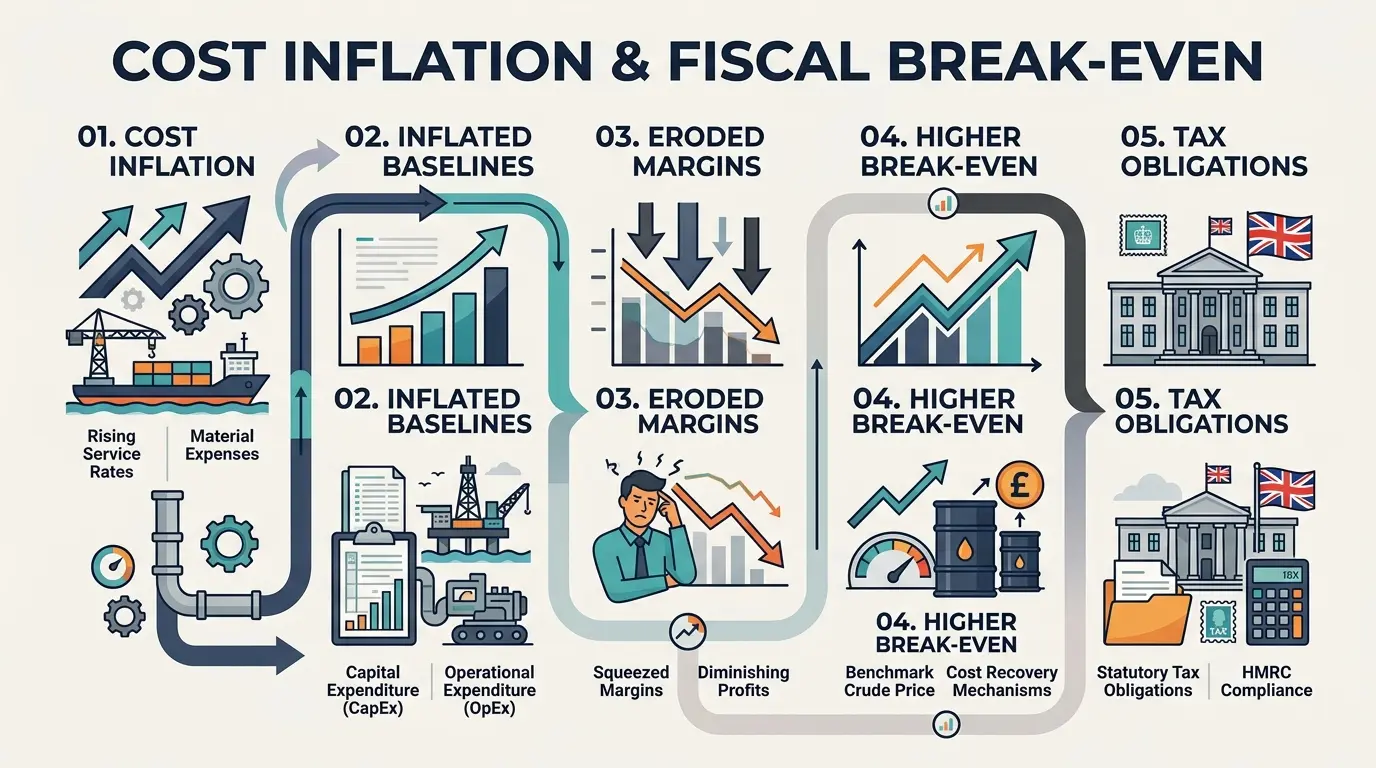
Oilfield service inflation rapidly distorts fixed fiscal assumptions within long-term field development plans. Equipment rates, offshore supply logistics, and specialized labor costs drive capital expenditure beyond original projections. When operational expenses rise faster than benchmark crude prices, asset economics deteriorate rapidly.
Analysts perform rigorous cost escalation sensitivity modeling to evaluate project resilience under sustained inflationary conditions. In production sharing contracts with strict cost caps, unrecovered cost pools accumulate during periods of high service cost inflation. The operator absorbs these unrecovered costs, which prevents the fiscal model from returning expected margins at baseline oil prices.
Rising capital costs defer the tax-paying stage in progressive fiscal systems, but regressive systems continue collecting fixed royalties from gross revenue. This structural divergence increases corporate vulnerability during low-price environments. Financial planners must recalculate price floors continually to ensure field operations cover escalating operating expenditures without eroding net asset value.
How Do Finance Teams Evaluate Hedged Versus Unhedged Price Floors?
Finance teams evaluate hedged price floors by replacing spot price assumptions with locked derivative contracts to establish guaranteed baseline cash flows. Unhedged price floors expose the asset directly to market volatility, requiring higher fiscal cushions to prevent cash shortfalls.
Managing commodity price volatility requires structural risk mitigation within upstream portfolio planning. Corporate treasurers establish derivative structures, including fixed-swap contracts and zero-cost collars, to secure revenue stability. Evaluating a hedged versus unhedged price floor helps commercial teams isolate operational risks from broader market fluctuations.
Derivative hedging guarantees specific revenue inflows, enabling operators to service debt commitments and fulfill capital expenditure schedules under restrictive fiscal terms. In high-tax jurisdictions, fixed revenues allow precise calculation of taxable income and royalty tiers, eliminating sudden fiscal shifts caused by spot price spikes. Unhedged assets remain fully exposed to spot price declines, which can push net cash flows below royalty obligations.
Financial planners assess how hedging programs support cash distribution goals. Maintaining a steady dividend payout ratio requires aligning derivative floor prices with total operational costs, tax liabilities, and capital reinvestment targets. A structured hedging strategy protects the asset against sudden market downturns while maintaining compliance with host government fiscal covenants.
How Does Fiscal Structure Impact Corporate Cash Break-Even Levels?
Fiscal structures dictate the exact revenue required to satisfy operational expenses, government royalties, debt servicing, and statutory corporate distributions. Flexible fiscal terms lower corporate cash break-even levels, whereas rigid revenue-based royalties compress operational margins and increase liquidity risk.
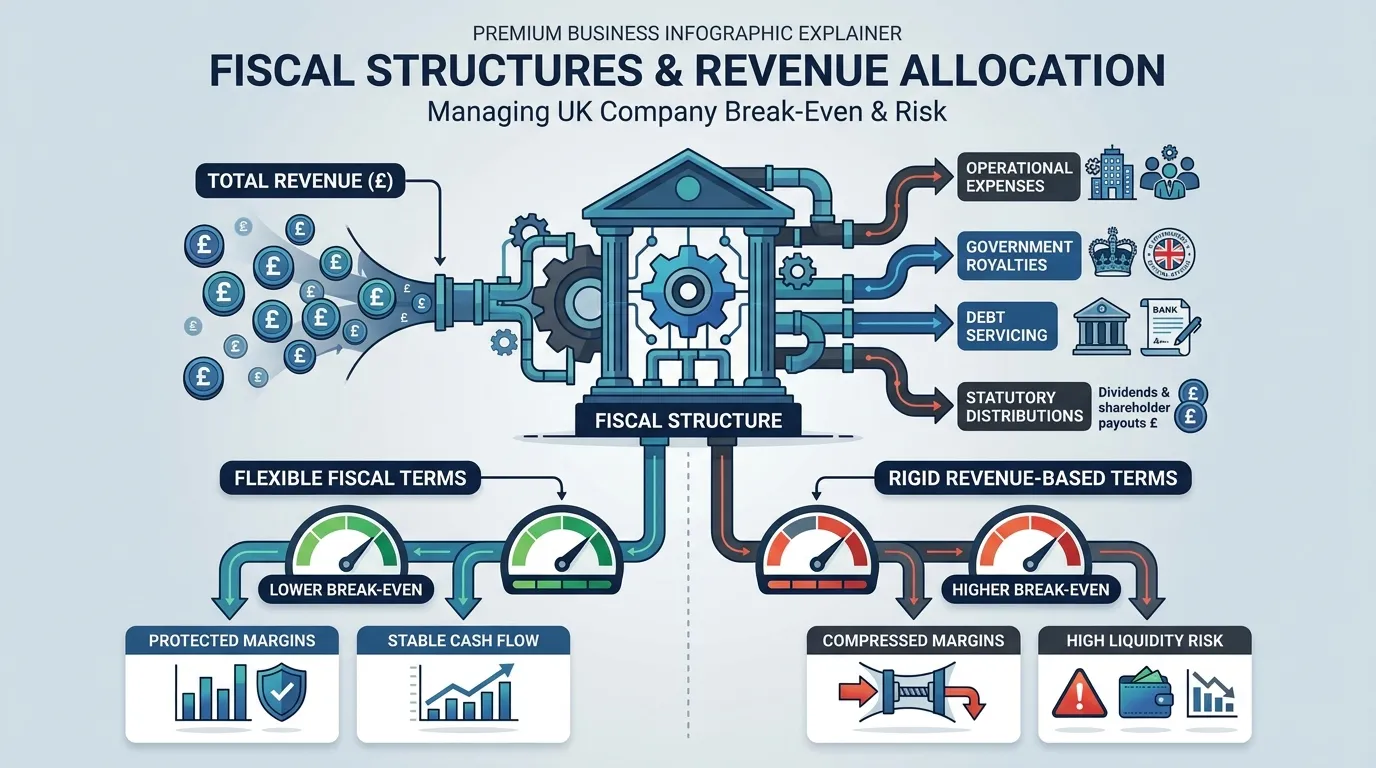
Corporate financial health depends on maintaining cash flows above baseline spending commitments. Unlike project-level discount models, the corporate cash break-even price represents the realized oil price needed to achieve neutral cash flow across all corporate operations. High government take directly increases this threshold by siphoning off operational income before administrative and financing obligations are met.
Integrated oil companies must maintain a dividend covering oil price to preserve investor confidence and sustain equity valuations. When government fiscal terms prioritize immediate state revenue over operator return, corporate treasury departments must divert cash from asset reinvestment to cover capital costs and shareholder returns. This capital compression reduces overall corporate flexibility.
Financial leaders evaluate fiscal terms across the entire asset portfolio to balance high-margin, high-risk production sharing contracts with stable tax-and-royalty concessions. Cross-border asset diversification mitigates country-specific fiscal risks, lowering the enterprise-wide cash break-even point and protecting balance sheets during multi-year commodity downturns.
Which Framework Best Compares Upstream Fiscal Regimes?
Selecting the appropriate fiscal comparison methodology depends on the technical stage, geographical location, and capital structure of the asset portfolio. Commercial evaluation teams use structured analytical models to rank fiscal regimes based on risk distribution, cash flow timing, and long-term yield.
Evaluation Metric | Concessionary Tax/Royalty System | Production Sharing Contract (PSC) | Risk Service Contract (RSC) |
Primary Revenue Driver | Equity production minus royalties | Cost oil and profit oil allocation | Fixed service fee per barrel |
Government Take Timing | Immediate through gross royalties | Deferred until cost recovery cap | Tied to operational milestones |
Inflation Absorption | Operator absorbs expense increases | Expense offset via cost oil pool | State entity reimburses capped costs |
Break-Even Sensitivity | Highly sensitive to gross revenue | Sensitive to cost recovery limits | Sensitive to fee payment delays |
Capital Recovery Speed | Dependent on tax depreciation rates | Rapid early recovery via cost oil | Structured fee payment schedule |
Concessionary models offer operational autonomy but impose fixed royalty burdens that elevate early-stage price floors. Production sharing arrangements provide structural cost protection through cost oil allocations, provided inflation does not breach contract cost caps. Service contracts eliminate market price exposure but introduce counterparty credit risk and capped operational upside.
Commercial management teams apply standardized metrics to evaluate these trade-offs across capital budgets. Analyzing fiscal structures through unified economic parameters ensures consistent capital allocation across competing global opportunities.
How Do Organizations Build Analytical Capability for Fiscal Analysis?
Building internal capability in economic evaluation requires structured professional development focused on advanced fiscal modeling, contract analysis, and risk management. Corporate learning initiatives ensure finance, planning, and commercial operations teams interpret complex contract mechanics accurately.
Organizations choose between internal workshops, university partnerships, and specialized corporate training providers. Interactive corporate programs offer practical exposure to live fiscal frameworks, contract negotiation simulations, and sensitivity modeling software.
Corporate decision-makers evaluate training solutions based on practical relevance, delivery efficiency, and measurable business performance outcomes. Upskilling financial analysts directly reduces external advisory costs while improving capital deployment precision.
Teams preparing to manage complex fiscal regimes benefit from targeted instruction. The Break-Even Oil Price Analysis Under Fiscal Terms Training Course provides commercial professionals with practical frameworks to quantify fiscal risk, evaluate contract structures, and calculate resilient break-even metrics across diverse host-nation environments.
How Should Management Select the Optimal Fiscal Evaluation Approach?
Selecting an evaluation model requires matching organizational capabilities with the complexity of the host country's contractual framework. Executive leadership must adopt a systematic selection process to validate economic assumptions before committing capital.
Executives choose between dynamic cash flow modeling, probabilistic decision-tree analysis, and multi-scenario stress testing. Applying Break Even Oil Price Analysis Under Fiscal Terms Training for Oil and Gas Finance Professionals ensures evaluation teams apply rigorous analytical methods during asset screening and contract negotiation.
Selection Criterion | Dynamic Cash Flow Modeling | Probabilistic Monte Carlo | Multi-Scenario Stress Testing |
Primary Use Case | Baseline NPV and IRR calculation | Risk quantification and range mapping | Severe downturn resilience testing |
Fiscal Data Input | Deterministic contract terms | Variable range fiscal parameters | Boundary-condition fiscal shocks |
Target Audience | Project finance analysts | Investment committee members | Executive board and risk managers |
Decision Output | Base break-even oil price | Probability of achieving target return | Minimum survival price floor |
Adopting dynamic scenario modeling allows planning departments to perform continuous resilience testing across macro-economic cycles. Stress-testing asset models against extreme fiscal revisions, unexpected cost inflation, and commodity price collapses prevents premature capital deployment into fragile assets.
Organizations that standardize these analytical processes improve investment efficiency and capital preservation. Decision-makers maintain total visibility over fiscal risks, ensuring the corporate portfolio remains profitable across all commodity price environments.
Frequently Asked Questions
What is oil and gas petroleum financial analysis?
Oil and gas petroleum financial analysis is the strategic evaluation of capital allocation, fiscal terms, reserve valuation, and operating economics within upstream, midstream, and downstream assets. Financial analysts use this process to model production cash flows, project break-even commodity prices, and assess tax regime risks before making capital expenditure decisions. The Institute For Oil & Gas Training delivers specialized Oil and Gas Petroleum Financial Analysis programs designed to build these analytical capabilities across corporate finance and commercial planning teams.
What are the key components of petroleum financial modeling?
The key components of petroleum financial modeling include forecasting production decline curves, evaluating production sharing contracts, and calculating discounted cash flow metrics such as net present value and internal rate of return. Analysts must also incorporate sensitivity modeling for commodity price volatility, cost recovery caps, and host government royalty structures to determine asset commerciality. Corporate professionals master these modeling frameworks through hands-on Oil and Gas Petroleum Financial Analysis instruction provided by the Institute For Oil & Gas Training.
Why is petroleum financial analysis important for energy companies?
Petroleum financial analysis provides corporate leaders and investors with objective data required to manage capital risk, optimize project portfolios, and navigate volatile energy markets. Accurate commercial evaluations ensure upstream companies account for capital expenditure inflation, tax liabilities, and regulatory burdens prior to sanctioning major field developments. Corporate training in Oil and Gas Petroleum Financial Analysis from the Institute For Oil & Gas Training ensures commercial decision-makers apply consistent evaluation standards across global energy assets.
How do fiscal terms affect petroleum project returns?
Fiscal terms directly dictate net cash flow distribution between host governments and operating companies through royalties, profit oil shares, and corporate tax obligations. Progressive and regressive fiscal systems alter project break-even prices and shift capital recovery timelines, impacting long-term return on investment. The Institute For Oil & Gas Training teaches commercial managers how to model diverse international fiscal regimes through practical Oil and Gas Petroleum Financial Analysis courses.
How can professionals improve their oil and gas financial analysis skills?
Professionals can enhance their financial analysis skills by completing practical training programs focused on advanced cash flow modeling, capital budgeting techniques, and fiscal risk management. Engaging with real-world industry case studies enables analysts to evaluate real-option valuation, joint venture accounting, and portfolio resilience under market stress scenarios. The Institute For Oil & Gas Training offers structured corporate programs in Oil and Gas Petroleum Financial Analysis to rapidly build these decision-critical capabilities.
Related training courses
Petroleum Refinery Processes & Operations Training Course
- Specialisation
- Oil & Gas Process Engineering and Operations
- Duration
- 5 days · 15 CPD hours
API RP 1188 Hazardous Liquid Pipeline Facilities Integrity Training Course
- Specialisation
- Oil & Gas Pipeline Integrity and Inspection
- Duration
- 5 days · 15 CPD hours
Corrosion Control in Petroleum Refineries Training Course
- Specialisation
- Oil & Gas Corrosion Management and Control
- Duration
- 5 days
More articles

Production Forecasting and Decline Curve Analysis Training for Oil and Gas Finance Professionals
Master production forecasting and decline curve analysis. Evaluate reservoir performance for oil and gas financial planning.
Read article →
How to Evaluate Production Forecasts and Decline Curves for Reliable Financial Analysis
Learn how to evaluate production forecasts and decline curves to improve financial modeling, risk assessments, and asset valuations in oil and gas.
Read article →
Why Production Forecasting and Decline Curve Analysis Matter in Oil and Gas Financial Planning
Discover why production forecasting and decline curve analysis drive oil and gas financial planning, workforce capability, and corporate capital allocation.
Read article →