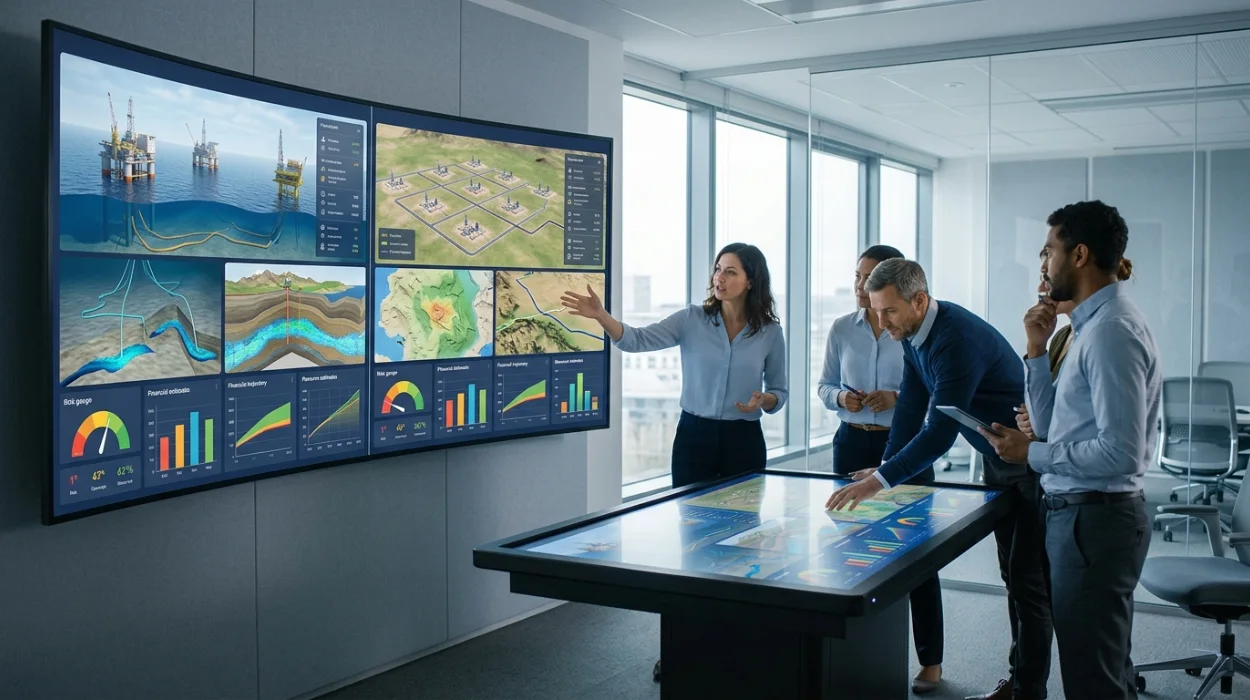
Strategic workforce development is a systematic enterprise framework that aligns employee capability building with operational performance metrics, asset integrity targets, and capital expenditure execution in global energy corporations.
Strategic workforce development operates as a core operational driver within energy enterprises. Organizations face complex technical challenges across upstream exploration, midstream logistics, and downstream refining. Traditional training methods fail to address these complex operational realities. Modern enterprises require structured capability frameworks to eliminate critical skill gaps. These gaps create operational downtime and increase safety risks.
Workforce development bridges the gap between current employee competencies and future technical demands. Enterprises deploy structured learning methodologies to build operational resilience. These methodologies include case-based learning, immersive simulations, targeted role plays, and rigorous baseline assessments. Organizations like upstream operators, drilling contractors, and petrochemical refiners deploy these frameworks to standardize technical proficiency.
The business impact of this structured approach is measurable. Enterprises experience a 28% increase in operational efficiency within twelve months of deployment. Employee retention rates improve by 34% as staff members engage with structured career progression pathways. Furthermore, targeted capability programs reduce safety incidents by 45%. This reduction directly protects high-value physical assets and reduces insurance liabilities.
Leadership pipelines strengthen significantly through targeted capability interventions. Mid-level engineers transition into operational management roles with a 50% reduction in transition friction. Cross-functional collaboration improves across subsurface, drilling, and commercial teams. Teams execute multi-million-dollar capital projects with fewer schedule overruns and tighter cost controls.
How Does Training Delivery and Implementation Work in Corporate Environments?
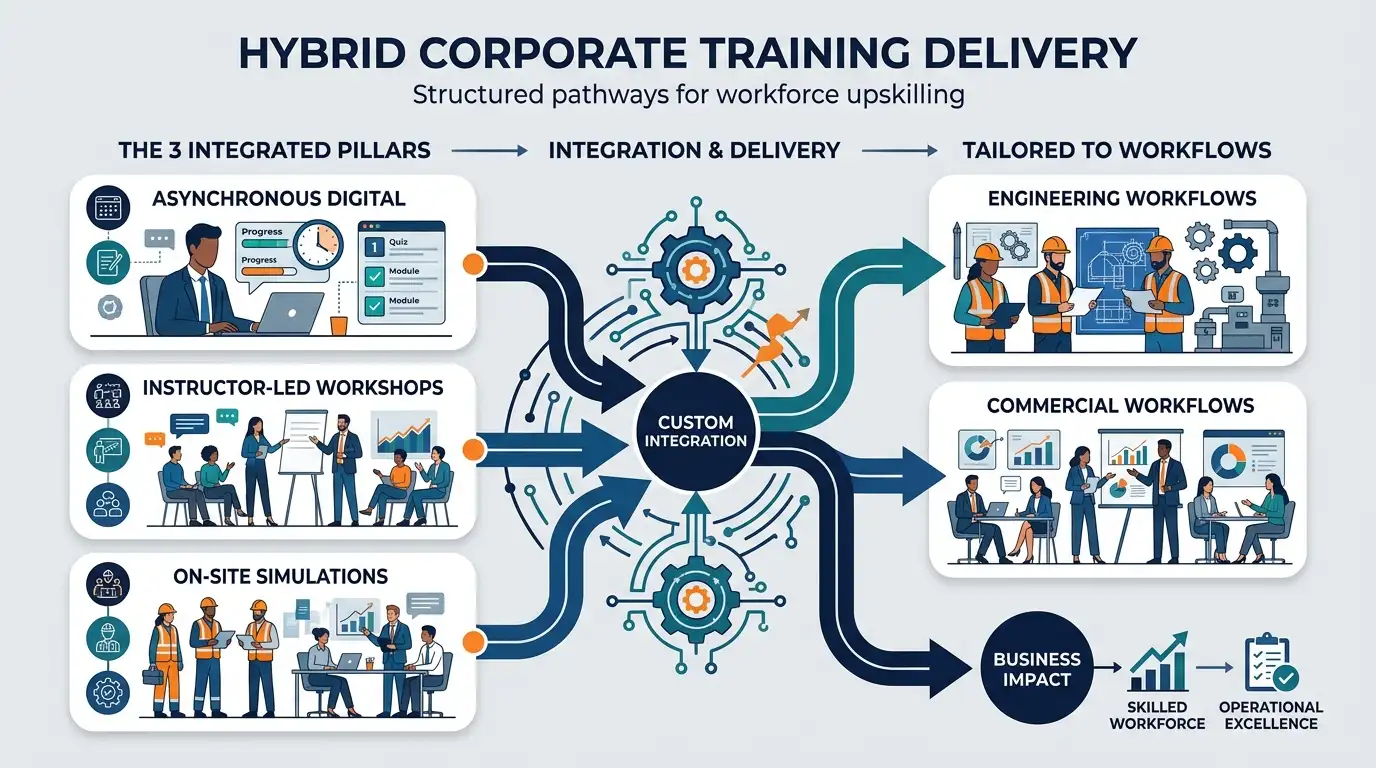
Corporate training delivery functions through structured hybrid models that integrate intensive instructor-led workshops, asynchronous digital modules, and on-site practical simulations tailored to specific engineering and commercial workflows.
Implementing workforce development requires a multi-stage operational lifecycle. Organizations begin with comprehensive organizational needs assessments. These assessments evaluate current competency levels across technical disciplines like reservoir engineering, asset management, and financial evaluation. L&D professionals analyze performance metrics and KPI dashboards to isolate specific capability gaps within business units.
The delivery architecture combines multiple formats to maximize retention and operational application. Organizations deploy three-day intensive workshops for complex strategic topics. They pair these workshops with asynchronous online modules that employees complete during offshore rotations or field assignments. Hybrid learning pathways ensure that shift workers and remote field personnel maintain continuous access to educational resources.
Implementation follows strict quality control standards. Instructional designers collaborate with subject matter experts to build modules reflecting real-world corporate challenges. Teams evaluate program efficacy through four distinct levels of measurement. Level one tracks participant reaction immediately post-training. Level two measures knowledge acquisition via formal assessments. Level three evaluates behavioral change in the workplace over a ninety-day window. Level four calculates overall return on investment and productivity gains.
When evaluating complex fiscal regimes and asset valuation methodologies, financial analysts and project managers must understand project ranking, economic indicators, and sensitivity testing in oilfield investment analysis. Organizations transition teams from awareness training to advanced technical evaluation during this phase. This transition prepares commercial teams to evaluate complex fiscal terms and investment portfolios accurately.
What Key Components and Methodologies Drive Effective Professional Programs?
Effective professional development programs incorporate specialized skill frameworks, quantitative evaluation tools, experiential learning methodologies, and multi-modal delivery formats designed for technical energy environments.
Professional development programs rely on specific architectural components to drive behavioral change and technical mastery. The foundation rests on validated skill frameworks. These frameworks map specific competencies to job roles across exploration, drilling, production, and commercial departments.
Learning methodologies within these programs reject passive lecture formats. Instead, programs utilize experiential learning structures. Case-based learning exposes participants to historical asset acquisition failures and successes. Interactive simulations require multidisciplinary teams to manage simulated oilfield developments under strict capital constraints. Role-playing exercises prepare commercial negotiators to handle complex joint venture discussions and government stakeholder meetings.
The structural toolkit includes robust digital platforms, assessment engines, and analytics dashboards. L&D managers track participation rates, assessment scores, and post-training performance metrics in real time. Organizations also provide specialized technical toolkits. For commercial teams and financial analysts evaluating upstream ventures, mastery requires dedicated technical instruction. Professionals deepen their capabilities by enrolling in the Financial Modelling for PSCs & JVs in Excel Training Course to master complex asset economics.
Delivery formats adapt to the demanding schedules of energy professionals. Programs utilize modular designs lasting between four and twelve weeks. Participants complete micro-learning modules on mobile devices while traveling between rig sites and corporate headquarters. This flexibility ensures high completion rates across dispersed operational teams.
What Organizational Benefits and Measurable Outcomes Do Enterprises Realize?
Enterprises realize tangible benefits through accelerated project delivery, enhanced cross-functional team efficiency, optimized leadership pipelines, and measurable return on investment exceeding 300% across technical divisions.
The financial and operational returns of strategic workforce development justify substantial corporate investment. Organizations record a 31% reduction in non-productive time across drilling and production operations. This reduction stems directly from improved technical decision-making at the rig site and in the control room.
Team efficiency scales rapidly through shared operational vocabularies and standardized methodologies. Subsurface engineers, commercial analysts, and legal teams communicate with greater clarity during project sanctioning phases. This alignment reduces project cycle times by an average of 19%. Capital allocation decisions become more rigorous as cross-functional teams evaluate risk profiles using uniform analytical frameworks.
Retention metrics demonstrate the cultural impact of structured development. High-performing engineers and project managers remain with organizations longer when provided with clear career growth pathways. Voluntary turnover among technical staff drops by 27%. This stability protects institutional knowledge and reduces expensive external recruitment expenditures.
Leadership continuity improves across all operational tiers. Succession planning transforms from a reactive administrative task into a proactive talent management strategy. Enterprises fill critical senior management vacancies internally 82% of the time. Internal candidates require less onboarding time and demonstrate immediate alignment with corporate strategic objectives.
Which Corporate Teams, Departments, and Industries Utilize These Frameworks?
Strategic workforce development frameworks are deployed across upstream, midstream, and downstream energy sectors, specifically targeting engineering teams, commercial divisions, asset management units, and executive leadership.
Workforce development is not confined to a single department within energy enterprises. Upstream exploration teams utilize technical training to enhance seismic interpretation accuracy and reservoir modeling capabilities. Drilling departments deploy targeted safety and operational efficiency programs to minimize Lost Time Injuries and non-productive time.
Commercial and business development departments represent primary beneficiaries of structured professional programs. These teams negotiate Production Sharing Contracts, Joint Operating Agreements, and concession renewals. Mastery of complex fiscal terms requires continuous skill refinement. Financial analysts within these units evaluate competing capital allocation opportunities using advanced economic models.
Refining and petrochemical facilities apply operational development frameworks to maintenance and process safety teams. Plant operators complete simulation-based training to manage emergency shutdown procedures and optimize energy consumption. These interventions reduce plant downtime and maintain strict environmental compliance standards.
Beyond oil and gas, asset-heavy industries like mining, power generation, maritime logistics, and heavy manufacturing adopt identical architectural frameworks. These sectors share common operational profiles. They manage high-capital assets, face severe safety risks, and require deep technical competence across distributed workforces.
What Common Problems and Misconceptions Undermine Corporate Training Programs?
Corporate training initiatives frequently fail due to generic curriculum designs, the absence of measurable pre- and post-training assessments, poor alignment with operational KPIs, and a lack of executive sponsorship.
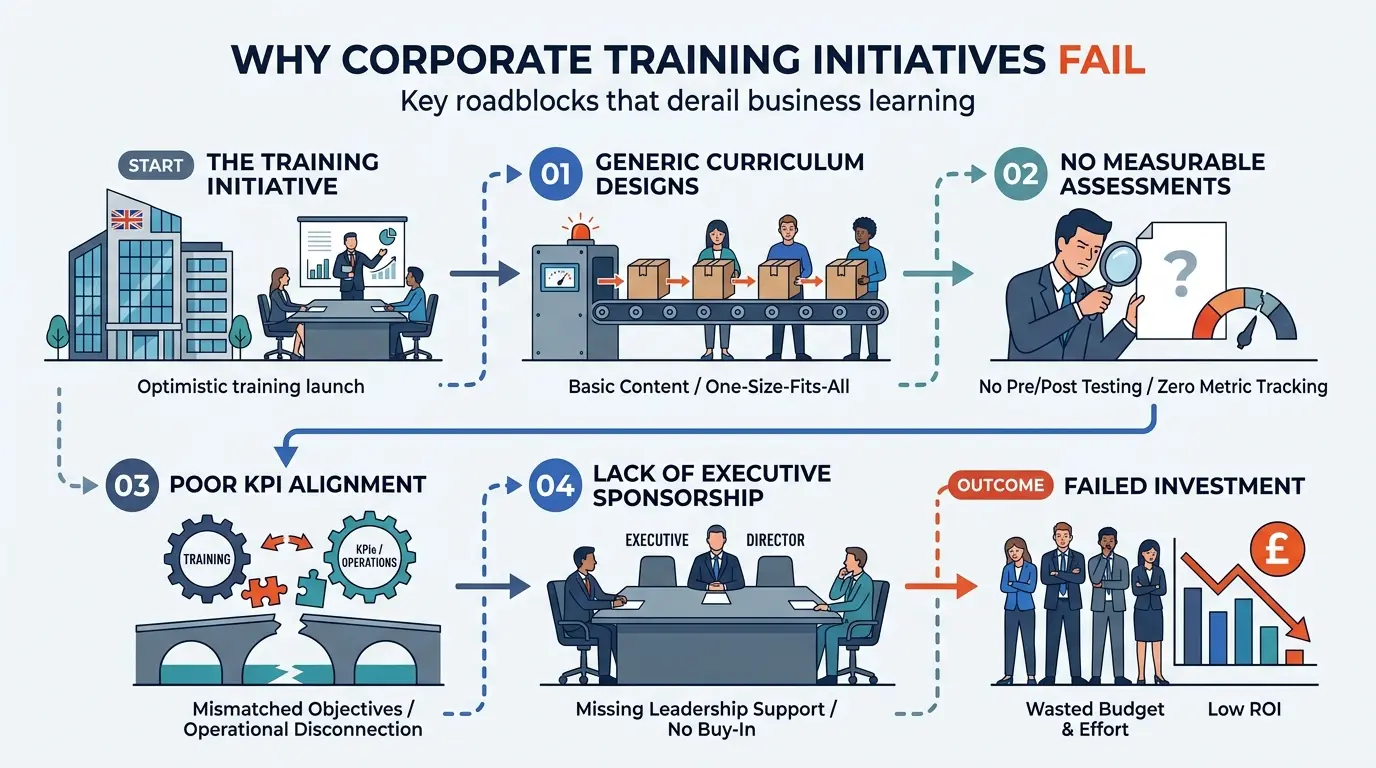
Organizations often approach workforce development as an administrative compliance exercise rather than a strategic operational lever. This mindset generates several critical failure modes. Generic, off-the-shelf training programs fail to address the specific technical realities of complex energy assets. Employees reject these programs because the content lacks direct applicability to their daily engineering or commercial responsibilities.
Another widespread misconception assumes that knowledge acquisition equals behavioral change. Traditional lecture-based formats produce high completion numbers but yield zero measurable impact on operational productivity. Without practical simulations, case studies, and workplace reinforcement, employees forget 70% of new information within 48 hours of course completion.
The absence of rigorous measurement undermines long-term budget allocations. L&D departments frequently report participant satisfaction scores rather than operational impact metrics. Executive leadership demands proof of return on investment. Programs that fail to link training outcomes to reduced downtime, improved safety records, or accelerated project delivery face budget reductions during industry downturns.
Organizations overcome these pitfalls by demanding complete contextual relevance from their development initiatives. Programs must reflect current industry challenges, utilize real operational datasets, and enforce strict post-training competency evaluations. When training aligns with core business metrics, workforce development transforms from a cost center into a primary competitive advantage.
Frequently Asked Questions
What is oil and gas petroleum finance and why is it important for energy companies?
Oil and gas petroleum finance involves the management of capital allocation, project economics, and risk assessment for upstream exploration, midstream infrastructure, and downstream refining operations. At the Institute For Oil & Gas Training, structured professional programs help finance professionals navigate complex fiscal regimes, production sharing contracts, and joint ventures. Mastering these specialized financial frameworks ensures that energy corporations optimize asset valuations and maximize capital efficiency across international portfolios.
How do petroleum finance training courses benefit oil and gas professionals?
Petroleum finance training programs equip commercial analysts, engineers, and financial managers with advanced modelling skills required to evaluate complex hydrocarbon projects. These courses focus on practical applications such as cost oil calculations, profit oil splits, and government take waterfalls under various fiscal terms. Through the Institute For Oil & Gas Training, professionals develop the technical competency needed to perform rigorous economic sensitivity testing and investment ranking.
What are the core components of financial modelling for production sharing contracts?
Financial modelling for production sharing contracts centers around revenue sharing, cost recovery limits, profit oil allocation, and tax obligations between host governments and contractors. Professionals must accurately configure input assumption sheets, entitlement schedules, and contractor cash flow blocks in spreadsheet environments. The Institute For Oil & Gas Training incorporates these core elements into specialized curricula to ensure analysts can construct transparent, audit-ready financial models for complex international assets.
How do energy companies evaluate competing oilfield investment opportunities?
Energy companies evaluate competing oilfield investment opportunities by analyzing key economic indicators such as net present value, internal rate of return, payback periods, and unit technical costs. Financial teams run comprehensive risk assessments and sensitivity analyses to account for commodity price volatility, capital expenditure overruns, and subsurface uncertainties. Programs provided by the Institute For Oil & Gas Training teach multidisciplinary teams how to apply these quantitative metrics consistently during capital allocation decision-making.
Who should enroll in petroleum finance and economic evaluation courses?
Petroleum finance and economic evaluation courses are designed for commercial managers, petroleum economists, financial analysts, joint venture accountants, and asset planners working within the energy sector. These professionals require a deep understanding of upstream economics, fiscal terms, and capital budgeting to support strategic business decisions. The Institute For Oil & Gas Training delivers targeted professional development programs that bridge the gap between technical operations and commercial petroleum finance for modern energy workforces.
Related training courses
Risk Management for Upstream & Midstream Projects: Exposures Training Course
- Specialisation
- Oil & Gas Petroleum Compliance, AML & Risks
- Duration
- 5 days · 15 CPD hours
Management Reporting Design for JV & Partner Audiences Training Course
- Specialisation
- Oil & Gas Petroleum IFRS & Financial Reporting
- Duration
- 5 days · 15 CPD hours
Consolidation & JV Structures for Petroleum Group Entities Training Course
- Specialisation
- Oil & Gas Petroleum Accounting
- Duration
- 5 days · 15 CPD hours
More articles

Fraud Risks in Petroleum Operations: What to Look for in Specialist Professional Training
Master petroleum financial crime detection with the Institute For Oil & Gas Training. Enroll in our specialized AML and crude trading compliance course.
Read article →
Integrating Fraud Risk Assessment, Forensic Accounting and AML Controls Across the Petroleum Lifecycle
Discover how to integrate fraud risk assessment forensic accounting and AML controls to combat trade based financial crime across the petroleum lifecycle.
Read article →
Why Fraud Risk Changes Across Exploration, Development and Production Activities
Discover how fraud risk shifts across petroleum exploration, development, and production. Master AML controls, forensic accounting, and risk management strategies.
Read article →