
The economics of oilfield development govern the transition from raw subsurface hydrocarbon volumes to commercial capital allocation decisions, dictating whether upstream energy portfolios capture required shareholder returns or incur stranded asset liabilities. Organizations in heavy industries like oil and gas, mining, and capital infrastructure frequently encounter multi-million dollar capital expenditure decisions where deterministic forecasting fails to account for geological and fiscal volatility. To bridge this competency gap, learning and development departments deploy structured professional programs that transform engineering teams into commercially literate decision-makers capable of managing portfolio risk.
What is oilfield economic evaluation in professional corporate training?
Oilfield economic evaluation training is a specialized workforce development framework that teaches technical and commercial teams how to quantify cash flow generation, capital efficiency, and fiscal risk across the upstream asset lifecycle. Organizations implement this training to eliminate silos between subsurface geoscience teams and corporate finance departments, ensuring engineers understand net present value calculations while commercial analysts grasp reservoir recovery mechanics.
Corporate training programs in this domain combine discounted cash flow modeling, production decline curve analysis, and fiscal regime tax-royalty structures into immersive, case-based curricula. Team leaders utilize these programs to establish standardized corporate evaluation protocols, reducing appraisal discrepancies between exploration assets and producing fields. Workforce competency improves as engineers and economists learn to speak a unified valuation language, accelerating final investment decision timelines by 25% across global operating units.
How do organizations implement oilfield economics training programs?
Organizations implement oilfield economics training through blended learning architectures combining self-paced technical modules, instructor-led financial modeling workshops, and asset evaluation simulations. L&D managers begin by conducting organizational skill gap assessments, measuring current proficiency in capital budgeting, risk quantification, and discounted cash flow mechanics across engineering, commercial, and subsurface departments.
Delivery formats follow a structured three-phase corporate implementation roadmap:
Post-training reinforcement occurs through workplace application projects, where petroleum engineers and financial analysts co-evaluate live asset acquisition targets under senior mentorship. Organizations track success using key performance indicators such as model accuracy audits, capital project approval cycle times, and portfolio forecast variance reduction.
What core competencies and technical frameworks are included in the curriculum?
The curriculum integrates financial mathematics, geological risk quantification, and corporate governance frameworks to build comprehensive asset evaluation capability. Training modules incorporate deterministic valuation metrics alongside advanced probabilistic techniques to prepare corporate teams for high-uncertainty investment environments.
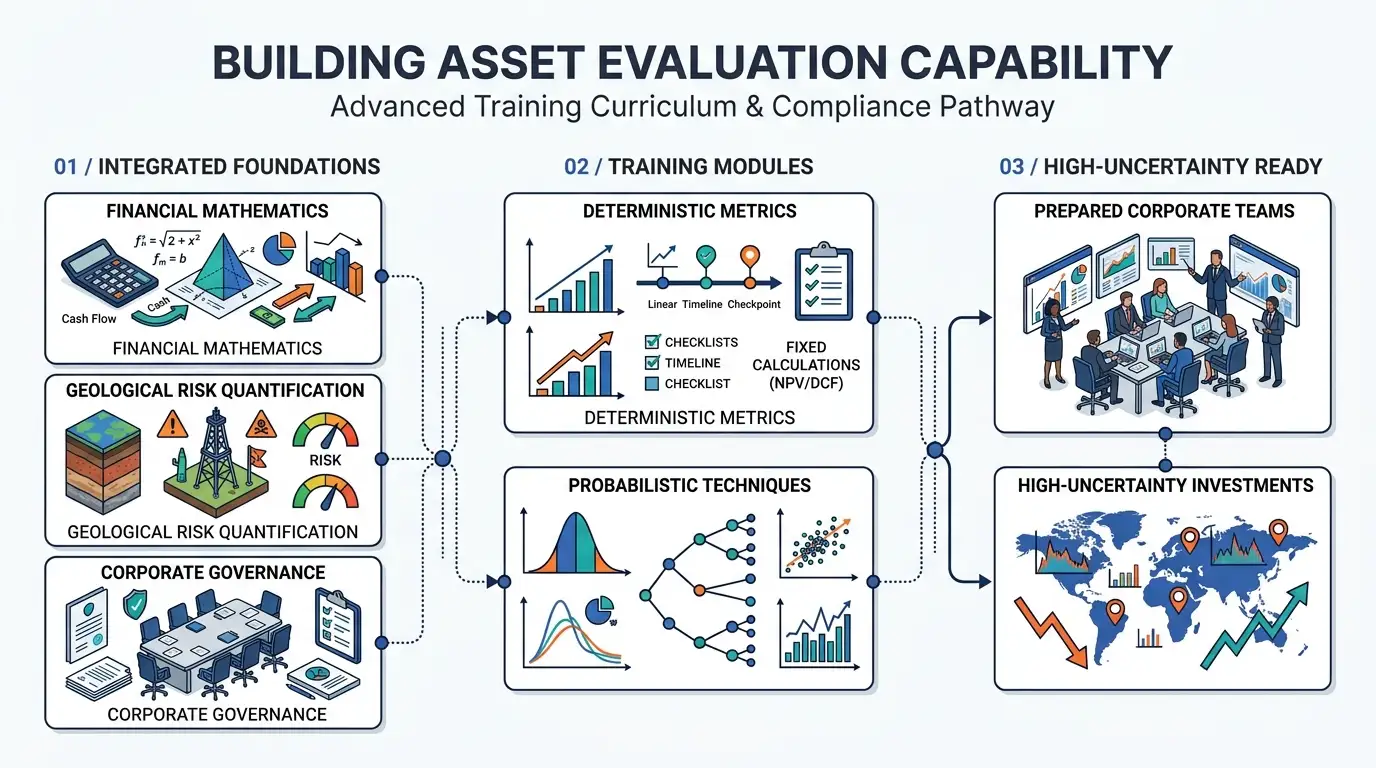
The technical framework covers several essential analytical components:
Deterministic Valuation Metrics: Net present value, internal rate of return, payback period, and profitability index calculations applied to multi-decade upstream cash flow streams.
Fiscal Regime Mechanics: Concession systems, production sharing contracts, service agreements, sliding-scale royalties, and petroleum resource rent taxes across international jurisdictions.
Uncertainty Quantification Tools: $\text{tornado diagram}$ tornado diagrams for ranking input variable sensitivity, $\text{spider chart}$ spider charts for multi-variable variance comparison, and $\text{one-way and two-way sensitivity}$ one-way and two-way sensitivity analyses.
Probabilistic Modeling Techniques: $\text{Monte Carlo simulation}$ Monte Carlo simulation algorithms for combining geological and economic variables, yielding cumulative distribution functions for asset value.
Decision Analysis Metrics: $\text{expected monetary value}$ expected monetary value calculations, $\text{probability of success}$ probability of success factors, $\text{risked value}$ risked value assessments, and $\text{switching values}$ switching values for project abandonment thresholds.
Scenario Evaluation: $\text{downside and upside cases}$ downside and upside cases modeling macroeconomic volatility and commodity price cycles.
For a deeper exploration of how these analytical frameworks integrate into corporate investment workflows, professionals examine the principles covered in the $\text{NPV, IRR \& Fiscal Sensitivity Analysis: Probabilistic Techniques Training Course}$ NPV, IRR & Fiscal Sensitivity Analysis: Probabilistic Techniques Training Course.
What organizational benefits result from advanced economic evaluation training?
Advanced economic evaluation training drives measurable performance improvements across upstream portfolios, transforming technical specialists into commercially astute enterprise contributors. Companies deploying structured workforce development programs in economic evaluation report a 30% reduction in capital allocation errors and a 15% improvement in project delivery efficiency.
Organizational benefits manifest across multiple operational dimensions:
Capital Efficiency: Teams optimize capital expenditure sizing, eliminating over-capitalized field development plans and improving return on capital employed metrics.
Risk Mitigation: Enhanced competency in probabilistic modeling prevents the authorization of projects vulnerable to downside commodity price shocks or adverse fiscal regime changes.
Cross-Functional Collaboration: Subsurface geoscientists, reservoir engineers, and corporate finance analysts operate from a shared economic vocabulary, resolving project valuation disputes 40% faster.
Leadership Pipeline Acceleration: Mid-career engineers develop executive-level financial literacy, preparing them to lead asset evaluation committees and portfolio review boards.
Talent Retention: Structured professional development pathways increase technical employee engagement, reducing voluntary turnover among senior subsurface personnel by 18% in competitive energy markets.
Which corporate teams and industries utilize oilfield economic evaluation training?
Upstream energy corporations, national oil companies, oilfield service providers, and energy investment banking firms utilize economic evaluation training to maintain underwriting accuracy and operational compliance. Within these organizations, training programs target distinct functional groups to address specific professional responsibilities.
Beyond pure-play upstream operators, downstream refining enterprises, sovereign energy ministries, and energy-focused private equity funds deploy these programs to evaluate joint-venture equity stakes and concession bidding rounds.
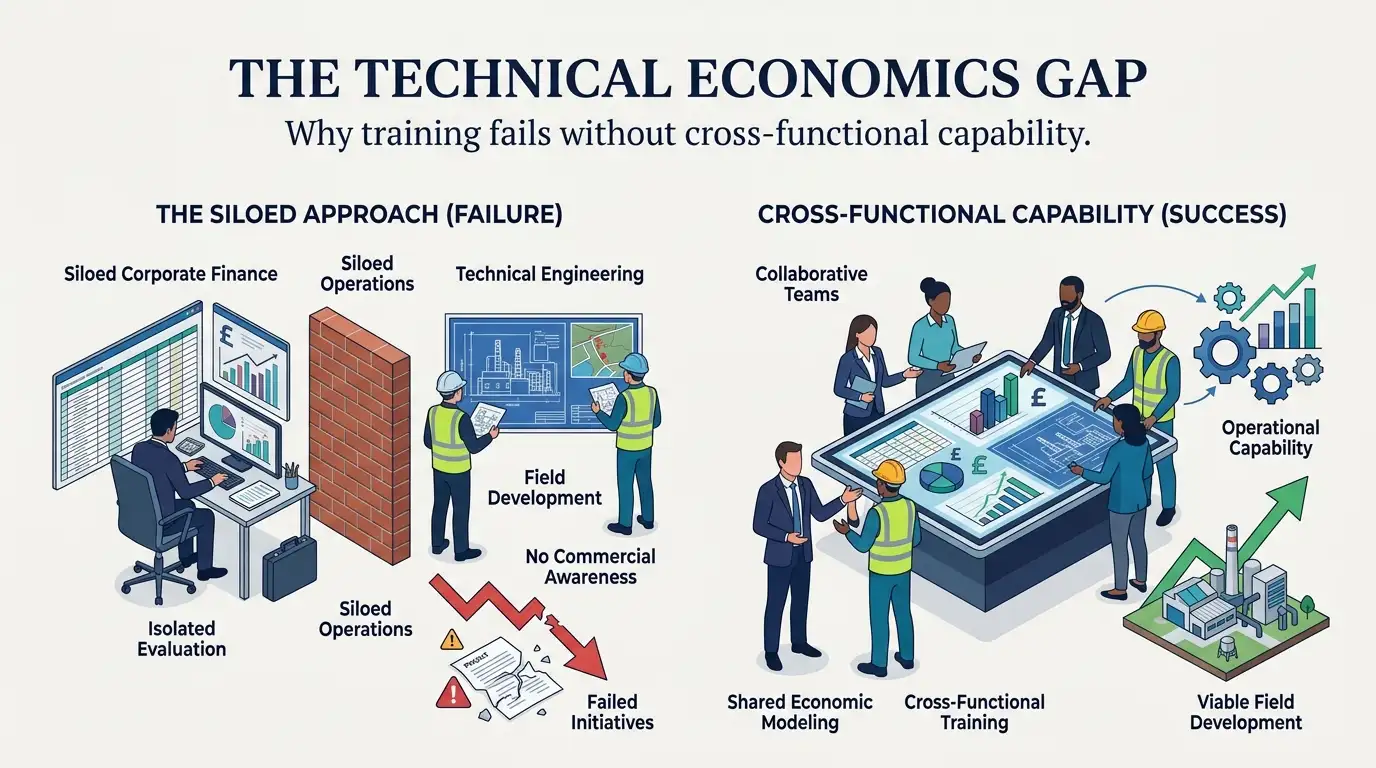
Corporate training initiatives in technical economics frequently fail when organizations treat financial evaluation as a theoretical spreadsheet exercise rather than a cross-functional operational capability. A prevalent misconception is that economic modeling is solely the responsibility of the corporate finance department, leading technical engineering teams to design field developments without commercial awareness.
Additional hurdles include relying on generic, out-of-the-box financial models that ignore complex local fiscal regimes, production sharing agreements, and state participation clauses. Organizations that bypass practical, case-based learning simulations in favor of passive lecture formats observe negligible knowledge retention among engineering staff. Effective workforce transformation requires rigorous, asset-specific workshops where multidisciplinary teams evaluate live portfolio data under realistic market volatility constraints.
Frequently Asked Questions
What is oil and gas petroleum finance?
Oil and gas petroleum finance encompasses the specialized financial accounting, capital budgeting, and risk assessment methodologies used to evaluate upstream, midstream, and downstream energy assets. Through programs offered by the Institute For Oil & Gas Training, finance professionals and engineers master discounted cash flow modeling, production sharing contracts, and capital expenditure allocation. This discipline enables organizations to manage commodity price volatility and secure accurate economic valuations for multi-million-dollar energy projects.
How does petroleum accounting differ from standard corporate finance?
Petroleum accounting diverges from standard corporate finance due to the unique accounting treatments required for mineral rights acquisition, exploration expenditures, and reservoir depletion. Practitioners apply specialized cost-tracking methods such as successful efforts or full cost accounting to reflect high-risk subsurface asset lifecycles accurately. The Institute For Oil & Gas Training equips corporate finance teams with the technical skills needed to navigate these complex regulatory standards and international fiscal regimes.
Why is economic evaluation critical in upstream oilfield development?
Economic evaluation is critical in upstream oilfield development because it dictates whether raw hydrocarbon reserves can be extracted profitably under volatile market and fiscal conditions. By utilizing advanced metrics like net present value, internal rate of return, and Monte Carlo simulations, decision-makers mitigate financial exposure across complex operating portfolios. The Institute For Oil & Gas Training delivers practical, outcome-based courses that bridge the gap between subsurface engineering data and commercial investment strategies.
What are the primary revenue-sharing models in petroleum finance?
The primary revenue-sharing models in petroleum finance include concessionary tax-royalty systems, production sharing contracts, and risk service agreements established with host governments. Each fiscal framework determines how capital costs, operating expenses, and hydrocarbon profits are distributed between national oil companies and international operators. Professionals utilize petroleum finance training to model these intricate contract terms and assess the true economic viability of international exploration assets.
How do organizations measure the return on investment for petroleum finance training?
Organizations measure the return on investment for petroleum finance training by tracking reductions in capital allocation errors, improvements in project approval cycle times, and enhanced portfolio forecast accuracy. Corporate L&D leaders evaluate program success through cross-functional collaboration metrics and the precision of capital expenditure valuations across multidisciplinary teams. The Institute For Oil & Gas Training supports workforce transformation by providing industry-driven programs designed to improve operational performance and strategic decision-making.
Related training courses
Management Reporting Design for JV & Partner Audiences Training Course
- Specialisation
- Oil & Gas Petroleum IFRS & Financial Reporting
- Duration
- 5 days · 15 CPD hours
Consolidation & JV Structures for Petroleum Group Entities Training Course
- Specialisation
- Oil & Gas Petroleum Accounting
- Duration
- 5 days · 15 CPD hours
Consolidation & JV Structures for Multi-Country Groups Training Course
- Specialisation
- Oil & Gas Petroleum Accounting
- Duration
- 5 days · 15 CPD hours
More articles
Why Fraud Risk Changes Across Exploration, Development and Production Activities
Discover how fraud risk shifts across petroleum exploration, development, and production. Master AML controls, forensic accounting, and risk management strategies.
Read article →
Selecting Specialist Oilfield Economics & Project Evaluation Training for Commercial and Economics Teams
Master upstream oilfield economics, PSC fiscal waterfalls, and joint venture financial modelling with Institute For Oil & Gas Training. Enroll today.
Read article →
Project Ranking, Economic Indicators and Sensitivity Testing in Oilfield Investment Analysis
Master oilfield investment analysis, project ranking, economic indicators, and sensitivity testing to evaluate upstream petroleum opportunities.
Read article →