
Oilfield development demands capital allocation models that balance geological uncertainty against multi-million-dollar expenditure profiles. Corporate decision-makers evaluate upstream hydrocarbon projects by constructing financial frameworks that quantify net present value, internal rate of return, and fiscal risk exposure under volatile commodity pricing environments. Strategic asset planning requires petroleum economists and corporate finance teams to transition from broad feasibility studies into granular valuation architectures that reflect subsurface complexities, fiscal regimes, and capital expenditure schedules.
Initial capital allocation assessments begin long before engineering teams finalize well placements, relying on foundational concepts outlined in From Field Reserves to Investment Decision: The Economics Behind Oilfield Development, which explores the baseline metrics governing upstream resource commercialisation. Establishing robust asset valuation architectures requires finance professionals and subsurface engineers to master advanced probabilistic modeling techniques, deterministic sensitivity metrics, and commercial risk adjustment protocols. Integrating these analytical layers into standard corporate workflows ensures that investment committees commit capital only to assets with verified risk-adjusted return profiles.
What is a deterministic sensitivity analysis in oilfield economics?
A deterministic sensitivity analysis evaluates how changes in individual input variables impact project net present value by isolating one variable at a time while holding all other parameters constant. This analytical method identifies primary value drivers across an oilfield lifecycle, enabling petroleum economists to pinpoint which operational or fiscal variables exert the greatest influence on project economics. Finance teams construct deterministic models using core variables such as initial production rates, capital expenditure overruns, operating costs per barrel, and realized hydrocarbon prices.
Evaluating single-variable variance illuminates operational vulnerabilities before field development begins. When crude oil prices fluctuate by ten percent, the corresponding shift in net present value exposes the project's baseline resilience. Analysts utilise specialized visualization tools to communicate these sensitivities across executive boards. A tornado diagram visually ranks variables by their magnitude of impact, displaying horizontal bars that stretch outward from a baseline net present value to show the financial consequences of high and low input scenarios. Conversely, a spider chart plots multiple sensitivity lines on a single set of axes, allowing evaluators to compare the steepness of various slopes and identify which parameters introduce the steepest financial risk.
Understanding single-variable exposure forms the foundation for multi-variable testing. When evaluators examine simultaneous variations in capital expenditure and production decline rates, they deploy one-way and two-way sensitivity matrices. A one-way analysis measures the output change resulting from a single input shift, while a two-way analysis maps net present value across a grid of paired variables, such as oil price versus discount rate or capital cost versus recovery factor. These deterministic matrices establish boundary conditions for asset valuation, yet they assume variables operate independently. Upstream environments require advanced probabilistic frameworks to account for simultaneous, correlated uncertainties across complex geological and economic landscapes.
How do probabilistic techniques account for subsurface and market uncertainty?
Probabilistic techniques replace single-point deterministic estimates with complete probability distributions for every uncertain variable, generating thousands of randomized economic outcomes through statistical simulation.
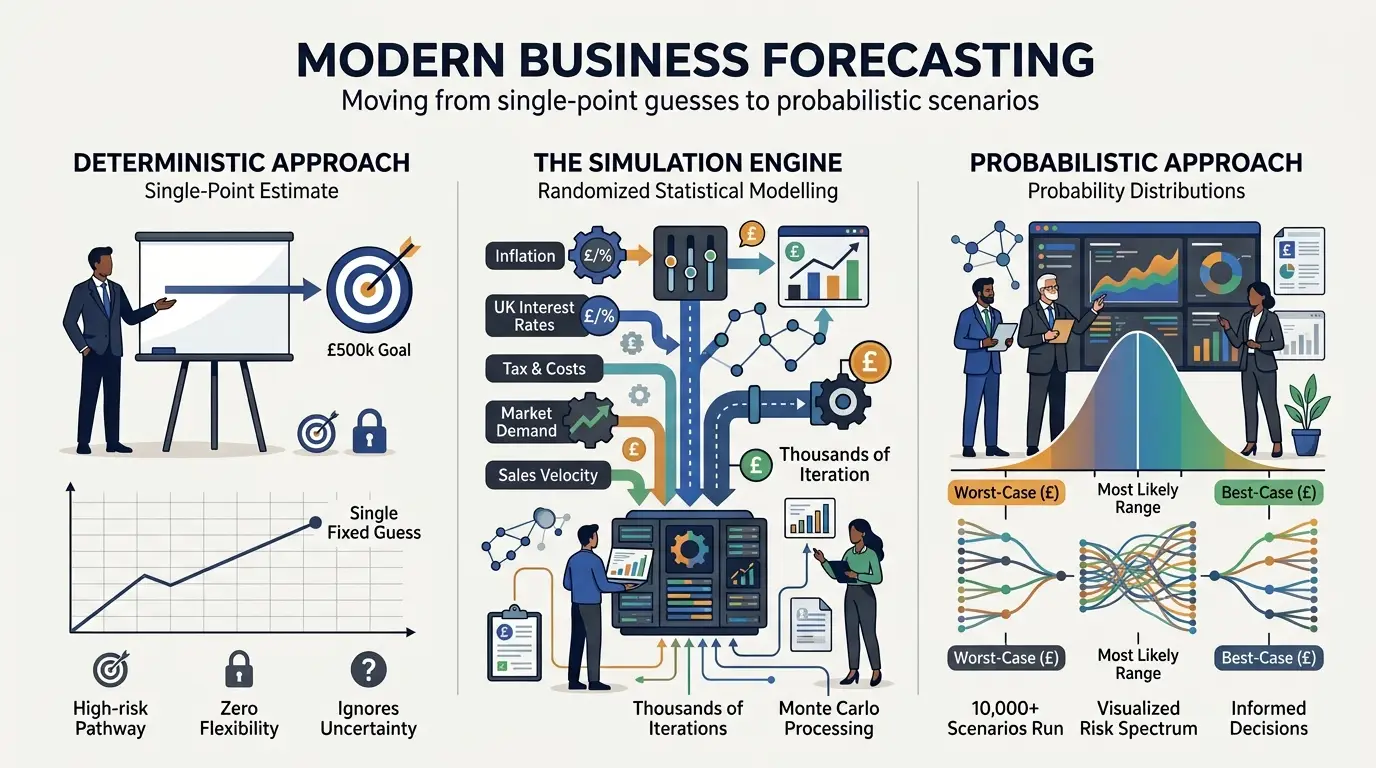
Upstream projects face inherent geological ambiguity, reservoir pressure declines, and unpredictable commodity markets that render deterministic forecasting insufficient for capital allocation decisions. Implementing sophisticated risk models requires organisations to upskill their technical staff through targeted programs such as the NPV, IRR & Fiscal Sensitivity Analysis: Probabilistic Techniques Training Course, ensuring engineering and finance departments apply standardized evaluation methodologies.
The industry standard for generating probabilistic valuation distributions is the Monte Carlo simulation. This computational algorithm samples input values thousands of times from predefined probability distributions, such as triangular, log-normal, or beta distributions assigned to porosity, permeability, recovery factor, and capital expenditures. The resulting output is a cumulative distribution function of net present value and internal rate of return, rather than a single deterministic figure. Upstream organizations use these probability curves to establish expected monetary value, which calculates the probability-weighted average of all possible financial outcomes, factoring in both positive upside potentials and catastrophic downside scenarios.
Quantifying project viability under uncertainty relies heavily on calculating the probability of success, which separates geological discovery risk from commercial development risk. Multiplying the probability of geological success by the probability of commercial success yields an aggregate technical success factor. Financial analysts then compute the risked value by multiplying the net present value of a successful development by this total probability factor. This calculation prevents capital committees from overvaluing high-return, low-probability assets, directing corporate investment toward balanced portfolios with resilient expected outcomes.
How are downside risks and upside potential quantified in field development?
Quantifying downside risks and upside potential involves establishing probabilistic boundary cases that capture extreme market volatility, technical variance, and fiscal adjustments over the producing life of the asset. Upstream projects operate under non-linear fiscal regimes where government take, royalty structures, and production-sharing contracts shift dynamically based on profitability and production volumes. Finance teams map these variables by establishing explicit downside and upside cases that reflect worst-case operational delays and best-case reservoir performance distributions.
Identifying the exact thresholds where a project transitions from economically viable to financially unviable requires calculating switching values. A switching value represents the specific price, cost, or production rate at which project net present value drops to zero or internal rate of return equals the hurdle rate. If the switching value for a Brent crude price is forty dollars per barrel, the asset possesses a safety margin against current market pricing. If the switching value sits at seventy-five dollars per barrel, minor downward price movements threaten capital recovery, signaling the need for contract renegotiation or capital restructuring.
Translating these probabilistic metrics into actionable corporate strategy requires specialized technical competencies. Organizations seeking to institutionalize these evaluation frameworks often implement structured curricula such as the Oilfield Economics & Project Evaluation Training Course for Professionals Working on Petroleum Investment Cases, which bridges subsurface engineering realities with corporate finance decision criteria. HR directors and technical managers utilize these structured learning pathways to eliminate skill gaps in economic modeling, ensuring multidisciplinary teams evaluate capital projects using rigorous, repeatable methodologies.
How do corporate learning models drive accuracy in upstream investment decisions?
Corporate learning models drive accuracy in upstream investment decisions by combining practical, industry-driven training frameworks with measurable competency benchmarks for finance, engineering, and HR teams.
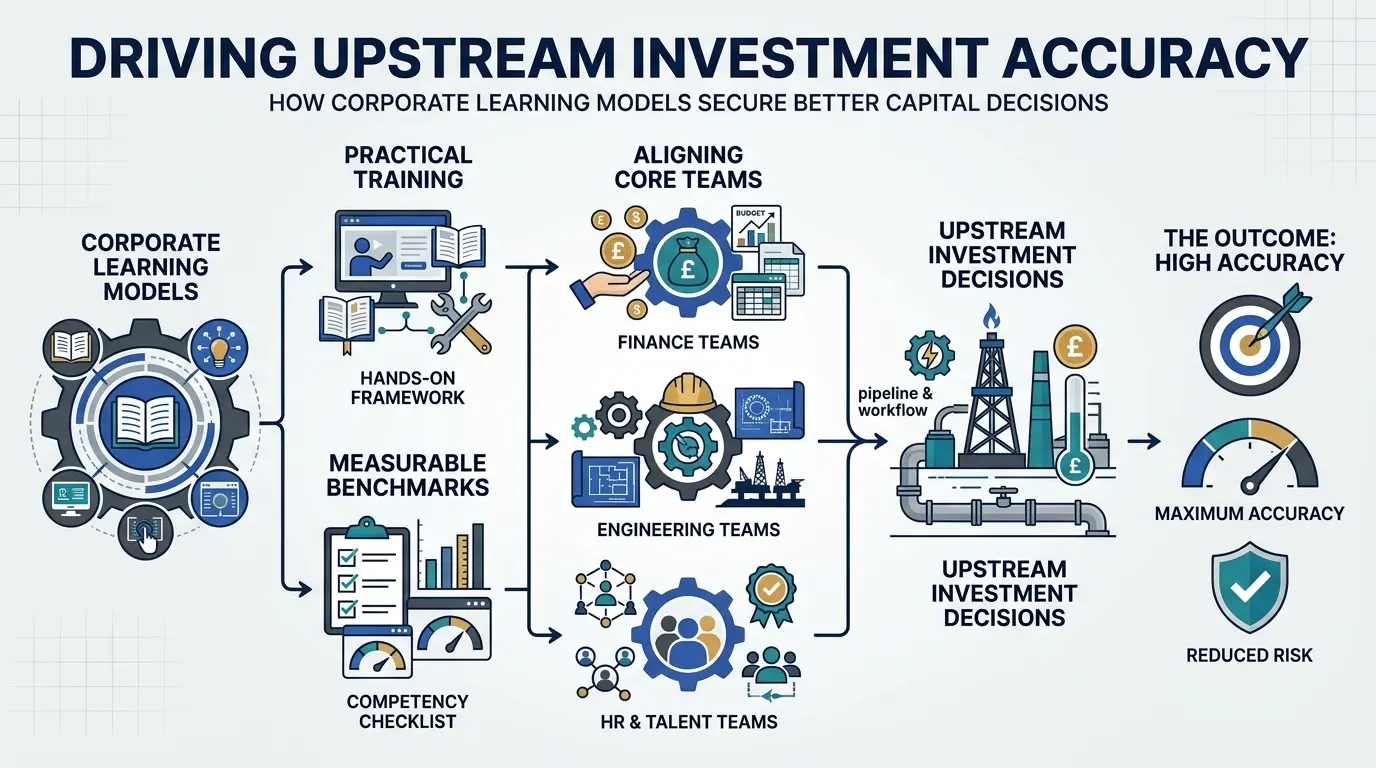
Capital allocation errors in oilfield development stem not only from geological forecasting mistakes but also from organizational silos where subsurface engineers and financial analysts speak different valuation languages. Integrating technical training with strategic financial evaluation bridges this gap, enabling cross-functional teams to construct unified economic models that withstand executive scrutiny.
Workforce capability building in petroleum economics requires a deliberate shift from passive academic instruction to applied, scenario-based learning models. Upstream operators face continuous talent shortages in fiscal analysis, tax regime modeling, and probabilistic risk assessment. Forward-thinking HR departments address these challenges by deploying blended learning architectures that combine digital simulation exercises with instructor-led valuation workshops. These programs focus on real-world asset evaluations, ensuring that project engineers understand how capital expenditure timing impacts discount cash flow calculations and corporate balance sheets.
Measuring the return on investment for corporate training involves tracking improvements in project sanctioning accuracy, reduction in post-audit variance between forecasted and actual cash flows, and acceleration of cycle times for investment committee approvals. When petroleum economists and project managers master deterministic sensitivity tools, probabilistic simulation algorithms, and fiscal modeling structures, the organization reduces exposure to unquantified subsurface risks. Aligning workforce development directly with strategic asset evaluation criteria ensures long-term capital efficiency and sustainable portfolio growth across global energy markets.
Frequently Asked Questions
What is oil and gas petroleum finance?
Oil and gas petroleum finance is a specialized branch of corporate finance that focuses on capital allocation, asset valuation, and risk management across the upstream, midstream, and downstream sectors. It involves structuring investments, evaluating capital expenditure portfolios, and managing fiscal regimes such as production-sharing contracts and royalty agreements. Programs at the Institute For Oil & Gas Training equip professionals with the analytical framework required to navigate these complex petroleum economics and investment decisions.
How do companies evaluate upstream oil and gas investments?
Upstream oil and gas investments are evaluated using discounted cash flow models, net present value calculations, and internal rate of return metrics alongside probabilistic risk assessments like Monte Carlo simulations. Financial analysts examine geological uncertainties, capital expenditure profiles, and operating cost estimates to determine the expected monetary value of a hydrocarbon asset. The Institute For Oil & Gas Training provides specialized oil and gas petroleum finance courses that teach practitioners how to model these probabilistic cash flows accurately.
Why is risk management critical in petroleum financial modeling?
Risk management is essential in petroleum financial modeling because upstream projects involve immense capital outlays, volatile commodity prices, and high geological ambiguity over multi-decade lifecycles. Incorporating deterministic sensitivity analyses and probabilistic variables allows finance teams to identify switching values, downside exposure, and upside potential before sanctioning funds. Professionals looking to master these valuation safeguards often complete targeted training via the Institute For Oil & Gas Training.
What are the primary revenue drivers in oil and gas financial analysis?
The primary revenue drivers in oil and gas financial analysis include realized hydrocarbon commodity prices, daily production volumes, reserve replacement ratios, and operating expenditures per barrel of oil equivalent. Analysts must also account for government take, fiscal contract terms, and inflation rates that directly alter net cash distributions over time. Comprehensive curricula at the Institute For Oil & Gas Training train corporate teams to accurately isolate and forecast these critical valuation drivers.
How do petroleum accounting and finance differ from standard corporate finance?
Petroleum accounting and finance differ from standard corporate finance due to unique industry practices like full cost versus successful efforts accounting, depletion calculations, and complex concession agreements. Upstream finance professionals must navigate specialized asset retirement obligations, joint venture billing, and government tax regimes that do not exist in conventional corporate sectors. Specialized educational programs from the Institute For Oil & Gas Training bridge this knowledge gap by focusing exclusively on petroleum-specific financial workflows.
Related training courses
Risk Management for Upstream & Midstream Projects: Exposures Training Course
- Specialisation
- Oil & Gas Petroleum Compliance, AML & Risks
- Duration
- 5 days · 15 CPD hours
Regulatory Compliance for Petroleum Entities Training Course
- Specialisation
- Oil & Gas Petroleum Compliance, AML & Risks
- Duration
- 5 days · 15 CPD hours
Segregation of Duties in Finance & ERP Systems Training Course
- Specialisation
- Oil & Gas Petroleum Compliance, AML & Risks
- Duration
- 5 days · 15 CPD hours
More articles
Why Fraud Risk Changes Across Exploration, Development and Production Activities
Discover how fraud risk shifts across petroleum exploration, development, and production. Master AML controls, forensic accounting, and risk management strategies.
Read article →
Selecting Specialist Oilfield Economics & Project Evaluation Training for Commercial and Economics Teams
Master upstream oilfield economics, PSC fiscal waterfalls, and joint venture financial modelling with Institute For Oil & Gas Training. Enroll today.
Read article →
Project Ranking, Economic Indicators and Sensitivity Testing in Oilfield Investment Analysis
Master oilfield investment analysis, project ranking, economic indicators, and sensitivity testing to evaluate upstream petroleum opportunities.
Read article →