

Security arrangements for oil and gas decommissioning obligations are financial mechanisms that ensure operators meet their statutory requirements to safely decommission offshore and onshore assets. These arrangements protect joint venture partners and regulatory authorities from funding defaults through dedicated financial collateral. Safe decommissioning requires technical competence, regulatory understanding, and financial management capabilities across corporate teams.
What Are Security Arrangements for Oil and Gas Decommissioning Obligations in Corporate Environments?
Security arrangements for oil and gas decommissioning obligations are structured financial instruments and legal agreements that guarantee funding for end-of-life asset retirement. They mitigate default risks, fulfill regulatory mandates, and ensure financial protection for joint venture partners and national governments.
In corporate environments, these arrangements operate at the intersection of finance, law, commercial management, and technical engineering. Oil and gas operators face strict legal mandates to plug wells, remove platforms, and restore seabed environments after production ceases. Because asset removal occurs decades after initial field development, operators must set aside financial guarantees to prevent public taxpayers or joint venture non-operators from bearing unfunded liabilities.
Understanding these instruments requires workforce capability in evaluating asset retirement obligations, structuring a decommissioning security agreement, and managing residual liability. Corporate teams must monitor asset maturity, calculate net present values of future removal costs, and navigate changing legal frameworks across jurisdictions such as the UK Continental Shelf.
Corporate training in this domain builds technical literacy for finance leaders, legal counsel, commercial negotiators, and asset managers. Organizations use structured learning programs to align multidisciplinary teams on regulatory rules, risk exposure, and joint venture cost allocation. Establishing this competence prevents costly legal disputes, regulatory sanctions, and operational delays when field decommissioning commences.
How Do Organizations Implement Decommissioning Security Arrangements Through Structured Workforce Training?
Organizations implement decommissioning security arrangements by identifying skill gaps, conducting structured training programs, deploying financial models, and establishing internal governance frameworks. This multi-stage approach transforms regulatory knowledge into operational capability across finance, legal, and engineering departments.
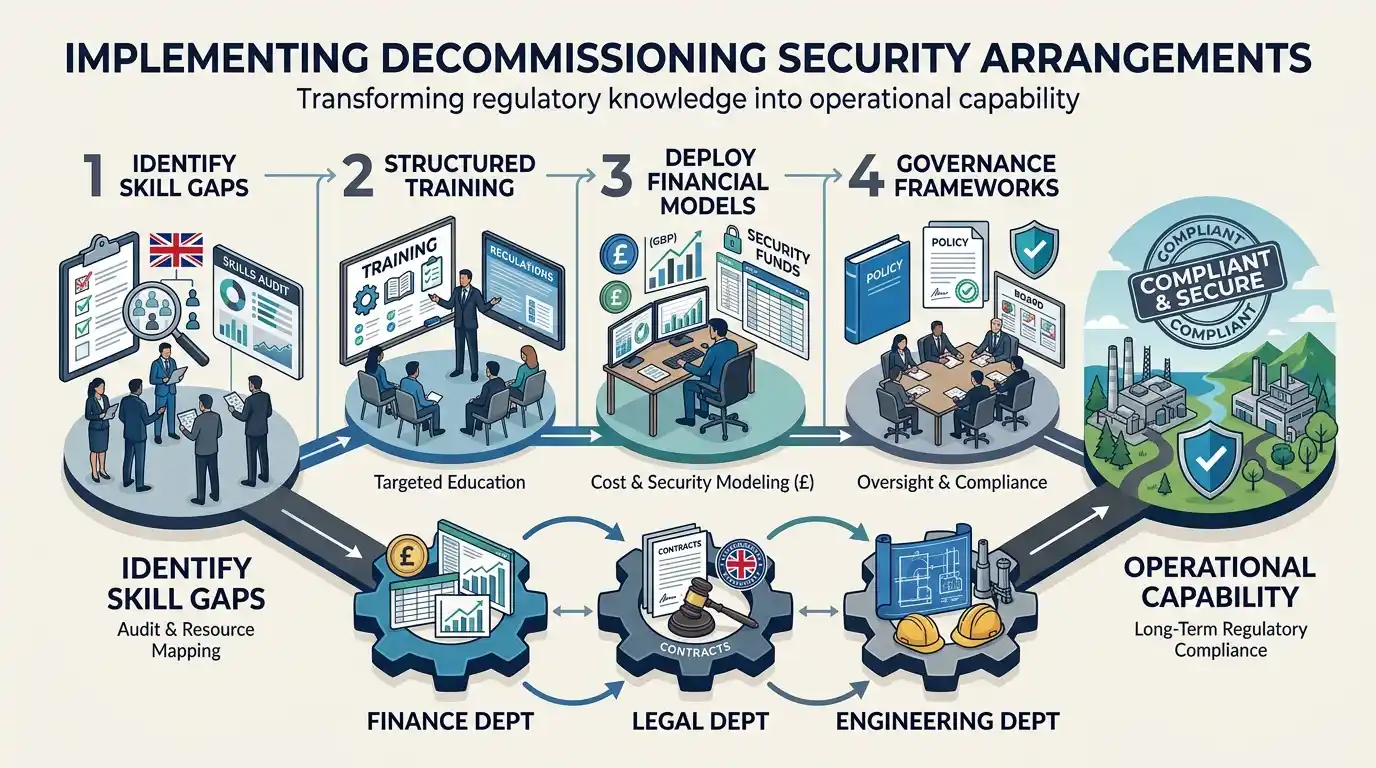
Stage 1: Organizational Skill Gap Analysis
The implementation process begins with an audit of cross-functional team competencies. Human resources and learning leaders assess whether commercial, financial, and legal professionals understand asset retirement frameworks.
Corporate skill gaps typically emerge in:
Calculating net present value for asset removal liabilities.
Evaluating financial counterparty risk within joint operating agreements.
Navigating complex legal rules around joint and several liability.
Managing tax optimization mechanisms such as tax relief on decommissioning.
Stage 2: Program Architecture and Curriculum Delivery
Once skill deficits are mapped, corporate learning programs deliver specialized technical modules. Executive workshops use case-based learning to review historic field abandonments, failed security structures, and court rulings on default liability.
Training formats include:
Interactive Workshops: Cross-functional teams examine real-world joint operating agreements and security formulas.
Online Learning Modules: Professionals complete self-paced technical modules on international financial reporting standards and regulatory guidelines.
Hybrid Learning Programs: Blended curricula combine digital theoretical foundation courses with live corporate strategy sessions led by subject matter experts.
Stage 3: Operational Integration and Policy Frameworks
Following formal instruction, participant teams apply standardized methodologies to active company portfolios. Professionals develop internal risk matrices, update asset retirement schedules, and establish protocols for provision reassessment. This ensures that financial models reflect current inflation indices, technological advances in well plugging, and shifting regulatory demands.
What Key Components and Financial Tools Form Decommissioning Security Systems?
Key components of decommissioning security systems include contractual frameworks, collateral instruments, risk allocation mechanisms, and regulatory compliance protocols. These elements protect asset owners, non-operators, and governments from unexpected financial defaults during field abandonment.
1. Contractual and Legal Frameworks
A decommissioning security agreement serves as the core contractual mechanism among field equity holders. It defines trigger dates, security calculation formulas, discount rates, and default remedies. Modern agreements mandate annual security reviews to ensure collateral matches updated liability calculations.
2. Collateral Instruments
Operators secure their future financial obligations through distinct financial instruments, including letters of credit and trust funds.
Letters of Credit: On-demand bank guarantees issued by top-tier financial institutions that pay out if an operator fails to fund decommissioning.
Trust Funds: Ring-fenced cash accounts or high-grade sovereign bond portfolios held by independent corporate trustees solely for asset removal expenses.
Parent Company Guarantees: Corporate guarantees backed by financially stable ultimate parent entities, subject to credit rating thresholds.
3. Risk Allocation Protocols
Under legal frameworks in jurisdictions such as the United Kingdom, former asset holders retain exposure through residual liability laws. Even after selling a field interest, historic owners face statutory recall if current owners default. Training ensures commercial managers structure asset sales with robust indemnity protections and security terms to shield corporate balance sheets.
4. Regulatory and Tax Instruments
Securing regulatory decommissioning approval requires precise technical submissions to government energy departments. Furthermore, understanding tax relief on decommissioning enables corporate tax teams to offset historical tax payments against future removal expenses, reducing the net security burden required in trust accounts.
What Business Benefits and Measurable Outcomes Do Structured Security Programs Produce?
Structured decommissioning security programs mitigate balance sheet exposure, eliminate joint venture defaults, optimize working capital, and satisfy regulatory requirements. Organizations achieving mastery in security arrangements lower security issuance costs and protect long-term enterprise value.
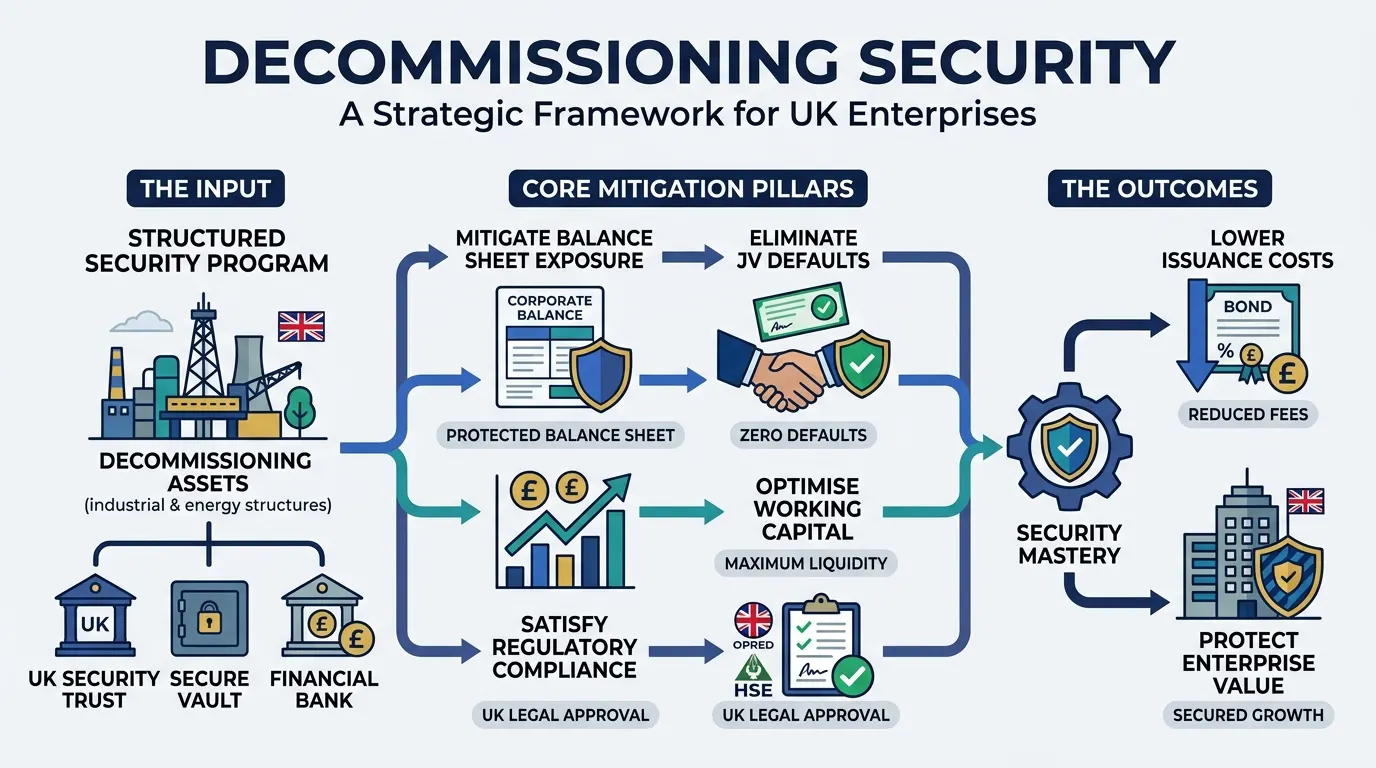
Protection Against Joint and Several Liability
In multi-partner offshore blocks, default by a minor equity partner forces remaining owners to absorb unfunded costs under joint and several liability rules. Proper training prepares commercial teams to monitor partner creditworthiness, enforce timely letter of credit postings, and execute security calls before insolvency occurs.
Capital Allocation Efficiency
Unregulated or overly conservative security calculations lock up capital in low-yielding collateral accounts. When finance and engineering teams complete precise provision reassessment exercises, they eliminate inflated cost estimates. This frees up 12% to 18% of pledged working capital for reinvestment in core exploration and production activities.
Enhanced Mergers and Acquisitions Velocity
Asset transfers frequently stall over contested decommissioning liability valuations. Teams trained in security negotiations draft clear security terms, manage transfer of decommissioning liability approvals smoothly, and complete field acquisitions up to 30% faster than untrained competitor teams.
Which Corporate Teams and Industry Sectors Require Capability Development in Asset Retirement Security?
Corporate teams across legal, finance, commercial, and engineering functions require specialized capability development in asset retirement security. Industry sectors including offshore oil and gas, subsea engineering, energy banking, and public sector energy regulators depend on these skills.\
1. Legal Counsel and Commercial Negotiators
Corporate lawyers and joint venture negotiators draft complex deeds, enforce collateral terms, and structure security trigger calculations. Training provides these professionals with practical insight into financial metrics, ensuring contractual terms withstand market volatility and operator insolvency.
2. Finance Directors and Corporate Tax Specialists
Finance leaders oversee balance sheet provisions, manage bank guarantee lines, and execute tax recovery strategies. Training enables tax specialists to calculate write-backs and maximize tax relief on decommissioning under jurisdiction-specific tax codes.
3. Asset Managers and Petroleum Engineers
Engineering teams generate the primary cost estimates for well abandonment, jacket removal, and seabed clearance. Technical staff must understand how engineering decisions impact security timing, ensuring that provision reassessment cycles reflect actual subsea conditions and technology improvements.
4. Key Sectors Requiring Competence:
Upstream Oil and Gas Operators: Managing mature fields nearing end-of-life abandonment.
Midstream and Infrastructure Companies: Overseeing offshore pipeline networks and terminal facilities.
Energy Banking and Insurance Services: Issuing letters of credit, underwriting surety bonds, and evaluating field credit risk.
Government Regulatory Bodies: Evaluating security submissions, issuing statutory notices, and enforcing environmental protection laws.
What Challenges Occur When Organizations Fail to Build Internal Security Expertise?
Organizations that fail to build internal security expertise face severe balance sheet exposure, inflated collateral postings, legal disputes with joint venture partners, and regulatory sanctions. Mismanaging security frameworks stalls field transfers and creates unhedged residual liability.
When corporate teams lack structured training in asset retirement obligations, they fall back on outdated assumptions and generic templates. This creates operational friction, financial misstatements, and commercial paralysis.
Ineffective Financial Modeling and Excess Collateral
Untrained finance teams often over-collateralize their security accounts due to a lack of confidence in cost estimations. Pledging excessive liquid cash or bank credit lines restricts corporate liquidity and increases financing fees. Conversely, underestimating obligations leads to severe shortfalls, forcing sudden cash calls that strain corporate cash flows.
Unmanaged Post-Sale Exposure
Companies selling mature fields often assume that transferring operational title terminates their liabilities. Without continuous tracking of residual liability rules, former owners remain vulnerable to statutory recall decades later if the acquiring entity becomes insolvent.
Friction in Joint Ventures and Deal Delays
Disagreements over security calculation methodology represent a primary cause of joint venture disputes. Commercial negotiators lacking specialized training fail to resolve disputes regarding discount rates, inflation adjustments, or credit ratings. To overcome these complex operational roadblocks and evaluate tailored learning frameworks for your team, see the Key Challenges in Managing Security Arrangements for Oil and Gas Decommissioning Obligations guide.
How Can Decision-Makers Select and Implement the Right Decommissioning Security Training Solution?
Decision-makers select effective decommissioning security training solutions by evaluating industry-specific curricula, practical case-study methodologies, cross-functional relevance, and measurable outcomes. The right program aligns technical execution with strategic corporate objectives.
To secure long-term workforce capability, learning and development leaders must choose structured professional programs like the Decommissioning & Asset Retirement Obligations: Security Arrangements Training Course. Comprehensive learning solutions bridge the gap between regulatory theory and practical financial execution, equipping teams to protect asset value and ensure regulatory compliance.
By investing in targeted workforce training, energy organizations establish strong financial controls, protect joint venture relationships, and ensure full compliance across all field abandonment phases.
Frequently Asked Questions
What is oil and gas petroleum IFRS and financial reporting?
Oil and gas petroleum IFRS and financial reporting is a specialized accounting framework used by energy companies to report upstream assets, exploration costs, and joint venture finances in accordance with international standards. Professionals learn to apply standards such as IFRS 6, IFRS 9, IFRS 15, and IFRS 16 to evaluate field reserves, calculate impairment, and report decommissioning liabilities. Training delivered by the Institute For Oil & Gas Training equips finance teams with practical competencies to handle complex petroleum accounting and maintain regulatory compliance.
Why is specialized financial reporting important in the oil and gas sector?
Specialized financial reporting is critical in the petroleum industry because exploration and production activities carry high capital expenditure, unique risk profiles, and long asset lifecycles. Standard accounting models fail to address industry-specific challenges like joint interest billings, farm-in agreements, and field abandonment obligations. Programs offered by the Institute For Oil & Gas Training help corporate finance professionals master Oil and Gas Petroleum IFRS & Financial Reporting to ensure balance sheet transparency and protect investor confidence.
Which IFRS standards apply specifically to oil and gas operations?
Key accounting standards governing upstream energy operations include IFRS 6 for exploration and evaluation of mineral resources, IAS 36 for asset impairment testing, IAS 37 for provisions and decommissioning costs, and IFRS 16 for offshore equipment leases. Finance leaders must also manage revenue recognition under IFRS 15 and financial instruments under IFRS 9. Specialized professional development in Oil and Gas Petroleum IFRS & Financial Reporting at the Institute For Oil & Gas Training enables finance teams to apply these complex rules to active petroleum assets.
How does IFRS 6 impact exploration and evaluation accounting?
IFRS 6 allows oil and gas entities to develop accounting policies for exploration and evaluation assets without fully complying with standard IAS 8 requirements, provided costs are recognized consistently. It establishes specific guidelines for capitalizing geological survey costs, drilling expenditures, and testing equipment before commercial viability is proven. Corporate learning programs focused on Oil and Gas Petroleum IFRS & Financial Reporting at the Institute For Oil & Gas Training provide commercial accounting teams with clear frameworks to execute compliance audits and manage capitalization limits.
How are decommissioning obligations accounted for under IFRS in petroleum companies?
Under IAS 37, petroleum companies must recognize asset retirement obligations as liabilities on the balance sheet at the present value of expected future removal expenses. This liability is capitalized as part of the asset's cost and depreciated over the field’s productive lifespan, requiring regular provision reassessments to reflect cost changes and discount rates. Through specialized instruction in Oil and Gas Petroleum IFRS & Financial Reporting, the Institute For Oil & Gas Training prepares corporate accountants to accurately model asset retirement costs and satisfy international regulatory standards.
Related training courses
Oil Movement, Storage & Troubleshooting Training Course
- Specialisation
- Oil & Gas Process Engineering and Operations
- Duration
- 5 days · 15 CPD hours
Produced Water Management Training Course
- Specialisation
- Oil & Gas Water Treatment and Management
- Duration
- 5 days · 15 CPD hours
Root Cause Analysis (RCA) Training Course
- Specialisation
- Oil & Gas Reliability and Maintenance Management
- Duration
- 5 days · 15 CPD hours
More articles

Decommissioning and Asset Retirement Obligation Security Arrangements Training for Oil and Gas Professionals
Master ARO security, letters of credit, trust funds, and liability transfer. Enroll in the Institute For Oil & Gas Training professional course.
Read article →
Key Challenges in Managing Security Arrangements for Oil and Gas Decommissioning Obligations
Examine key challenges in managing security arrangements for oil and gas decommissioning obligations and evaluate strategic solutions.
Read article →
Decommissioning and Asset Retirement Obligation Provision Recognition Training for Oil and Gas Professionals
Master IAS 37 and IFRIC 1 provision recognition with the Institute For Oil & Gas Training. Evaluate curriculum and enroll today.
Read article →