

Managing asset retirement obligations and decommissioning security arrangements requires structured technical expertise across commercial, financial, and legal disciplines. Offshore and onshore petroleum assets reaching the end of their economic life present exposure to unfunded plugging, abandonment, and site restoration liabilities. Regulatory bodies enforce strict security collateral requirements to protect public funds and joint venture partners from default.
Understanding Why Security Arrangements Matter for Oil and Gas Decommissioning Obligations provides the baseline operational context for assessing asset retirement risks across asset life cycles. Institute For Oil & Gas Training delivers structured corporate programs designed to resolve these compliance and financial challenges across commercial, legal, and finance departments.
The Decommissioning & Asset Retirement Obligations: Security Arrangements Training Course equips commercial managers, legal counsel, corporate finance specialists, and HR learning planners with the analytical tools to structure compliant, cost-effective security instruments. This specification document outlines the curriculum, delivery modalities, skill outcomes, and enrollment requirements for organizational teams and individual professionals.
What is the course and what problem does it solve?
The Decommissioning & Asset Retirement Obligations: Security Arrangements Training Course resolves operational skill gaps in structuring decommissioning collateral, calculating asset retirement obligations, evaluating residual liability, and negotiating joint venture security agreements to prevent capital inefficiency and regulatory non-compliance.
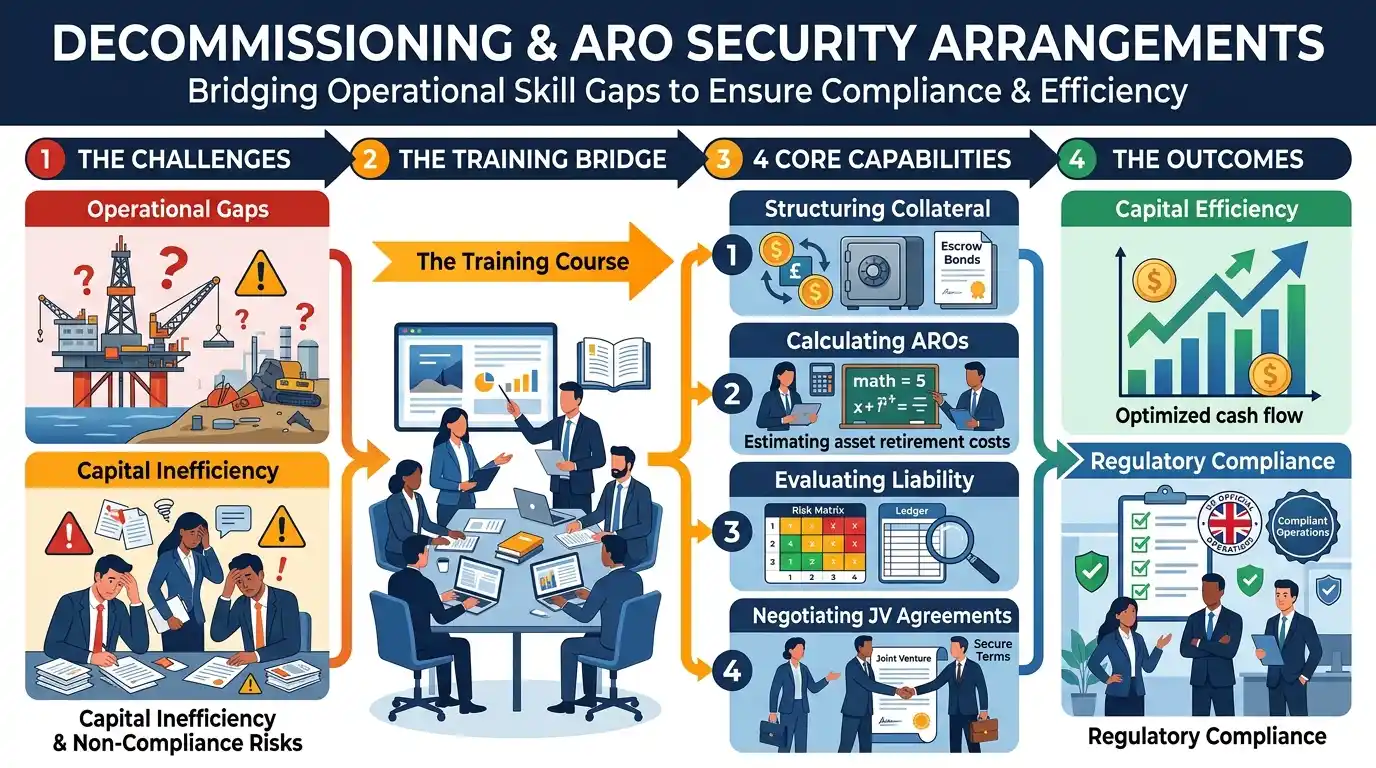
Upstream and midstream oil and gas assets carry substantial future liabilities that must be reflected accurately on balance sheets and secured through recognized financial mechanisms. A primary challenge for energy operating companies, non-operating partners, and national oil companies is navigating complex regulatory frameworks while managing tied-up working capital.
Unstructured security agreements often lead to excessive capital tie-ups in bank guarantees or letters of credit. Misaligned assumptions regarding discounting rates, inflation, and field life expectancy result in distorted provision estimations. Furthermore, transactions involving asset sales require clear legal mechanisms to govern the transfer of decommissioning liability without leaving seller organizations exposed to unexpected residual liability claims.
The Institute For Oil & Gas Training developed this specialized course to address these multi-disciplinary friction points. The program bridges operational engineering data, corporate accounting rules, and legal contract design into a single operational framework.
Organizational teams learn to draft balanced decommissioning security agreement structures, establish appropriate collateral formulas, and protect corporate liquidity while remaining fully compliant with host government regulations and joint operating agreement terms.
Why this course is structured this way
This curriculum follows an applied learning model progressing from regulatory foundation and liability assessment through financial instrument selection to complex multi-party negotiations and live case simulation for immediate corporate application.
Evaluating structural decision criteria requires analyzing Key Challenges in Managing Security Arrangements for Oil and Gas Decommissioning Obligations before implementing company-wide framework adjustments. The program architecture established by Institute For Oil & Gas Training ensures that technical knowledge translates directly into corporate execution capability.
Module Phase | Focus Area | Key Technical Focus | Primary Deliverable |
Phase 1: Foundation | Regulatory & Accounting | IFRS/US GAAP provisions & regulatory approvals | Accurately recalculated ARO provisions |
Phase 2: Instruments | Security Architecture | Letters of credit, trust funds, parent guarantees | Cost-optimal security instrument selection |
Phase 3: Legal & M&A | Liability Transfer | Joint and several liability, residual liability exposure | Compliant liability transfer agreement |
Phase 4: Operations | Reassessment & Tax | Periodic provision reassessment & tax relief models | Integrated corporate security schedule |
The sequence begins with regulatory standards and accounting principles (IAS 37 / FASB ASC 410-20) governing asset retirement obligations. Delegates must understand how provisions are recognized, measured, and discounted before evaluating collateral mechanisms.
The middle phase examines security instruments—comparing cash collateral, standby letters of credit and trust funds, surety bonds, and parent company guarantees based on credit ratings, net asset thresholds, and cost of capital impact.
The advanced modules cover complex commercial structures, including farm-outs, asset transfers, and joint venture defaults. Participants learn how joint and several liability principles operate under foreign legal systems and how to mitigate residual liability when disposing of mature assets.
Finally, the course addresses tax relief on decommissioning, demonstrating how tax allowances impact net security calculations and long-term fund liquidity.
What will participants learn?
Participants gain verifiable competencies in calculating ARO provisions, negotiating decommissioning security agreements, structuring letters of credit and trust funds, managing residual liability, and optimizing tax relief mechanisms.
The course learning outcomes focus on practical execution rather than theoretical overview. Upon completion of the program, delegates demonstrate practical mastery across five core functional domains:
1. Provision Reassessment and Accounting Calculations
Calculate asset retirement obligations using present value techniques, inflation adjustments, and revised discount rates.
Conduct periodic provision reassessment to reflect changed well-decommissioning cost estimates and field life extensions.
Align balance sheet liabilities with international accounting standards to maintain compliance during corporate audits.
2. Decommissioning Security Agreement (DSA) Structuring
Draft and review a standard decommissioning security agreement for joint ventures.
Establish trigger points, security calculation formulas, and net liability thresholds.
Implement mechanisms for dynamic security adjustments based on credit rating changes of joint venture partners.
3. Financial Instrument Optimization
Structure letters of credit and trust funds to meet regulator and co-venturer requirements at minimum capital cost.
Evaluate the usage conditions and limitations of parent company guarantees versus third-party bank security.
Manage liquidity impact by balancing cash escrows against dynamic credit facilities.
4. Liability Transfer and Exposure Management
Navigate complex transaction terms governing the transfer of decommissioning liability during asset sales.
Establish legal safeguards against retained joint and several liability under national regulatory regimes.
Draft protective indemnities and seller security caps to manage long-term residual liability.
5. Regulatory Approvals and Fiscal Optimization
Prepare comprehensive security submissions required for regulatory decommissioning approval.
Model the net impact of tax relief on decommissioning obligations across different fiscal regimes.
Integrate tax deduction timing into long-term funding schedules to prevent over-collateralization.
How is the course delivered?
Institute For Oil & Gas Training offers this program across four flexible delivery formats including intensive public workshops, live interactive virtual classrooms, hands-on hybrid sessions, and customized in-house corporate cohorts.
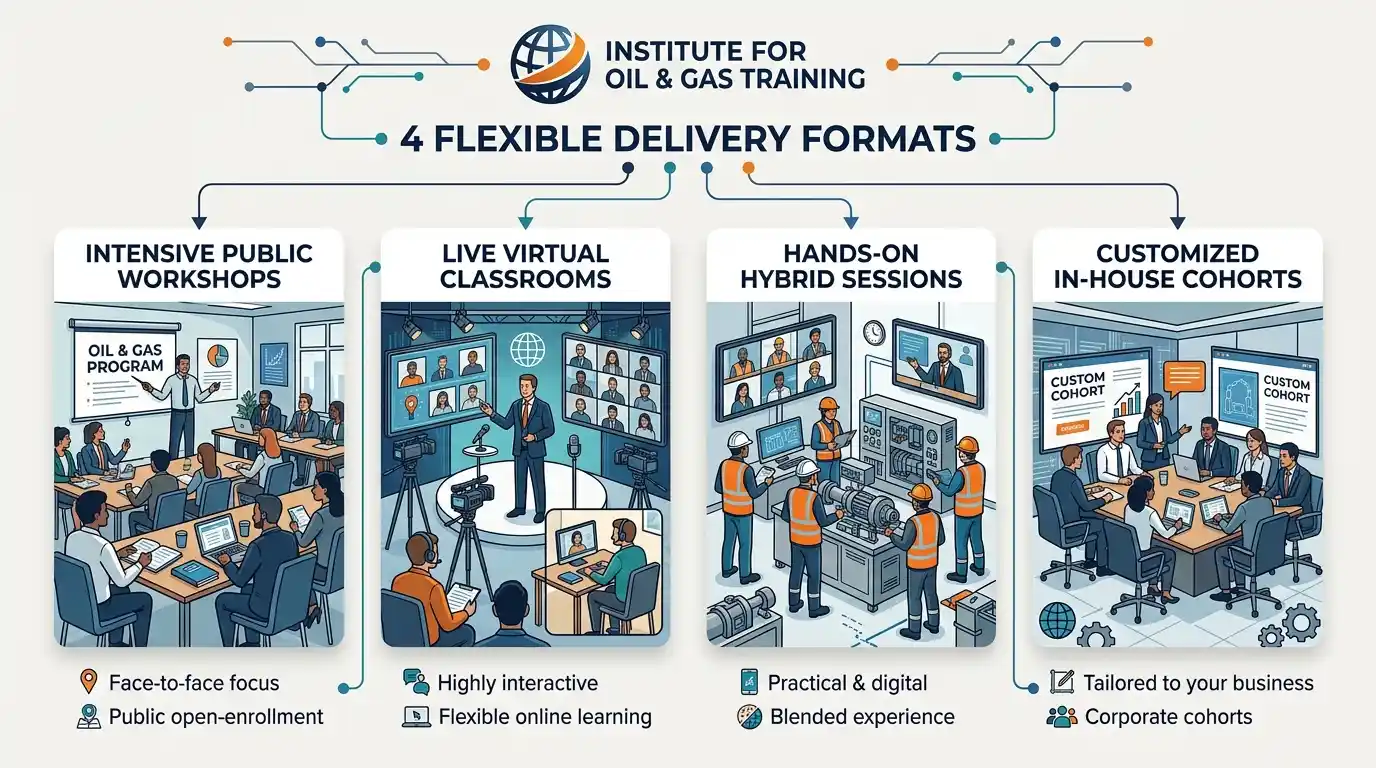
To accommodate international corporate schedules and workforce development requirements, Institute For Oil & Gas Training utilizes a specification-led instructional design. All formats maintain identical academic rigor, learning hours, and practical evaluation standards.
Delivery Modalities Overview
Public In-Person Workshops: Delivered over five consecutive days at key international oil and gas hubs (London, Dubai, Houston, Singapore, Aberdeen). Features direct instructor interaction, peer collaboration, and dedicated case study syndicate work.
Live Virtual Classroom: Structured across ten half-day live online sessions. Uses interactive whiteboards, break-out syndicate rooms, and digital model templates to deliver the full curriculum without travel requirements.
Hybrid Learning Path: Combines modular online lecture modules for foundational legal and accounting principles with intensive two-day live virtual or physical workshops focused on negotiation simulations and modeling.
In-House Corporate Cohorts: Customized specifically for corporate teams. The curriculum is tailored using the organization’s actual asset portfolio, joint venture agreements, and regulatory environment.
Instructional Methods and Assessment
Learning is driven by real-world technical tasks. Participants do not simply attend lectures; they actively solve financial and legal problems. Instruction includes financial spreadsheet modeling, contract clause redlining, and structured negotiation role-play.
Assessment is conducted continuously throughout the program:
Pre-Course Baseline Evaluation: Identifies participant knowledge gaps across accounting, legal, and financial categories.
Practical Modeling Assignments: Delegates construct ARO discounting and security provision models using industry templates.
DSA Negotiation Simulation: Team-based drafting and redlining of a complex multi-party decommissioning security agreement.
Final Technical Knowledge Verification: A structured scenario-based examination confirming mastery of collateral formulas, residual liability management, and tax relief integration.
What results can be expected?
Organizations achieve measurable risk reduction, optimized capital efficiency in security collateral, standardized corporate DSA templates, and improved cross-departmental alignment between legal, finance, and operational teams.
Enrolling teams in the program delivered by Institute For Oil & Gas Training generates clear corporate returns across risk management, financial management, and workforce development.
Measurable Corporate Outcomes
Capital Optimization: Corporate treasury teams avoid unnecessary cash locking by learning to structure tiered collateral arrangements using letters of credit and trust funds effectively.
Contractual Safeguards: Commercial and legal departments eliminate ambiguities in joint operating agreements, reducing exposure to partner default and unmanaged joint and several liability.
Audit Readiness: Financial accounting teams align internal asset retirement obligation calculations with rigorous international standards, streamlining external audit approvals.
Smooth M&A Transactions: Business development teams execute asset divestments with clear mechanisms for the transfer of decommissioning liability, ensuring former owners avoid unexpected residual liability claims.
Real-World Workplace Application Examples
Corporate Treasury & Finance Teams: A national oil company team reassessed its historical ARO discounting model using methods learned in the course. By incorporating accurate inflation adjustments and valid tax relief on decommissioning assumptions, the team reduced unnecessary collateral posting requirements in an active offshore joint venture by 18%.
Legal and Commercial Operations: An independent operator preparing to sell mature UK Continental Shelf assets utilized the course frameworks to draft liability transfer terms. The commercial team structured a dual-tiered trust fund and indemnity cap that satisfied regulatory requirements while fully insulating the seller against future residual liability.
HR and Workforce Leadership Pipelines: An enterprise HR department embedded the course into the mandatory professional development pathway for mid-career commercial managers. This cross-functional training eliminated silos between engineering cost-estimators, finance managers, and legal counsel, reducing corporate agreement review cycles by 30%.
How does enrollment work?
Enrollment requires a relevant professional background in energy finance, law, commercial management, or asset governance, followed by formal application submission, portfolio review, and registration confirmation.
The Decommissioning & Asset Retirement Obligations: Security Arrangements Training Course is designed for industry practitioners requiring operational capability in managing asset retirement obligations.
Eligibility Criteria
Candidates must meet at least one of the following criteria:
Minimum two years of professional experience in oil and gas commercial management, corporate finance, legal counsel, joint venture accounting, or asset management.
HR-sponsored participation as part of a formal corporate development program or leadership pipeline track.
Background in energy sector regulation, banking, insurance, or financial auditing.
Step-by-Step Registration Process
Application Submission: Candidates or corporate HR coordinators submit the formal registration form specifying preferred training dates, venue, or online format.
Profile Verification: The academic committee at Institute For Oil & Gas Training reviews candidate profiles to ensure baseline alignment with technical course requirements.
Pre-Course Technical Briefing: Admitted participants receive preparatory reading materials covering fundamental accounting definitions and sample joint operating agreement clauses.
Course Execution: Delegates complete the intensive instructional modules, practical workshops, and assessment exercises.
Certification: Graduates receive a recognized Professional Certificate of Completion issued by Institute For Oil & Gas Training, detailing earned CPD hours and verified competency domains.
Program Tuition and Inclusions
Individual Public Registration: Includes comprehensive course manual, financial template libraries, model DSA contract clauses, executive catering (for physical venues), and post-course instructor support for 60 days.
Corporate Group Cohorts: Tailored pricing structures are available for corporate teams of five or more delegates. Includes custom scenario integration, private delivery schedules, and executive performance reporting for HR leadership.
To secure your seat or register an enterprise team, enroll in this program today.
Frequently Asked Questions
What is Oil and Gas Petroleum IFRS & Financial Reporting?
Oil and Gas Petroleum IFRS & Financial Reporting encompasses the specialized accounting standards, including IFRS 6, IAS 36, and IAS 37, used to account for exploration, evaluation, impairment, and asset retirement obligations in the energy sector. Delivered by Institute For Oil & Gas Training, this professional framework equips finance teams to accurately recognize, measure, and report complex petroleum assets on corporate balance sheets.
Why is IFRS financial reporting critical for petroleum companies?
IFRS financial reporting ensures transparent, standardized, and audit-ready financial statements that reflect the high-risk, capital-intensive nature of upstream and midstream operations. Mastering Oil and Gas Petroleum IFRS & Financial Reporting through Institute For Oil & Gas Training helps organizations maintain international compliance, satisfy joint venture partners, and attract institutional investment.
What key accounting standards are covered in oil and gas IFRS training?
Core standards include IFRS 6 for exploration and evaluation costs, IAS 36 for impairment testing of producing assets, IAS 37 for decommissioning provisions, and IFRS 11 for joint arrangements. The specialized Oil and Gas Petroleum IFRS & Financial Reporting course from Institute For Oil & Gas Training provides practical guidance on applying these standards to complex operational scenarios.
Who should attend an oil and gas financial reporting course?
This training is designed for corporate accountants, finance managers, financial controllers, auditors, and treasury professionals working within energy companies, government ministries, and financial institutions. Enrolling with Institute For Oil & Gas Training in Oil and Gas Petroleum IFRS & Financial Reporting enables professionals to resolve technical reporting challenges and improve cross-departmental financial governance.
How do oil and gas companies account for decommissioning obligations under IFRS?
Decommissioning and asset retirement obligations are measured under IAS 37 by discounting projected future abandonment costs to present value and recognizing them as a liability alongside a corresponding capital asset. The Oil and Gas Petroleum IFRS & Financial Reporting curriculum at Institute For Oil & Gas Training details exact calculation methodologies, discount rate applications, and annual provision reassessments.
Related training courses
Hedging & Derivatives Governance & Policy Design Training Course
- Specialisation
- Oil & Gas Petroleum Treasury, Cash and Banking
- Duration
- 5 days · 15 CPD hours
Oil Movement, Storage & Troubleshooting Training Course
- Specialisation
- Oil & Gas Process Engineering and Operations
- Duration
- 5 days · 15 CPD hours
Corrosion Management Systems (CMS) Training Course
- Specialisation
- Oil & Gas Corrosion Management and Control
- Duration
- 5 days · 15 CPD hours
More articles

Key Challenges in Managing Security Arrangements for Oil and Gas Decommissioning Obligations
Examine key challenges in managing security arrangements for oil and gas decommissioning obligations and evaluate strategic solutions.
Read article →
Why Security Arrangements Matter for Oil and Gas Decommissioning Obligations
Learn how security arrangements for oil and gas decommissioning obligations protect organizations, mitigate liabilities, and optimize working capital.
Read article →
Decommissioning and Asset Retirement Obligation Provision Recognition Training for Oil and Gas Professionals
Master IAS 37 and IFRIC 1 provision recognition with the Institute For Oil & Gas Training. Evaluate curriculum and enroll today.
Read article →