

Managing security arrangements for decommissioning obligations in the oil and gas sector requires balancing complex financial liability, shifting regulatory mandates, and joint risk exposure. Energy companies must establish financial collateral to guarantee future site restoration and asset retirement duties without draining operational capital.
Navigating asset retirement obligations involves evaluating varied legal frameworks, economic fluctuations, and joint venture dynamics. Understanding why security arrangements matter for oil and gas decommissioning obligations provides the foundation for managing these obligations across asset lifecycles. Organizations must systematically assess structural challenges to protect liquidity and satisfy statutory demands.
What Financial Liabilities Define Oil and Gas Decommissioning Security?
Oil and gas decommissioning security relies on letters of credit, trust funds, parent company guarantees, and surety bonds. Operators must commit capital decades before asset retirement occurs, tying up liquidity and impacting corporate balance sheets throughout the production lifecycle.
Decommissioning security arrangements protect governments and joint venture partners from default risks. Regulators require license holders to demonstrate financial capability for plugging wells, removing infrastructure, and restoring marine or land environments. These obligations fall under complex accounting standards requiring accurate present-value calculations of future liabilities.
Credit Instruments and Capital Lock-Up
Letters of credit and trust funds form the primary financial backstops for offshore and onshore liabilities. Bank-issued letters of credit reduce an operator's available borrowing capacity, creating cash flow constraints for exploration and production activities.
Escrow accounts and decommissioning trust funds ring-fence capital early in the asset life. Liquid cash committed to escrow yields low returns and remains unavailable for core operational reinvestment.
Parent Company Guarantees and Surety Bonds
Parent company guarantees avoid direct cash locking but depend heavily on the corporate credit rating of the ultimate parent. Rating downgrades trigger immediate requirements to replace parent guarantees with hard collateral like cash or letters of credit.
Surety bonds offer an alternative, yet market capacity for long-term environmental surety bonds remains constrained. Providers demand strict indemnity agreements and adjust premium rates based on volatile commodity pricing.
How Does Regulatory Uncertainty Affect Decommissioning Security Arrangements?
Regulatory uncertainty dynamic creates shifting compliance metrics, varying collateral demands, and frequent provision reassessments. Government authorities alter financial assurance guidelines to prevent taxpayer exposure, forcing operators to recalculate security requirements continuously.
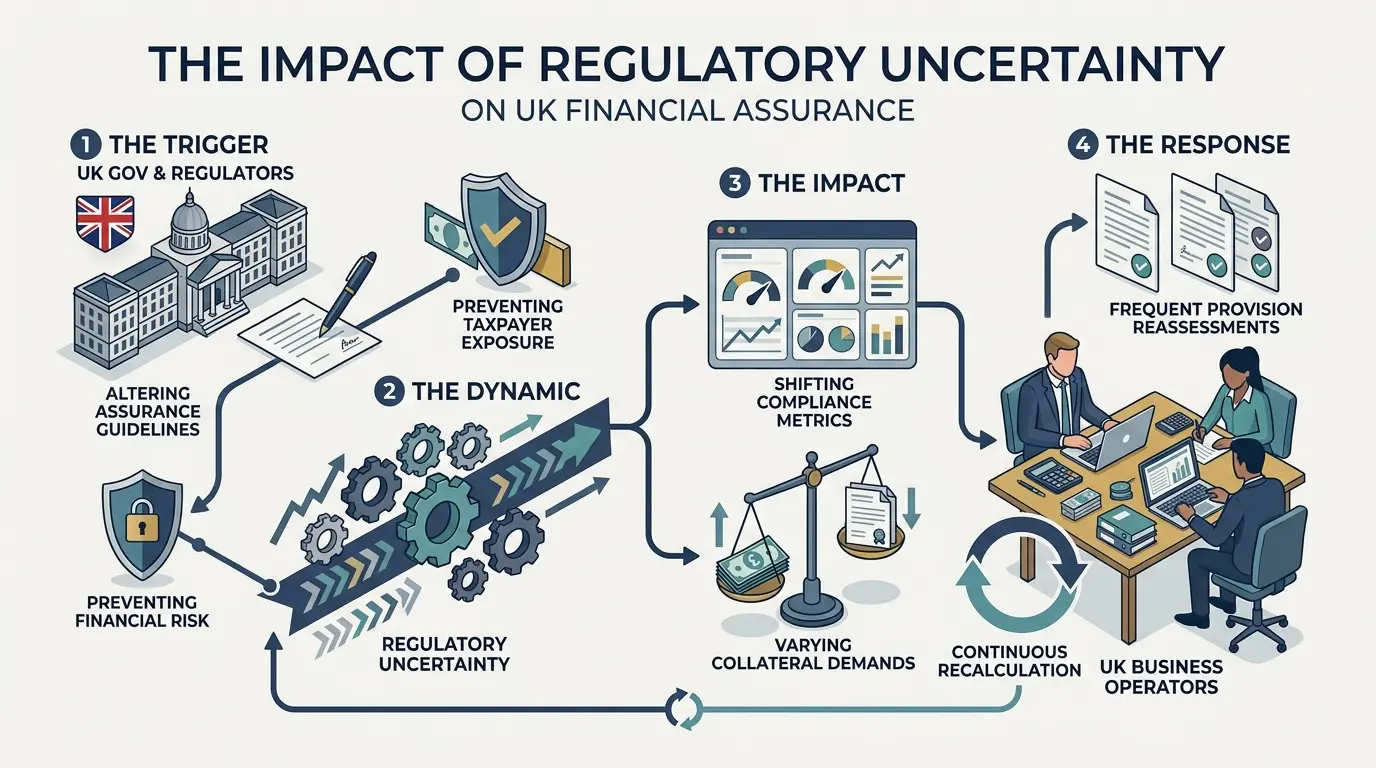
Jurisdictions worldwide update decommissioning frameworks to reflect higher environmental standards and rising actual removal costs. Changes in legislation directly affect how security agreements are structured, executed, and audited.
Provision Reassessment and Cost Escalation
Regulators demand periodic provision reassessment to align security instruments with current removal cost estimates. Inflation, supply chain constraints for heavy-lift vessels, and stricter well-plugging mandates drive decommissioning estimates upward.
Unexpected cost escalation creates collateral shortfalls. Operators must furnish additional security on short notice, disrupting capital allocation plans and corporate budgeting.
Jurisdiction-Specific Compliance Demands
Different regimes impose distinct rules regarding when security must be posted. Some regimes require full security 10 years before estimated field end-of-life, while others tie security postings to remaining field reserves.
Cross-border fields present double exposure risks when neighboring nations enforce conflicting security calculation formulas. Managing compliance across multiple national frameworks demands specialized legal, financial, and technical expertise.
Why Is Liability Transfer Complex in Oil and Gas Asset Sales?
Liability transfer in asset transactions remains complex due to residual liability laws and joint and several liability principles. Selling an asset does not completely release former owners from historical decommissioning obligations if the buyer defaults.
Mergers, acquisitions, and divestments require careful negotiation of the decommissioning security agreement to allocate future liabilities. Financial security arrangements must satisfy both the buyer, the seller, and the licensing regulator before transaction completion.
Structure Type | Legal Mechanism | Primary Financial Exposure | Regulatory Approval Complexity |
Seller Retained Security | Decommissioning Trust Account | Full funding tied up by seller post-sale | Low direct risk to state; high legal negotiation |
Buyer Provided Collateral | Letter of Credit / Bank Guarantee | Capital tied up against buyer's credit facility | High regulatory scrutiny on buyer creditworthiness |
Decommissioning Security Agreement (DSA) | Multi-Party Trust / Escrow Structure | Proportional security posted annually based on reserve ratios | Standardized framework under regulatory oversight |
Residual Liability and Former Owner Exposure
Regulatory regimes retain the power to look back at previous license holders if current operators fail to perform decommissioning. This lingering residual liability forces sellers to demand security guarantees from buyers long after asset disposal.
Sellers often require buyers to establish independent security funds as a condition of sale. These requirements complicate transaction negotiations, occasionally causing asset deals to collapse over collateral terms.
Joint and Several Liability Issues in Joint Ventures
Joint venture partnerships operate under joint and meveral liability mandates. If a non-operating partner enters insolvency, the remaining operating and non-operating partners must absorb the defaulting party’s financial share.
Partner default risk necessitates rigorous joint venture security agreements. Partners must monitor each other's financial health and audit security calculations annually to protect against unexpected default liability.
What Role Does Tax Relief Play in Decommissioning Calculations?
Tax relief on decommissioning reduces the net financial burden by allowing companies to offset field restoration expenses against historical tax liabilities. Security arrangements must account for whether security balances are calculated on a pre-tax or post-tax basis.
Tax structures significantly alter the actual cash outlay required for decommissioning. Miscalculating tax credits leads to over-collateralization or severe capital shortfalls at asset retirement.
Pre-Tax Versus Post-Tax Security Calculations
Regulators and joint venture partners debate whether security posting should reflect gross pre-tax estimates or net post-tax estimates. Pre-tax requirements demand significantly higher collateral, locking up unnecessary capital.
Post-tax security calculations rely on assumptions regarding future tax laws and corporate tax capacity. If tax legislation changes before field abandonment, post-tax security balances can fall short of actual liabilities.
Cross-Border Tax Asymmetries
Multinational energy firms face tax asymmetries across different operating jurisdictions. Tax relief mechanisms such as loss carry-backs, tax ring-fences, and capital allowance rules vary widely between countries.
Uncertainty around tax relief rules prevents standardized global treasury management. Corporate finance teams must customize security arrangements field by field based on local fiscal terms.
How Can Organizations Build Competency in Decommissioning Security?
Organizations build competency in decommissioning security by training cross-functional teams in financial modeling, regulatory compliance, legal drafting, and joint venture negotiations. Structured professional learning bridges knowledge gaps between finance, legal, and operational units.
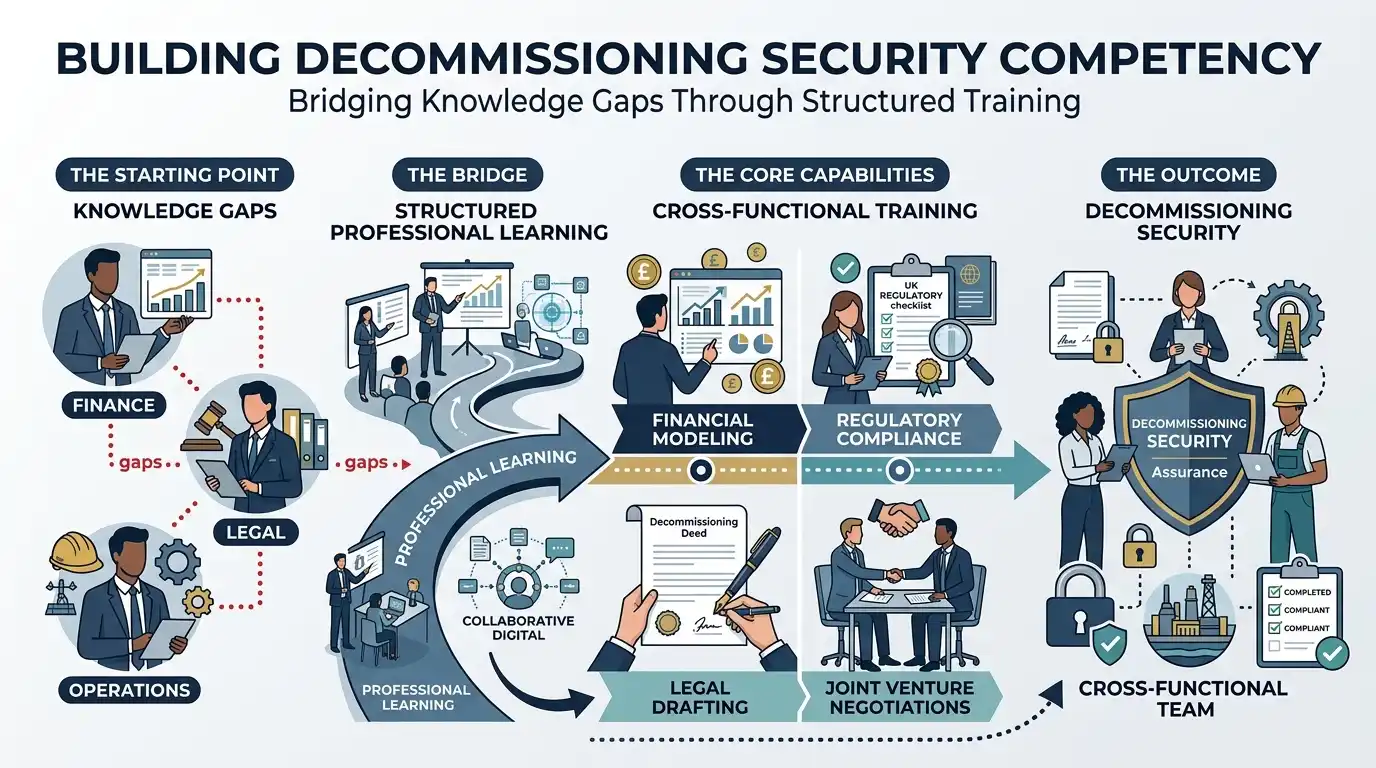
Managing retirement obligations requires synchronized decision-making across disparate corporate departments. Specialized skill development ensures workforce alignment with international best practices and regulatory compliance expectations.
Addressing Skill Gaps Across Functional Teams
Engineers understand physical removal techniques, while treasury managers understand credit facilities, and legal counsel understands joint liability. Skill gaps occur when these teams operate in isolation without understanding the broader security structure.
Cross-functional training programs establish a shared baseline of knowledge. Finance teams learn technical cost driver variables, while engineering teams grasp how provision reassessments impact line-of-credit availability.
Evaluating Training Approaches and Delivery Models
Corporate HR leaders must choose training formats that deliver practical, industry-driven outcomes. Specialized executive education programs evaluate real-world case studies of asset retirement obligation failures, regulatory DSA disputes, and security negotiations.
Formal professional development programs, such as the Decommissioning & Asset Retirement Obligations: Security Arrangements Training Course, equip commercial managers and legal advisors to structure resilient security frameworks. Practical workshops provide actionable tools for managing asset transfer liabilities and optimizing tax relief mechanisms.
Commercial teams seeking structured training options often evaluate comprehensive specialized programs like Decommissioning and Asset Retirement Obligation Security Arrangements Training for Oil and Gas Professionals to build internal expertise and streamline compliance workflows.
How Do Solutions for Managing Decommissioning Security Compare?
Solutions for managing decommissioning security range from traditional bank credit facilities to structured multi-party trusts and dedicated commercial training initiatives. Organizations evaluate these options based on capital efficiency, risk mitigation, and operational capability.
Choosing the right approach depends on financial standing, portfolio risk profile, and internal workforce capability. Energy leaders must weigh direct capital costs against long-term organizational competence.
Structured Comparison of Management Approaches
Evaluating security management mechanisms requires analyzing financial impact, regulatory acceptance, and internal management complexity.
Evaluation Attribute | Traditional Bank Collateral (LOCs/Cash) | Multi-Party DSA Trust Structures | Advanced Workforce Competency Building |
Primary Mechanism | Financial guarantees issued by financial institutions | Legal trust funds managed by neutral trustees | Specialized internal skill development |
Capital Efficiency | Low (directly restricts credit capacity or liquid cash) | Moderate (staged cash contributions tied to reserves) | High (prevents over-collateralization via skilled negotiation) |
Risk Mitigation Focus | Financial default risk protection for state/partners | Multi-partner default and asset transaction risk | Operational, legal, and compliance execution risk |
Implementation Complexity | Low to Moderate (standard bank legal documentation) | High (complex multi-party negotiation and auditing) | Low to Moderate (structured corporate learning programs) |
Long-Term Strategic Value | Temporary risk transfer; no internal capability built | Structured risk sharing; administrative burden | Permanent internal expertise and optimized security terms |
Decision Framework for Organizational Implementation
Selecting an optimal framework involves assessing corporate objectives against portfolio demands. Organizations follow a structured selection process to determine appropriate security strategies.
Assess Portfolio Exposure: Calculate total asset retirement obligations across all operated and non-operated licenses.
Audit Collateral Efficiency: Evaluate current cash lock-up, bank fees, and borrowing capacity usage across existing letters of credit.
Review Regulatory and JV Commitments: Identify upcoming provision reassessment deadlines and joint venture security agreement renewal dates.
Identify Internal Skill Gaps: Determine whether legal, finance, and technical teams possess the expertise needed to negotiate favorable security terms.
Implement Targeted Capability Building: Invest in specialized corporate training to ensure cross-functional teams optimize future security negotiations and regulatory filings.
Frequently Asked Questions
What is included in an oil and gas petroleum IFRS and financial reporting training program?
An oil and gas petroleum IFRS and financial reporting training program covers key accounting standards applicable to upstream, midstream, and downstream operations, including IFRS 6, IFRS 15, and IFRS 16. Participants learn how to account for exploration and evaluation assets, joint operations, impairment testing, asset retirement obligations, and revenue recognition. The Institute For Oil & Gas Training delivers practical, industry-driven modules that help finance teams align corporate reporting with international compliance standards.
How does IFRS 6 affect financial reporting in the oil and gas industry?
IFRS 6 governs the accounting for exploration and evaluation of mineral resources, allowing entities to develop specific accounting policies for capitalising or expensing exploration costs. It defines guidelines for impairment triggers and requires financial statements to clearly disclose cash flows arising from resource exploration. Through training with the Institute For Oil & Gas Training, accounting professionals master the application of IFRS 6 alongside broader petroleum financial reporting practices.
Why is specialised financial reporting training necessary for petroleum sector accountants?
Petroleum sector accounting involves unique financial complexities, such as volatile commodity pricing, joint venture cost allocation, farm-in agreements, and long-term decommissioning liabilities. Standard accounting frameworks often require specific industry adaptations to accurately reflect field economics and asset impairment risks. Oil and gas petroleum IFRS & financial reporting instruction equips corporate accounting teams with the analytical skills needed to produce audit-ready financial statements.
How are joint arrangements and joint ventures accounted for under IFRS in energy companies?
Under IFRS 11, energy sector joint arrangements are classified as either joint operations or joint ventures depending on the contractual rights and obligations of the parties. Joint operators recognise their direct share of assets, liabilities, revenues, and expenses, whereas joint venturers account for their net interest using the equity method. The Institute For Oil & Gas Training trains finance professionals to structure joint interest accounting and overcome complex joint venture reporting challenges.
What are the main challenges in accounting for decommissioning obligations under IFRS?
The primary challenge in accounting for decommissioning obligations under IAS 37 is accurately estimating long-term asset retirement costs and selecting appropriate discount rates for present-value calculations. Changes in inflation, environmental regulations, or field life estimates require periodic provision reassessments and adjustments to carrying amounts. Specialized instruction in oil and gas petroleum IFRS & financial reporting ensures treasury and legal-finance teams correctly record asset retirement obligations and satisfy regulatory disclosures.
Related training courses
Produced Water Management Training Course
- Specialisation
- Oil & Gas Water Treatment and Management
- Duration
- 5 days · 15 CPD hours
Root Cause Analysis (RCA) Training Course
- Specialisation
- Oil & Gas Reliability and Maintenance Management
- Duration
- 5 days · 15 CPD hours
Corrosion Management Systems (CMS) Training Course
- Specialisation
- Oil & Gas Corrosion Management and Control
- Duration
- 5 days · 15 CPD hours
More articles

Decommissioning and Asset Retirement Obligation Security Arrangements Training for Oil and Gas Professionals
Master ARO security, letters of credit, trust funds, and liability transfer. Enroll in the Institute For Oil & Gas Training professional course.
Read article →
Why Security Arrangements Matter for Oil and Gas Decommissioning Obligations
Learn how security arrangements for oil and gas decommissioning obligations protect organizations, mitigate liabilities, and optimize working capital.
Read article →
Decommissioning and Asset Retirement Obligation Provision Recognition Training for Oil and Gas Professionals
Master IAS 37 and IFRIC 1 provision recognition with the Institute For Oil & Gas Training. Evaluate curriculum and enroll today.
Read article →