

This specialised training course provides oil and gas finance, accounting, and technical professionals with exact methodologies for identifying, calculating, and recognising asset retirement obligations under IAS 37 and IFRIC 1, ensuring full compliance and accurate financial statements.
Accounting for offshore and onshore asset retirements presents complex financial challenges for energy sector entities. Operators must balance technical abandonment cost estimates against rigorous accounting standards. Misclassifying obligations or misapplying discount rates leads to significant audit adjustments and financial statement restatements. Energy professionals require a precise understanding of how environmental legislation, field development plans, and contractual concessions create financial liabilities. Without structured technical accounting training, finance teams struggle to align engineering timelines with legal reporting standards.
To address these reporting complexities, professionals often evaluate Why Decommissioning Provisions Matter in the Oil and Gas Industry to establish baseline accounting principles. Building on these fundamentals, the Decommissioning & Asset Retirement Obligations: Provision Recognition Training Course offered by Institute For Oil & Gas Training bridges the critical gap between engineering estimates and balance sheet compliance. This program transforms raw technical decommissioning data into auditable financial disclosures. Participants gain a clear framework for distinguishing between legal obligations and constructive liabilities across multi-asset portfolios.
Corporate finance teams and asset managers face evolving regulatory requirements that mandate precise provision recognition. The Institute For Oil & Gas Training designed this curriculum to eliminate ambiguity in financial reporting. By working through operational scenarios, learners examine how field production life extensions, inflation adjustments, and site restoration obligations alter long-term liabilities. This course equips finance functions, internal audit departments, and joint-venture accountants with the precise tools required to manage financial risk throughout the asset lifecycle.
Why Is This Asset Retirement Obligation Course Structured for Energy Professionals?
Structured around the complete accounting lifecycle of offshore and onshore fields, this course moves systematically from legal liability identification through complex discounting mechanics to annual IFRIC 1 liability adjustments and detailed balance sheet disclosures.
Financial professionals in the energy sector encounter significant operational roadblocks when managing retirement liabilities. Understanding the Key Challenges in Recognising Decommissioning and Asset Retirement Provisions helps corporate teams identify internal control weaknesses before audit cycles begin. The curriculum progression created by Institute For Oil & Gas Training addresses these specific pain points by mirroring the exact life cycle of an upstream or midstream asset, ensuring immediate workplace application.
The course structure prioritises technical precision over theoretical discussion. Early modules focus on establishing legal obligations and constructive liabilities stemming from concession agreements and environmental regulations. Once participants establish the legal foundation, the focus shifts to quantitative measurement. Learners master discounting and unwinding techniques, applying market-based risk-free rates to long-term cash flow projections. This sequence ensures that accounting teams comprehend the full mathematical model before making journal entries.
The final modules address ongoing asset maintenance and reporting adjustments under IFRIC 1 changes in existing provisions. As abandonment cost estimates fluctuate due to technological shifts or regulatory updates, accounting teams must adjust both the asset retirement cost and the corresponding liability correctly. The Institute For Oil & Gas Training structures this training progression so that participants master both initial recognition mechanics and subsequent measurement adjustments, building a complete compliance skillset.
What Will Participants Learn in the Decommissioning & Asset Retirement Obligations Training Course?
Participants learn to quantify abandonment cost estimates, calculate present value discounting, apply IFRIC 1 adjustments, construct compliant IAS 37 disclosures, and audit long-term restoration obligations across complex multi-jurisdictional oil and gas assets.
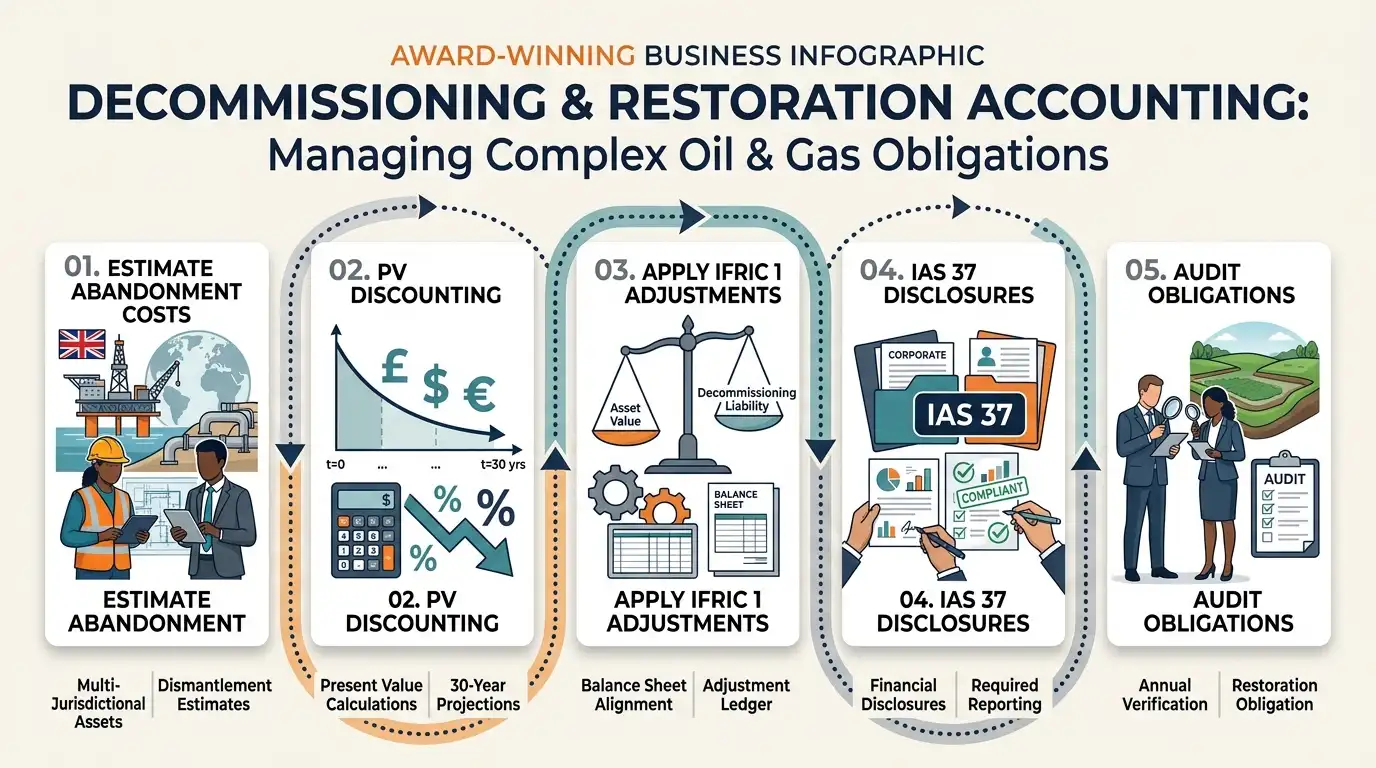
The syllabus is organized into five specialized modules designed to build technical competence step by step:
Module 1: Regulatory Foundations and Liability Identification
Distinction between legal obligations and constructive obligations under IAS 37 provisions.
Analysis of joint operating agreements (JOA), production sharing contracts (PSC), and environmental licences.
Determining the precise timing of liability recognition for offshore platforms, subsea infrastructure, and onshore wells.
Evaluating site restoration obligations resulting from field development activities.
Module 2: Abandonment Cost Estimates and Financial Modelling
Translating AACE (Association for the Advancement of Cost Engineering) estimates into accounting inputs.
Incorporating cost escalation assumptions and long-term inflation parameters into cash flow models.
Assessing technological risk and contingency allowances in abandonment budgets.
Establishing baseline cash flows for deepwater, shallow water, and unconventional land assets.
Module 3: Present Value Mechanics and Discounting
Selecting appropriate risk-free discount rates reflecting current market conditions.
Executing discounting and unwinding calculations across long-term asset horizons.
Accounting for the unwinding of discount as a finance cost in the statement of profit or loss.
Managing currency risk and hyperinflation adjustments in multi-national obligation models.
Module 4: Asset Retirement Capitalisation and IFRIC 1 Adjustments
Capitalising initial decommissioning costs into the historical cost of the decommissioning asset.
Calculating depreciation schedules for capitalised retirement assets using the unit-of-production method.
Applying IFRIC 1 changes in existing provisions for assets measured under the cost model.
Handling accounting treatments when changes in liability exceed the carrying amount of the underlying asset.
Module 5: Financial Statement Disclosure and Audit Preparation
Drafting detailed IAS 37 disclosures for financial statement notes.
Reconciling opening and closing balances of decommissioning provisions.
Managing auditor reviews of discount rate sensitivity analysis and engineering estimate changes.
Aligning accounting records with joint-venture partner reporting and regulator submittals.
How Is the Training Delivered by the Institute For Oil & Gas Training?
The Institute For Oil & Gas Training delivers this program through intensive three-day live workshops, interactive virtual classrooms, or customised on-site corporate programs, utilizing financial model simulations and practical case studies.
The course delivery model combines technical presentations with practical application. Facilitators lead participants through real-world financial modeling exercises using industry standard spreadsheet templates. Learners manipulate variable cost inputs, adjust discount rates, and calculate the resulting impact on balance sheets. This hands-on method ensures that technical concepts are immediately translated into working skills.
Every learning pathway maintained by the Institute For Oil & Gas Training includes rigorous assessment protocols. Participants complete practical financial modeling assignments, execute IFRIC 1 adjustment scenarios, and take a final comprehensive technical assessment. The course materials include working financial templates, checklist guides for IAS 37, and audit trail documentation tools.
What Measurable Results Can Corporate Teams and HR Departments Expect?
Corporate teams achieve unified financial reporting practices, reduced audit adjustment risks, improved forecasting accuracy for asset retirement liabilities, and enhanced cross-departmental collaboration between engineering and accounting divisions.
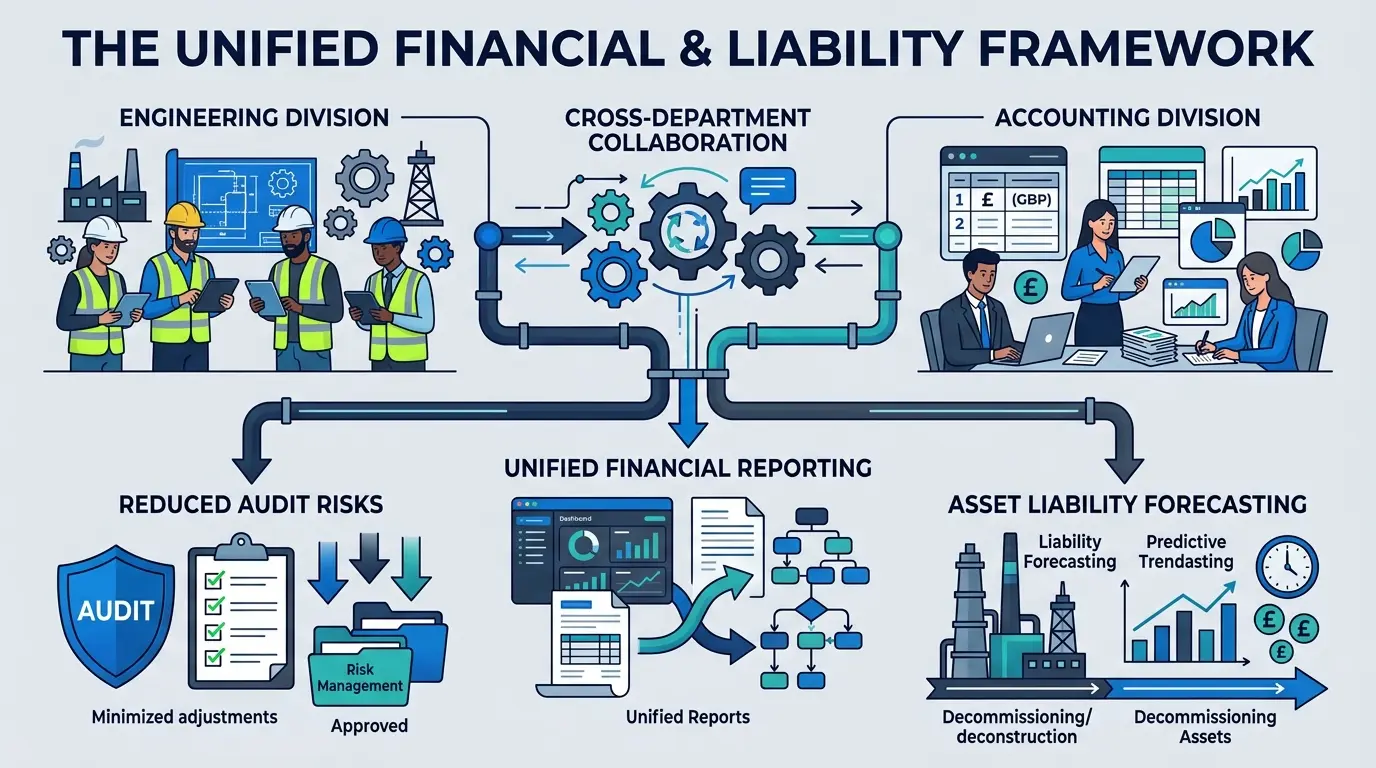
Organisations that enroll their personnel in training delivered by the Institute For Oil & Gas Training observe immediate improvements in financial control processes. Financial statement preparation cycles become more efficient as accounting teams apply standardized templates for asset retirement obligations. By standardizing the measurement of restoration obligations, corporate finance leadership gains clearer visibility into long-term enterprise cash flow requirements.
For HR departments and corporate learning directors, this program serves as an effective capability-building tool for senior accountants, finance managers, and joint-venture controllers. Upward technical mobility requires finance professionals to master complex standards like IAS 37 and IFRIC 1. Providing structured instruction in these niche topics strengthens internal leadership pipelines while ensuring corporate compliance with international financial reporting standards.
How Does Enrollment Work for Individuals and Corporate Cohorts?
Enrollment involves a formal prerequisite review of financial or technical background, selection of delivery format, registration through the corporate portal, and completion of pre-course preparation modules.
Entry Requirements and Prerequisites
Applicants should possess a foundational understanding of financial accounting concepts or asset management principles. The course is specifically designed for:
Financial controllers, chief accountants, and financial reporting managers.
Joint-venture accountants and joint-interest billing specialists.
Project controls managers and decommissioning cost estimators.
Internal and external auditors specializing in energy sector clients.
Step-by-Step Enrollment Process
Prerequisite Assessment: Submit an application detailing current professional roles and accounting background.
Format Selection: Choose between open-enrollment public workshops, virtual live cohorts, or dedicated corporate on-site sessions.
Pre-Course Preparation: Access the learning portal to complete preliminary reading materials on IAS 37 provisions and basic discounting principles.
Program Completion: Attend all training modules, participate in financial modeling workshops, and complete practical evaluations.
Certification: Achieve a passing score on the final assessment to receive the professional certificate in asset retirement obligation recognition.
Corporate HR teams managing multi-participant enrollments can request customized scheduling and tailored case studies reflecting their specific operational assets. Secure your organization's financial compliance capabilities and apply for course access today.
Frequently Asked Questions
What is covered in the Oil and Gas Petroleum IFRS & Financial Reporting training by the Institute For Oil & Gas Training?
The Oil and Gas Petroleum IFRS & Financial Reporting program by the Institute For Oil & Gas Training covers specialized accounting standards, including IFRS 6, IAS 37, IFRIC 1, and IFRS 16. Participants gain practical skills in handling exploration expenditure, decommissioning provisions, joint venture cost allocation, and revenue recognition across upstream and midstream operations.
Why is specialized IFRS training essential for oil and gas finance professionals?
Petroleum accounting involves unique financial complexities such as volatile commodity pricing, high-risk exploration costs, and complex asset retirement obligations. Training with the Institute For Oil & Gas Training ensures finance teams can accurately apply standards like IAS 36 and IFRS 6 to prevent financial statement misstatements and pass regulatory audits.
How does the Institute For Oil & Gas Training address joint venture accounting under IFRS?
The Oil and Gas Petroleum IFRS & Financial Reporting course delivers practical instruction on accounting for joint operations, joint ventures, and production sharing agreements under IFRS 11 and IFRS 15. Professionals learn to calculate cash calls, manage joint interest billing, and correctly classify shared assets and liabilities on balance sheets.
What are the entry requirements for the Oil and Gas Petroleum IFRS & Financial Reporting course?
This program is designed for corporate accountants, financial controllers, auditors, and finance managers operating within the energy sector. A basic understanding of general accounting principles or financial reporting is recommended to fully engage with the advanced petroleum accounting scenarios presented by the Institute For Oil & Gas Training.
How do IFRS reporting standards affect decommissioning and asset retirement obligations in energy firms?
Under IAS 37 and IFRIC 1, energy companies must recognize the present value of future site restoration and abandonment costs as capitalised assets and financial liabilities. The Oil and Gas Petroleum IFRS & Financial Reporting training at the Institute For Oil & Gas Training teaches professionals how to model discount rates, unwind finance costs, and adjust provisions for annual reporting compliance.
Related training courses
Oil Movement, Storage & Troubleshooting Training Course
- Specialisation
- Oil & Gas Process Engineering and Operations
- Duration
- 5 days · 15 CPD hours
Produced Water Management Training Course
- Specialisation
- Oil & Gas Water Treatment and Management
- Duration
- 5 days · 15 CPD hours
Corrosion Management Systems (CMS) Training Course
- Specialisation
- Oil & Gas Corrosion Management and Control
- Duration
- 5 days · 15 CPD hours
More articles

Decommissioning and Asset Retirement Obligation Security Arrangements Training for Oil and Gas Professionals
Master ARO security, letters of credit, trust funds, and liability transfer. Enroll in the Institute For Oil & Gas Training professional course.
Read article →
Key Challenges in Managing Security Arrangements for Oil and Gas Decommissioning Obligations
Examine key challenges in managing security arrangements for oil and gas decommissioning obligations and evaluate strategic solutions.
Read article →
Why Security Arrangements Matter for Oil and Gas Decommissioning Obligations
Learn how security arrangements for oil and gas decommissioning obligations protect organizations, mitigate liabilities, and optimize working capital.
Read article →