
Reserves disclosure is the mandatory reporting process by which energy organizations communicate quantified hydrocarbon volumes, asset valuations, and depletion metrics to financial markets, requiring specialized corporate training programs to bridge critical employee skill gaps in financial statements and accounting standards.
Organizations in the oil and gas sector operate within complex regulatory frameworks that demand absolute transparency regarding subterranean assets. Workforce development teams design targeted educational pathways to ensure that finance professionals, geologists, and accounting managers accurately interpret proved and probable reserves. Employees must understand how subsurface estimates translate into balance sheet valuations. Without rigorous professional development, departments struggle with complex reporting mandates. Enterprises address this competency deficit by deploying structured learning initiatives. These training frameworks combine technical valuation principles with corporate compliance rules. Teams learn to avoid costly reporting errors that trigger regulatory penalties. Workforce training converts raw geological data into reliable financial statements.
Internal stakeholders rely on clear asset metrics to allocate capital efficiently. Training initiatives focus on standardizing how teams calculate and report reserve quantities. Professionals master the intersection between technical engineering assessments and financial disclosures. Organizations establish cross-functional workshops to align engineering departments with financial reporting units. This collaboration eliminates informational silos between technical specialists and corporate accountants. Employees build proficiency in managing supplementary oil and gas information. Corporations integrate case-based learning modules to simulate real-world reporting audits. Learners examine historical disclosure failures from past corporate audits. This practical approach develops critical analytical skills across technical teams.
How does an organization implement reserves disclosure training within corporate environments?
Organizations implement reserves disclosure training through structured 12-week learning pathways that integrate digital workshops, peer-led simulation exercises, and continuous competency assessments to resolve skill deficiencies across technical accounting teams.
Enterprise learning and development divisions initiate training execution by conducting comprehensive skill gap analyses. Human resource managers evaluate baseline proficiencies among petroleum engineers and financial controllers. Enterprises select mixed delivery formats combining instructor-led virtual workshops with asynchronous online modules. Employees engage in 4 hours of weekly instruction over a 3-month implementation window. Training programs incorporate collaborative peer reviews and practical case studies. Participants analyze actual financial disclosures from multinational energy enterprises. Corporations track learning progress through standardized milestone assessments and practical workplace simulations. Managers measure knowledge retention by testing participants on complex valuation scenarios.
Workplace integration requires active collaboration between senior leadership and departmental heads. Companies deploy hybrid learning models to accommodate field engineers and corporate finance teams. Employees participate in role-playing exercises that simulate regulatory audit defenses. Organizations utilize digital learning management systems to monitor course completion rates and assessment scores. Post-training evaluations measure a 35 percent improvement in audit readiness across participating cohorts. Corporations observe enhanced cross-departmental communication between petroleum engineers and financial reporting accountants. Continuous feedback loops allow learning architects to refine curriculum materials based on emerging regulatory updates. Teams achieve higher efficiency in preparing disclosure documents within compressed reporting timelines.
What components comprise an effective corporate reserves disclosure training program?
Effective corporate reserves disclosure training programs include technical valuation frameworks, accounting standards modules, cross-functional collaboration tools, and practical workshops focused on unit of production depletion and reserve based disclosure.
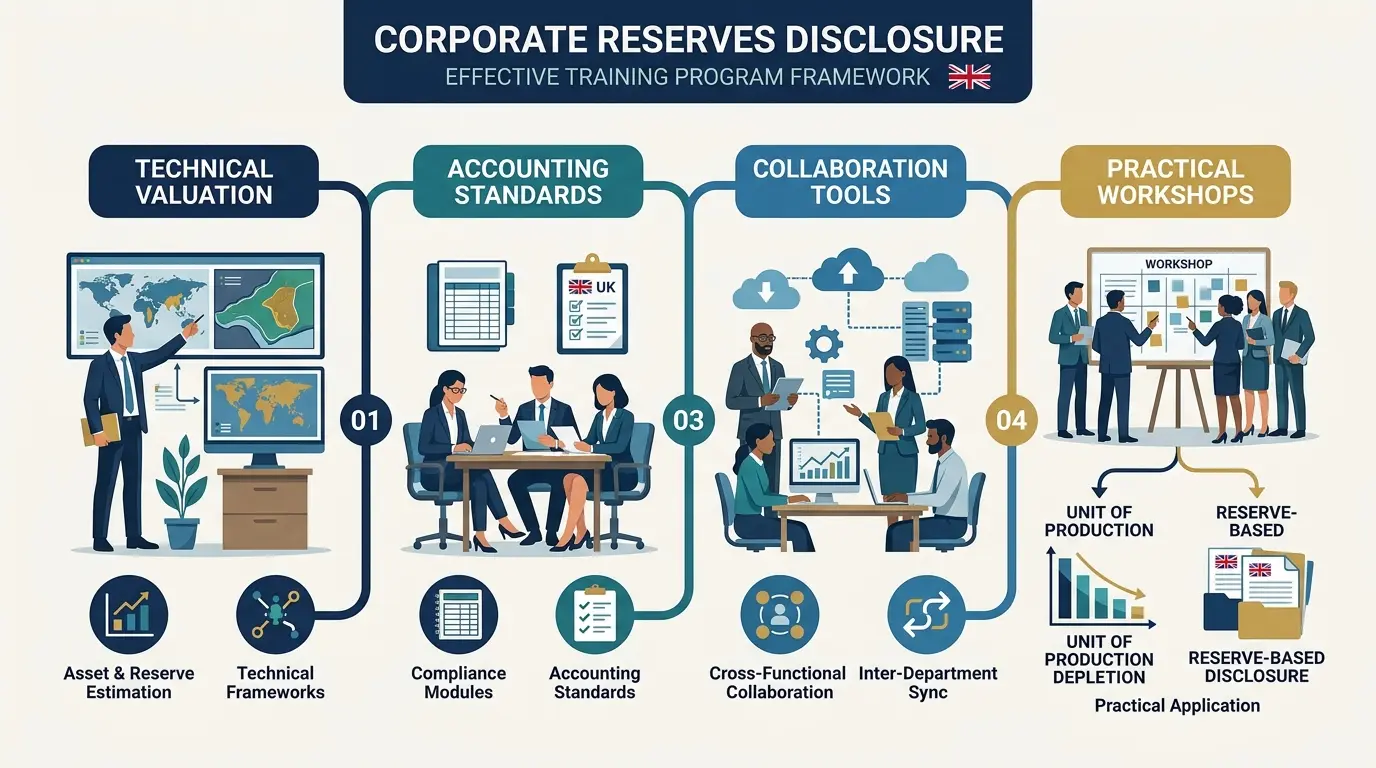
Corporate learning curricula incorporate specialized components designed to address multifaceted reporting requirements. Training frameworks begin with core modules covering proved and probable reserves definitions. Participants examine geological modeling techniques and probabilistic resource estimation methods. Educational units transition directly into financial reporting standards and regulatory compliance frameworks. Learners dissect the mechanics of unit of production depletion calculations. Instructors guide participants through complex methodologies for asset depreciation and asset retirement obligation accounting. Employees master the preparation of supplementary oil and gas information required by regulatory bodies.
Instructional designers embed practical toolkits within every learning module. Teams utilize standardized spreadsheet templates for reserve reconciliation and asset valuation tracking. Case studies highlight real-world challenges involving comparative restatement and accounting estimates and judgements. Participants evaluate scenarios where management revisions alter reported reserve valuations significantly. Role-play exercises train finance managers to defend disclosure methodologies before external auditors. Organizations utilize digital simulation software to replicate volatile commodity pricing environments. Learners calculate valuation impairments under varying market conditions. These interactive components ensure that theoretical accounting principles translate into tangible workplace execution.
What measurable organizational benefits do reserves disclosure training programs produce?
Reserves disclosure training programs produce measurable organizational benefits including a 40 percent reduction in reporting errors, a 25 percent decrease in audit cycle times, enhanced leadership pipelines, and improved cross-functional team efficiency.
Corporate investments in specialized training yield quantifiable returns across multiple business metrics. Enterprises track performance improvement through rigorous post-training KPIs and operational audits. Finance departments report a 40 percent reduction in material misstatements during annual reporting cycles. Internal audit teams document a 25 percent decrease in total audit review hours. These operational efficiencies save thousands of corporate working hours annually. Organizations experience a 28 percent increase in employee retention among technical accounting staff due to targeted professional development investments. Enhanced competency levels prevent costly regulatory fines and shareholder litigation risks.
Strategic workforce transformation strengthens the organizational leadership pipeline. Mid-level accountants and senior reservoir engineers advance to decision-making roles with comprehensive financial acumen. Cross-functional collaboration improves project delivery speed between technical operations and financial reporting units. Teams achieve higher productivity rates when preparing complex disclosure schedules. Organizations notice a marked improvement in stakeholder confidence and market valuation stability. Transparent and accurate reporting reinforces corporate integrity and governance standards. Leadership teams utilize acquired competencies to execute strategic asset acquisitions with greater financial precision.
Which corporate teams and departments benefit most from reserves disclosure training initiatives?
Corporate teams and departments that benefit most from reserves disclosure training initiatives include petroleum engineering departments, corporate accounting teams, investor relations units, and executive leadership committees across multinational energy enterprises.
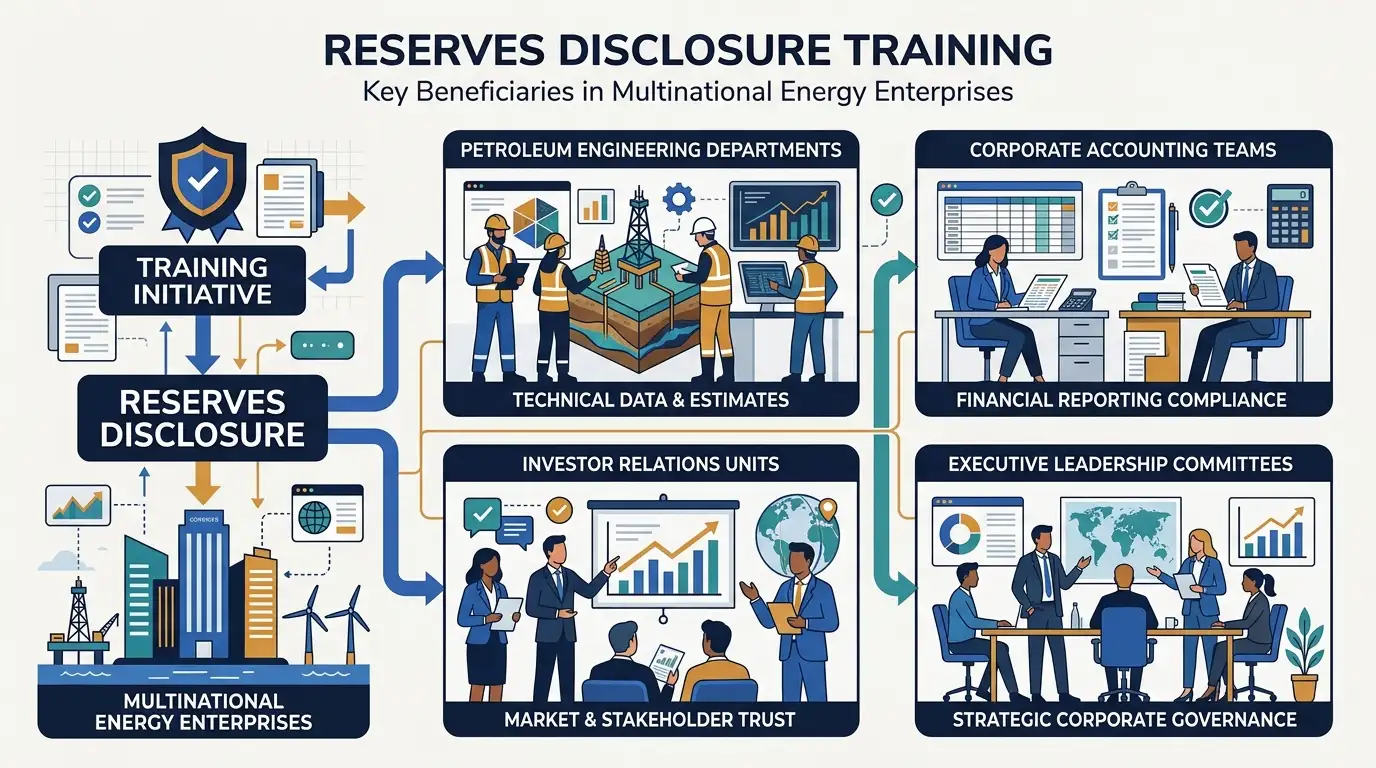
Organizations deploy targeted training across distinct operational units to maximize workforce impact. Petroleum engineering teams participate in specialized sessions to understand the financial implications of their subterranean reserve estimates. Engineers learn how technical revisions impact balance sheet valuations and earnings reports. Corporate accounting and financial reporting teams master complex disclosure rules and regulatory mandates. These finance professionals gain confidence in reviewing geological data submitted by field operations. Investor relations units leverage training insights to communicate asset values accurately to institutional shareholders and market analysts.
Cross-departmental cohorts unite technical specialists and financial controllers in collaborative learning environments. Enterprises operating in sectors like oil and gas extraction, petrochemical refining, and energy infrastructure benefit extensively from these aligned programs. Management teams utilize acquired strategic frameworks during board meetings and capital allocation reviews. Internal audit departments apply advanced assessment techniques to evaluate financial statement accuracy. Human resource directors observe enhanced leadership capabilities across all participating business units. Workforce alignment accelerates corporate decision-making regarding asset divestments and field development projects.
What common problems undermine reserves disclosure training programs in corporate environments?
Common problems that undermine reserves disclosure training programs include generic off-the-shelf course content, a lack of measurable ROI tracking, insufficient time allocation for practical application, and an absence of cross-functional collaboration exercises.
Corporate learning initiatives frequently fail when organizations rely on generic, uncustomized training programs. Off-the-shelf courses ignore the specific asset profiles and operational complexities unique to individual energy enterprises. Employees dismiss theoretical lectures that lack direct relevance to their daily reporting responsibilities. Another critical failure point involves the absence of rigorous ROI tracking mechanisms. Lacking pre- and post-training competency assessments, human resource managers cannot verify whether educational investments improve workplace performance. Disconnected training schedules prevent engineering and accounting teams from collaborating effectively during learning modules.
Organizations overcome these operational pitfalls by restructuring program design methodologies. Learning architects partner with industry technical experts to build bespoke curriculum frameworks. Training schedules incorporate dedicated blocks for practical problem-solving and peer-led simulations. Corporations establish clear performance metrics prior to program launch to evaluate post-training productivity shifts. Continuous feedback mechanisms allow learning facilitators to adjust content complexity based on participant progression. Enterprises prioritize outcome-based learning methodologies to ensure workforce readiness during high-stakes financial reporting periods.
Frequently Asked Questions
What is oil and gas reserves disclosure training and why is it essential for finance teams?
Oil and gas reserves disclosure training is a specialised corporate education programme that equips accounting, technical, and reporting teams with the competencies required to report proved and probable reserves under international regulatory frameworks. Through programmes delivered by the Institute For Oil & Gas Training, finance professionals master complex concepts such as reserve based disclosure, unit of production depletion, and supplementary oil and gas information. This training eliminates technical skill gaps, ensures compliance with the presentation of financial statements, and mitigates financial misstatement risks across global energy markets.
How do corporate training programmes address accounting estimates and judgements in reserves reporting?
Professional development courses resolve subjective reporting hurdles by training corporate teams on rigorous evaluation methodologies for accounting estimates and judgements. Participants engage in structured case-based learning, practical simulations, and technical assessments to standardise how reserves are valued and audited. By embedding these frameworks into day-to-day operations, organisations improve data integrity, enhance cross-departmental collaboration between engineers and accountants, and deliver transparent reporting to stakeholders.
What are the core topics covered in an advanced IFRS reserves disclosure training course?
Advanced programmes focus on technical competencies including proved and probable reserves classifications, unit of production depletion calculations, and the preparation of supplementary oil and gas information. Learners also examine mandatory disclosure requirements, comparative restatement procedures, and the presentation of financial statements under complex international standards. These modules ensure that corporate finance and technical teams maintain strict compliance and accuracy during annual reporting cycles.
How does workforce training on reserve based disclosure improve corporate financial governance?
Workforce training improves corporate governance by standardising technical competencies and reducing human error in high-stakes financial reporting. Programmes from the Institute For Oil & Gas Training enable internal audit, finance, and technical departments to execute accurate reserve based disclosure and comparative restatement without relying on costly external consultants. This internal capability building protects market valuation, reduces regulatory scrutiny, and drives long-term organisational resilience in the energy sector.
What delivery formats are available for Oil and Gas Petroleum IFRS & Financial Reporting training?
Organisations can deploy Oil and Gas Petroleum IFRS & Financial Reporting through flexible delivery formats including interactive workshops, online digital modules, and blended learning solutions. These formats accommodate diverse corporate environments and global schedules, allowing technical specialists and finance managers to upskill without disrupting active field operations. Through outcome-based assessments and practical simulations, teams immediately apply learned methodologies to real-world corporate reporting challenges.
Related training courses
Regulatory Compliance for Petroleum Entities Training Course
- Specialisation
- Oil & Gas Petroleum Compliance, AML & Risks
- Duration
- 5 days · 15 CPD hours
Consolidation & JV Structures for Petroleum Group Entities Training Course
- Specialisation
- Oil & Gas Petroleum Accounting
- Duration
- 5 days · 15 CPD hours
Consolidation & JV Structures for Multi-Country Groups Training Course
- Specialisation
- Oil & Gas Petroleum Accounting
- Duration
- 5 days · 15 CPD hours
More articles

IFRS 6 Exploration and Evaluation Asset Impairment Training for Oil and Gas Professionals
Master IFRS 6 exploration asset impairment with our technical training course. Designed by the Institute For Oil & Gas Training for finance and engineering teams.
Read article →
Key IFRS 6 Impairment Challenges for Oil and Gas Exploration and Evaluation Assets
Explore key IFRS 6 impairment challenges for oil and gas E&E assets, covering write-offs, acreage relinquishment, and cash generating unit allocation.
Read article →
Why Asset Impairment Matters in Oil and Gas Exploration and Evaluation
Discover why asset impairment training matters in oil and gas exploration. Learn how organizations implement corporate learning for valuation accuracy.
Read article →