
The valuation and carrying amount review of upstream assets present severe technical complexities for finance teams, technical departments, and corporate leadership within the energy sector. Navigating the regulatory landscape requires a robust understanding of accounting principles specifically designed for the extractive industries. Finance professionals often struggle to interpret how standard accounting frameworks apply to high-risk upstream capital allocation. Grasping the fundamentals is essential before exploring advanced technical mechanisms, which is why understanding Why Asset Impairment Matters in Oil and Gas Exploration and Evaluation sets the critical foundational context for senior decision-makers and accounting teams.
What are the primary impairment indicators under IFRS 6 for exploration and evaluation assets?
Impairment indicators under IFRS 6 require finance teams to assess whether the carrying amount of exploration and evaluation assets exceeds their recoverable amount, triggered by expired license periods, substantive expenditure halts, or negative technical data outcomes.
Under standard accounting frameworks, the assessment of impairment normally relies on strict cash flow generation models. However, IFRS 6 introduces a modified approach that allows entities to defer the standard IAS 36 impairment testing until technical feasibility and commercial viability are demonstrable. This departure creates significant ambiguity for financial controllers. When exploration rights approach their statutory expiry dates without active renewal applications underway, an immediate trigger occurs. Organizations must evaluate whether substantive expenditure on further exploration and evaluation is neither budgeted nor planned.
Furthermore, when core seismic data or exploratory drilling yields no commercial discoveries, management must immediately initiate a carrying amount review. Technical departments often delay sharing negative subsurface findings with finance teams, leading to delayed asset write-downs. Corporate governance structures must bridge this communication gap between geologists and accountants. Training programs delivered by the Institute For Oil & Gas Training ensure that cross-functional teams recognize these trigger events early, preventing distorted balance sheets and regulatory penalties. Without standardized oversight, companies face material misstatements that directly undermine stakeholder trust and trigger aggressive audit scrutiny.
How does the expiry of exploration rights and relinquishment of acreage impact asset carrying values?
The expiry of exploration rights and the formal relinquishment of acreage mandate an immediate technical write-down of associated capitalized costs because future economic benefits can no longer materialize from the licensed geographical block.
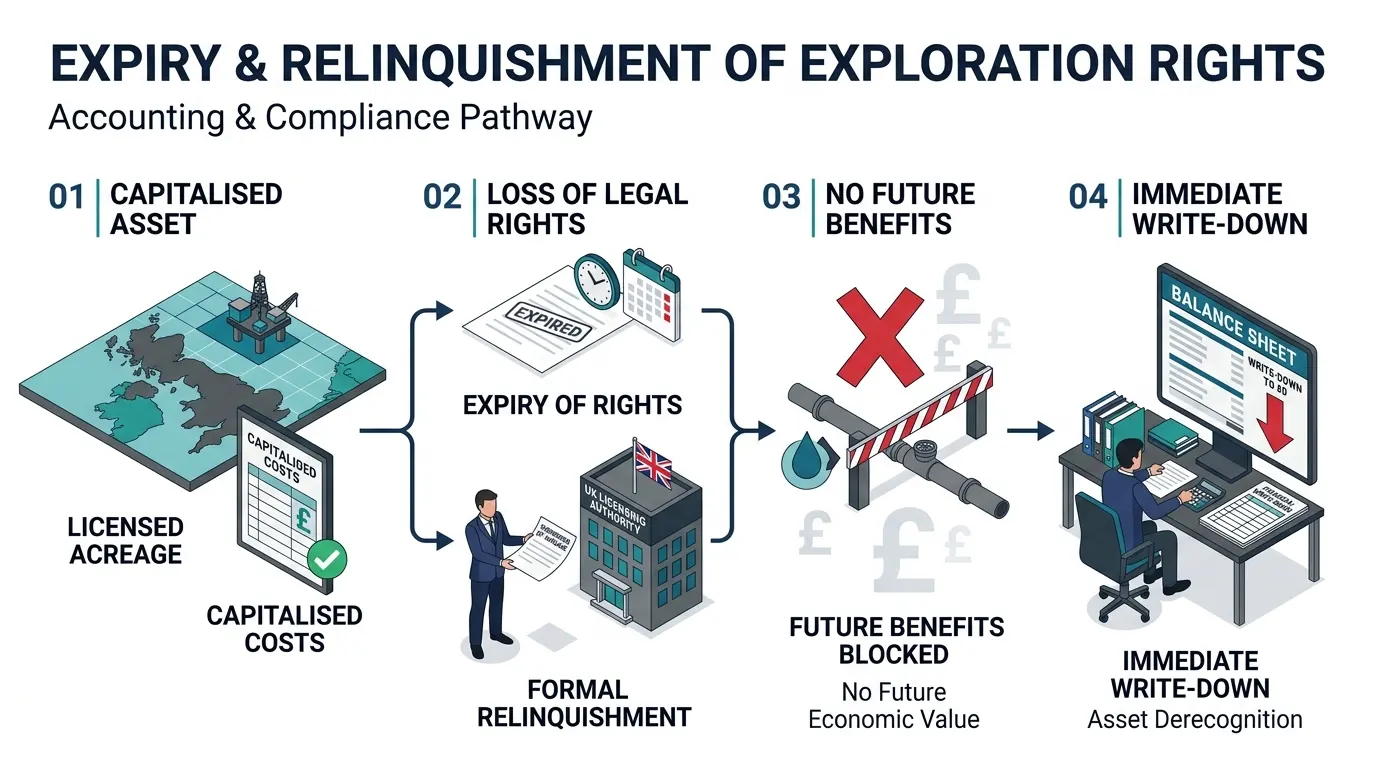
Exploration licenses are granted for finite periods, typically ranging from three to seven years, depending on the jurisdiction and basin maturity. As these deadlines approach, operators must demonstrate sufficient work program compliance to secure extensions. If an operator decides to surrender a portion of the acreage due to unpromising well results, the specific costs allocated to that relinquished sub-block must be isolated and expensed immediately. Financial analysts frequently miscalculate the net book value of partial relinquishments when capitalized costs are pooled across oversized license areas.
To maintain compliance, accounting teams must implement granular cost-pooling methodologies. Every seismic survey, core sample analysis, and topographical study must map directly to distinct geographical subsets. When acreage is surrendered, the unamortized balance becomes impaired. Organizations leveraging the IFRS 6 – Exploration & Evaluation Assets: Impairment Training Course build internal competencies to isolate these specific capital pools efficiently. This precision prevents residual capital from lingering on the statement of financial position, ensuring that reported asset values reflect actual geological potential rather than historical sunk costs.
What complications arise during unsuccessful well write-offs and carrying amount reviews?
Unsuccessful well write-offs complicate carrying amount reviews because management must determine whether to expense dry hole costs immediately or defer them while adjacent exploratory drilling prospects within the same license area remain active.
The accounting treatment of dry holes represents one of the most contentious areas in upstream financial reporting. When an exploratory well is plugged and abandoned, standard practice dictates that all direct drilling costs are written off to the income statement. However, operators often argue that a single dry hole does not invalidate the potential of an entire basin or license block if secondary drilling targets exist. This tension requires finance committees to exercise rigorous professional judgment. Auditors demand objective, verifiable evidence that secondary targets possess genuine commercial viability before allowing capitalization to continue.
Carrying amount reviews must balance optimism from the technical team against conservative accounting mandates. If management defers a write-off without substantive future work commitments, external auditors will force retroactive adjustments that damage quarterly earnings reports. Corporate learning interventions must address this behavioral bias. Training curricula must empower finance professionals to challenge technical assumptions objectively. By establishing clear internal thresholds for project continuation, organizations protect themselves against prolonged asset overstatements and volatile earnings corrections during annual audit cycles.
How should cash generating unit allocation for E&E assets be structured before commercial viability?
Cash generating unit allocation for exploration and evaluation assets requires grouping properties into larger operational pools than normal IAS 36 rules permit, provided that the aggregation does not exceed a single operating segment.
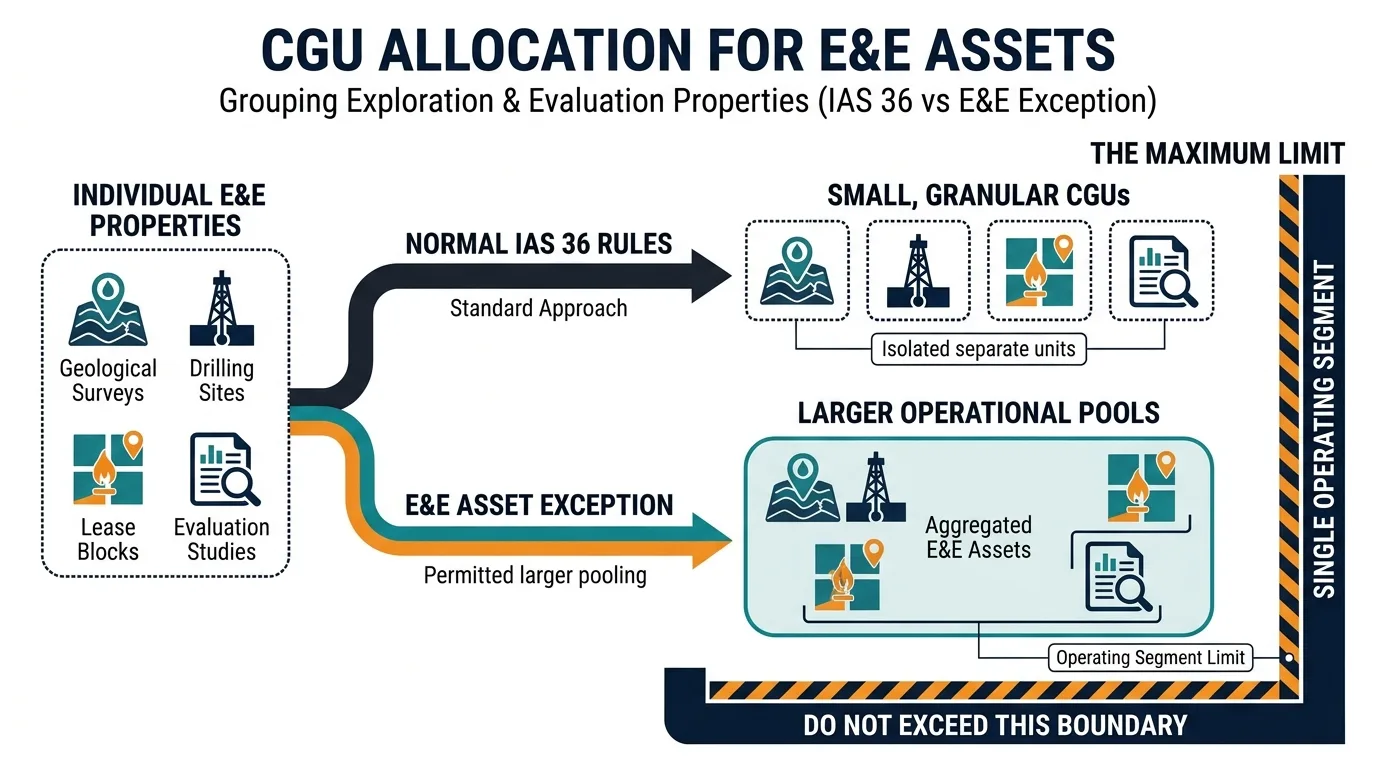
Under standard IAS 36 guidelines, impairment is tested at the individual cash generating unit level, defined as the smallest identifiable group of assets generating independent cash inflows. Because exploration and evaluation assets do not generate cash inflows independently, IFRS 6 provides a temporary exemption. It permits entities to establish accounting policies that allocate exploration assets to larger units for impairment testing. This flexibility allows companies to pool multiple early-stage licenses into a regional cluster, offsetting underperforming prospects against promising discoveries within the same geological basin.
However, this aggregation creates vulnerability during economic downturns or commodity price slumps. If a regional cluster contains marginal discoveries alongside dry acreage, the collective carrying amount can easily exceed the total recoverable amount, triggering a massive impairment loss. Finance teams must define their aggregation boundaries meticulously during the initial accounting policy setup. Auditors scrutinize these boundaries to ensure companies are not masking localized asset failures within massive regional pools. Establishing transparent allocation frameworks requires specialized cross-functional collaboration between reservoir engineers and financial controllers.
What principles govern the disclosure of impairment losses and subsequent reversals in upstream reports?
The disclosure of impairment losses and subsequent reversals demands absolute transparency regarding the key assumptions, discount rates, and geological triggers used to determine the recoverable amount in financial statements.
Transparency is the ultimate safeguard for investor confidence in capital-intensive extractive industries. When an entity recognizes an impairment loss on an exploration and evaluation asset, financial statement footnotes must articulate the exact operational catalysts that drove the decision. This includes disclosing the specific discount rates applied to future cash flow projections, commodity price decks used for modeling, and the specific geological findings that prompted the revision. Omitting these details invites regulatory inquiries and lowers market credibility.
Conversely, if external market conditions improve or subsequent appraisal drilling yields exceptional results, IFRS 6 permits the reversal of previously recognized impairment losses under strict conditions. Such reversals must be justified by demonstrable changes in the economic or technical feasibility of the asset. Managing these complex disclosures requires meticulous record-keeping and advanced reporting workflows. Organizations that invest in targeted professional development ensure their reporting teams communicate these volatile adjustments clearly, protecting the enterprise from compliance failures while maintaining high standards of corporate transparency.
Frequently Asked Questions
What does Oil and Gas Petroleum IFRS & Financial Reporting training cover?
The Oil and Gas Petroleum IFRS & Financial Reporting program offered by the Institute For Oil & Gas Training covers complex accounting standards unique to the upstream, midstream, and downstream sectors. Participants learn how to apply IFRS 6 for exploration and evaluation assets, manage decommissioning provisions under IAS 37, and account for production-sharing contracts accurately.
Who should attend petroleum financial reporting courses?
These specialized training programs are designed for finance directors, corporate accountants, internal auditors, and commercial managers operating within the upstream and downstream energy sectors. Professionals looking to master petroleum revenue recognition, joint venture accounting, and impairment reviews benefit significantly from this curriculum.
How does IFRS 6 impact upstream exploration asset accounting?
IFRS 6 allows energy companies to defer standard impairment testing for exploration and evaluation assets until technical feasibility and commercial viability are established. This temporary exemption requires specialized financial reporting expertise to ensure compliance during carrying amount reviews and license relinquishments.
What are the main challenges in upstream oil and gas accounting?
Key challenges include handling unsuccessful well write-offs, managing asset retirement obligations, and allocating cash-generating units before commercial production begins. Organizations must align technical subsurface data with financial controllership to prevent material misstatements in their statutory reports.
Why is specialized petroleum accounting training essential for energy firms?
Specialized petroleum accounting training ensures that finance teams navigate complex regulatory frameworks while mitigating audit risks and regulatory non-compliance penalties. Upskilling staff through the Institute For Oil & Gas Training bridges the gap between technical operational data and corporate financial transparency.
Related training courses
Risk Management for Upstream & Midstream Projects: Exposures Training Course
- Specialisation
- Oil & Gas Petroleum Compliance, AML & Risks
- Duration
- 5 days · 15 CPD hours
Regulatory Compliance for Petroleum Entities Training Course
- Specialisation
- Oil & Gas Petroleum Compliance, AML & Risks
- Duration
- 5 days · 15 CPD hours
Consolidation & JV Structures for Petroleum Group Entities Training Course
- Specialisation
- Oil & Gas Petroleum Accounting
- Duration
- 5 days · 15 CPD hours
More articles

IFRS 6 Exploration and Evaluation Asset Impairment Training for Oil and Gas Professionals
Master IFRS 6 exploration asset impairment with our technical training course. Designed by the Institute For Oil & Gas Training for finance and engineering teams.
Read article →
Why Asset Impairment Matters in Oil and Gas Exploration and Evaluation
Discover why asset impairment training matters in oil and gas exploration. Learn how organizations implement corporate learning for valuation accuracy.
Read article →
IFRS 6 Exploration and Evaluation Asset Recognition Training for Oil and Gas Professionals
Master IFRS 6 asset recognition, capitalization policies, and impairment testing with the Institute For Oil & Gas Training. Enroll today.
Read article →