
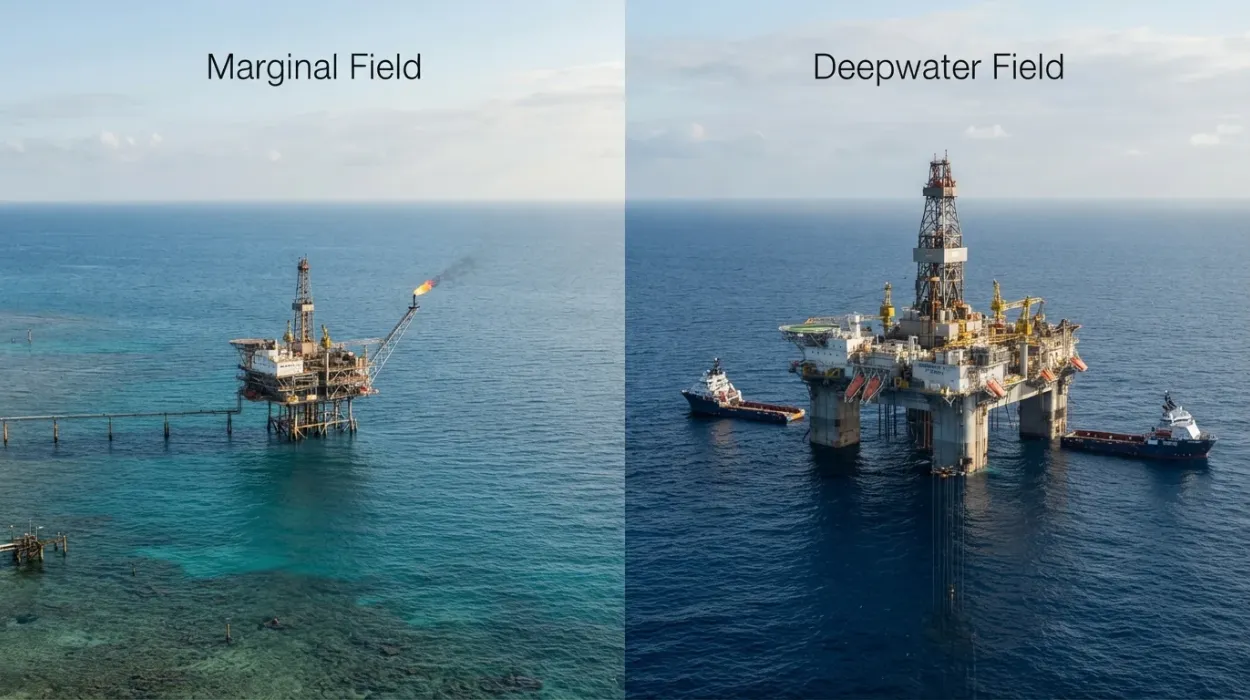
Differentiating fiscal approaches for marginal and deepwater oil fields establishes tailored tax, royalty, and production-sharing mechanisms that reflect specific cost structures, technical risks, and commercial viability thresholds, enabling resource holders to attract capital while maximizing long-term state revenue.
Petroleum fiscal regimes dictate how financial risks and revenues split between resource-holding host governments and commercial operating companies. Marginal fields represent discovery deposits with constrained economic returns due to small reserve volumes, distance from processing infrastructure, or complex reservoir geology. Deepwater assets involve offshore developments in water depths exceeding 300 metres, characterized by capital expenditure requirements reaching USD 2 billion to USD 5 billion before achieving first oil. Applying identical tax and contractual structures across these distinct risk profiles causes sub-optimal field development or project abandonment.
Understanding the economic mechanics of fiscal design requires corporate teams to evaluate revenue sharing, cost recovery limits, and taxation models across varied field classifications. Multi-disciplinary corporate teams comprising petroleum accountants, asset managers, corporate legal counsel, and commercial strategists must develop proficiency in assessing technical risk against financial terms. Corporate workforce training in fiscal regime analysis builds institutional capability to evaluate competitive bidding rounds, draft petroleum contracts, and model long-term project economics accurately under volatile commodity price scenarios.
How Do Distinct Fiscal Regimes Function Within Corporate Oil and Gas Environments?
Fiscal regimes function within corporate environments by establishing operational decision-making frameworks, influencing capital allocation decisions, driving risk mitigation strategies, and directly determining project net present value across the multi-decade lifecycle of upstream petroleum exploration and production assets.
Upstream energy companies operate within rigid capital budget constraints, evaluating potential global projects using standardized financial hurdles such as Internal Rate of Return exceeding 15% and Payback Period under 5 years. Fiscal terms establish the commercial boundary conditions for these hurdle rates. Host government regulatory agencies and national oil companies enforce these terms to ensure public resource monetization aligns with national energy security goals and economic development targets.
Corporate decision-making requires commercial teams to model distinct fiscal instruments against specific field types. Marginal fields require early cash-flow protection through upfront investment allowances, reduced royalty rates, or tax holidays to offset low production volumes. Deepwater fields necessitate flexible fiscal instruments such as sliding scale terms tied to daily production rates or cumulative profitability index markers, ensuring the host state captures windfall profits during high-price cycles while insulating the operator during initial high-CAPEX payback phases.
Organizational implementation relies on continuous alignment between commercial, technical, and regulatory compliance units. Industry professionals develop corporate financial models that simulate variable production profiles against progressive tax scales, ring fencing provisions, and domestic supply obligations. Standardizing this skill set across regional operating teams ensures that corporate capital allocation decisions reflect precise fiscal risk assessments rather than generic financial assumptions.
What Are the Core Components of Marginal and Deepwater Fiscal Frameworks?
The core components of fiscal frameworks comprise contractual mechanisms, tax structures, financial incentives, ring-boxing rules, and domestic market requirements designed to balance investor capital recovery against host government revenue collection.
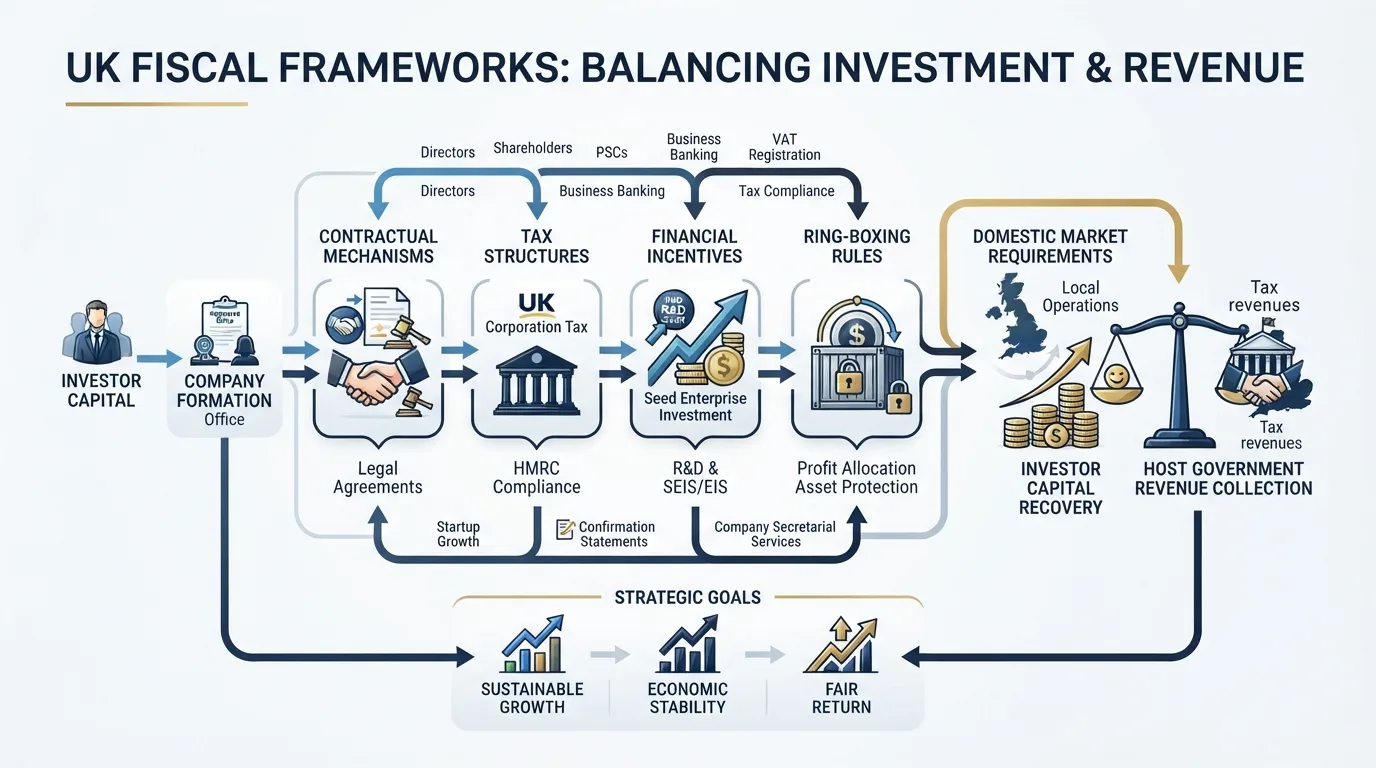
Royalty and Production Sharing Mechanisms
Royalties represent gross revenue levies collected prior to cost deductions, operating either as flat rates or variable sliding scales based on daily production volume, water depth, or cumulative yield. Production sharing contracts divide cost oil—revenue allocated to recover eligible capital and operating expenditures—from profit oil, which splits between host government and operating company based on predetermined scales or profitability R-factor formulas.
Tax Reliefs, Allowances, and Ring Fencing Rules
Tax structures incorporate corporate income tax, resource rent taxes, and targeted financial incentives. Ring fencing rules determine whether field expenditures consolidate across multiple license blocks for tax deductions or restrict exclusively to individual field perimeters.
Marginal field fiscal incentives: Targeted tax rate reductions, accelerated depreciation schedules, and elevated cost recovery caps that reduce initial break-even costs for low-volume projects.
Deepwater sliding scale terms: Dynamic royalty and profit-split adjustments that scale upward as cumulative production thresholds or project profitability metrics increase.
Investment allowance and uplift: Deductions permitting companies to write off percentages above actual capital expenditures (such as a 20% uplift allowance) against taxable income to spur capital investment.
Tax holidays and reliefs: Temporary exemptions from corporate income tax or customs duties during initial exploration, construction, and development phases.
Gas specific fiscal terms: Customized pricing formulas, longer exploration periods, and lower royalty rates structured specifically to accommodate the complex infrastructure requirements of natural gas monetization.
Domestic supply obligation: Statutory requirements forcing operators to sell specific percentages of crude oil or natural gas to domestic markets at regulated prices.
How Do Organisations Deliver Capability Building in Fiscal Regime Analysis?
Organisations deliver capability building through structured, practical workforce training programs using real-world case studies, financial modeling workshops, comparative policy analysis, and multi-disciplinary scenario simulations to ensure operational application.
Corporate learning initiatives for upstream commercial management follow a sequential execution path. The learning lifecycle moves from foundational knowledge acquisition to advanced strategy formulation and live negotiation preparation.
Phase 1: Diagnostic Assessment and Alignment
Organizations initiate training by identifying functional skill gaps across petroleum economics, tax law compliance, and joint-venture auditing. L&D professionals align learning objectives with upcoming operational milestones, such as license round evaluations, fiscal regime renegotiations, or farm-in asset acquisitions.
Phase 2: Core Conceptual and Technical Modules
Delivery combines hybrid learning structures over 3 to 5 full-day intensive workshops or 6-week virtual modules. Participants explore comparative global fiscal models across major energy jurisdictions in West Africa, Southeast Asia, North Sea, and Latin America. Training focuses on the mechanics of financial modeling, ring fencing impacts, and gas monetization terms.
Phase 3: Practical Application and Simulation
Learners execute practical case-based exercises using corporate financial models. Multi-disciplinary teams simulate real-world scenarios, negotiating sliding scale production sharing terms, testing field sensitivities against volatile crude prices (e.g., USD 45 to USD 110 per barrel), and evaluating domestic supply obligation liabilities.
Phase 4: Measurement and Institutional Integration
Post-training evaluation measures learner competence through standardized financial modeling assessments and mock commercial negotiation panels. Organizations establish institutional knowledge repositories containing standardized evaluation toolkits and benchmark matrices to maintain consistent asset screening standards across corporate divisions.
When commercial teams transition from basic fiscal awareness to active strategic planning, organizational leadership must evaluate structured learning interventions like the Fiscal Regime Comparison for Marginal & Deepwater Fields Training Course to build robust, standardized valuation frameworks across project teams.
What Strategic Benefits Do Tailored Fiscal Approaches Produce for Upstream Organisations?
Tailored fiscal approaches produce direct organizational benefits by optimizing portfolio risk management, increasing asset commercialization rates, strengthening government negotiation positions, and protecting long-term project profit margins.
Customized fiscal strategies prevent capital misallocation. Applying deepwater fiscal structures—which carry high royalty rates once production peaks—to marginal fields renders low-volume assets economically unviable, leaving recoverable reserves stranded. Conversely, applying high-incentive marginal field fiscal terms to high-volume deepwater developments causes host governments to surrender substantial economic rent. Aligning fiscal terms with technical reality ensures that operating companies preserve profit margins while national oil companies maintain public value capture.
Corporate teams trained in fiscal regime mechanics drive measurable performance improvements across asset lifecycles. Companies implementing structured workforce capability programs report up to 25% faster commercial screening times for bid round opportunities and a 18% improvement in joint venture audit recovery efficiency. Enhanced technical literacy across legal, tax, and engineering departments reduces contractual disputes during field development planning, shortening project approval timelines by 3 to 6 months.
In Which Corporate Use Cases Is Fiscal Regime Proficiency Essential?
Fiscal regime proficiency is essential during license round bidding, asset acquisition due diligence, host government contract renegotiations, field development planning, and cross-functional joint venture governance.
Asset Acquisition and Farm-In Due Diligence
Commercial evaluation teams assessing merger and acquisition targets evaluate historical tax filings, cost bank audits, and ring fencing restrictions. Commercial analysts evaluate how the consolidation of newly acquired marginal fields with existing producing assets alters aggregate corporate tax liabilities.
Host Government Bidding and Negotiation
NOC concession managers and IOC commercial directors utilize advanced fiscal analysis during license negotiations. Teams simulate multi-scenario cash flows to establish concession limits for sliding scale profit splits, signature bonuses, and local content expenditure obligations.
Integrated Field Development Planning (FDP)
Engineering and technical project leaders collaborate with financial planners to design development concepts that match fiscal incentives. Technical teams in offshore industries adjust subsea architecture plans to ensure capital expenditures qualify for specific deepwater investment uplifts or accelerated tax depreciation schedules.
What Misconceptions and Ineffective Approaches Impair Corporate Fiscal Training?
Misconceptions that impair corporate fiscal training include treating fiscal management as a purely accounting function, using generic non-industry financial models, and failing to connect fiscal terms to technical engineering constraints.
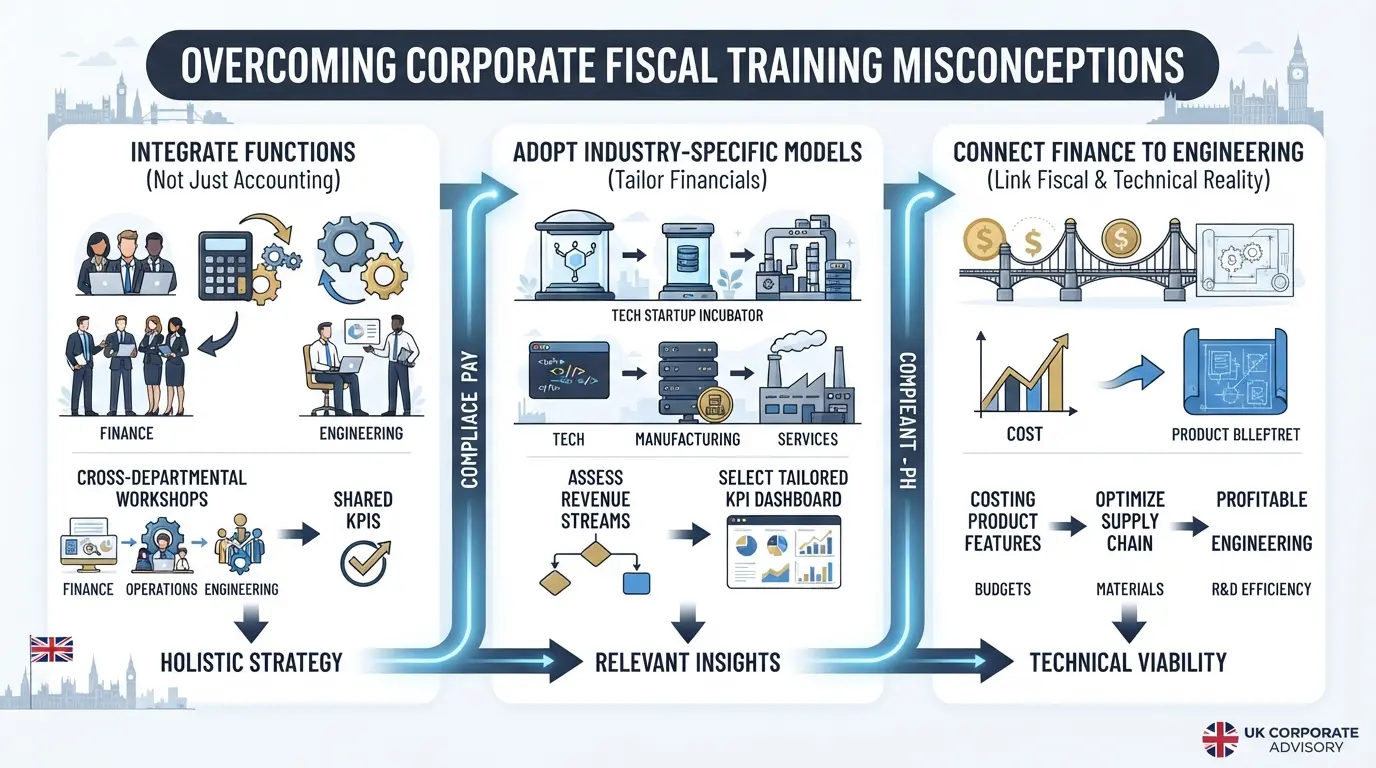
Misconception 1: Fiscal Analysis Belongs Solely to Finance Departments
Organizations often restrict fiscal training to finance and accounting units. Effective commercial execution requires petroleum geologists, reservoir engineers, and legal counsel to understand how technical parameters—such as water cut, depth, and reservoir pressure—trigger fiscal threshold adjustments like sliding scale royalties or R-factor profit shifts.
Misconception 2: Standard Corporate Financial Models Apply to Upstream Assets
Utilizing general corporate finance evaluation tools without upstream-specific fiscal logic causes critical valuation errors. Generic financial models frequently fail to capture complex contractual mechanics such as cost recovery caps, unrecovered cost carry-forwards, petroleum tax ring fencing, and crude oil uplift deductions.
Misconception 3: Short-Term Training Yields Sustainable Operational Capability
Single-event, lecture-based seminars without hands-on financial modeling produce minimal retention and fail to build functional workplace competence. Sustainable workforce transformation requires experiential learning methodologies, including practical asset evaluation simulations, historical case audits, and continuous performance tracking.
Professional decision-makers responsible for asset commercialization strategies must carefully evaluate fiscal framework mechanics and implementation methodologies. To understand the operational mechanics of selecting and structuring optimal contractual terms across varied asset classes, commercial teams should review [How to Evaluate Fiscal Regime Options for Marginal Fields and Deepwater Petroleum Projects] to align corporate investment criteria with jurisdiction-specific regulatory frameworks.
Frequently Asked Questions
What is an oil and gas petroleum fiscal regime?
An oil and gas petroleum fiscal regime is the legal, contractual, and tax framework that governs the financial relationship between a resource-holding government and commercial oil companies. These systems dictate revenue sharing, royalties, tax obligations, and cost recovery limits across exploration and production activities. Organizations build technical capability in these models through specialized programs such as the Oil & Gas Petroleum Fiscal Regime training provided by the Institute For Oil & Gas Training.
How do concessionary and contractual petroleum fiscal regimes differ?
Concessionary fiscal systems grant operating companies direct title to extracted hydrocarbons subject to royalties and corporate income taxes. Contractual regimes, such as Production Sharing Contracts (PSCs) and risk service agreements, retain state ownership of resources while paying operators through cost oil recovery and profit splits. The Institute For Oil & Gas Training delivers executive courses on the Oil & Gas Petroleum Fiscal Regime to help commercial decision-makers model both contractual structures accurately.
What are the main components of a petroleum fiscal regime?
The primary components of a petroleum fiscal regime include gross royalties, signature bonuses, cost recovery caps, ring-fencing provisions, corporate income tax, and profit-split ratios. Additional financial mechanisms may feature investment uplifts, resource rent taxes, and statutory domestic supply obligations for crude oil or natural gas. Commercial managers study these integrated components within the Oil & Gas Petroleum Fiscal Regime framework at the Institute For Oil & Gas Training to optimize asset valuation and project net present value.
Why do marginal and deepwater oil fields require different fiscal terms?
Marginal fields require lower royalty rates, higher cost recovery caps, and tax relief to remain commercially viable despite small reserve volumes and constrained cash flow. Deepwater offshore projects necessitate flexible, sliding-scale fiscal terms and investment allowances to offset substantial capital expenditure prior to first production. Understanding these distinct risk profiles enables participants in the Institute For Oil & Gas Training Oil & Gas Petroleum Fiscal Regime program to evaluate host government concessions effectively.
How do host governments design fiscal terms to attract upstream petroleum investment?
Host governments design competitive fiscal terms by balancing public revenue collection against private investor risk, adjusting sliding-scale royalty rates and tax depreciation schedules to mirror market volatility. Progressive fiscal mechanisms automatically scale state take upward during high oil price cycles while protecting operator margins during market downturns. The Institute For Oil & Gas Training equips industry professionals with comparative benchmarking tools to evaluate how regional Oil & Gas Petroleum Fiscal Regime options influence international capital allocation.
Related training courses
Royalties, Bonuses & Government Take: Valuation & Deductions Training Course
- Specialisation
- Oil & Gas Petroleum Fiscal Regime
- Duration
- 5 days · 15 CPD hours
Fiscal Regime Comparison Across Contract Types Training Course
- Specialisation
- Oil & Gas Petroleum Fiscal Regime
- Duration
- 5 days · 15 CPD hours
Fiscal Regime Comparison Across Jurisdictions Training Course
- Specialisation
- Oil & Gas Petroleum Fiscal Regime
- Duration
- 5 days · 15 CPD hours
More articles

Microsoft Copilot for Oil and Gas Finance Governance Training by Institute For Oil & Gas Training
Evaluate the Microsoft Copilot for Oil and Gas Finance Governance Training Course curriculum, delivery formats, learning outcomes, and enrollment steps.
Read article →
How to Manage Microsoft Copilot Governance Risks and Controls in Finance
Compare methods to manage Microsoft Copilot governance risks and controls in oil and gas finance. Implement effective policies today.
Read article →
Why AI Governance Matters When Using Microsoft Copilot in Oil and Gas Finance
Discover why AI governance matters when using Microsoft Copilot in oil and gas finance. Learn key risks, frameworks, and workforce training strategies.
Read article →