
Lease charging and modifications in oil and gas joint ventures represent the systematic accounting, cost allocation, and contractual adjustments of right-of-use assets across multiple participating partners under IFRS 16 guidelines.
This discipline involves defining how exploration assets, drilling rigs, FPSOs, and production facilities are capitalized and subsequently charged back to joint venture partners based on working interest percentages. Organizations handle these complexities through specialized corporate training programs that build critical financial, operational, and compliance competencies among accounting personnel, commercial managers, and joint venture auditors.
Addressing skill gaps in this area prevents multi-million dollar billing disputes, ensures regulatory compliance, and protects capital recovery frameworks. Corporate learning initiatives bridge the gap between technical accounting standards and field-level operations. Teams acquire precise skills to handle intricate billing arrangements across complex ownership structures.
Professional development programs utilize case-based learning, financial simulations, and practical assessments to reinforce core competencies. Participants evaluate real-world billing errors and apply corrective lease remeasurement strategies. Educational pathways incorporate structured workshops, interactive online modules, and hybrid delivery formats to accommodate demanding operational schedules.
Organizations deploy these structured training interventions to mitigate financial risks associated with joint operation lease treatment. Finance professionals master the complexities of lease cost allocation to partners without disrupting active field operations. Enhanced workforce capabilities drive operational excellence, strict integrity in reporting, and robust financial collaboration across multinational teams.
How do organizations implement lease accounting training programs?
Organizations implement lease accounting training programs through a structured five-stage methodology involving competency assessments, curriculum design, blended delivery execution, practical simulations, and rigorous post-training performance evaluations.
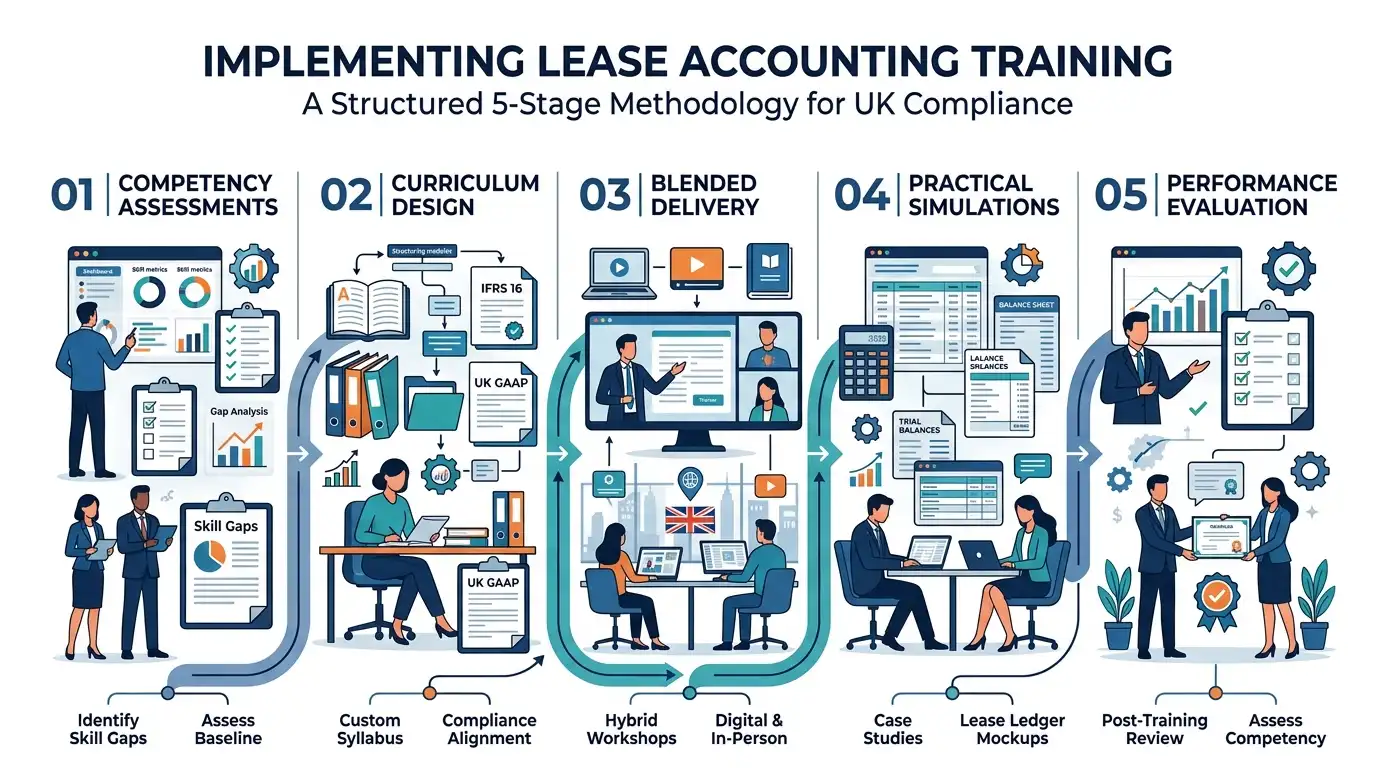
Enterprises begin by conducting comprehensive baseline assessments to identify exact knowledge gaps in technical accounting standards and joint venture agreements. Learning and Development teams then design targeted modules focusing on lease identification, initial measurement, and subsequent modifications.
Training delivery occurs through a blend of 3-day intensive workshops, 6-week online modules, and hybrid learning formats tailored to busy schedules. Participants engage with real-world scenarios, including lease cost allocation to partners and variable lease payments, to cement theoretical knowledge into practical capability.
Learning methodologies prioritize experiential acquisition through case-based learning, interactive financial modeling simulations, and peer-led role-playing sessions. These methods ensure that accountants and commercial managers can immediately apply complex reporting rules to daily operations.
Evaluation frameworks track success using concrete operational metrics. Organizations measure knowledge retention through pre- and post-training assessments, tracking a 35% reduction in billing errors within 90 days post-training. Key Performance Indicators monitor audit compliance rates, time-to-close efficiency, and the accuracy of cost recovery statements.
Leadership pipelines strengthen as mid-level accountants advance into strategic joint venture management roles. Workforce retention rates improve by 22% as employees gain mastery over high-value, specialized competencies. Continuous professional development ensures that corporate teams adapt seamlessly to evolving regulatory requirements and complex contract modifications.
What are the key components of effective joint venture lease training?
Effective joint venture lease training includes core technical modules on lease cost allocation, variable payment mechanics, regulatory disclosure frameworks, and practical cost recovery analysis tools.
Curriculum designers incorporate specialized components that address the unique operational realities of upstream and downstream energy sectors. Participants study lease modification and remeasurement principles, learning how to recalculate lease liabilities following changes in lease terms or scope.
Training modules cover complex contractual arrangements such as subleasing arrangements, sale and leaseback transactions, and multi-party asset sharing. Learners master the mechanics of variable lease payments tied to index rates or operational performance metrics, ensuring accurate financial reporting across all participating entities.
Frameworks taught during these programs emphasize strict adherence to international accounting standards and joint operating agreements. Professionals utilize specialized financial modeling tools and audit checklists to verify lease disclosure requirements and prevent unauthorized cost absorption.
Delivery formats leverage blended learning ecosystems, combining self-paced digital modules with expert-led instructor sessions. Workshops feature collaborative group exercises where cross-functional teams resolve simulated joint venture billing disputes.
Organizations track training efficacy through measurable performance indicators, including a 40% improvement in audit turnaround speed and zero material compliance discrepancies. Team efficiency rises as standardized accounting workflows replace fragmented manual calculations.
Continuous assessment mechanisms validate skill acquisition, ensuring that commercial departments operate with absolute precision and integrity. Employees gain the confidence to manage high-stakes partner audits and defend complex cost recovery claims successfully.
What organizational benefits do these training programs deliver?
These training programs deliver substantial organizational benefits, including a 30% reduction in financial compliance errors, enhanced joint venture partner trust, accelerated audit turnaround times, and optimized cost recovery efficiency.
Businesses operating in capital-intensive sectors achieve superior financial governance through targeted workforce development. Accurate lease cost allocation to partners eliminates chronic billing disputes, preserving collaborative relationships within multi-corporate joint operations.
Operational efficiency surges as accounting and commercial teams eliminate redundant manual verification steps. Standardized training equips staff to execute lease modification and remeasurement tasks with 95% first-time accuracy, significantly lowering administrative overhead.
Risk management capabilities improve substantially across the enterprise. Personnel trained in rigorous compliance protocols successfully navigate complex lease disclosure requirements, safeguarding the organization against regulatory penalties and costly legal challenges.
Workforce metrics reflect positive internal transformation. Employee retention within specialized finance departments increases by 25% following structured upskilling initiatives. Leadership pipelines mature, providing qualified successors for senior commercial and joint venture management positions.
Innovation in financial workflows emerges as teams apply newly acquired strategic thinking skills to streamline cost recovery processes. Collaboration between technical engineering units and finance departments strengthens, ensuring seamless alignment between field operations and corporate accounting obligations.
Which corporate teams and industries utilize lease modification training?
Corporate teams utilizing lease modification training include joint venture accounting departments, commercial negotiation units, internal audit divisions, and financial controllers across capital-intensive industries like oil and gas, mining, and maritime logistics.
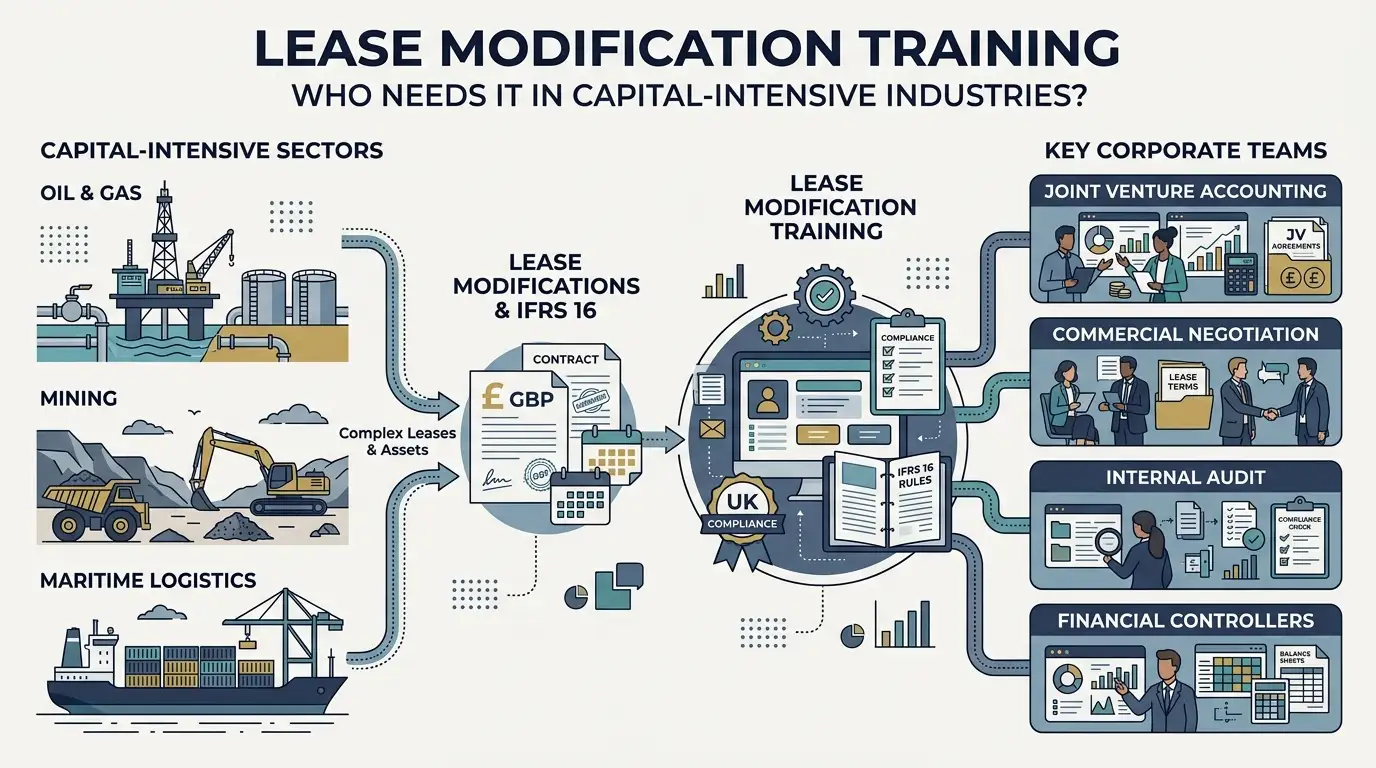
Organizations deploy these targeted programs to upskill professionals who manage multi-party assets and complex contractual frameworks. Commercial managers rely on this training to negotiate equitable lease terms and structure favorable cost recovery clauses during venture formation.
Internal audit teams participate in these courses to sharpen their oversight capabilities, enabling them to detect discrepancies in joint operation lease treatment before external auditors intervene. Financial controllers use the curriculum to standardize reporting practices across international subsidiaries and joint operating companies.
While energy enterprises represent the primary adopters, parallel asset-heavy sectors face identical accounting complexities. Industries such as heavy manufacturing, commercial aviation, and telecommunications infrastructure utilize these exact training frameworks to manage leased assets and shared cost structures.
Cross-functional participation enhances inter-departmental collaboration. Legal, engineering, and finance teams train together to understand how field-level operational changes trigger mandatory accounting adjustments under current lease standards.
Organizations measure the impact of these initiatives through strict performance KPIs. Teams report a 50% decrease in partner audit pushback and a significant acceleration in monthly financial close cycles, proving the tangible value of targeted professional development in complex operational environments.
What common problems arise from inadequate lease accounting training?
Inadequate lease accounting training causes chronic billing disputes, severe cost recovery losses, prolonged audit cycles, and significant compliance penalties across joint venture operations.
Without structured professional development, corporate teams frequently misinterpret complex accounting rules, leading to systematic errors in lease cost allocation to partners. These calculation flaws trigger friction and distrust among joint venture participants, damaging long-term business relationships.
Organizations suffer direct financial leakage when employees fail to execute proper lease modification and remeasurement procedures following contract extensions or scope alterations. Unrecognized variable lease payments and overlooked subleasing arrangements result in distorted balance sheets and restated financial statements.
Operational inefficiencies multiply as unqualified staff spend excessive hours attempting to resolve discrepancies manually. Audit cycles stretch from weeks to months, consuming valuable executive bandwidth and delaying capital distribution to stakeholders.
Generic, off-the-shelf training programs fail to address the specific nuances of energy operations, leaving skill gaps wide open. Employees struggle to apply abstract rules to tangible assets like drilling rigs and production platforms, resulting in persistent non-compliance risks.
Enterprises mitigate these systemic failures by investing in rigorous, practical, and industry-tailored education. Building internal expertise ensures accurate financial reporting, robust audit defense, and seamless operational execution across all joint venture activities.
Frequently Asked Questions
What is Oil and Gas Petroleum IFRS & Financial Reporting training?
Oil and Gas Petroleum IFRS & Financial Reporting training by the Institute For Oil & Gas Training equips finance professionals with specialized knowledge in upstream, midstream, and downstream accounting standards. The curriculum focuses on complex financial frameworks, asset impairment, decommissioning provisions, and production sharing contracts to ensure accurate corporate reporting.
How does IFRS impact financial reporting in the oil and gas sector?
IFRS impacts financial reporting in the oil and gas sector by governing how exploration and evaluation assets, production assets, and joint venture arrangements are recognized and measured. Specialized training from the Institute For Oil & Gas Training helps organizations master these standards to maintain absolute transparency and compliance during regulatory audits.
Why are lease charging and modifications critical in oil and gas joint ventures?
Lease charging and modifications are critical in oil and gas joint ventures because right-of-use assets like drilling rigs and production facilities must be accurately allocated among multiple participating partners. The Institute For Oil & Gas Training delivers practical programs that help finance teams manage lease cost allocations, variable payments, and subsequent remeasurements without billing disputes.
What skills are developed through petroleum financial reporting courses?
Petroleum financial reporting courses develop advanced competencies in joint operation lease treatment, cost recovery tracking, impairment testing, and revenue recognition under international standards. Through the Institute For Oil & Gas Training, professionals acquire the analytical precision required to handle high-value multi-party assets and complex contractual obligations.
Who should attend IFRS training for oil and gas companies?
IFRS training for oil and gas companies is designed for joint venture accountants, financial controllers, commercial managers, and internal auditors working within energy enterprises. Programs provided by the Institute For Oil & Gas Training enable these cross-functional corporate teams to eliminate reporting errors and optimize cost recovery efficiency.
Related training courses
Water Treatment Technology Training Course
- Specialisation
- Oil & Gas Water Treatment and Management
- Duration
- 5 days · 15 CPD hours
Pipeline Integrity Management (API 1160/ASME B31.8) Training Course
- Specialisation
- Oil & Gas Pipeline Integrity and Inspection
- Duration
- 5 days · 15 CPD hours
Corrosion Control by Cathodic Protection Systems Training Course
- Specialisation
- Oil & Gas Corrosion Management and Control
- Duration
- 5 days · 15 CPD hours
More articles

IFRS 9 Expected Credit Loss Training for Oil and Gas Financial Professionals
Master IFRS 9 expected credit loss models for oil and gas assets. Enhance compliance and valuation accuracy. Enroll in our specialized training course today.
Read article →
Key IFRS 9 Expected Credit Loss Challenges for Oil and Gas Companies
Explore key IFRS 9 expected credit loss challenges in oil and gas, covering business model assessments, SPPI tests, and lifetime ECL measurement.
Read article →
Why Expected Credit Loss Matters for Oil and Gas Financial Instruments
Discover how expected credit loss training closes skill gaps, improves financial reporting, and ensures IFRS 9 compliance in oil and gas companies.
Read article →