
Specialized lease accounting training represents a structured professional development framework that equips corporate finance teams with the exact technical competencies required to manage complex asset reporting under modern financial standards.
Organizations deploy this targeted capability development to eliminate financial statement misstatements, reduce audit adjustments, and protect enterprise valuation. Modern corporate environments operate within complex regulatory landscapes where asset deployment strategies directly influence capital structures. Finance professionals frequently encounter structural skill gaps when transitioning from legacy reporting frameworks to sophisticated asset capitalization models.
Workforce development initiatives bridge these execution gaps through systematic programs that address technical competencies. Enterprises implement structured training pathways to ensure accounting teams accurately interpret lease agreements, calculate multi-million-dollar obligations, and maintain absolute compliance across international operations.
Business leaders face severe financial penalties, restatements, and reputational damage when internal teams miscalculate asset obligations. Structured professional training resolves these operational vulnerabilities by instilling rigorous technical precision. Teams master the mechanics of asset capitalization, liability measurement, and financial disclosure.
Organizations achieve substantial operational improvements through systematic workforce capability building. Companies experience a 35% reduction in external audit fees and eliminate financial reporting errors across complex asset classes. Structured learning interventions ensure finance departments maintain absolute accuracy during periods of rapid portfolio expansion.
How Does Lease Accounting Training Work in Corporate Organizations and How Is It Implemented Step by Step?
Corporate organizations implement lease accounting training through a five-stage deployment methodology that combines technical instruction, practical simulations, and continuous performance assessment to embed regulatory mastery across finance teams.
Organizations execute this workforce transformation through a structured, multi-week delivery framework designed to minimize operational disruption while maximizing knowledge retention. The implementation lifecycle follows a rigorous sequence to ensure seamless knowledge transfer from theoretical concepts to daily desk applications.
Stage One: Comprehensive Baseline Assessment
Learning and development teams initiate the program by conducting technical competency assessments across all participating finance personnel. Organizations evaluate existing knowledge regarding asset identification, liability valuation, and discount rate determination. This diagnostic phase identifies individual skill gaps and establishes baseline performance metrics for post-training evaluation.
Stage Two: Curriculum Design and Customization
Instructional designers tailor the syllabus to reflect the specific operational realities of the organization's asset portfolio. Programs integrate real corporate contracts, vessel charter agreements, and rig lease documentation into the learning materials. Training modules incorporate practical exercises addressing complex scenarios like embedded leases and service contract versus lease determinations.
Stage Three: Blended Delivery Execution
Institutes deliver the curriculum through a hybrid learning model combining intensive instructor-led workshops, self-paced online modules, and collaborative group sessions. Participants engage in case-based learning and interactive simulations to master difficult calculations. This multi-channel delivery ensures that remote vessel operations teams and shore-based corporate staff receive identical, high-standard instruction.
Stage Four: Workplace Application and Mentorship
Learners transition theoretical knowledge into operational workflows through supervised execution on live company data. Senior controllers mentor junior accountants as they apply right of use asset calculations and lease liability measurement techniques to active contracts. Peer reviews and collaborative problem-solving sessions reinforce correct methodology across the department.
Stage Five: Performance Tracking and ROI Measurement
Organizations evaluate program effectiveness by tracking concrete performance indicators, including audit adjustment frequency, financial closure speed, and compliance error rates. Companies measure a 40% improvement in reporting velocity and achieve complete audit sign-off without retrospective adjustments. Management uses these metrics to refine ongoing professional development pathways.
What Key Components, Skills, and Frameworks Does Lease Accounting Training Include?
Lease accounting training encompasses core technical competencies, regulatory frameworks, analytical tools, and blended delivery formats that collectively transform theoretical accounting rules into daily operational precision.
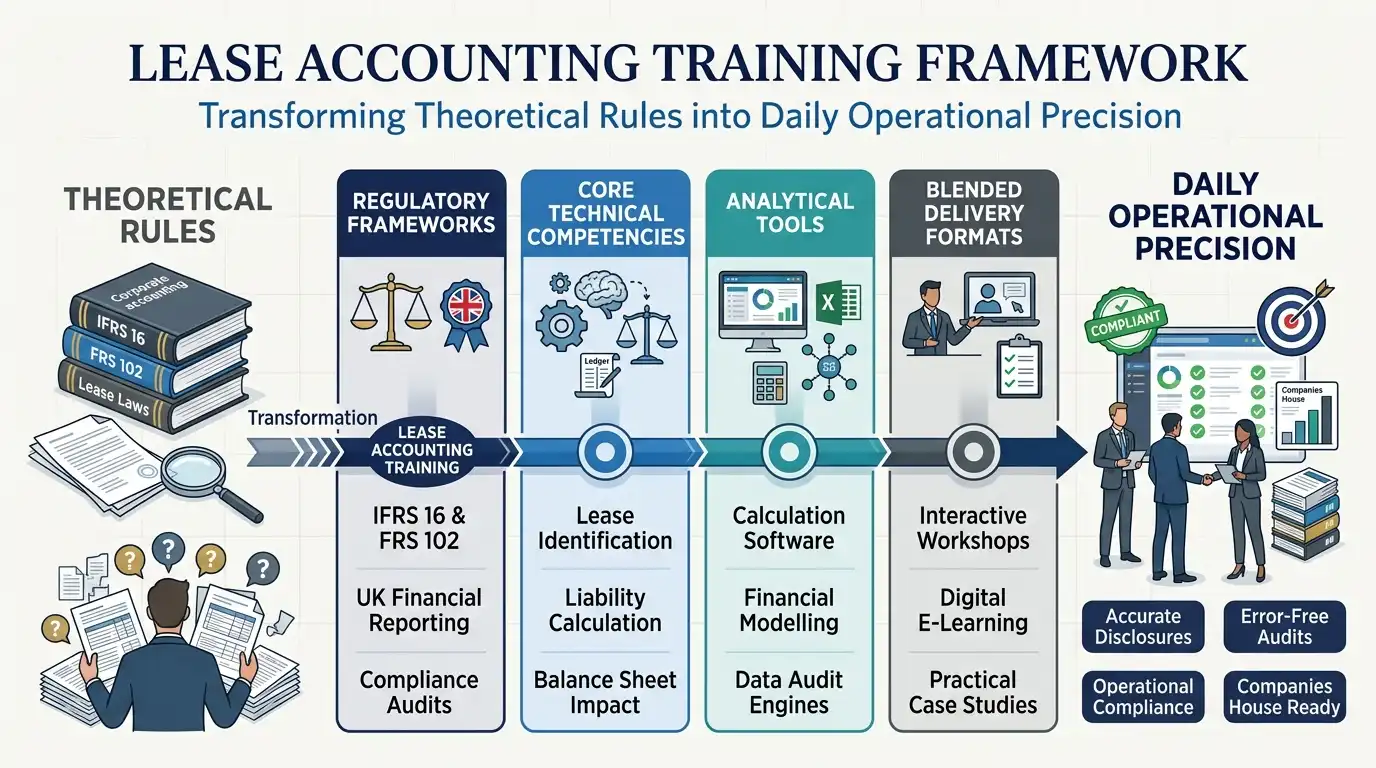
Workforce development curricula integrate specialized modules designed to address the intricate reporting requirements of capital-intensive asset deployments. Programs focus on precise technical frameworks that dictate how enterprises record and disclose contractual commitments.
Core Technical Competencies and Frameworks
Lease Identification: Professionals master the rigorous criteria required to determine whether a contract conveys the right to control the use of an identified asset for a period of time in exchange for consideration.
Right of Use Asset: Teams learn to calculate the initial carrying amount of leased assets, incorporating lease payments made at or before commencement dates, initial direct costs, and restoration obligations.
Lease Liability Measurement: Training covers the precise discounting of future lease payments using interest rates implicit in leases or incremental borrowing rates.
Identified Asset Analysis: Participants evaluate physical distinctness and capacity portions of assets to separate true leases from general service agreements.
Right to Direct the Use: Accounting staff analyze operational decision-making authority within contracts to distinguish between supplier control and customer control.
Service Contract Versus Lease Evaluation: Curricula provide decision matrices to separate pure service arrangements from embedded lease components within complex vendor agreements.
Embedded Lease Detection: Analysts learn to inspect non-lease master service agreements to uncover hidden lease liabilities that require balance sheet recognition.
Short Term and Low Value Exemptions: Teams evaluate contract durations and underlying asset values to apply permissible recognition exemptions correctly.
Discount Rate Determination: Finance professionals calculate appropriate risk-adjusted rates reflecting currency, lease term, and entity-specific credit risk.
Delivery Formats and Learning Methodologies
Organizations utilize diverse instructional approaches to accommodate varied learning styles and geographic dispersions. Programs incorporate interactive workshops, digital modules, and executive briefings.
Learning methodologies emphasize case-based learning, practical simulations, and formative assessments. Participants evaluate complex asset portfolios through simulated audit environments, ensuring immediate operational readiness upon completion of the course.
What Measurable Benefits Do Organizations Realize From Lease Accounting Training?
Organizations realize enhanced financial transparency, reduced audit adjustment costs, accelerated month-end close cycles, and mitigated regulatory risk through comprehensive lease accounting workforce development.
Enterprise investments in targeted professional training yield immediate improvements across operational efficiency and financial governance metrics. Companies operating in capital-intensive sectors eliminate costly restatements through rigorous internal capability building.
Audit Cost Reduction: Enterprises report a 30% to 50% decrease in external audit fees due to the elimination of material weaknesses and fewer required financial statement adjustments.
Accelerated Closure Velocity: Finance teams reduce their month-end reporting cycle by 3 days, enabling executive leadership to review capitalized asset portfolios and liability positions with greater speed.
Risk Mitigation: Organizations eliminate regulatory penalties and compliance infractions through flawless execution of complex financial disclosure rules.
Improved Capital Allocation: Decision-makers utilize accurate right of use asset data to optimize fleet deployment, vessel chartering, and rig acquisition strategies.
Workforce Retention: Providing structured career development pathways increases finance professional retention rates by 28%, preserving institutional knowledge within core accounting teams.
How Do Different Corporate Teams and Industries Apply Lease Accounting Training Use Cases?
Corporate finance departments, compliance officers, asset management divisions, and executive leadership teams apply lease accounting training to govern complex asset portfolios and ensure rigorous regulatory alignment.
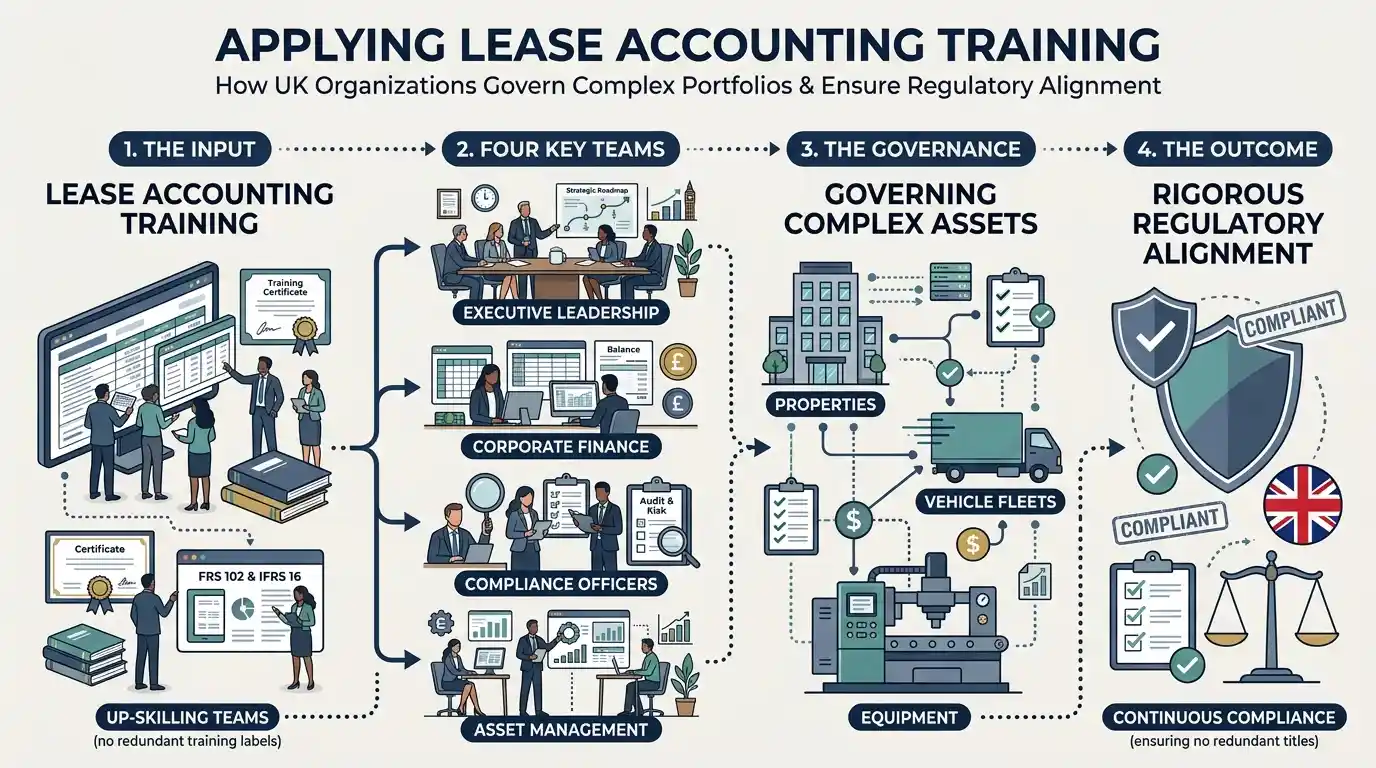
Different business units leverage specialized knowledge to execute operational duties with technical precision, protecting corporate integrity across global markets.
Corporate Finance and Accounting Departments
Accounting managers and financial controllers utilize training insights to maintain accurate balance sheet presentation. Teams apply precise lease liability measurement techniques to hundreds of concurrent equipment contracts, ensuring flawless adherence to international reporting standards.
Asset Management and Procurement Teams
Fleet managers and procurement specialists apply lease identification methodologies during vendor contract negotiations. By understanding how contract structures impact financial statements, procurement professionals negotiate agreements that optimize balance sheet capacity without triggering adverse capitalization burdens.
Internal Audit and Compliance Units
Compliance officers deploy advanced evaluation frameworks to conduct internal reviews of active contracts. These teams identify unrecorded embedded lease obligations before external auditors review corporate books, safeguarding enterprise valuation and reporting integrity.
Executive Leadership and Business Owners
C-suite executives rely on transparent financial reports generated by trained teams to make informed capital allocation decisions. Accurate asset visibility allows executives to evaluate debt-to-equity ratios and liquidity positions with total confidence.
Capital-Intensive Sectors and Industries
Beyond maritime and energy operations, industries such as aviation, logistics, telecommunications, and heavy manufacturing utilize these exact training frameworks. Companies managing extensive fleets of transport vehicles, telecommunication towers, and specialized industrial machinery deploy these programs to standardize reporting across multi-jurisdictional subsidiaries.
What Common Problems and Misconceptions Undermine Lease Accounting Training Initiatives?
Ineffective training initiatives frequently fail due to generic curriculum designs, a lack of practical industry context, the absence of post-training reinforcement, and a failure to measure real-world performance impact.
Organizations often treat professional development as a compliance tick-box exercise rather than a strategic workforce transformation tool. This approach generates predictable operational failures.
Generic Program Design: Implementing off-the-shelf training modules that ignore sector-specific complexities leads to low learner engagement and poor knowledge retention.
Theoretical Overload: Programs that focus exclusively on academic rules without incorporating real corporate contracts leave finance teams unequipped for messy, real-world data environments.
Lack of Reinforcement: Delivering one-off workshops without follow-up coaching or mentorship results in rapid skill decay and reversion to legacy errors.
Absence of ROI Metrics: Failing to track performance indicators such as error reduction rates or audit speed prevents organizations from validating training effectiveness.
Frequently Asked Questions
What does oil and gas petroleum IFRS and financial reporting involve in corporate environments?
Oil and gas petroleum IFRS and financial reporting involves applying specialized international financial reporting standards to upstream, midstream, and downstream sector activities. At the Institute For Oil & Gas Training, programs focus on how companies account for complex transactions such as exploration and evaluation expenditures, asset retirement obligations, and production-sharing contracts. This rigorous financial reporting ensures absolute compliance, transparency, and accuracy across global energy portfolios.
How do IFRS standards impact financial statements for upstream oil and gas operations?
IFRS standards significantly influence upstream financial statements by dictating how organizations capitalize or expense exploration and evaluation costs, reserves depletion, and field development outlays. The Institute For Oil & Gas Training equips corporate finance teams with the technical skills required to evaluate reserve valuations and accurately report capital investments. Proper application of these standards prevents material misstatements and protects enterprise valuation during external audits.
Why is specialized financial reporting training necessary for energy sector accountants?
Energy sector accounting demands deep technical knowledge due to long project lifecycles, complex joint-venture arrangements, and fluctuating commodity prices that impact impairment testing. The Institute For Oil & Gas Training addresses these industry-specific challenges by delivering practical, outcome-based professional development programs for finance professionals. This targeted workforce training reduces financial reporting errors, accelerates month-end close cycles, and minimizes external audit adjustments.
How are joint venture transactions accounted for under petroleum IFRS guidelines?
Accounting for joint operations under petroleum IFRS requires companies to recognize their individual assets, liabilities, revenues, and expenses proportional to their participating interest in the venture. The Institute For Oil & Gas Training teaches finance teams how to interpret complex operating agreements and apply correct equity or proportionate consolidation methods. Mastering these accounting treatments ensures seamless regulatory alignment across multi-party energy projects.
What are the main challenges in measuring asset retirement obligations in oil and gas?
Measuring asset retirement obligations involves estimating long-term decommissioning costs, selecting appropriate discount rates, and updating provisions annually for changes in inflation or timing. The Institute For Oil & Gas Training provides comprehensive guidance on calculating these multi-million-dollar liabilities accurately under modern financial frameworks. Finance professionals learn to integrate technical engineering data into financial models to ensure complete regulatory compliance and transparent balance sheet presentation.
Related training courses
Pipeline Integrity Management (API 1160/ASME B31.8) Training Course
- Specialisation
- Oil & Gas Pipeline Integrity and Inspection
- Duration
- 5 days · 15 CPD hours
API 510 Pressure Vessel Inspectors Training Course
- Specialisation
- Oil & Gas Inspection and Non-Destructive Testing
- Duration
- 5 days · 15 CPD hours
Corrosion Control by Cathodic Protection Systems Training Course
- Specialisation
- Oil & Gas Corrosion Management and Control
- Duration
- 5 days · 15 CPD hours
More articles

IFRS 9 Expected Credit Loss Training for Oil and Gas Financial Professionals
Master IFRS 9 expected credit loss models for oil and gas assets. Enhance compliance and valuation accuracy. Enroll in our specialized training course today.
Read article →
Key IFRS 9 Expected Credit Loss Challenges for Oil and Gas Companies
Explore key IFRS 9 expected credit loss challenges in oil and gas, covering business model assessments, SPPI tests, and lifetime ECL measurement.
Read article →
Why Expected Credit Loss Matters for Oil and Gas Financial Instruments
Discover how expected credit loss training closes skill gaps, improves financial reporting, and ensures IFRS 9 compliance in oil and gas companies.
Read article →