

Hedging governance in oil and gas financial risk management is a operational framework that establishes mandatory rules, board-approved mandates, and oversight controls for executing derivative contracts to protect corporate cash flows from commodity price, exchange rate, and interest rate volatility.
Oil and gas corporations operate in capital-intensive markets subject to extreme commodity price fluctuations. Upstream producers, midstream transporters, and downstream refiners face daily price exposure on crude oil, natural gas, and refined products. Unhedged market shifts erode profit margins, compromise liquidity, and disrupt long-term capital allocation programs.
Financial risk management through derivative instruments provides cash flow stability. However, derivative contracts carry inherent structural risks. Without strict oversight, financial hedging activities can transform from risk-mitigation strategies into speculative positions that expose organizations to catastrophic financial losses.
Hedging governance establishes clear organizational boundaries between risk reduction and speculation. The governance framework formalizes the strategic objectives of hedging, defines risk limits, and assigns explicit operational roles across accounting, treasury, risk control, and executive board teams. Corporate training builds essential competencies across these functional departments. Structured workforce learning ensures personnel execute hedging transactions within approved limits, evaluate counterparty risks, and meet international derivative disclosure requirements accurately.
Why Is Hedging Governance Critical for Modern Petroleum Enterprises?
Hedging governance is critical for petroleum enterprises because unmanaged derivative exposure causes financial insolvency, violates debt covenants, erodes shareholder value, and triggers severe regulatory penalties across global energy markets, making structured oversight essential for financial stability.
Energy markets experience price swings driven by geopolitical tensions, supply chain bottlenecks, and macroeconomic shifts. Petroleum companies utilize derivative instruments such as futures, options, and swaps to lock in revenues or cap operational costs. When companies trade these complex instruments without robust governance, operational errors and Unauthorized trading occur.
Historical corporate failures across energy markets demonstrate that improper risk controls turn risk management programs into profit-seeking operations. Speculative trading prohibition must be enforced through clear policy mandates, board-approved position limits, and continuous oversight.
Governance policies ensure that hedging activities align strictly with corporate strategy. Strong controls preserve corporate credit ratings, safeguard debt service coverage ratios, and reassure external stakeholders including commercial lenders, institutional investors, and regulatory bodies. Developing financial risk competence through corporate training ensures that risk control teams continuously monitor positions, enforce compliance, and detect unauthorized deviations before market exposure causes severe enterprise damage.
How Does Hedging Governance Work in Corporate Energy Environments?
Hedging governance operates through a structured lifecycle of strategic policy formulation, board delegation, daily operational execution, independent risk monitoring, and transparent financial reporting across all organizational departments involved in energy trading and financial management.
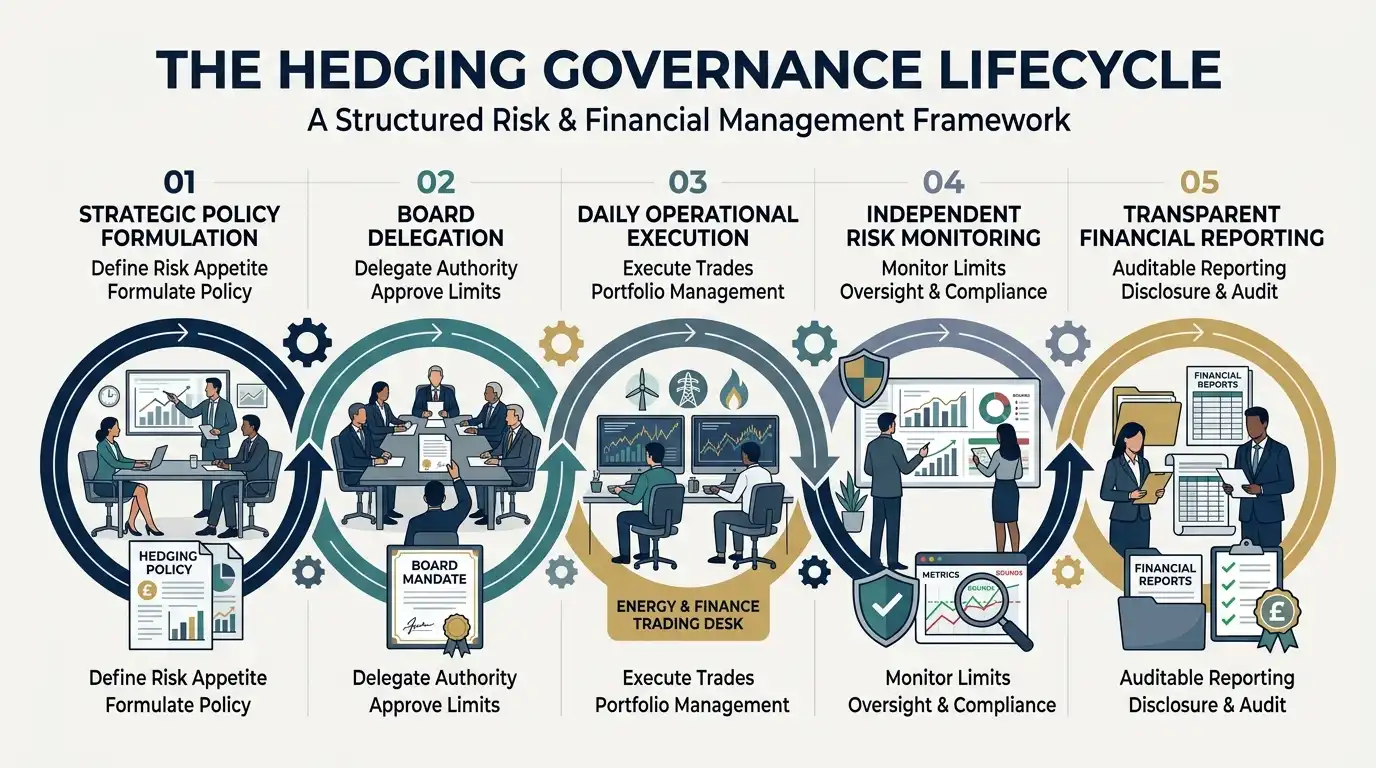
1. Strategic Mandate and Policy Design
The board of directors defines the financial risk appetite of the energy enterprise. This stage establishes the hedging policy and mandate, outlining acceptable derivative instruments, approved hedging horizons, and authorized risk mitigation targets.
2. Operational Delegation and Risk Limits
The board delegates daily oversight to a corporate risk committee. This body translates enterprise goals into precise quantitative boundaries, setting board approved limits for total position volume, value-at-risk metrics, and tenor limits for energy derivatives.
3. Counterparty Risk and Legal Frameworks
Treasury teams evaluate financial institutions before executing derivative transactions. Corporate teams establish strict counterparty selection criteria and formalize standardized legal agreements, including ISDA agreements and credit support annex (CSA) documentation, to manage collateral obligations.
4. Trade Execution and Independent Controls
Execution traders execute hedge orders within assigned policy boundaries. To prevent conflicts of interest, an independent middle-office team conducts independent valuation daily and tracks position limits, ensuring execution details match risk models.
5. Performance Monitoring and Regulatory Reporting
Risk managers evaluate hedge effectiveness monitoring protocols to verify that derivative instruments perform as intended under relevant accounting standards. Financial reporting teams aggregate trade data to fulfill statutory derivative disclosure requirements for external stakeholders and market regulators.
What Are the Core Components of an Effective Governance Framework?
An effective hedging governance framework comprises board-approved mandates, clear risk thresholds, legal trade agreements, independent valuation models, hedge effectiveness protocols, and formal reporting mechanisms that govern corporate financial trading operations systematically.
Strategic Boundaries and Policy Controls
Hedging Policy and Mandate: A formal corporate document defining approved risk management goals, authorized derivative instruments, and explicit operational guidelines.
Board Approved Limits: Quantitative boundaries specifying maximum allowable contract volumes, financial exposure caps, value-at-risk limits, and transaction tenors.
Speculative Trading Prohibition: A clear policy mandate prohibiting unauthorized position-taking, directional market betting, and unhedged derivative exposure.
Legal and Counterparty Frameworks
Counterparty Selection: Standardized evaluation procedures assessing creditworthiness, financial strength, and market reputation of financial institution partners.
ISDA Agreements and CSA: Standardized legal framework agreements and Credit Support Annex documentation governing derivative transactions, margin calls, and collateral management.
Risk Controls and Financial Compliance
Independent Valuation: Daily mark-to-market calculations performed by middle-office risk teams separate from execution desks to ensure asset pricing accuracy.
Hedge Effectiveness Monitoring: Ongoing statistical testing verifying that derivative positions successfully offset fair value or cash flow fluctuations in physical commodity positions.
Position Reporting: Automated reporting workflows providing daily, weekly, and monthly derivative exposure summaries to executive leadership and risk committees.
Derivative Disclosure Requirements: Comprehensive reporting systems ensuring complete compliance with international accounting standards, including IFRS 9 and US GAAP ASC 815.
How Do Organizations Implement Hedging Governance Through Professional Development?
Organizations implement hedging governance by conducting targeted workforce training programs that build technical capabilities across treasury, accounting, legal, and executive leadership teams to align daily operations with corporate risk policies.
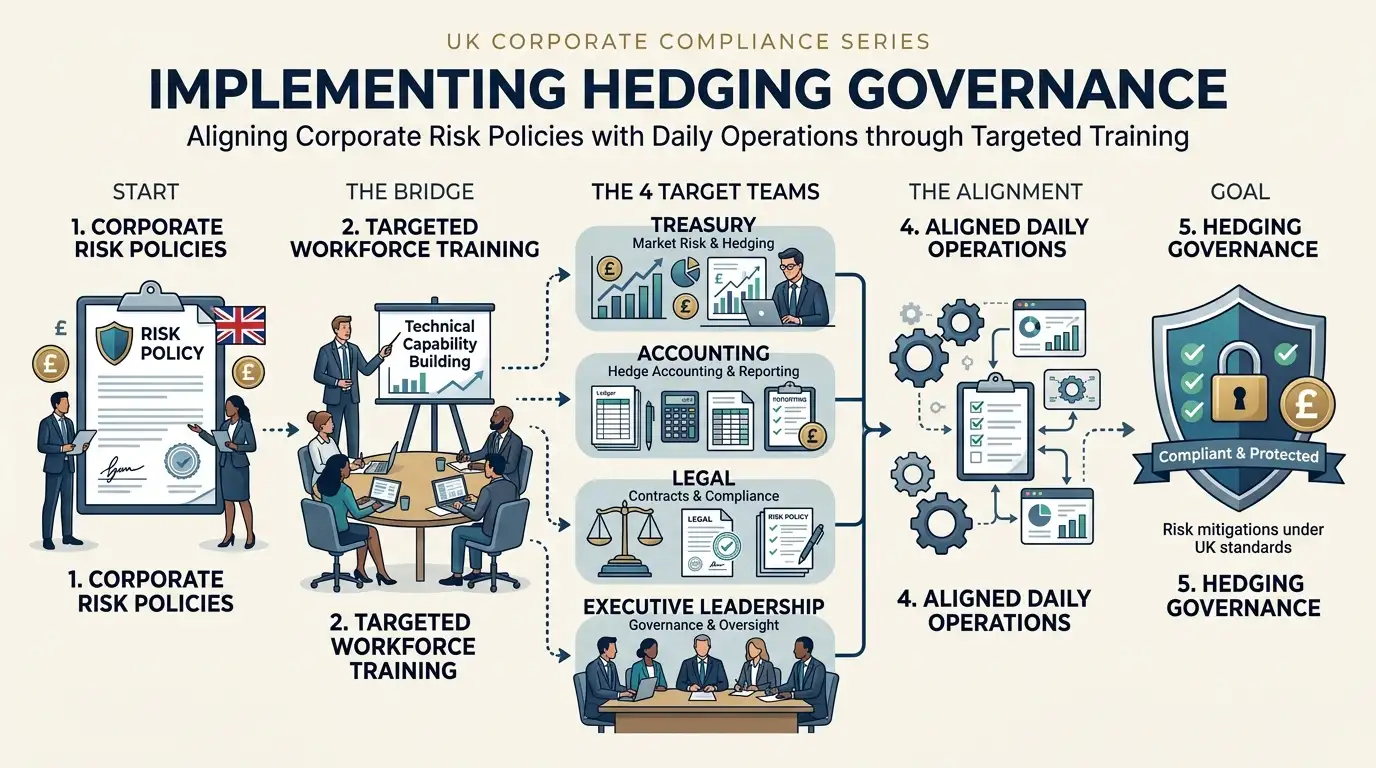
Professional training bridges the gap between theoretical risk policies and daily workplace execution. Energy companies address employee skill gaps by implementing practical learning initiatives for functional teams operating in financial management, compliance, and energy trading.
Corporate learning solutions utilize interactive training formats to ensure rapid knowledge transfer:
Executive Leadership Workshops: 2-day intensive seminars focused on setting risk tolerances, reading risk dashboards, and evaluating board approved limits.
Technical Online Modules: Self-paced digital instruction covering ISDA agreements and CSA documentation, collateral rules, and derivative valuation math.
Hybrid Learning Programs: Structured multi-week blended learning combining virtual classroom sessions with instructor-led practical workshops.
Organizations leverage specialized training methodologies to build practical competence:
Case-Based Learning: Teams analyze historical corporate risk failures in energy sectors like petroleum refining, offshore exploration, and natural gas distribution to understand structural policy breakdowns.
Simulated Risk Management: Risk analysts evaluate real-time market data in simulated trading software to practice mark-to-market calculations, position reporting, and speculative trading prohibition enforcement.
Cross-Functional Role Play: Treasury, accounting, and legal teams simulate collateral margin calls, counterparty default scenarios, and hedge effectiveness monitoring audits.
Practical Assessments: Staff complete technical evaluations testing knowledge of derivative disclosure requirements, cash flow accounting, and counterparty selection criteria.
When evaluating external learning solutions to strengthen financial control systems, corporate leaders assess policy frameworks, trade controls, and audit mechanics. Evaluating structured curriculum options such as the Hedging & Derivatives Governance & Policy Design Training Course allows L&D professionals to align organizational risk management training with recognized industry benchmarks.
What Common Governance Pitfalls and Misconceptions Risk Enterprise Value?
Common governance pitfalls include viewing hedging as a profit center, treating policy documentation as static compliance tasks, failing to establish independent trade valuation, and relying on generic staff training that lacks energy sector context.
Treating Hedging Desks as Profit Centers
A frequent operational mistake is evaluating treasury execution teams on trading profits rather than risk reduction efficiency. When organizations compensate treasury staff on revenue generation, employees take unapproved directional market positions. Effective governance maintains strict speculative trading prohibition rules and measures success by margin stability rather than speculative gain.
Treating Policy Manuals as Static Documentation
Many petroleum enterprises create hedging policy and mandate documents during initial corporate structuring but fail to update them as market dynamics evolve. A policy written for stable price environments fails during extreme liquidity squeezes or unexpected market shifts. Governance frameworks require annual policy audits and continuous employee training to keep pace with changing market structures.
Relying on Execution Desks for Valuation
Allowing execution traders to price their own open derivative positions creates severe conflict of interest risks. Independent valuation conducted by middle-office risk control teams is mandatory. Without independent pricing controls, valuation errors and hidden trading losses accumulate undetected until financial audits occur.
Implementing Generic Off-the-Shelf Training
Generic corporate finance training courses fail to address the specific complexities of petroleum financial risk management. Off-the-shelf courses omit energy-specific topics such as physical commodity basis risk, crack spread hedging, and specialized collateral mechanics under ISDA agreements and CSA guidelines. Energy companies require outcome-based training tailored to oil and gas market structures.
What Measurable Outcomes Does Hedging Governance Training Produce?
Hedging governance training produces quantifiable business outcomes including reduced policy violations, zero speculative trading losses, faster margin call processing times, and full compliance with international financial reporting standards.
Key Performance Indicator (KPI) | Pre-Training Benchmark | Post-Training Impact | Organizational Benefit |
Policy Compliance Rate | 82% compliance with board limits | 99.5% compliance with board limits | Prevents unauthorized trading and exposure breaches. |
Valuation Reconciliation Time | 14 hours per reporting cycle | 3 hours per reporting cycle | Accelerates middle-office reporting and daily risk analysis. |
Audit Findings & Deficiencies | 6 external audit findings annually | 0 critical financial audit findings | Eliminates regulatory penalties and financial restatements. |
Collateral Processing Speed | 48-hour margin call resolution | 4-hour margin call resolution | Optimizes cash liquidity and eliminates counterparty disputes. |
Employee Retention Rates | 71% retention in risk/treasury teams | 89% retention in risk/treasury teams | Retains specialized technical talent in critical risk functions. |
Investing in structured workforce development strengthens operational resilience across energy market cycles. Highly trained treasury and risk management teams protect profit margins, maintain stable capital expenditure plans, and ensure cash flow predictability across oil and gas operations.
To systematically evaluate risk policy frameworks and trade controls across functional teams, enterprise decision-makers often utilize structured evaluation guides such as How to Evaluate Hedging Policies Controls and Derivatives Governance in Petroleum Companies to benchmark internal risk protocols against international industry standards.
Frequently Asked Questions
What is petroleum treasury, cash, and banking management in the oil and gas sector?
Petroleum treasury, cash, and banking management is the operational framework used by energy enterprises to oversee liquidity, manage foreign exchange risks, and maintain banking relationships. The Institute For Oil & Gas Training provides professional development in this discipline to help finance teams optimize working capital across complex international supply chains. Structured learning in Oil & Gas Petroleum Treasury, Cash and Banking ensures personnel can effectively manage capital-intensive cash flows, debt service requirements, and multi-currency transactions.
Why is cash management unique for oil and gas companies?
Cash management in the energy sector is distinct due to extreme commodity price volatility, high capital expenditure requirements, and complex international trade flows. Energy corporations must maintain robust liquidity buffers and automated cash pooling structures to handle sudden market shifts and cross-border settlement schedules. Through specialized training in Oil & Gas Petroleum Treasury, Cash and Banking, the Institute For Oil & Gas Training equips finance professionals with technical skills to forecast daily liquidity, manage joint venture cash calls, and mitigate credit counterparty risks.
How do petroleum companies manage foreign exchange and liquidity risks?
Petroleum companies manage foreign exchange and liquidity risks by utilizing corporate cash concentration accounts, automated sweeping mechanisms, and financial derivative hedging strategies. Finance departments align daily cash forecasting with short-term borrowing facilities and long-term liquidity reserves to maintain financial stability. Professionals trained by the Institute For Oil & Gas Training learn to implement robust internal controls within Oil & Gas Petroleum Treasury, Cash and Banking operations to safeguard cash assets and streamline bank reconciliation processes.
What core skills are required for oil and gas treasury and banking professionals?
Treasury and banking professionals in the energy industry require strong competencies in financial risk analysis, short-term liquidity forecasting, international trade finance, and bank fee negotiation. Staff must also master treasury management systems (TMS) and understand global banking compliance standards like SWIFT security protocols and anti-money laundering regulations. The Oil & Gas Petroleum Treasury, Cash and Banking curriculum at the Institute For Oil & Gas Training develops these practical skill sets to help corporate teams improve treasury efficiency and operational precision.
How does treasury management training improve corporate financial performance?
Structured treasury management training improves corporate performance by reducing idle cash balances, lowering foreign exchange transaction costs, and minimizing bank service fees. Enhanced staff capabilities accelerate cash settlement cycles and prevent unauthorized liquidity losses across global subsidiaries. By completing Oil & Gas Petroleum Treasury, Cash and Banking programs at the Institute For Oil & Gas Training, corporate treasury units establish stronger internal governance, optimize working capital cycles, and protect corporate balance sheets against financial market shocks.
Related training courses
Industrial Steam Boiler Systems and Operational Control Training Course
- Specialisation
- Oil & Gas Process Engineering and Operations
- Duration
- 5 days · 15 CPD hours
Pipeline Inspection and Integrity Assessment Training Course
- Specialisation
- Oil & Gas Pipeline Integrity and Inspection
- Duration
- 5 days · 15 CPD hours
Offshore Pipeline Inspection and Integrity Assessment Training Course
- Specialisation
- Oil & Gas Pipeline Integrity and Inspection
- Duration
- 5 days · 15 CPD hours
More articles

Petroleum Taxation Fundamentals Training for Oil and Gas Tax Professionals
Master petroleum taxation fundamentals with Institute For Oil & Gas Training. Explore modules, outcomes, and enrollment paths for tax professionals.
Read article →
How to Evaluate Tax Obligations and Tax Risks Across Upstream Midstream and Downstream Operations
Master evaluation of upstream, midstream, and downstream petroleum tax obligations, ring fencing, capital allowances, and transfer pricing risks.
Read article →
Why Petroleum Taxation Matters Across the Oil and Gas Value Chain
Master petroleum taxation fundamentals across upstream midstream and downstream operations to mitigate tax risks and drive corporate profitability.
Read article →