

Hedge accounting is a specialized financial framework under IFRS 9 that aligns accounting treatment with risk management activities, reducing income statement volatility caused by commodity price, foreign exchange, and interest rate fluctuations in energy enterprises.
Oil and gas enterprises operate in volatile markets characterized by sharp commodity price movements, shifting foreign exchange rates, and fluctuating interest rates. Standard financial reporting measures derivatives at fair value through profit or loss, which creates temporary timing mismatches between hedged items and derivative contracts. Hedge accounting resolves this structural disconnect by matching gains and losses from hedging instruments with parallel movements in hedged risks within the same reporting period.
Energy companies manage vast exposures across upstream exploration, midstream transport, and downstream refining operations. Corporate finance teams utilize hedge accounting to ensure financial statements reflect actual operational economics rather than market volatility. Implementing this accounting treatment requires formal hedge accounting designation, precise hedge documentation, and rigorous hedge effectiveness testing at inception and on an ongoing basis.
When corporate finance teams lack mastery over these reporting standards, financial statements misrepresent economic stability. Developing in-house competence across financial control and treasury departments stabilizes reported earnings, preserves credit ratings, and strengthens stakeholder trust. Structured corporate training programs establish baseline capabilities across reporting units, enabling financial controllers to manage complex accounting standards without reliance on external auditors.
Why Do Oil and Gas Companies Experience Financial Statement Volatility Without Hedge Accounting?
Unhedged derivatives and standard accounting treatments force price volatility directly into earnings, creating artificially fluctuating quarterly income statements that obscure operational performance and erode investor confidence across energy capital markets.
Derivatives used in commodity risk management register mark-to-market valuations at each reporting date. When enterprises mark derivative contracts to fair value without applying hedge accounting, valuation changes hit profit or loss immediately. However, underlying physical transactions, such as crude oil sales or jet fuel purchases, affect financial statements only when physical delivery occurs. This structural timing difference generates volatile profit figures that fail to mirror commercial stability.
Finance professionals must understand the mechanics of derivative classification to eliminate artificial reporting swings. Under standard rules, derivative positions fluctuate with daily spot and forward market curves. Without designated hedging relationships, a rising oil price increases physical sales revenue in future periods, while generating immediate, unrealized derivative losses in the current quarter.
Workforce capability gaps in technical accounting worsen these volatility challenges. Treasury teams execute financial hedges to lock in revenue cash flows, yet financial control teams fail to capture these relationships within general ledgers due to missing documentation or improper valuation models. Professional development programs bridge the gap between treasury operations and financial reporting, training accountants to apply the own use exemption or designate valid financial hedges before transaction execution.
How Does Hedge Accounting Function Within Corporate Energy Operations?
Hedge accounting functions by establishing formal accounting designations that track financial derivatives alongside physical market exposures, deferring valuation changes in equity reserves until underlying commercial transactions impact profit or loss.
The operational execution of hedge accounting requires systemic collaboration among treasury, accounting, risk management, and legal departments. Energy corporations manage three distinct categories of hedging relationships:
Cash flow hedge structures hedge exposure to cash flow variability associated with forecasted transactions, such as future crude oil production sales.
Fair value hedge structures manage exposure to changes in the fair value of recognized assets, liabilities, or unrecognised firm commitments, such as fixed-rate fuel supply contracts.
Hedge of net investment structures mitigate foreign currency translation risks arising from foreign subsidiaries operating in offshore jurisdictions.
Applying these structures requires strict adherence to IFRS 9 criteria. Finance teams map every hedging instrument and hedged item pair prior to execution. For cash flow hedges, effective derivative gains and losses accumulate in a dedicated hedge reserve within equity. When physical sales occur, the enterprise executes a hedge reserve recycling transfer, moving deferred amounts from equity into revenue.
Corporate learning initiatives build multi-disciplinary competency in these workflows. Training structured around practical financial modeling enables accounting staff to identify complex contract terms, evaluate embedded derivatives inside long-term gas supply agreements, and build compliant tracking models. Systems-based training ensures enterprise resource planning environments capture mark-to-market valuations accurately.
What Core Components Define a Successful Hedge Accounting Implementation Framework?
A successful hedge accounting framework integrates rigorous policy documentation, prospective risk assessment models, integrated valuation software, and multi-departmental governance protocols to ensure full compliance with international reporting standards.
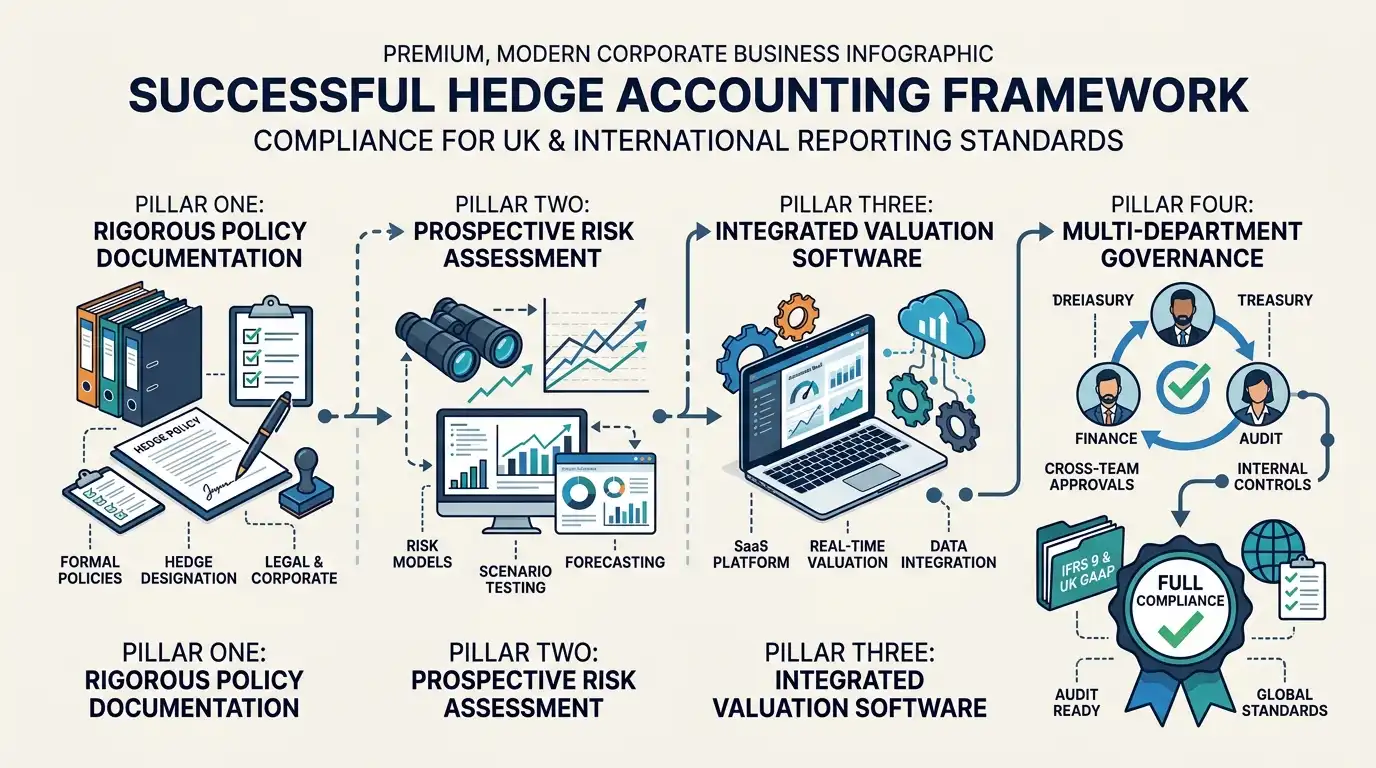
Implementing IFRS 9 hedge accounting requires structured technical foundations across the organization. The four essential components include:
Risk Management Strategy & Documentation: Organizations produce comprehensive strategy documents outlining hedging objectives, risk ratios, and economic relationships. Documentation must define the hedged item, derivative instrument, nature of risk, and prospective effectiveness measurement methodology.
Effectiveness Assessment Methodologies: IFRS 9 replaces strict quantitative thresholds with an economic relationship model. Finance teams evaluate whether an economic relationship exists between hedged items and hedging instruments, analyze credit risk impacts, and calculate appropriate hedge ratios.
Valuation and Accounting Engines: Energy enterprises deploy risk platforms to calculate fair values, isolate ineffective hedge portions, and track equity reserves. These engines separate intrinsic values from time values to optimize income statement outcomes.
Cross-Functional Governance Teams: Risk managers, corporate treasurers, and accounting controllers meet regularly to align commercial contract executions with financial statement objectives.
Building these components requires technical expertise across corporate finance teams. Organizations invest in structured workshops to upskill staff on underlying contract valuation techniques. Training builds internal capability to evaluate underlying contract mechanics, preventing compliance failures during external audit cycles.
What Are the Primary Challenges Energy Companies Face During Hedge Accounting Execution?
Energy enterprises face severe execution challenges from extreme market volatility, complex contract structures, prospective effectiveness testing requirements, and technical valuation demands that trigger financial restatements when managed improperly.
Energy commodity markets feature unique operational complexities that complicate accounting compliance. Key operational hurdles include:
Basis Risk and Ineffective Matching: Crude oil grades, delivery locations, and settlement dates frequently mismatch derivative contract specifications, creating hedge ineffectiveness that must enter profit or loss immediately.
Complex Embedded Terms: Long-term supply contracts in natural gas and liquefied natural gas markets contain price adjustment formulas that qualify as embedded derivatives, requiring split accounting treatment.
Forecast Reliability Shifts: Geopolitical events and operational shutdowns alter forecasted production volumes, causing designated cash flow hedges to fail highly probable tests.
System and Data Fragmentation: Disconnected software systems across trading floors and accounting departments increase manual entry errors and delay valuation processing.
Organizations encounter severe technical obstacles when applying accounting standards to complex energy portfolios. Navigating these complexities requires specialized technical training. Finance leadership must proactively address Key IFRS 9 Hedge Accounting Challenges for Oil and Gas Companies by upskilling internal teams on valuation frameworks, hedge effectiveness assessments, and compliance documentation.
Capability building across financial control units reduces error rates in valuation schedules. Standardized corporate training programs resolve operational bottlenecks by establishing clear protocols for derivative tracking, contract analysis, and auditor communications.
How Do Organizations Train Their Financial and Operations Workforce to Master Hedge Accounting?
Organizations train their workforce through structured technical workshops, case-based learning, hands-on valuation exercises, and real-world simulation modules tailored to commodity trading and corporate treasury environments.
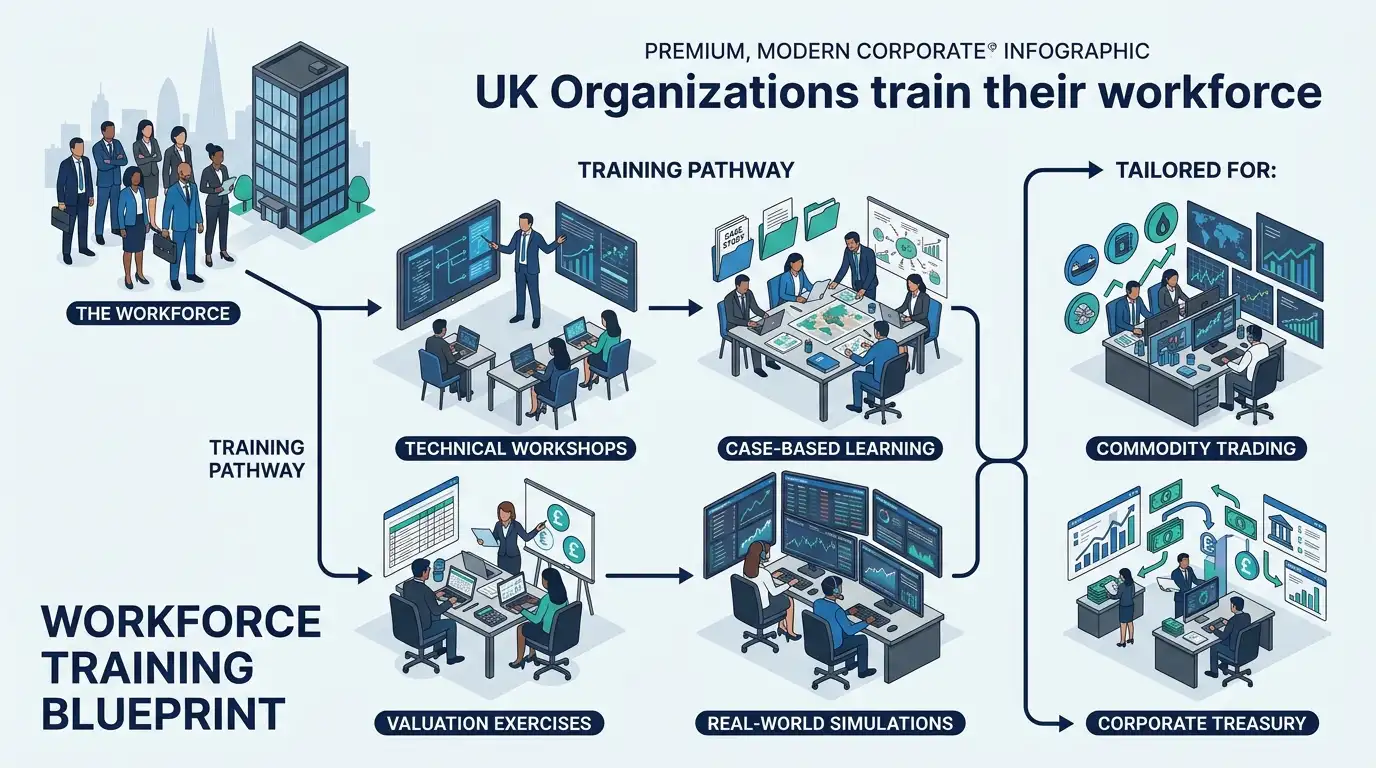
Capability development in technical finance requires an outcome-based methodology. Effective corporate learning programs combine theoretical standard interpretations with direct quantitative application. Organizations structure technical upskilling through progressive learning phases:
Phase 1: Standards Interpretation and Economic Risk Analysis
Finance teams review IFRS 9 frameworks, distinguishing between physical operational contracts and financial derivative structures. Participants analyze corporate risk strategy documents to align reporting classifications with commercial hedging mandates.
Phase 2: Designation and Documentation Workshops
Learners draft compliant hedge documentation for actual operational scenarios, such as crude oil collar options, interest rate swaps, and foreign currency forward contracts. Teams establish explicit definitions for designated risks, hedged items, and quantitative effectiveness metrics.
Phase 3: Financial Modeling and Effectiveness Testing
Participants build financial models in spreadsheet environments to calculate intrinsic and time values, prospective effectiveness ratios, and credit risk adjustments. Hands-on exercises cover complex calculations involving hedge reserve recycling schedules and ineffectiveness recognition.
Phase 4: Financial Statement Disclosures and Audit Preparation
Teams prepare end-of-period financial statement disclosures, equity movements, and footnote disclosures. Practical exercises simulate external audit inquiries, training staff to defend accounting decisions with compliant documentation.
Structured initiatives like the IFRS 9 – Financial Instruments: Hedge Accounting Training Course deliver target competencies across finance, audit, and risk units. Combining case-based learning with practical financial modeling equips professionals to execute compliant hedge accounting across global energy markets.
What Measurable Business Outcomes Does Technical Mastery of Hedge Accounting Produce?
Mastering hedge accounting yields measurable returns by reducing earnings volatility by 60% to 80%, decreasing external audit fees, lowering debt capital costs, and expanding leadership capacity across corporate finance functions.
Investing in specialized financial training for corporate accounting and treasury teams generates direct quantitative and strategic benefits:
Reduced Financial Statement Volatility
Proper application of hedge accounting neutralizes mark-to-market fluctuations in profit or loss statements. Companies achieve an 80% reduction in reporting volatility, providing financial markets with a clear picture of underlying operational profitability.
Lower Cost of Debt Capital
Lenders and credit rating agencies evaluate earnings stability when determining credit risk profiles. Energy enterprises with stabilized income statements secure favorable credit ratings, reducing borrowing costs across debt facilities by 25 to 50 basis points.
Decreased External Advisory Costs
Developing internal technical competence reduces reliance on expensive external consulting firms. Finance teams handle derivative valuations, effectiveness testing, and standard interpretations internally, lowering annual third-party advisory spending by 45%.
Streamlined Financial Close Cycles
Upskilled accounting staff execute period-end closing tasks with speed and accuracy. Automated tracking templates and standard documentation formats decrease financial reporting close cycles by 30%, giving executive leadership faster access to financial data.
How Should Energy Enterprises Structure Their Learning Strategy for Financial Risk Teams?
Energy enterprises should structure their learning strategy around role-based competency frameworks, blended delivery formats, continuous assessments, and direct alignment with real-world trading and financial reporting cycles.
A successful capability development plan requires clear alignment with corporate financial calendars and reporting requirements. Organizations execute learning strategies through four structured implementation steps:
Conduct Skill Gap Assessments: Audit existing competencies within treasury, financial accounting, and internal audit teams. Identify specific weaknesses in derivative valuation, standard interpretation, and software utilization.
Design Role-Based Learning Paths: Tailor curriculum intensity to specific job functions. Treasury staff focus on derivative instruments and economic relationships; financial controllers focus on hedge reserve accounting and financial statement disclosures.
Deploy Blended Learning Formats: Combine instructor-led technical workshops with self-paced online modules and hands-on simulation tools. Incorporate real company data and live contract examples into workshop exercises.
Evaluate Application and Performance: Measure training success through pre- and post-learning assessments, reduction in period-end accounting errors, and feedback from external audit partners.
Establishing an ongoing learning infrastructure ensures energy enterprises maintain compliance amidst evolving accounting standards and shifting energy markets. Continuous upskilling protects corporate earnings, optimizes risk management practices, and maintains market leadership across the global energy landscape.
Frequently Asked Questions
What is Oil and Gas Petroleum IFRS & Financial Reporting?
Oil and Gas Petroleum IFRS & Financial Reporting refers to the specialized application of International Financial Reporting Standards to the exploration, evaluation, development, and production stages of energy enterprises. Programs delivered by the Institute For Oil & Gas Training equip finance professionals with standard-compliant methods for capitalising exploration costs, valuing reserves, and managing complex asset retirement obligations. Mastery of these reporting frameworks ensures transparent financial disclosures and maintains regulatory compliance across global capital markets.
Why is specialized financial reporting training critical for petroleum companies?
Petroleum accounting involves unique complexities such as variable commodity prices, heavy upfront capital expenditure, joint venture accounting, and decommissioning liabilities that general accounting rules do not address. Through Oil and Gas Petroleum IFRS & Financial Reporting courses at the Institute For Oil & Gas Training, finance teams learn to standardize reporting procedures, eliminate audit discrepancies, and accurately reflect operational performance. This specialized knowledge directly protects company credit ratings and enhances investor confidence.
How does IFRS 6 impact upstream oil and gas accounting?
IFRS 6 specifically governs the financial accounting of exploration for and evaluation of mineral resources, permitting entities to determine accounting policies for capitalising or expensing E&E expenditures. Training programs in Oil and Gas Petroleum IFRS & Financial Reporting at the Institute For Oil & Gas Training instruct financial controllers on applying successful efforts or full cost accounting methodologies within IFRS guidelines. This prevents inappropriate asset capitalization and reduces the risk of unexpected impairment write-downs.
What are the main financial reporting challenges in the energy sector?
Key challenges include volatile commodity derivative valuations, impairment testing of unproved properties, accounting for joint operations, and calculating production sharing contract revenue. The Institute For Oil & Gas Training addresses these technical hurdles through practical Oil and Gas Petroleum IFRS & Financial Reporting modules focused on IFRS 9, IFRS 11, IFRS 15, and IAS 36 standards. Up-skilling workforce capabilities in these area speeds up period-end close cycles and minimizes reliance on external advisory consultants.
Who should enroll in an oil and gas financial reporting course?
This technical training is designed for financial controllers, chief accountants, treasury managers, finance directors, and internal auditors working in upstream, midstream, or downstream energy organizations. Participating in Oil and Gas Petroleum IFRS & Financial Reporting programs at the Institute For Oil & Gas Training provides professionals with the technical competence required to interpret complex contracts, build compliant financial models, and lead successful external audit processes.
Related training courses
Hedging & Derivatives Governance & Policy Design Training Course
- Specialisation
- Oil & Gas Petroleum Treasury, Cash and Banking
- Duration
- 5 days · 15 CPD hours
Oil Movement, Storage & Troubleshooting Training Course
- Specialisation
- Oil & Gas Process Engineering and Operations
- Duration
- 5 days · 15 CPD hours
Root Cause Analysis (RCA) Training Course
- Specialisation
- Oil & Gas Reliability and Maintenance Management
- Duration
- 5 days · 15 CPD hours
More articles

Decommissioning and Asset Retirement Obligation Security Arrangements Training for Oil and Gas Professionals
Master ARO security, letters of credit, trust funds, and liability transfer. Enroll in the Institute For Oil & Gas Training professional course.
Read article →
Key Challenges in Managing Security Arrangements for Oil and Gas Decommissioning Obligations
Examine key challenges in managing security arrangements for oil and gas decommissioning obligations and evaluate strategic solutions.
Read article →
Why Security Arrangements Matter for Oil and Gas Decommissioning Obligations
Learn how security arrangements for oil and gas decommissioning obligations protect organizations, mitigate liabilities, and optimize working capital.
Read article →