
Exploration and evaluation asset recognition is a specialized financial training discipline that teaches accounting and finance teams how to identify, categorize, and record capital expenditures incurred during the initial phases of mineral and petroleum exploration before technical feasibility and commercial viability are established.
Organizations in heavy industries face severe compliance risks when finance teams lack clarity on accounting standards. Companies operating in sectors like oil and gas, mining, and heavy manufacturing struggle with volatile capital expenditures and stringent regulatory oversight. Corporate learning programs address this gap by establishing structured educational pathways that align technical field operations with rigorous financial reporting frameworks.
Workforce development initiatives focus on equipping professionals with the exact competencies needed to navigate complex accounting standards without ambiguity. Training programs bridge the divide between field geologists, project engineers, and corporate controllers. Teams learn to interpret expenditure data accurately, ensuring that preliminary outlays follow established capitalization policies rather than immediate expense reporting.
Workplace capability frameworks emphasize precision in asset recognition to prevent costly regulatory audits and restatements. Organizations deploy comprehensive learning models to eliminate employee skill gaps related to asset classification. These training interventions utilize case-based learning, practical simulations, and diagnostic assessments to measure competency acquisition. Structured professional development transforms raw financial data processing into an accurate, compliant organizational workflow.
How Does Asset Recognition Training Function in Corporate Environments?
Asset recognition training functions through a systematic, multi-phase corporate learning methodology that delivers foundational instruction, operational simulations, and performance evaluations to upskill technical and financial personnel.
Workforce capability enhancement begins with a comprehensive skills assessment to identify existing knowledge gaps among accounting staff and technical teams. Organizations deploy blended delivery formats that combine intensive instructor-led workshops, asynchronous online modules, and collaborative hybrid learning sessions. This multi-channel approach ensures that professionals master regulatory rules without disrupting ongoing operational workflows.
Implementation proceeds through structured milestones designed to embed knowledge into daily routines. Teams engage in scenario-based learning exercises that replicate real-world balance sheet challenges. Organizations track progress using specific performance metrics, including pre-assessment and post-assessment score differentials, knowledge retention rates, and practical application accuracy during internal audits.
Structured learning models require active participation from cross-functional teams, including subsurface engineers, commercial analysts, and financial controllers. This collaborative environment fosters shared understanding of cost categorization rules. Corporations measure training efficacy through direct performance improvements, tracking a 35% reduction in asset classification errors and a 40% acceleration in financial closing cycles after program completion.
What Key Components Constitute Comprehensive Asset Recognition Programs?
Comprehensive asset recognition programs incorporate essential components such as regulatory frameworks, capitalization threshold policies, technical feasibility milestones, and practical delivery tools designed to standardize financial reporting across enterprise teams.
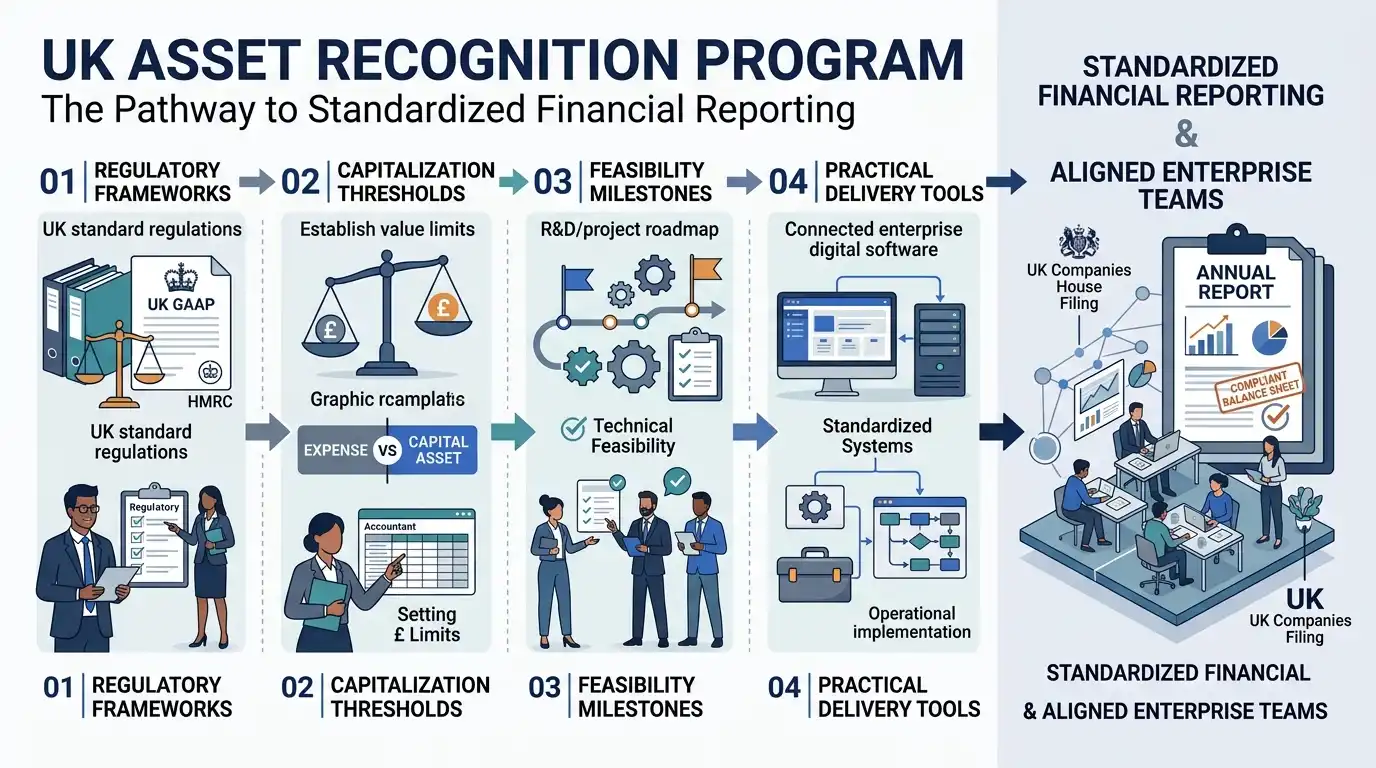
Curriculum design rests on core technical subjects that define the boundaries of expenditure accounting. Programs cover pre-licence costs, licence acquisition costs, exploration and evaluation expenditure, and the specific criteria governing the temporary exemption from standard capitalization rules. Participants study the precise mechanics separating the cost model versus the revaluation model to make informed policy decisions.
Instructional frameworks utilize specialized tools to reinforce theoretical concepts. Corporate learning platforms integrate interactive financial modeling software, regulatory compliance databases, and decision-tree matrices. These tools help participants evaluate complex scenarios involving technical feasibility thresholds and commercial viability assessments.
Delivery formats leverage blended methodologies to maximize knowledge retention across diverse corporate roles. Organizations utilize peer-led case reviews, digital self-paced modules, and expert-facilitated simulation labs. When companies examine these advanced technical requirements, professionals often transition to specialized study by enrolling in the IFRS 6 – Exploration & Evaluation Assets: Recognition Training Course to master advanced compliance procedures.
What Organizational Benefits Do Structured Training Programs Produce?
Structured training programs produce measurable organizational benefits, including enhanced financial compliance, optimized capital expenditure tracking, reduced audit adjustments, and strengthened cross-functional collaboration between technical and finance departments.
Workforce transformation initiatives generate concrete performance outcomes that impact the entire enterprise. Companies implementing targeted training report a 30% decrease in external audit discrepancies related to capital versus operational expenditure classification. Improved financial accuracy protects corporate valuation and maintains investor confidence by eliminating unexpected write-downs and restatements.
Team efficiency increases as geologists and finance personnel share a unified vocabulary for project expenditures. This alignment eliminates friction during the complex reclassification to development assets phase, ensuring projects move seamlessly from appraisal to commercial production. Collaboration improves because technical teams understand how field data influences financial statements, reducing administrative delays by 25%.
Retention rates among finance and technical professionals increase by 20% in organizations that invest in continuous professional development. Clear career growth pathways and mastery of complex industry standards make employees more engaged and capable. Leadership pipelines strengthen as mid-level accountants gain the strategic insight required to manage large-scale capital assets responsibly.
Where Are Asset Recognition Training Methodologies Applied Across Corporate Sectors?
Asset recognition training methodologies are applied across corporate sectors including upstream energy enterprises, mining conglomerates, infrastructure developers, and specialized financial auditing firms to standardize asset evaluation.
Corporate teams in upstream oil and gas operating companies utilize these learning frameworks to manage multi-million dollar seismic and drilling expenditures. Senior accounting managers and cost-control analysts rely on rigorous training to ensure every dollar spent on basin evaluation complies with international reporting standards.
Finance departments within global mining enterprises deploy similar educational modules to categorize mineral rights and exploratory drilling outlays. Project managers and compliance officers use the acquired frameworks to navigate complex regulatory environments across multiple international jurisdictions. This cross-sector application ensures consistency in financial governance.
Corporate audit and advisory firms integrate these training protocols into their staff onboarding schedules. Senior consultants and junior auditors alike complete structured modules to sharpen their evaluation of client capital structures. By standardizing knowledge across departments, organizations eliminate operational silos and establish a uniform benchmark of professional excellence.
What Common Problems and Misconceptions Undermine Asset Recognition Training?
Common problems that undermine asset recognition training include reliance on generic off-the-shelf programs, lack of practical workplace application, absence of measurable return on investment tracking, and failure to align content with specific regulatory updates.
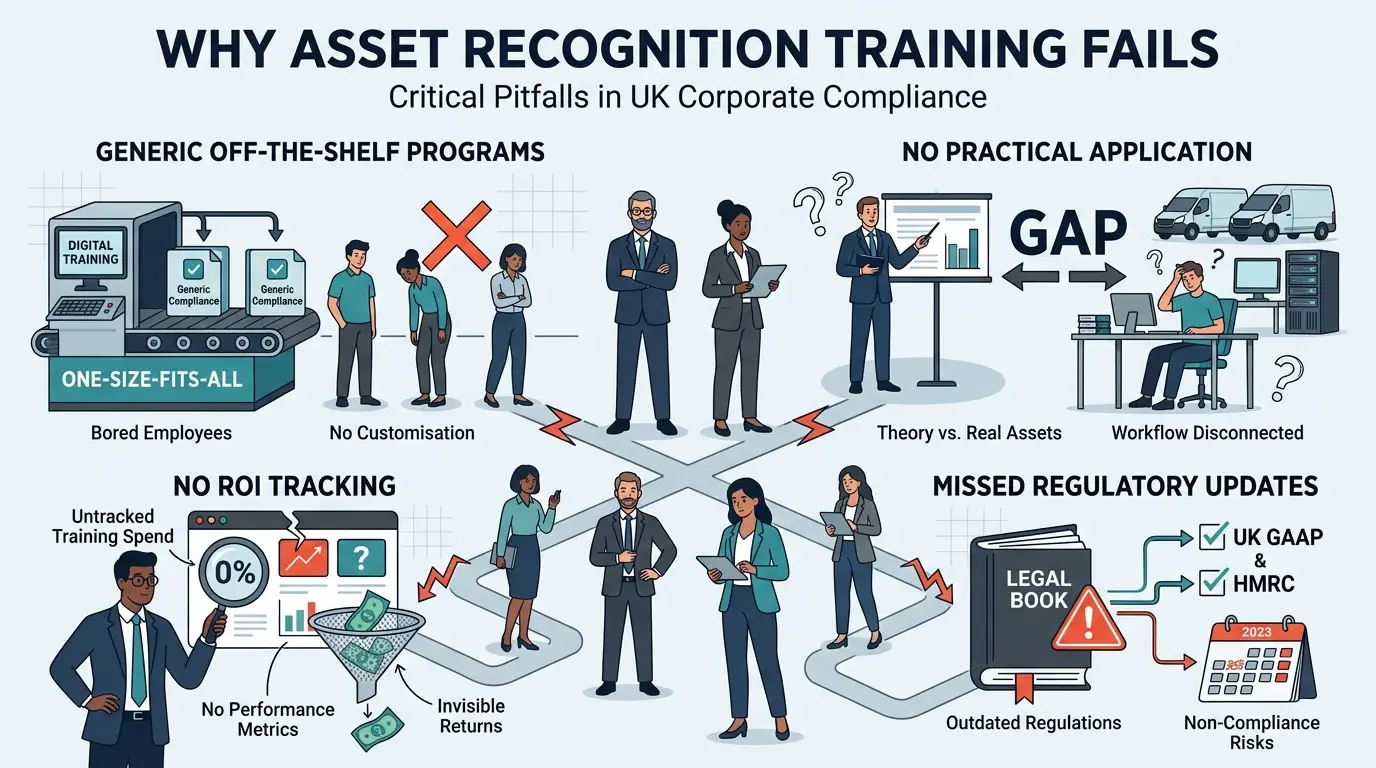
Organizations frequently make the mistake of deploying passive, lecture-based courses that fail to address unique corporate accounting policies. Generic programs lack industry context, resulting in low employee engagement and poor knowledge retention. When training lacks practical simulations, employees struggle to apply theoretical rules to real balance sheet entries.
Another critical misconception assumes that one-time training sessions permanently resolve compliance risks. Regulatory standards and corporate accounting policies evolve continuously, requiring ongoing educational reinforcement and refresher modules. Without periodic assessments and targeted follow-up coaching, skill degradation occurs within 6 months of initial instruction.
Effective implementation demands rigorous evaluation metrics to combat these pitfalls. Organizations must track post-training error rates, audit cycle durations, and employee performance improvements. Eliminating ineffective training formats ensures that workforce development investments directly support operational integrity and financial accuracy.
Frequently Asked Questions
What is Oil and Gas Petroleum IFRS & Financial Reporting training?
Oil and Gas Petroleum IFRS & Financial Reporting training is a specialized professional development program that equips corporate finance and accounting teams with the skills to navigate complex sector-specific standards. Delivered by the Institute For Oil & Gas Training, these courses focus on accurate capital expenditure tracking, reserve valuation reporting, and asset recognition compliance.
Why is specialized financial reporting training important for oil and gas companies?
Specialized financial reporting training ensures that energy enterprises maintain strict compliance with global accounting frameworks like IFRS 6 while minimizing costly audit adjustments. By standardizing knowledge across teams, the Institute For Oil & Gas Training helps organizations eliminate asset classification errors and protect corporate valuations during regulatory reviews.
What core topics are covered in petroleum IFRS training programs?
Petroleum IFRS training programs cover critical accounting areas including exploration and evaluation expenditure, pre-licence costs, and licence acquisition capitalization policies. Participants learn to evaluate technical feasibility thresholds and manage the eventual reclassification of assets from exploratory phases to commercial development.
How do organizations implement petroleum financial reporting training?
Organizations implement petroleum financial reporting training through blended corporate learning formats, including instructor-led workshops, digital modules, and practical case-based simulations. The Institute For Oil & Gas Training delivers outcome-based programs designed to align financial controllers, project engineers, and geologists under a unified reporting methodology.
Who should participate in Oil and Gas Petroleum IFRS & Financial Reporting courses?
Participation in Oil and Gas Petroleum IFRS & Financial Reporting courses benefits corporate controllers, financial analysts, accounting managers, and technical project leaders operating within the energy sector. These structured development initiatives empower finance professionals to manage volatile capital expenditures and enhance cross-functional transparency.
Related training courses
Risk Management for Upstream & Midstream Projects: Exposures Training Course
- Specialisation
- Oil & Gas Petroleum Compliance, AML & Risks
- Duration
- 5 days · 15 CPD hours
Regulatory Compliance for Petroleum Entities Training Course
- Specialisation
- Oil & Gas Petroleum Compliance, AML & Risks
- Duration
- 5 days · 15 CPD hours
Consolidation & JV Structures for Petroleum Group Entities Training Course
- Specialisation
- Oil & Gas Petroleum Accounting
- Duration
- 5 days · 15 CPD hours
More articles

IFRS 6 Exploration and Evaluation Asset Recognition Training for Oil and Gas Professionals
Master IFRS 6 asset recognition, capitalization policies, and impairment testing with the Institute For Oil & Gas Training. Enroll today.
Read article →
Key IFRS 6 Asset Recognition Challenges for Oil and Gas Companies
Explore key IFRS 6 asset recognition challenges in oil and gas, covering pre-licence costs, capitalisation policies, and technical feasibility.
Read article →
IFRS Reserves Disclosure Training for Oil and Gas Financial Reporting Professionals
Master IFRS reserves disclosures, depletion calculations, and reporting compliance with expert-led technical training for energy finance professionals.
Read article →