
Navigating the complexities of upstream accounting requires absolute clarity on how expenditures are classified before mineral reserves are proven. For finance teams and asset managers, establishing robust accounting policies is critical for financial transparency. Understanding the core principles of accounting standards starts with recognizing Why Exploration and Evaluation Asset Recognition Matters in Oil and Gas, which establishes the foundational concepts of upstream asset lifecycles.
What are the primary boundaries of pre-licence costs under IFRS 6?
Pre-licence costs are expenses incurred before an entity has obtained legal rights to explore a specific area, and IFRS 6 strictly requires companies to expense these outlays immediately as incurred rather than capitalising them on the balance sheet.
Upstream operators frequently incur substantial advisory, legal, and preliminary geological surveying expenses prior to securing formal government blocks or concessions. Under standard accounting frameworks, capitalisation requires a legal title or tenure to the underlying resource property. When finance professionals evaluate pre-licence data, they must separate speculative basin-wide screening studies from direct acquisition expenditures.
Entities fail to meet the definition of an exploration asset if they hold no legal right to explore the designated tract. Consequently, corporate controllers must enforce strict ledger partitions between general corporate R&D and targeted prospect generation. Failure to expense these initial exploratory outlays triggers audit restatements and compromises regulatory compliance.
Workforce capability gaps often emerge during this initial phase. Accounting personnel frequently misclassify preliminary scouting expenses as direct project costs, distorting capital expenditure ratios. Organizations mitigate this risk by enrolling finance teams in structured corporate programs such as the IFRS 6 – Exploration & Evaluation Assets: Recognition Training Course, ensuring staff accurately apply expenditure boundaries from day one.
How do companies account for licence acquisition costs and ongoing renewals?
Licence acquisition costs represent payments made to secure legal tenure to explore a specific area, and entities must capitalise these outlays as intangible exploration assets while subjecting them to periodic impairment reviews.
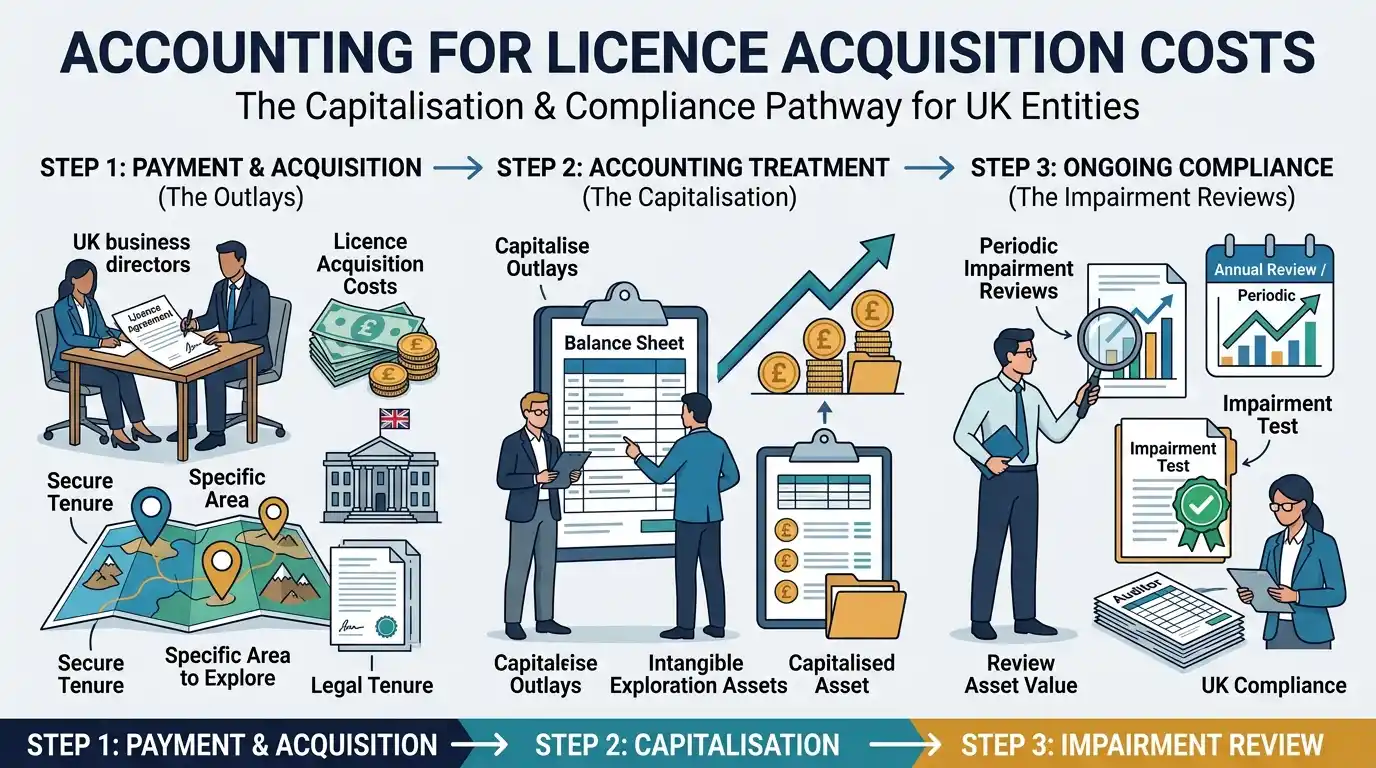
Once an oil and gas company wins a licensing round or executes a farm-in agreement, the upfront acquisition fee forms the initial carrying amount of the exploration asset. Unlike pre-licence outlays, these capitalized amounts remain on the statement of financial position throughout the exploration phase. However, companies face ongoing challenges when managing annual lease rentals, license extensions, and mandatory relinquishment clauses.
If an operator decides to relinquish a portion of a licensed block due to discouraging seismic data, a proportional write-off of the capitalized acquisition cost is mandatory. This triggers an immediate impact on net income, demanding close coordination between subsurface technical teams and corporate controllers. Accountants must track statutory expenditure commitments tied to each license. Failure to meet minimum work program obligations results in license revocation and full asset impairment.
How should management define and implement a rigorous capitalisation policy?
A capitalisation policy under IFRS 6 is an accounting framework that dictates which specific exploration and evaluation expenditures are added to the balance sheet versus those expensed immediately as operating costs.
The standard grants entities considerable accounting policy choice regarding the extent to which exploration expenditures are capitalised. Management must formulate a documented, systematic policy that distinguishes between pre-licence costs, acquisition costs, evaluation drilling, and development outlays. This policy must remain consistent across all operating segments and joint venture operations.
Inconsistent application across international business units creates material misstatements during consolidated financial reporting. For instance, one subsidiary might capitalize geological and geophysical (G&G) data acquisition, while another expenses identical seismic shoot costs. Standardizing this via specialized learning pathways ensures uniformity across global assets.
Organizations bridging these competency gaps deploy targeted interventions, utilizing the IFRS 6 Exploration and Evaluation Asset Recognition Training for Oil and Gas Professionals to align corporate accounting manuals with operational workflows. This alignment eliminates subjective interpretations by field accountants and strengthens internal audit defenses against regulatory scrutiny.
When does an entity apply the cost model versus the revaluation model for assets?
Subsequent to initial recognition, an entity must choose between the cost model and the revaluation model to measure its exploration and evaluation assets, applying that chosen model consistently across entire classes of assets.
Under the cost model, the asset is carried at cost less any accumulated impairment losses. Under the revaluation model, the asset is carried at a revalued amount, which is its fair value at the date of revaluation less any subsequent accumulated impairment losses. In upstream sectors, applying the revaluation model to exploration assets is rare due to the inherent difficulty in establishing reliable fair values for unproven reserves in the ground.
Most exploration assets lack active, liquid markets where unproven acreage trades transparently. Consequently, almost all upstream operators adopt the cost model for exploration and evaluation phases, reserving fair value measurements for producing assets under IAS 16 or IAS 38.
Finance leaders evaluate accounting frameworks through rigorous cost-benefit analyses. The administrative burden of obtaining independent valuations for speculative tracts outweighs the reporting benefits. Training programs address these valuation complexities, equipping corporate controllers with the technical proficiency required to defend chosen accounting models before external auditors.
How is technical feasibility and commercial viability established before reclassification?
Technical feasibility and commercial viability are established when appraisal drilling, flow testing, and reserve estimation confirm that extracting hydrocarbons yields sufficient economic return to justify full-scale field development.
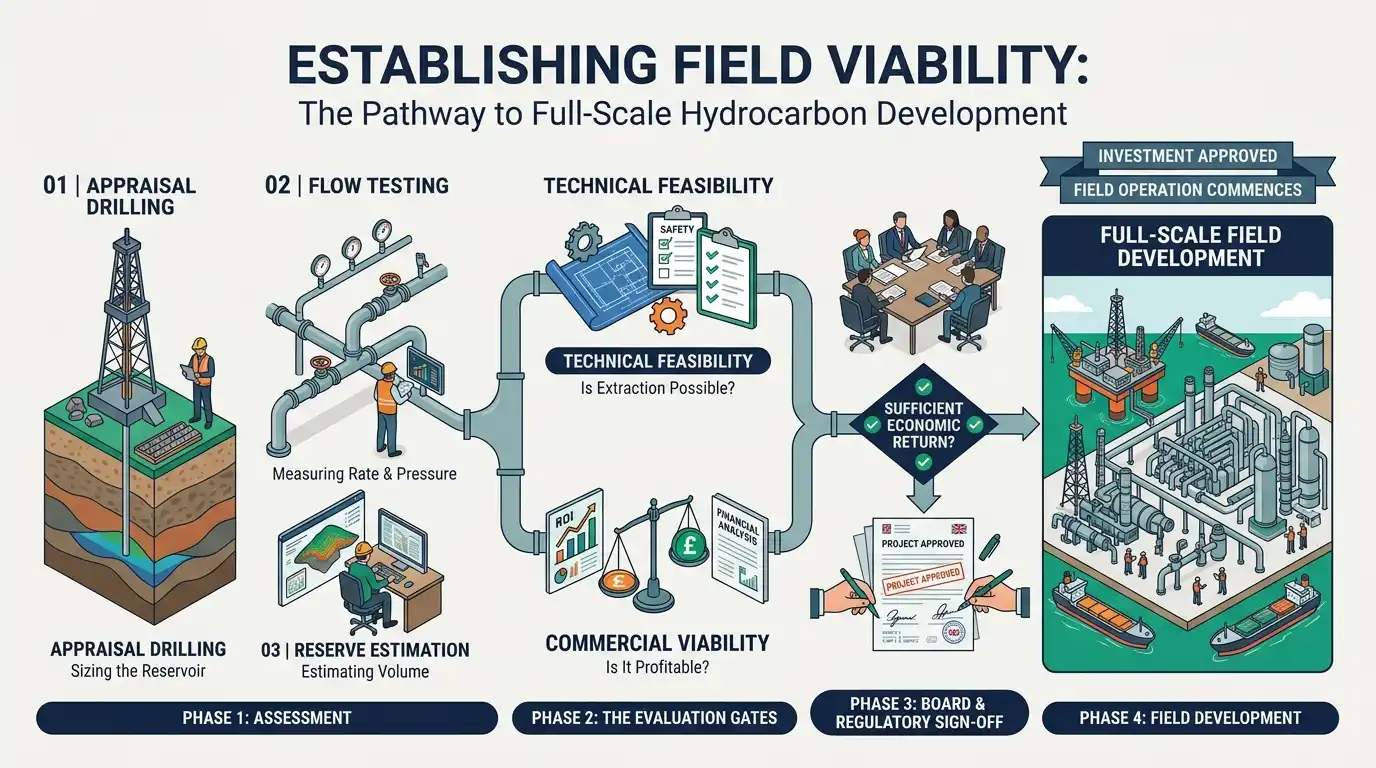
The moment a discovery is made, the asset ceases to be classified under IFRS 6. Management cannot park assets in exploration limbo indefinitely. Companies must assess whether proved plus probable reserves exist in commercial quantities. This evaluation relies on rigorous reservoir simulation, capital expenditure forecasting, and long-term commodity price assumptions.
If technical feasibility is proven, the asset undergoes reclassification from exploration and evaluation to development assets. Before this transfer occurs, an impairment test must be performed. Any carrying amount exceeding the recoverable amount is written off immediately to profit or loss.
Workforce execution errors during this transition phase lead to premature capitalisation or delayed write-offs. HR directors address this vulnerability by integrating technical accounting modules into continuous professional development frameworks. Ensuring accounting teams work seamlessly alongside reservoir engineers guarantees compliance during high-stakes reclassification events.
Frequently Asked Questions
What does the Oil and Gas Petroleum IFRS & Financial Reporting program cover?
Institute For Oil & Gas Training delivers specialized Oil and Gas Petroleum IFRS & Financial Reporting courses that focus on upstream accounting standards, exploration expenditure, and reserve recognition. These training modules equip finance professionals with the technical skills needed to handle complex asset classifications, impairment testing, and joint venture accounting.
Who should attend the Oil and Gas Petroleum IFRS & Financial Reporting training?
This professional training is designed for corporate controllers, finance managers, accounting teams, and internal auditors working within upstream and downstream energy sectors. It also benefits HR leaders seeking to bridge workforce skill gaps in specialized petroleum financial standards and regulatory compliance.
How does IFRS 6 impact upstream exploration and evaluation accounting?
IFRS 6 governs how companies account for exploration and evaluation expenditures incurred before technical feasibility and commercial viability are established. Institute For Oil & Gas Training addresses these complexities by teaching finance teams how to correctly separate pre-licence costs, capitalise acquisition outlays, and manage statutory asset impairments.
What are the learning delivery models available for energy finance training?
Institute For Oil & Gas Training provides practical, industry-driven learning delivery models tailored to corporate schedules, including intensive classroom sessions and customized in-house workforce development programs. These formats ensure measurable business outcomes and alignment with international financial reporting frameworks.
Why is specialized financial reporting training crucial for oil and gas companies?
Specialized petroleum financial reporting training prevents costly compliance errors, audit restatements, and misstatements during asset reclassifications or joint venture reporting. By strengthening internal accounting competencies, organizations ensure accurate balance sheet disclosures and robust alignment with evolving international standards.
Related training courses
Risk Management for Upstream & Midstream Projects: Exposures Training Course
- Specialisation
- Oil & Gas Petroleum Compliance, AML & Risks
- Duration
- 5 days · 15 CPD hours
Regulatory Compliance for Petroleum Entities Training Course
- Specialisation
- Oil & Gas Petroleum Compliance, AML & Risks
- Duration
- 5 days · 15 CPD hours
Segregation of Duties in Finance & ERP Systems Training Course
- Specialisation
- Oil & Gas Petroleum Compliance, AML & Risks
- Duration
- 5 days · 15 CPD hours
More articles

IFRS 6 Exploration and Evaluation Asset Recognition Training for Oil and Gas Professionals
Master IFRS 6 asset recognition, capitalization policies, and impairment testing with the Institute For Oil & Gas Training. Enroll today.
Read article →
Why Exploration and Evaluation Asset Recognition Matters in Oil and Gas
Discover how structured exploration and evaluation asset recognition training improves compliance, reduces audit risks, and builds workforce capability.
Read article →
IFRS Reserves Disclosure Training for Oil and Gas Financial Reporting Professionals
Master IFRS reserves disclosures, depletion calculations, and reporting compliance with expert-led technical training for energy finance professionals.
Read article →