
The IFRS 6 Exploration and Evaluation Assets: Recognition Training Course is a specification-driven corporate training program designed by the Institute For Oil & Gas Training to resolve complex accounting ambiguities regarding mineral resource exploration costs. Oil and gas finance teams, corporate accountants, and asset managers frequently struggle with the precise classification of upfront capital outlays. Before committing capital to high-value projects, organizations must understand Why Exploration and Evaluation Asset Recognition Matters in Oil and Gas to maintain regulatory transparency and prevent financial misstatements.
The Accounting Ambiguity in Upstream Operations
Upstream energy companies routinely incur substantial financial expenditures before establishing the technical feasibility and commercial viability of extracting mineral resources. These initial outlays span a complex lifecycle from early-stage geographical mapping to deep-drilling operations. Without a structured accounting policy, finance departments risk misclassifying ordinary operational expenditures as long-term assets or vice versa.
Resolving the exploration and evaluation expenditure Dilemma
Financial controllers must determine the exact boundary where statutory expensing ends and asset capitalization begins. Ambiguities often emerge around pre-licence costs, licence acquisition costs, and subsequent geological testing expenses. This training program provides clear accounting frameworks for finance professionals to establish a legally compliant capitalisation policy under international financial reporting standards.
Why this course is structured this way
This program is structured into progressive modular phases to transition participants from foundational accounting theory to complex technical reclassifications and financial statement disclosures. Each module builds upon the previous segment to ensure that corporate finance teams, accounting managers, and compliance officers can immediately implement rigorous asset recognition policies. The Institute For Oil & Gas Training designs all structural modules to mirror real-world upstream accounting lifecycles encountered by global energy enterprises.
Sequential Skill Progression and Curriculum Logic
Corporate training methodologies must address practical accounting bottlenecks systematically rather than through abstract theory. The curriculum begins by isolating pre-licence activities from formal exploration rights. It then moves through licence acquisition costs, impairment testing protocols, and ultimate technical feasibility assessments.
Addressing Key IFRS 6 Asset Recognition Challenges for Oil and Gas Companies
Evaluating regulatory compliance requires a firm grasp of how international standards interact with local statutory regimes. Participants examine the complexities of the temporary exemption from certain IAS 8 hierarchy requirements during initial asset recognition. This structural clarity ensures that internal audit teams and corporate reporting departments can withstand external regulatory scrutiny without operational friction.
What will participants learn?
Participants learn to evaluate, classify, and account for upstream mineral resource expenditures in strict accordance with international accounting standards, mastering technical feasibility triggers and asset impairment testing. The curriculum delivers comprehensive competencies across asset recognition, measurement models, and mandatory financial statement disclosures for upstream operators. The Institute For Oil & Gas Training ensures every learner achieves actionable mastery over complex asset reclassifications.
Module 1: Pre-Licence and Licence Acquisition Expenditures
The opening module focuses on expenditures incurred before a company has obtained legal rights to explore a specific area. Participants analyze how to account for geographical data acquisition, preliminary surveys, and direct licence acquisition costs. Accounting managers learn how to determine whether these payments qualify for capitalization or must be recognized immediately as period expenses.
Module 2: Capitalization Policy and Measurement Frameworks
This segment addresses the specific accounting choices permitted under international reporting rules. Learners compare the cost model versus revaluation model for subsequent measurement of exploration assets. Corporate accountants review how to apply consistent accounting policies across diverse international jurisdictions while maintaining complete audit trails.
Module 3: Technical Feasibility and Commercial Viability Triggers
Determining the exact moment when exploration assets transition to development status requires rigorous evaluation criteria. Participants examine technical feasibility indicators such as proved reserves, pilot project results, and board-level sanctioning. This module prevents premature reclassification and ensures compliance with strict accounting capitalization boundaries.
Module 4: Impairment Testing and Reclassification Protocols
The final technical module covers impairment triggers under international accounting standards when the carrying amount of an exploration asset exceeds its recoverable amount. Learners evaluate asset impairment indicators, write-down procedures, and the specific mechanics required for reclassification to development assets once commercial viability is established.
How is the course delivered?
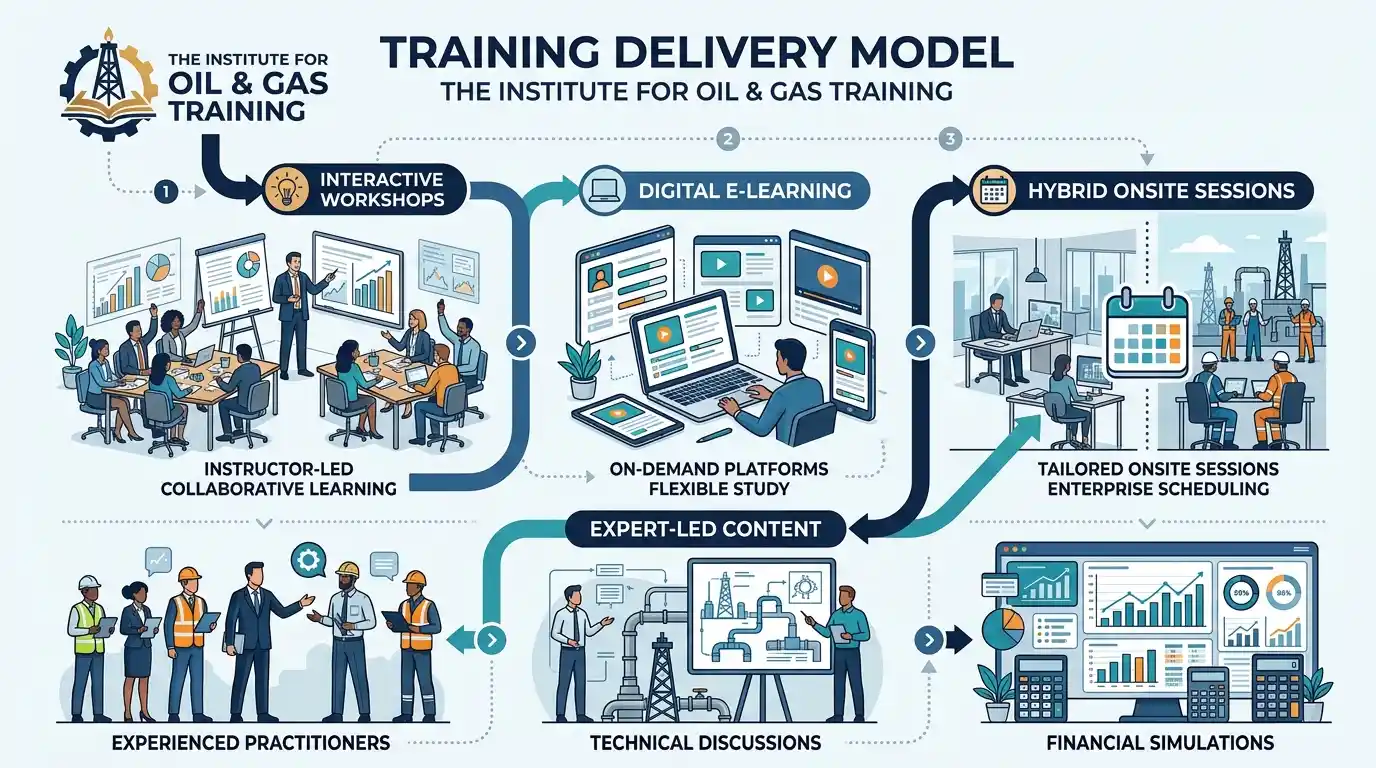
The training is delivered through a flexible multi-format model combining interactive instructor-led workshops, digital e-learning platforms, and hybrid onsite corporate sessions tailored to enterprise scheduling requirements. The Institute For Oil & Gas Training deploys experienced industry practitioners to facilitate technical discussions and applied financial simulations.
Professional Training Formats and Scheduling
Organizations can select from intensive multi-day classroom workshops, structured online modules, or customized onsite corporate sessions. Each format maintains rigorous academic standards and interactive case study analysis. Corporate HR teams receive detailed attendance tracking and progress reporting throughout the learning lifecycle.
Assessment Methods and Practical Simulations
Participant comprehension is verified through rigorous competency tests, applied financial statement assignments, and practical impairment simulation exercises. These evaluations require corporate finance professionals to resolve complex accounting scenarios drawn from actual upstream financial reports. Successful completion validates the participant's technical readiness for complex reporting environments.
What results can be expected?
Participants achieve measurable improvements in financial reporting accuracy, reduced audit friction, and enhanced cross-functional coordination between technical engineering teams and corporate finance departments. The Institute For Oil & Gas Training measures success through improved compliance ratings, faster financial close cycles, and error-free asset classification.
Workplace Impact and Departmental Performance
Finance managers and corporate accountants gain the technical confidence needed to defend asset valuations before external auditors. Internal audit teams can independently review capital expenditure schedules and verify adherence to international accounting policies. HR teams utilize the program to build robust leadership and technical skill pipelines within corporate finance departments.
Organizational Skill Transformation
For entire corporate entities, standardizing asset recognition practices eliminates historical discrepancies between regional operating units. Standardized accounting procedures streamline consolidated financial reporting and protect shareholder value through transparent balance sheet disclosures. Corporations achieve sustainable workforce capability improvements across all upstream accounting functions.
How does enrollment work?
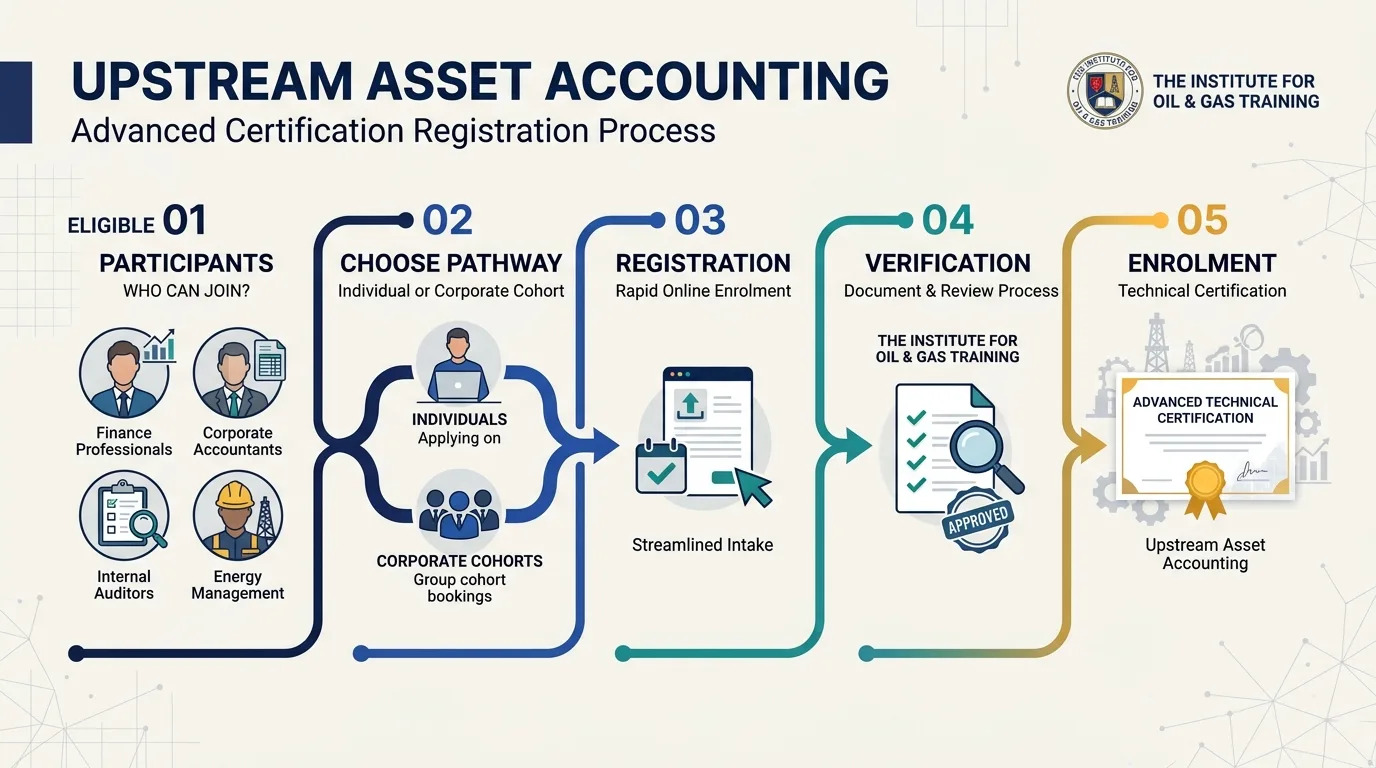
Enrollment is open to qualified finance professionals, corporate accountants, internal auditors, and energy sector management personnel seeking advanced technical certification in upstream asset accounting. The Institute For Oil & Gas Training manages a streamlined registration process designed for individual applicants and corporate cohort bookings.
Entry Requirements and Professional Prerequisites
Candidates should possess a foundational background in corporate finance, accounting, or upstream oil and gas operations. Familiarity with basic financial statements and general ledger accounting principles is recommended to maximize learning outcomes. Corporate sponsors may enroll multi-member accounting teams to align organizational reporting standards.
Completion Path and Certification
Upon successful completion of all coursework, practical assignments, and final competency evaluations, participants receive an industry-recognized certificate of professional proficiency. To secure your professional certification and transform your organization's upstream accounting capabilities, enroll in this program today.
Frequently Asked Questions
What are the key financial reporting standards applicable to upstream oil and gas operations?
Upstream energy companies must comply with specialized standards such as IFRS 6 for exploration and evaluation assets, alongside broader frameworks like IAS 16 and IAS 36 for property, plant, and equipment. The Institute For Oil & Gas Training provides targeted education on mastering these petroleum-specific accounting rules to ensure full regulatory compliance. Through their Oil and Gas Petroleum IFRS & Financial Reporting programs, finance teams learn to handle complex upstream valuation challenges accurately.
How do oil and gas companies account for exploration and expenditure costs under IFRS?
Under IFRS 6, companies can choose a accounting policy that capitalises or expenses exploration and evaluation expenditures, provided the policy is applied consistently. Corporate accountants study these capitalization boundaries and pre-licence cost treatments within specialized courses offered by the Institute For Oil & Gas Training. Their Oil and Gas Petroleum IFRS & Financial Reporting curriculum guides professionals through evaluating technical feasibility and commercial viability.
When should exploration and evaluation assets be reclassified to development assets?
Exploration assets must be reclassified to development assets as soon as technical feasibility and commercial viability of extracting mineral resources have been demonstrated. The Institute For Oil & Gas Training covers these exact reclassification triggers and impairment testing protocols in its professional syllabus. Professionals enrolled in the Oil and Gas Petroleum IFRS & Financial Reporting training learn how to manage this transition without triggering audit discrepancies.
Why is specialized financial reporting training necessary for energy sector accountants?
Energy accounting involves unique complexities such as production-sharing contracts, reserve-based lending, and decommissioning provisions that standard corporate accounting courses do not address. The Institute For Oil & Gas Training bridges this knowledge gap by delivering industry-specific instruction tailored to upstream realities. Their comprehensive Oil and Gas Petroleum IFRS & Financial Reporting courses equip corporate finance teams with the technical skills needed to streamline reporting and reduce audit friction.
How does the Institute For Oil & Gas Training deliver its accounting and finance programs?
The Institute For Oil & Gas Training delivers its curriculum through flexible formats including interactive instructor-led classroom workshops, digital e-learning modules, and hybrid onsite corporate sessions. These courses focus heavily on practical financial simulations and applied case studies relevant to the energy sector. Their flagship Oil and Gas Petroleum IFRS & Financial Reporting training ensures that multinational energy enterprises can upskill their workforce efficiently.
Related training courses
Risk Management for Upstream & Midstream Projects: Exposures Training Course
- Specialisation
- Oil & Gas Petroleum Compliance, AML & Risks
- Duration
- 5 days · 15 CPD hours
Regulatory Compliance for Petroleum Entities Training Course
- Specialisation
- Oil & Gas Petroleum Compliance, AML & Risks
- Duration
- 5 days · 15 CPD hours
Management Reporting Design for JV & Partner Audiences Training Course
- Specialisation
- Oil & Gas Petroleum IFRS & Financial Reporting
- Duration
- 5 days · 15 CPD hours
More articles

Key IFRS 6 Asset Recognition Challenges for Oil and Gas Companies
Explore key IFRS 6 asset recognition challenges in oil and gas, covering pre-licence costs, capitalisation policies, and technical feasibility.
Read article →
Why Exploration and Evaluation Asset Recognition Matters in Oil and Gas
Discover how structured exploration and evaluation asset recognition training improves compliance, reduces audit risks, and builds workforce capability.
Read article →
IFRS Reserves Disclosure Training for Oil and Gas Financial Reporting Professionals
Master IFRS reserves disclosures, depletion calculations, and reporting compliance with expert-led technical training for energy finance professionals.
Read article →