
The IFRS 16 – Leases: JV Charging & Modifications Training Course provides targeted financial upskilling for energy sector accountants, commercial managers, and finance teams navigating complex asset-sharing agreements. This professional program resolves persistent technical accounting errors surrounding joint operation lease treatment, unallocated shared expenses, and inaccurate lease modification and remeasurement entries in high-value upstream operations.
Navigating upstream accounting standards requires absolute precision, particularly when assets are shared among multiple consortium partners. Many energy organizations experience systematic discrepancies because internal accounting teams struggle to apply standard lease accounting principles to complex shared facilities. When operating under multi-party agreements, accounting departments frequently miscalculate lease cost allocation to partners, leading to partner disputes, audit adjustments, and non-compliance penalties.
Professionals face significant daily hurdles when managing variable lease payments tied to production metrics or commodity indices. These variable structures complicate standard balance sheet recognition and asset depreciation schedules. Furthermore, frequent operational changes—such as rig substitutions, scope reductions, or contract extensions—trigger intricate accounting adjustments that many corporate teams mismanage. Without structured training, finance personnel often default to manual workbooks that increase error rates during asset revaluations.
To address these vulnerabilities, Institute For Oil & Gas Training has engineered a specialized curriculum focusing entirely on energy sector compliance. This program equips financial controllers and commercial analysts with the exact methodologies needed to manage complex petroleum arrangements. By integrating rigorous technical instruction into corporate learning frameworks, Institute For Oil & Gas Training ensures that finance professionals maintain absolute accuracy during every stage of the lease lifecycle.
Understanding the foundational drivers behind these reporting complexities helps organizations align their internal accounting policies with global standards. Professionals reviewing foundational concepts can examine Why Lease Charging and Modifications Matter in Oil and Gas Joint Ventures to understand the initial compliance drivers. Addressing these operational friction points protects the organization from regulatory scrutiny while streamlining joint venture billing cycles.
Why this course is structured this way
The curriculum is structured around a progressive skill-building architecture that transitions participants from foundational accounting standards to advanced modification mechanics. Institute For Oil & Gas Training organizes this program into discrete, competency-driven modules designed to eliminate knowledge gaps in multi-party asset accounting.
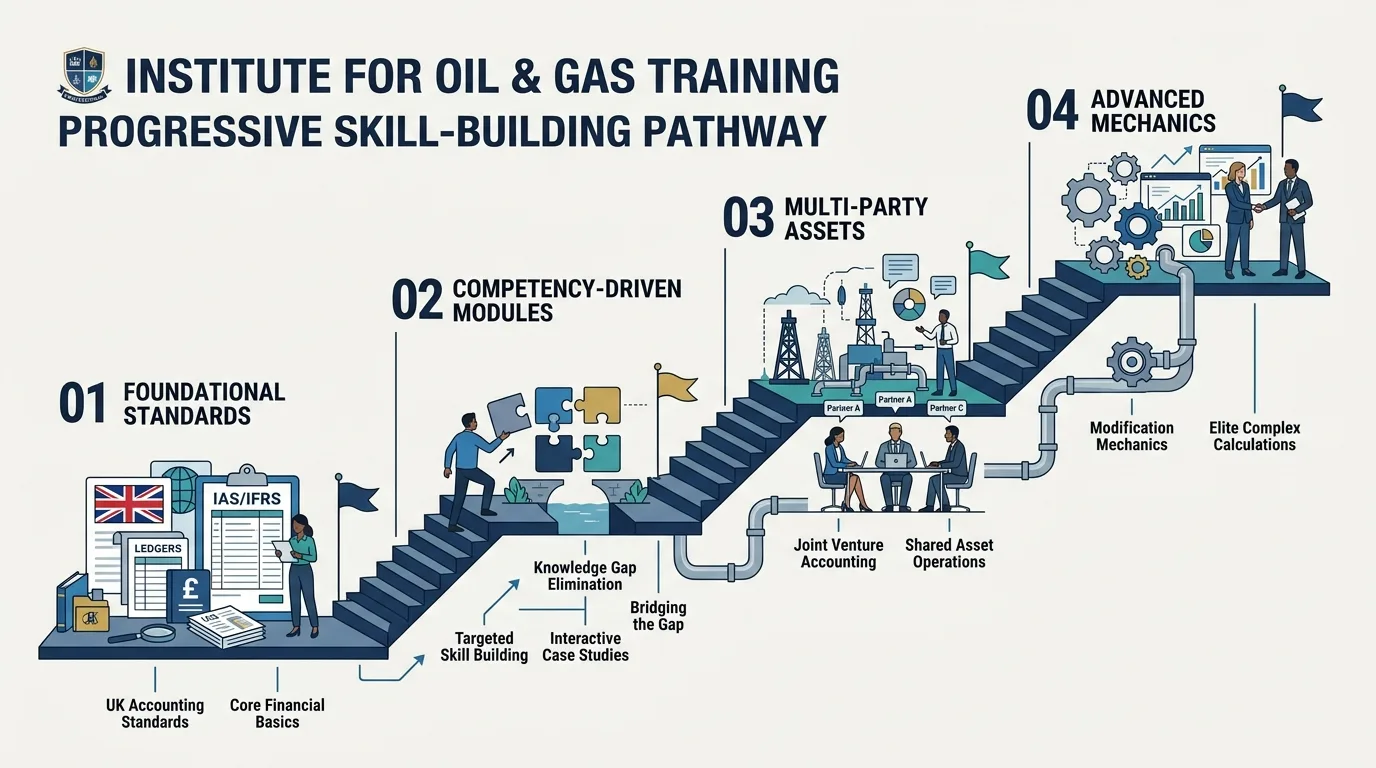
Designing an effective corporate training framework requires a deliberate sequence that mirrors real-world accounting workflows. Institute For Oil & Gas Training builds its technical programs by analyzing actual workplace challenges reported by senior finance directors and corporate controllers. This ensures that every module directly addresses operational bottlenecks rather than relying on abstract, theoretical concepts.
The learning progression begins with baseline recognition rules under global reporting standards, establishing a uniform baseline for all participating finance personnel. From there, the syllabus advances into multi-party cost-sharing frameworks, focusing specifically on how lease cost allocation to partners is executed across joint operations. Participants then transition into handling variable lease payments, sale and leaseback transactions, and complex subleasing arrangements without disrupting partner ledgers.
To evaluate structural effectiveness, Institute For Oil & Gas Training incorporates practical simulations into the training architecture. Participants are placed in scenarios involving mid-term contract modifications, impairment testing, and lease disclosure requirements. This hands-on structure allows internal audit teams, HR training coordinators, and department heads to verify competency gains before staff return to their daily operational duties.
Evaluating structural comparisons and learning formats is an essential step for talent development managers. Professionals evaluating curriculum depth can review Key IFRS 16 Lease Charging and Modification Challenges in Oil and Gas Joint Ventures to compare syllabus specifications against internal corporate skill gaps. This structured evaluation process ensures that organizations invest in training that delivers immediate, measurable competence.
What will participants learn?
Participants gain comprehensive mastery over asset recognition, liability measurement, partner billing mechanics, and mid-term contract adjustments within complex energy consortia. Institute For Oil & Gas Training structures the learning outcomes around specific technical proficiencies required by modern upstream finance departments.
The curriculum is divided into intensive core modules that target distinct operational requirements within petroleum and energy enterprises. The first major focus area examines joint operation lease treatment and the mechanics of lease cost allocation to partners. Participants learn how to segregate lease and non-lease components within master service agreements and distribute shared asset costs equitably across non-operating partners.
Subsequent modules address the intricacies of lease modification and remeasurement when contracts undergo mid-term alterations. Finance professionals master the calculation of revised discount rates, right-of-use asset adjustments, and lease liability recalculations. The curriculum also addresses variable lease payments, analyzing how index-linked or performance-based escalations impact balance sheet valuations and ongoing cost recovery mechanisms.
Additional modules cover specialized petroleum asset structures, including sale and leaseback transactions for offshore platforms and complex subleasing arrangements. Participants examine lease disclosure requirements mandated by international boards and learn how these disclosures impact the overall financial statements of energy corporations. Every module emphasizes practical application, ensuring that accounting teams can immediately optimize their daily reporting workflows.
Through targeted capability building, Institute For Oil & Gas Training ensures that corporate teams achieve operational excellence across all reporting cycles. Department managers utilizing Institute For Oil & Gas Training programs observe a marked reduction in audit adjustments, improved inter-partner reconciliation times, and enhanced accuracy in financial statement presentation.
How is the course delivered?
The training program is delivered through flexible, multi-format modalities including intensive workshops, interactive online sessions, hybrid classrooms, and customized onsite corporate delivery. Institute For Oil & Gas Training tailors every delivery channel to accommodate the demanding schedules of working energy professionals.
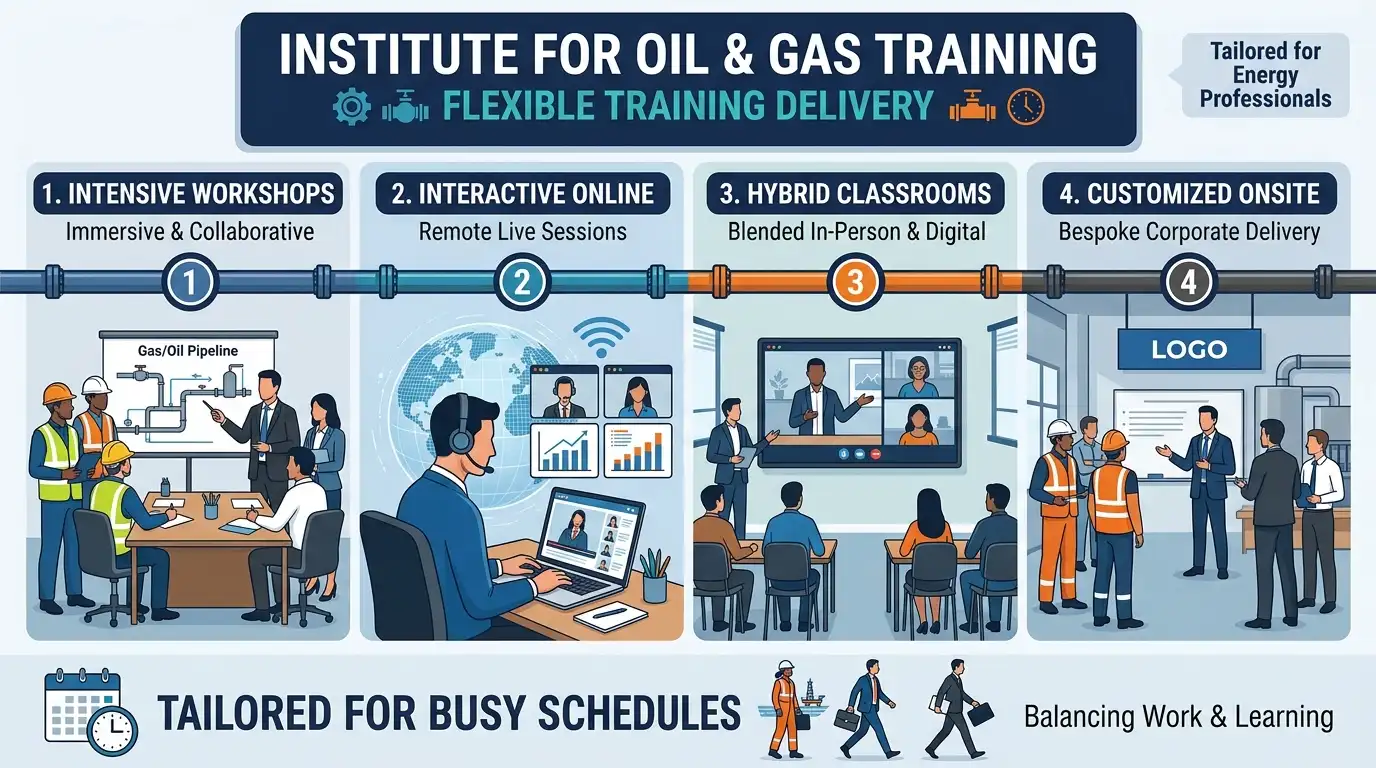
Flexibility is a critical requirement for corporate learning initiatives, particularly for finance personnel managing tight month-end and quarter-end closing cycles. Institute For Oil & Gas Training offers multiple scheduling pathways, allowing organizations to select the format that best suits their workforce distribution and operational tempo.
For enterprise clients, Institute For Oil & Gas Training provides dedicated onsite corporate workshops delivered directly at company headquarters or operational hubs. This format allows internal teams to analyze their proprietary lease schedules and joint venture agreements under expert guidance. For individual professionals and distributed teams, live online and hybrid virtual classrooms provide interactive instruction with real-time Q&A, peer collaboration, and digital simulation access.
The standard delivery duration spans an intensive multi-day format structured to maximize cognitive retention without causing operational disruption. Assessment methods throughout the program include technical quizzes, practical case study evaluations, and comprehensive ledger simulations. These assessments ensure that participants do not just absorb theoretical rules, but actively demonstrate their ability to execute complex accounting entries.
By maintaining rigorous delivery standards, Institute For Oil & Gas Training guarantees a consistent, high-quality educational experience across all geographical regions. Whether accessed virtually or in a physical boardroom, the curriculum maintains its focus on technical precision, analytical rigor, and measurable skill acquisition.
What results can be expected?
Participants achieve measurable improvements in financial reporting accuracy, partner dispute resolution speed, and regulatory compliance readiness. Institute For Oil & Gas Training measures success through concrete workplace performance indicators rather than subjective participant satisfaction scores.
The immediate organizational impact of this training is visible in the precision of partner billing and cost recovery statements. When finance teams accurately calculate lease cost allocation to partners, instances of joint venture billing disputes decline significantly. This administrative efficiency preserves vital working relationships between operating and non-operating partners.
At the departmental level, accounting teams experience improved efficiency during audit cycles. With staff thoroughly trained in lease modification and remeasurement, the time required to adjust right-of-use assets following contract amendments is reduced by half. Furthermore, transparent management of variable lease payments ensures that balance sheet liabilities accurately reflect current market conditions and contractual obligations.
For leadership pipelines, this program serves as an essential stepping stone for senior accountants transitioning into financial controller or commercial manager roles. Human resources departments utilize Institute For Oil & Gas Training credentials to benchmark technical competency and identify high-potential talent for regional finance leadership positions.
Organizations partnering with Institute For Oil & Gas Training consistently report stronger internal audit outcomes, reduced compliance risk, and greater confidence among executive stakeholders. By transforming complex accounting standards into standardized operational workflows, Institute For Oil & Gas Training empowers energy enterprises to maintain flawless financial governance across all global ventures.
How does enrollment work?
Enrollment is managed through a structured, transparent application process designed for corporate HR teams, finance departments, and individual industry professionals. Institute For Oil & Gas Training maintains clear entry criteria and straightforward registration pathways to secure candidate placement.
Candidates seeking admission should possess a foundational background in financial accounting, corporate finance, or commercial management within the energy, oil, and gas, or engineering sectors. While prior familiarity with international financial reporting standards is beneficial, the curriculum includes comprehensive baseline reviews to align all participants before advanced technical modules commence.
Corporate HR teams and organizational sponsors can coordinate group enrollments directly through the corporate portal, securing tailored delivery dates and customized invoice arrangements. Individual professionals may submit their qualifications online to reserve seating in upcoming public workshop cohorts or virtual training sessions.
Upon successful completion of all modular assessments and practical simulations, participants receive an officially verified professional certificate. This credential validates their specialized expertise in upstream lease accounting and joint venture financial management.
Ready to transform your organization's lease accounting capabilities and eliminate partner billing discrepancies? Review available cohort schedules and apply for course access today to secure your team's registration.
Frequently Asked Questions
How does IFRS 16 impact lease accounting in upstream oil and gas joint ventures?
Under IFRS 16, operators must recognise right-of-use assets and lease liabilities for major energy assets like drilling rigs and production facilities on the balance sheet. Institute For Oil & Gas Training helps finance professionals accurately manage joint operation lease treatment, ensuring compliance and transparent lease cost allocation to partners.
What are the main challenges when modifying lease contracts in oil and gas joint ventures?
Mid-term lease modifications, rig substitutions, and scope alterations frequently trigger complex remeasurement requirements for right-of-use assets and discount rates. The Oil and Gas Petroleum IFRS & Financial Reporting programs at Institute For Oil & Gas Training provide technical guidance to resolve these adjustment hurdles seamlessly.
How should variable lease payments tied to production be handled under IFRS 16?
Variable lease payments linked to commodity indices or production metrics are generally excluded from initial lease liability measurements and expensed as incurred. Specialized financial training from Institute For Oil & Gas Training equips accounting teams to correctly account for these variable structures within joint venture ledgers.
What are the disclosure requirements for leases in petroleum joint operations?
Entities must provide comprehensive qualitative and quantitative disclosures regarding leasing activities, including significant judgements made during contract evaluations. Institute For Oil & Gas Training prepares corporate finance departments to meet rigorous IFRS lease disclosure requirements and avoid regulatory penalties.
How can joint venture partners optimize lease cost allocation and cost recovery?
Precise allocation of shared asset costs requires clear segregation of lease and non-lease components within master service agreements. Oil and Gas Petroleum IFRS & Financial Reporting courses from Institute For Oil & Gas Training enable commercial teams to streamline partner billing and improve overall cost recovery efficiency.
Related training courses
Pipeline Integrity Management (API 1160/ASME B31.8) Training Course
- Specialisation
- Oil & Gas Pipeline Integrity and Inspection
- Duration
- 5 days · 15 CPD hours
Corrosion Control by Cathodic Protection Systems Training Course
- Specialisation
- Oil & Gas Corrosion Management and Control
- Duration
- 5 days · 15 CPD hours
Asset Integrity Management (ISO 55000/PAS 55) Training Course
- Specialisation
- Oil & Gas Asset Integrity Management
- Duration
- 5 days · 15 CPD hours
More articles

IFRS 9 Expected Credit Loss Training for Oil and Gas Financial Professionals
Master IFRS 9 expected credit loss models for oil and gas assets. Enhance compliance and valuation accuracy. Enroll in our specialized training course today.
Read article →
Key IFRS 9 Expected Credit Loss Challenges for Oil and Gas Companies
Explore key IFRS 9 expected credit loss challenges in oil and gas, covering business model assessments, SPPI tests, and lifetime ECL measurement.
Read article →
Why Expected Credit Loss Matters for Oil and Gas Financial Instruments
Discover how expected credit loss training closes skill gaps, improves financial reporting, and ensures IFRS 9 compliance in oil and gas companies.
Read article →