

Digital transformation in petroleum finance is the systematic integration of automated systems, advanced analytics, and cloud architecture into energy accounting workflows. It shifts finance departments from manual record-keeping to real-time strategic decision-making, direct cost control, and automated compliance.
Petroleum finance operates under complex operational structures involving joint ventures, production sharing contracts, complex royalty regimes, and volatile commodity prices. Traditional financial models relying on legacy spreadsheets and disconnected enterprise resource planning systems create data silos. These silos delay financial reporting by 15 to 30 days every month, increasing administrative overhead and exposure to fiscal risks.
In a modern corporate environment, digital transformation replaces disjointed processes with unified technology architectures. Financial management shifts from retrospective accounting to real-time predictive analytics. Automation handles high-volume tasks such as invoice processing, joint interest billing, and joint venture accounting. Energy companies reduce manual processing errors by 85 percent and accelerate monthly financial close cycles from 20 days to 4 days.
Organizational capability depends on workforce readiness. Transitioning systems without upskilling staff leads to underutilised software and operational disruption. Corporate development programs bridge this gap by training finance teams on advanced data architecture, automated fiscal modeling, and risk management systems. HR managers and decision-makers ensure that technology investments deliver operational efficiency by equipping teams with structured, practical technical capabilities.
How Does Digital Transformation Work in Energy Organisations?
Digital transformation works by aligning corporate strategy with operational workflows through a structured, phased implementation process. Organisations evaluate current capabilities, standardise processes, deploy automated finance technologies, and upskill employees through structured corporate training frameworks to ensure seamless adoption.
Implementation follows a macro-to-micro progression that starts with high-level corporate governance and moves down to individual desk procedures. Upstream and downstream businesses begin by standardising financial data structures across international business units. Standardisation eliminates regional reporting variations, enabling central financial software to parse joint venture expenses, capital expenditures, and operating costs consistently.
The transformation deployment process operates across four distinct phases:
Digital maturity assessment: Evaluation of existing software infrastructure, data flow bottlenecks, and workforce technical skill gaps.
Target operating model design: Establishing standardized finance processes, system architecture requirements, and unified data governance standards.
Capability building and execution: Delivering role-based corporate training through intensive workshops, case-based simulations, and structured hybrid modules.
Governance and continuous optimization: Monitoring processing speed, data accuracy, system adoption rates, and financial return on investment.
When organisations transition to centralized financial structures, understanding how to build a digital transformation strategy and roadmap for petroleum finance becomes essential for driving cross-departmental alignment. Establishing clear operational targets ensures that software deployments integrate smoothly with existing accounting controls and field operations.
Workforce alignment determines implementation speed. Finance professionals must learn to audit automated algorithms, manage cloud-based ERP systems, and interpret predictive risk models. Structured learning frameworks reduce transition resistance, enabling teams to maintain full financial compliance during system rollouts.
What Are the Key Components of Petroleum Finance Transformation?
The core components include centralized data governance, automated joint venture accounting, predictive financial modeling, modern software architecture, and role-specific workforce upskilling. Together, these elements form an integrated ecosystem that drives financial control, compliance, and operational efficiency.
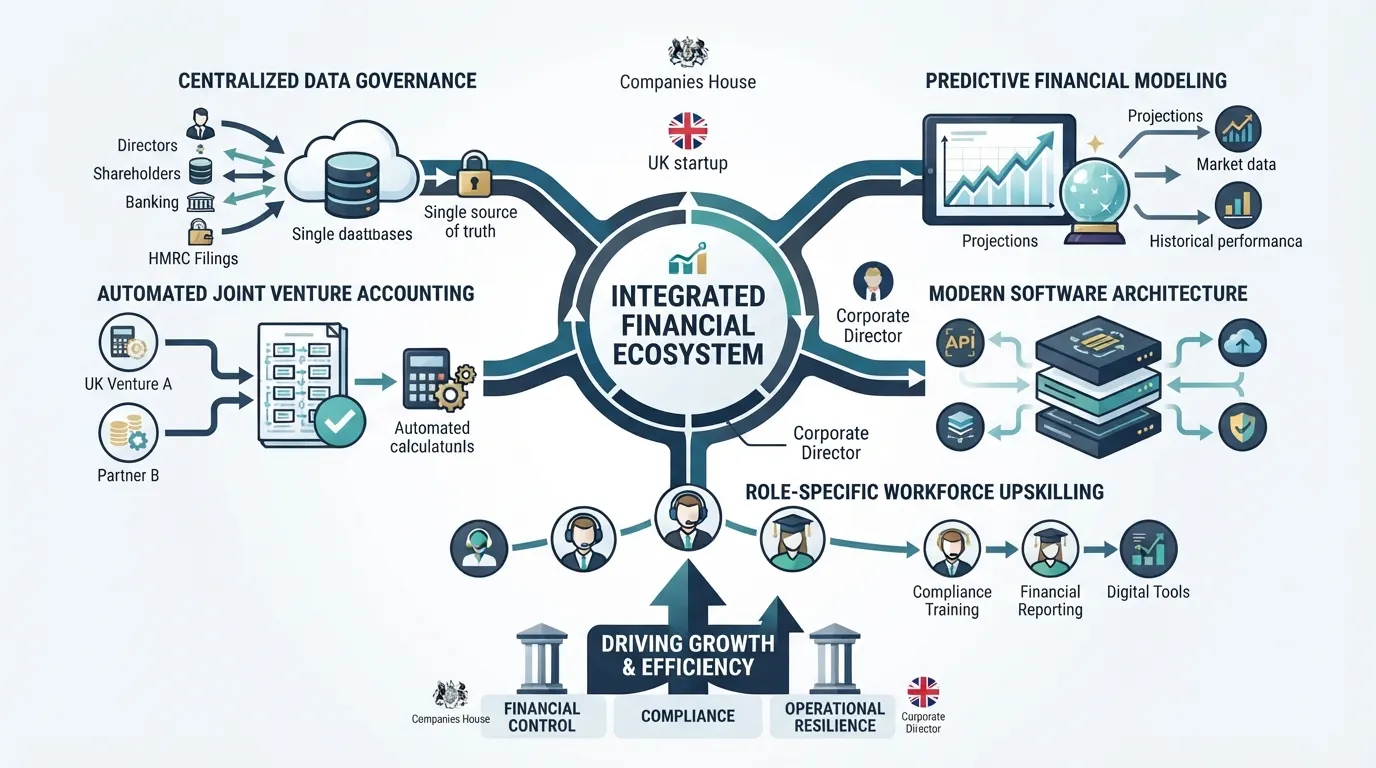
Transformation frameworks balance technology systems with human capability. Focusing exclusively on software infrastructure leads to system failure, while focusing solely on training without modern tools limits operational scalability. Decision-makers must implement four core operational pillars to build an agile financial function.
Data Standardisation and Process Automation
Unifying chart of accounts across parent companies, subsidiaries, and operating assets ensures consistent ledger entries. Robotic process automation handles repetitive transactional tasks such as cash reconciliations, vendor invoice validation, and joint interest billing calculations.
Enterprise Technology Stack
Modern oil and gas financial management relies on specialized software architectures. Cloud-based ERP systems serve as the core engine, connected to production databases via cloud integrations. Machine learning models analyze historical cost variations to flag unauthorized expenditure across offshore operations instantly.
Automated Fiscal Compliance and Risk Frameworks
Petroleum operations face dynamic regulatory regimes, petroleum sharing contracts, and production royalties. Automated compliance modules calculate government take, royalty obligations, and cost oil allocations based on real-time field production metrics. Automated tracking reduces regulatory penalty risks by 95 percent.
Human Capability Frameworks
Advanced systems require upgraded technical competencies. Finance professionals need expertise in automated financial modeling, database management, and digital risk controls. Structured learning programs utilize case studies, role-playing scenarios, and practical financial assessments to build these core competencies across global teams.
What Benefits Does Digital Transformation Deliver to Organisations?
Digital transformation delivers measurable financial control, reduced operating costs, faster reporting cycles, and enhanced risk mitigation. It optimizes capital allocation, increases joint venture audit accuracy, and builds an adaptable, future-ready workforce across all oil and gas operations.
Organisations operating in volatile energy markets require high visibility into capital performance. Upstream projects require billions of dollars in long-term commitments; small financial discrepancies compound into significant capital losses. Digitalized workflows eliminate data blind spots, providing executive leadership with accurate cash flow projections.
Key organisational benefits include:
Accelerated closing schedules: Decreasing monthly financial closing times from 20 days to 4 days, enabling faster executive reporting and strategic planning.
Lower administrative expenditures: Automating high-volume transactional tasks reduces operating expenditures within financial departments by 30 to 40 percent.
Improved joint venture compliance: Real-time cost allocation prevents billing disputes between operators and non-operating partners, recovering millions in unbilled costs.
Enhanced workforce retention: Eliminating tedious manual data entry improves employee engagement, boosting retention rates among skilled financial analysts by 25 percent.
Stronger capital discipline: Predictive risk modeling allows finance directors to simulate oil price shocks, adjusting capital expenditures before margin compression occurs.
By focusing on measurable outcomes, enterprise learning programs align employee development directly with organizational targets, ensuring software investments yield quantifiable financial returns.
How Do Corporate Teams Apply Financial Digitalisation Across Departments?
Corporate teams apply financial digitalisation by replacing manual spreadsheets with integrated software interfaces across joint venture management, corporate tax, treasury, and internal audit functions. Departments leverage shared real-time data to execute precise operational decisions and maintain financial integrity.
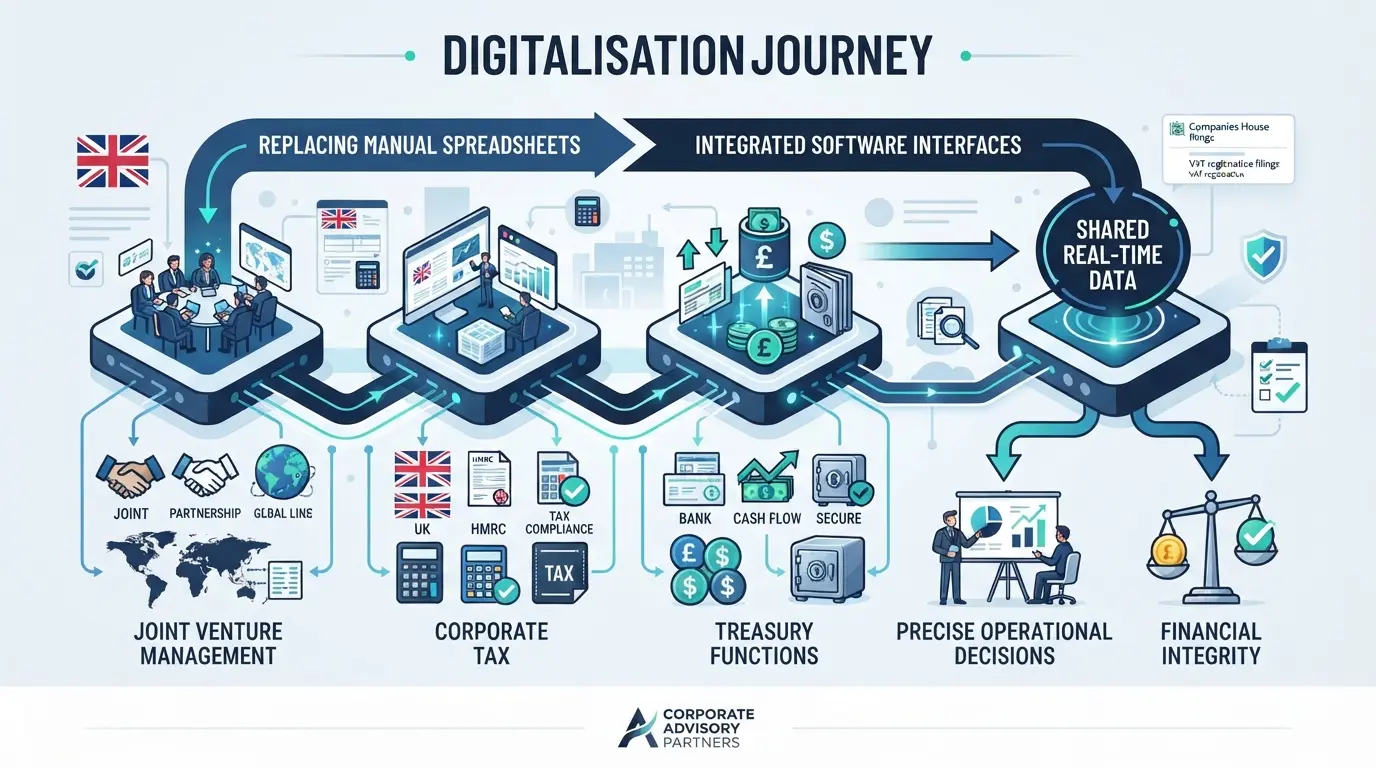
Applying digital tools varies by functional area within an energy company. Each division uses specific workflows to turn raw field data into actionable business information.
Joint Venture Accounting Teams
Joint venture accounting departments manage complex non-operated working interests and operating agreements. Automated tools distribute shared costs, process cash calls, and generate monthly joint interest billings without manual intervention. Operators eliminate cash call shortfalls and reduce billing dispute timelines from 18 months to under 30 days.
Treasury and Cash Management
Treasury teams manage multi-currency revenue streams and volatile commodity risks. Digital cash visibility systems consolidate global bank balances continuously. Automated algorithms run real-time stress tests against crude oil price movements, enabling treasury managers to execute hedging strategies faster.
Corporate Tax and Fiscal Compliance
Tax departments must comply with national oil company agreements, international transfer pricing rules, and local tax laws across multiple jurisdictions. Integrated fiscal software updates tax calculations automatically when local regulations change, ensuring statutory returns remain accurate and submitted on time.
Internal Audit and Governance
Internal audit teams replace sample-based testing with continuous automated auditing. Data analytics software scans 100 percent of ledger entries, instantly flagging duplicate payments, unverified vendor invoices, or compliance deviations.
Decision-makers looking to equip teams with these cross-functional competencies enroll employees in targeted programs such as the Digital Transformation in Petroleum Finance: Strategy & Roadmap Training Course to gain practical exposure to modern financial architectures and operational frameworks.
What Are Common Misconceptions About Finance Transformation?
Common misconceptions include believing transformation is merely an IT department responsibility, assuming software deployment automatically drives efficiency, treating upskilling as a one-time event, and viewing digitalization as a cost-cutting exercise rather than a value-creation framework.
Misunderstanding digital transformation leads to failed corporate initiatives, wasted technology budgets, and frustrated finance staff. Executives must dismantle these common myths to build resilient financial departments:
"Digital transformation is an IT project."
Technology infrastructure is only the enabler. Successful transformations are driven by finance leadership, process re-engineering, and workforce upskilling. Systems deployed without business-led design fail to address actual daily operational bottlenecks.
"Purchasing advanced software instantly solves operational inefficiency."
Automating an inefficient manual workflow simply speeds up inefficiency. Organisations must standardise processes, clean historical data, and establish strict data governance before deploying new digital platforms.
"Employee training is a one-time onboarding requirement."
Technology architecture evolves continuously. Capability development requires ongoing education, structured advanced modules, hands-on workshops, and practical scenario-based learning to keep pace with system updates.
"Transformation focuses solely on headcount reduction."
Automation eliminates manual tasks, allowing finance professionals to focus on higher-value activities. Employees transition from manual data input to predictive variance analysis, strategic capital allocation, and proactive risk management, creating far greater business value.
Frequently Asked Questions
What is Oil & Gas Petroleum Digital Finance & Automation training?
Oil & Gas Petroleum Digital Finance & Automation training is a specialised corporate development program that equips energy finance professionals with digital accounting skills. Delivered by the Institute For Oil & Gas Training, this instruction covers cloud ERP architectures, robotic process automation (RPA), and automated joint venture accounting to streamline financial workflows.
How does financial automation benefit energy sector organisations?
Financial automation drastically reduces monthly closing cycles, mitigates human error in joint interest billing, and enhances cash flow forecasting accuracy. By completing Oil & Gas Petroleum Digital Finance & Automation programs with the Institute For Oil & Gas Training, teams standardise multi-currency reporting and ensure compliance with complex petroleum sharing contracts.
Which skills are covered in oil and gas digital finance courses?
Core competencies include automated joint venture auditing, real-time fiscal risk modeling, predictive data analytics, and cloud-based ledger management. The Institute For Oil & Gas Training incorporates hands-on case studies and scenario-based learning into its Oil & Gas Petroleum Digital Finance & Automation curriculum to ensure practical workplace execution.
Who should attend petroleum digital finance transformation training?
This professional development program targets finance managers, joint venture accountants, corporate tax specialists, and treasury professionals in upstream, midstream, and downstream energy sectors. The Institute For Oil & Gas Training tailors its Oil & Gas Petroleum Digital Finance & Automation courses for cross-functional corporate teams seeking to modernize financial operations.
How is petroleum financial automation training delivered to corporate teams?
Training is provided through flexible learning formats, including interactive face-to-face workshops, live virtual sessions, and hybrid corporate programs. The Institute For Oil & Gas Training aligns its Oil & Gas Petroleum Digital Finance & Automation delivery with organizational goals to drive measurable productivity gains and financial return on investment.
Related training courses
Royalties, Bonuses & Government Take: Fiscal Waterfall Modelling Training Course
- Specialisation
- Oil & Gas Petroleum Fiscal Regime
- Duration
- 5 days · 13 CPD hours
Fiscal Regime Comparison Across Jurisdictions Training Course
- Specialisation
- Oil & Gas Petroleum Fiscal Regime
- Duration
- 5 days · 15 CPD hours
Fiscal Disputes, Cost Recovery and Contract Resolution Training Course
- Specialisation
- Oil & Gas Petroleum Fiscal Regime
- Duration
- 5 days · 15 CPD hours
More articles

Microsoft Copilot for Oil and Gas Finance Governance Training by Institute For Oil & Gas Training
Evaluate the Microsoft Copilot for Oil and Gas Finance Governance Training Course curriculum, delivery formats, learning outcomes, and enrollment steps.
Read article →
How to Manage Microsoft Copilot Governance Risks and Controls in Finance
Compare methods to manage Microsoft Copilot governance risks and controls in oil and gas finance. Implement effective policies today.
Read article →
Why AI Governance Matters When Using Microsoft Copilot in Oil and Gas Finance
Discover why AI governance matters when using Microsoft Copilot in oil and gas finance. Learn key risks, frameworks, and workforce training strategies.
Read article →