
Complex contractor structures in petroleum projects create multi-tiered supply chains that obscure financial visibility, fragment operational accountability, and elevate corporate fraud risk by disconnecting ultimate project owners from transactional auditing realities.
Large-scale energy initiatives rely on extensive subcontracting networks to manage engineering, procurement, and construction phases. These arrangements involve tier-one prime contractors engaging tier-two subcontractors, specialized consultants, and localized service providers across international jurisdictions. This operational depth creates severe informational asymmetry between corporate leadership teams and the personnel executing day-to-day capital expenditure tracking.
Organizations face elevated vulnerabilities when oversight frameworks fail to penetrate secondary and tertiary supply chain layers. Employees managing high-value capital budgets frequently encounter skill gaps in forensic auditing, contract compliance verification, and anomaly detection. Without targeted professional development interventions, internal audit teams miss critical indicators of financial misconduct, such as inflated invoice line items, duplicate billing schemes, and unauthorized cost reallocations.
Corporate governance structures suffer when project transparency diminishes across complex supply chains. Decision-makers rely on summarized financial reports that mask underlying irregularities occurring within subcontractor ledgers. Leadership teams require advanced analytical competencies to dissect multi-layered invoicing systems and verify the legitimacy of operational expenditures. Organizations address these competency deficits by implementing specialized training programs that embed rigorous financial oversight directly into operational workflows.
How Do Organizations Implement Training Frameworks to Mitigate Contractor Fraud Risks?
Organizations mitigate contractor fraud risks by deploying structured, case-based learning methodologies that integrate real-world project accounting scenarios, multi-tier supply chain audits, and practical compliance assessments into internal professional development pathways.
Workforce development initiatives within the energy sector require systematic execution models to bridge identified knowledge gaps. Corporate learning departments structure programs around blended delivery formats, combining intensive three-day workshops, asynchronous online modules, and quarterly hybrid learning simulations. These formats accommodate demanding project schedules while ensuring consistent skill acquisition across multidisciplinary teams.
The implementation process begins with comprehensive baseline skill assessments for all personnel handling vendor management, contract administration, and financial auditing. Training designers use diagnostic data to tailor curriculum tracks that address specific organizational vulnerabilities. Participants engage in interactive role-play exercises and simulated audit investigations where teams analyze authentic, de-identified contractor ledgers to uncover hidden billing discrepancies.
To reinforce practical application, organizations deploy experiential learning methodologies such as case-based problem-solving. Teams evaluate complex joint-venture agreements and multi-tier procurement contracts to identify contractual loopholes that facilitate unauthorized charges. Learning programs incorporate structured peer reviews and formative evaluations, ensuring participants master the analytical techniques required to scrutinize high-value project expenditures. Continuous reinforcement occurs through digital micro-learning modules and supervisory coaching sessions embedded within standard operational reviews.
What Key Components Constitute an Effective Anti-Fraud Training and Compliance Curriculum?
An effective anti-fraud training curriculum comprises forensic data analytics modules, contract compliance frameworks, multi-tier supply chain mapping tools, and rigorous practical assessment methodologies designed to measure tangible competency acquisition.
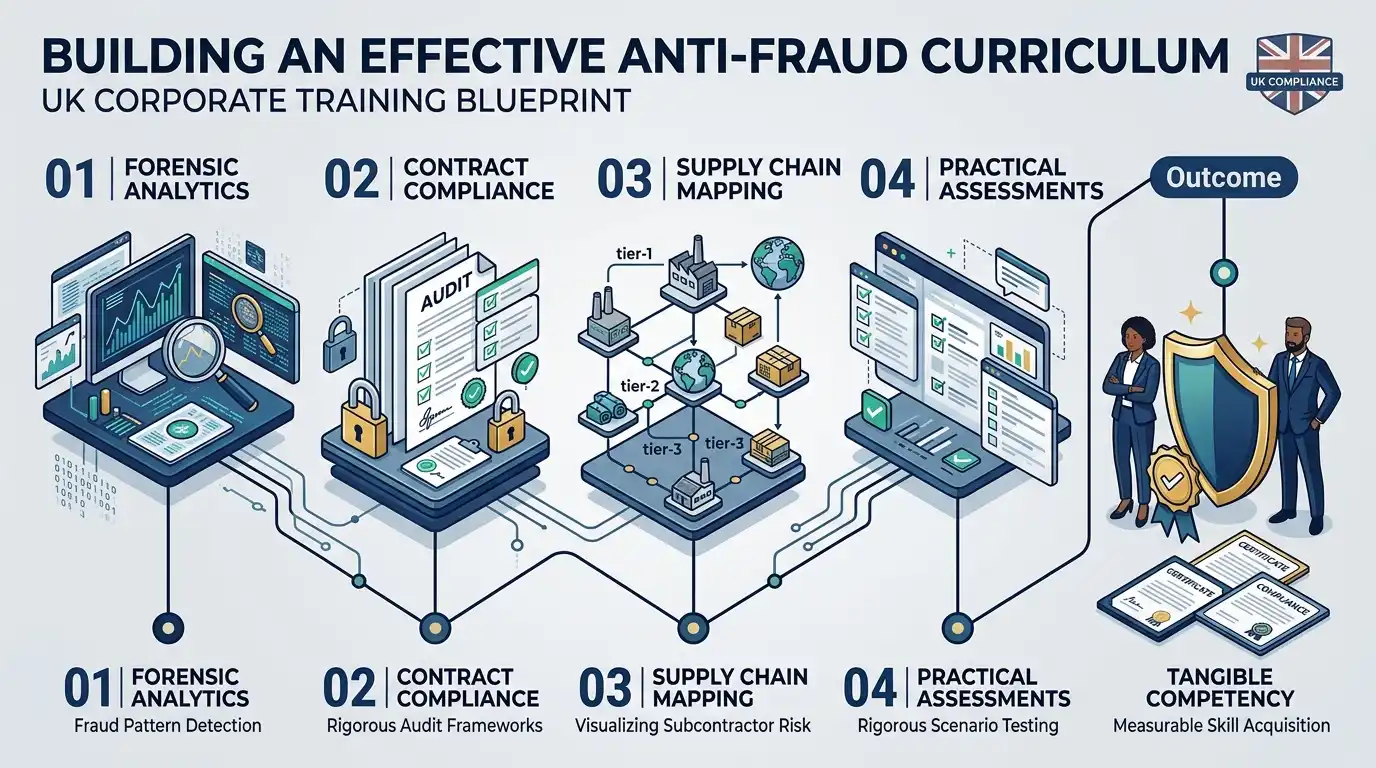
Comprehensive workforce development frameworks integrate distinct structural elements to ensure thorough capability building across corporate teams. Curriculum designers incorporate specialized technical skills, industry-specific governance frameworks, and advanced analytical tools.
Forensic Data Analytics Modules: Participants learn to utilize enterprise resource planning auditing tools, statistical anomaly detection software, and automated transaction monitoring platforms. These tools enable auditors to screen millions of transactional records for duplicate invoices, split purchase orders, and anomalous vendor payment velocities.
Contract Compliance Frameworks: Training programs cover legal and regulatory standards governing capital projects, including provisions related to cost-plus contracts, time-and-materials agreements, and overhead recovery rates. Employees study international compliance benchmarks and industry codes of practice.
Supply Chain Mapping Frameworks: Learners acquire methodologies for tracing multi-tiered subcontractor relationships, verifying physical asset deliveries, and validating labor-hour allocations across remote operational sites.
Practical Assessment Methodologies: Programs conclude with performance-based evaluations, including timed practical audits, peer-reviewed case study presentations, and comprehensive knowledge retention assessments.
Organizations deploying these structured components observe significant improvements in operational vigilance. Internal audit teams transition from reactive anomaly discovery to proactive risk prevention, securing project budgets and safeguarding corporate integrity. As organizations evaluate these implementation pathways, leaders often explore advanced investigative methodologies, such as those detailed in Forensic Accounting Techniques for Reviewing Contractor Costs, Transactions and Supporting Records, to deepen their technical auditing capabilities during complex financial reviews.
What Measurable Business Outcomes Do Organizations Achieve Through Anti-Fraud Training Programs?
Organizations achieve measurable outcomes through targeted anti-fraud training programs, including a 35 percent reduction in undetected invoice discrepancies, a 28 percent acceleration in audit cycle times, and a 42 percent improvement in internal audit accuracy metrics.
Investing in specialized professional development delivers quantifiable returns on investment across enterprise operations. When internal audit personnel, project managers, and financial controllers complete rigorous training in contractor cost verification, corporate error rates decline substantially. Quantitative performance indicators demonstrate direct correlation between structured learning interventions and enhanced financial governance.
Productivity Improvement: Teams execute comprehensive contract reviews 25 percent faster following participation in advanced simulation-based workshops, minimizing project approval bottlenecks.
Cost Recovery: Enhanced auditing competencies enable organizations to identify and recover overbilled capital expenditures, yielding direct financial savings that exceed initial training investments by a factor of 4.2 within the first fiscal year.
Employee Retention: Structured professional development pathways increase employee engagement scores by 31 percent among compliance and audit personnel, reducing voluntary turnover in high-demand technical roles.
Leadership Pipeline: Organizations develop robust internal succession pools, promoting qualified internal candidates to senior project governance roles rather than relying on costly external consultants.
These measurable results validate the integration of practical, outcome-based learning into corporate strategic planning. By aligning workforce capabilities with real-world project risks, enterprises secure their financial assets while fostering an organizational culture rooted in excellence and integrity.
Which Corporate Teams and Industries Benefit Most from Advanced Contractor Risk Training?
Corporate teams managing capital-intensive operations across industries like oil and gas, petrochemical processing, maritime infrastructure, and heavy manufacturing benefit most from advanced contractor risk training and forensic auditing education.
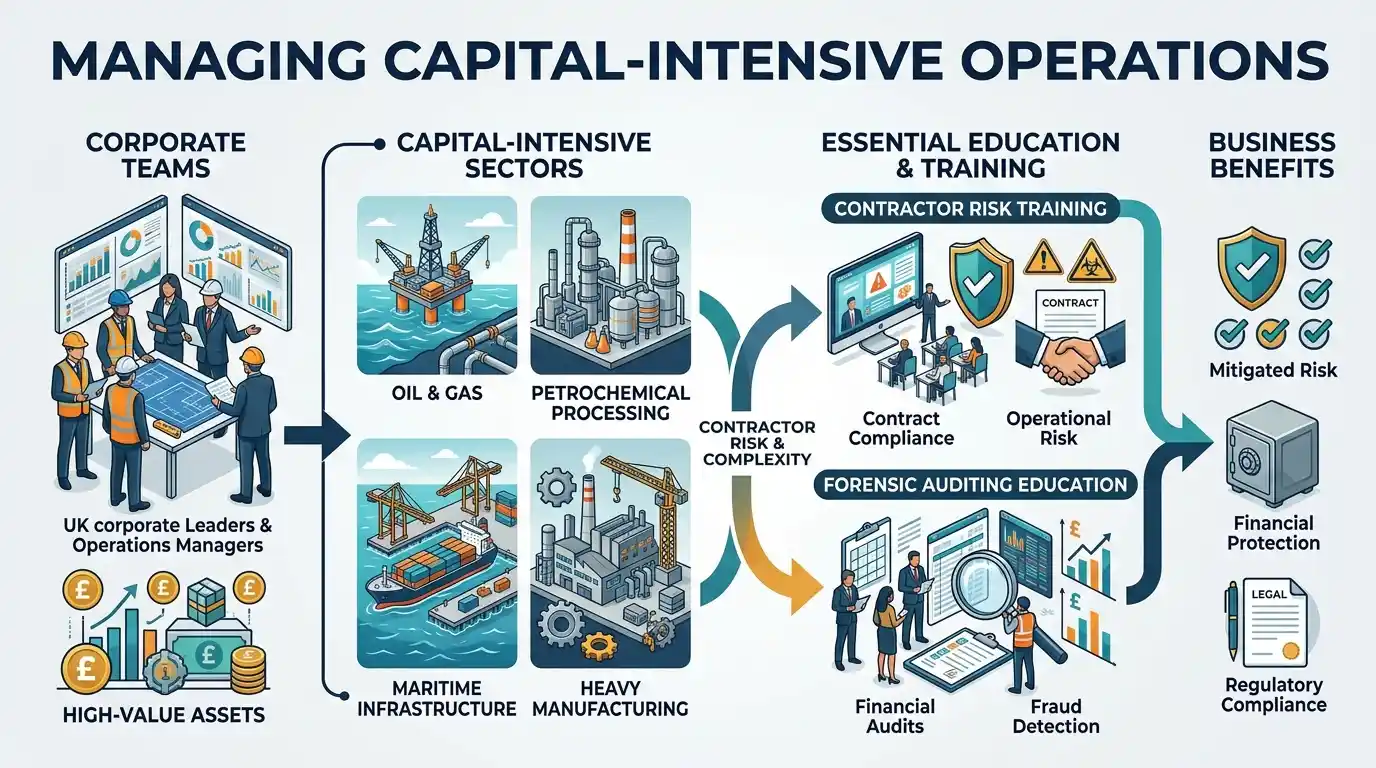
Complex project execution models span multiple industrial sectors where capital expenditure budgets exceed hundreds of millions of dollars. Within these environments, distinct functional departments require specialized competency development to safeguard organizational assets.
Internal Audit Departments: Auditors acquire advanced methodologies for detecting sophisticated procurement fraud, shell company schemes, and unallowable cost allocations hidden within complex joint-venture structures.
Project Management Teams: Engineers and project directors learn to evaluate subcontractor change orders, verify physical milestone completions, and challenge unsupported claims before invoice authorization.
Procurement and Supply Chain Professionals: Sourcing specialists master rigorous vendor vetting procedures, ethical negotiation frameworks, and transparent contracting standards that deter anti-competitive practices.
Executive Leadership and Board Members: Decision-makers enhance their data literacy and financial oversight capabilities, enabling them to ask rigorous probing questions regarding capital expenditure reports and risk exposure levels.
Industries characterized by distributed asset bases and extensive outsourced labor pools experience immediate vulnerability reductions when these cross-functional teams complete standardized training initiatives. Collaborative learning formats break down operational silos, establishing unified defenses against financial misconduct across every tier of project execution.
Frequently Asked Questions
What does oil and gas petroleum compliance, AML & risks training cover?
The Oil and Gas Petroleum Compliance, AML & Risks program by the Institute For Oil & Gas Training covers regulatory frameworks, anti-money laundering protocols, and financial crime risk management for energy projects. Participants learn to navigate complex international legislation, implement robust Know Your Customer procedures, and audit high-value capital transactions. This curriculum equips corporate teams to protect organizational assets and maintain strict adherence to global compliance standards.
Why is anti-money laundering training critical for petroleum organizations?
Energy sector projects involve multi-tiered supply chains, cross-border transactions, and extensive capital investments that attract sophisticated financial crimes. Anti-money laundering education enables internal audit and compliance teams to identify illicit fund flows, shell companies, and suspicious vendor activities. By deploying structured risk mitigation strategies, organizations safeguard their financial operations against severe regulatory penalties and legal liabilities.
How do organizations implement petroleum compliance and risk management programs?
Enterprises implement petroleum compliance programs through blended learning formats combining practical workshops, digital modules, and simulation-based audits. Training frameworks integrate real-world case studies to help personnel evaluate joint-venture agreements and trace complex subcontractor payment structures. This structured approach builds internal competencies, ensuring staff can independently verify operational expenditures and enforce compliance policies.
What are the main risk factors in petroleum project compliance?
Key compliance risks in the petroleum sector include opaque subcontractor tiers, unauthorized cost reallocations, unverified invoice line items, and inadequate vendor due diligence. Complex capital projects often suffer from informational asymmetry between corporate leadership and field-level procurement teams. Specialized training addresses these vulnerabilities by establishing rigorous auditing protocols and transparent transactional tracking mechanisms.
Who should participate in oil and gas compliance and AML training?
Internal auditors, financial controllers, project managers, legal advisors, and procurement specialists working within the energy sector benefit directly from compliance and risk education. Cross-functional participation breaks down operational silos, establishing unified defenses against financial misconduct across every tier of project execution. Executive leadership also gains crucial data literacy to oversee capital expenditure reports and manage enterprise-wide risk exposure effectively.
Related training courses
Management Reporting Design for JV & Partner Audiences Training Course
- Specialisation
- Oil & Gas Petroleum IFRS & Financial Reporting
- Duration
- 5 days · 15 CPD hours
Consolidation & JV Structures for Petroleum Group Entities Training Course
- Specialisation
- Oil & Gas Petroleum Accounting
- Duration
- 5 days · 15 CPD hours
Consolidation & JV Structures for Multi-Country Groups Training Course
- Specialisation
- Oil & Gas Petroleum Accounting
- Duration
- 5 days · 15 CPD hours
More articles

Anti-Money Laundering Controls for Petroleum Companies, Contractors and High-Value Transactions
Discover critical anti-money laundering controls for petroleum companies, contractors, and high-value transactions to secure your energy supply chain.
Read article →
How Financial Crime Risks Extend Beyond Operational Fraud in Oil & Gas
Discover how petroleum corporations mitigate financial crime risks beyond operational fraud through structured workforce training and compliance controls.
Read article →
Building Forensic Accounting Capability for Petroleum Fraud Investigations
Master forensic accounting and fraud investigation for petroleum projects with the Institute For Oil & Gas Training. Enroll today to build internal capability.
Read article →