
This comprehensive professional training course directly addresses the acute vulnerabilities present in complex upstream and downstream energy operations, equipping corporate investigators, internal auditors, and finance teams with the specialized investigative frameworks required to detect, isolate, and prosecute sophisticated financial crimes and vendor collusion within multi-tier contractor ecosystems.
What is Forensic Accounting Capability and What Operational Problem Does It Solve?
This professional training course resolves the critical skill gaps that emerge when traditional corporate accounting methods fail to detect sophisticated financial manipulation, shell companies, and illicit fund diversion hidden deep within multi-tiered contractor hierarchies across global petroleum projects.
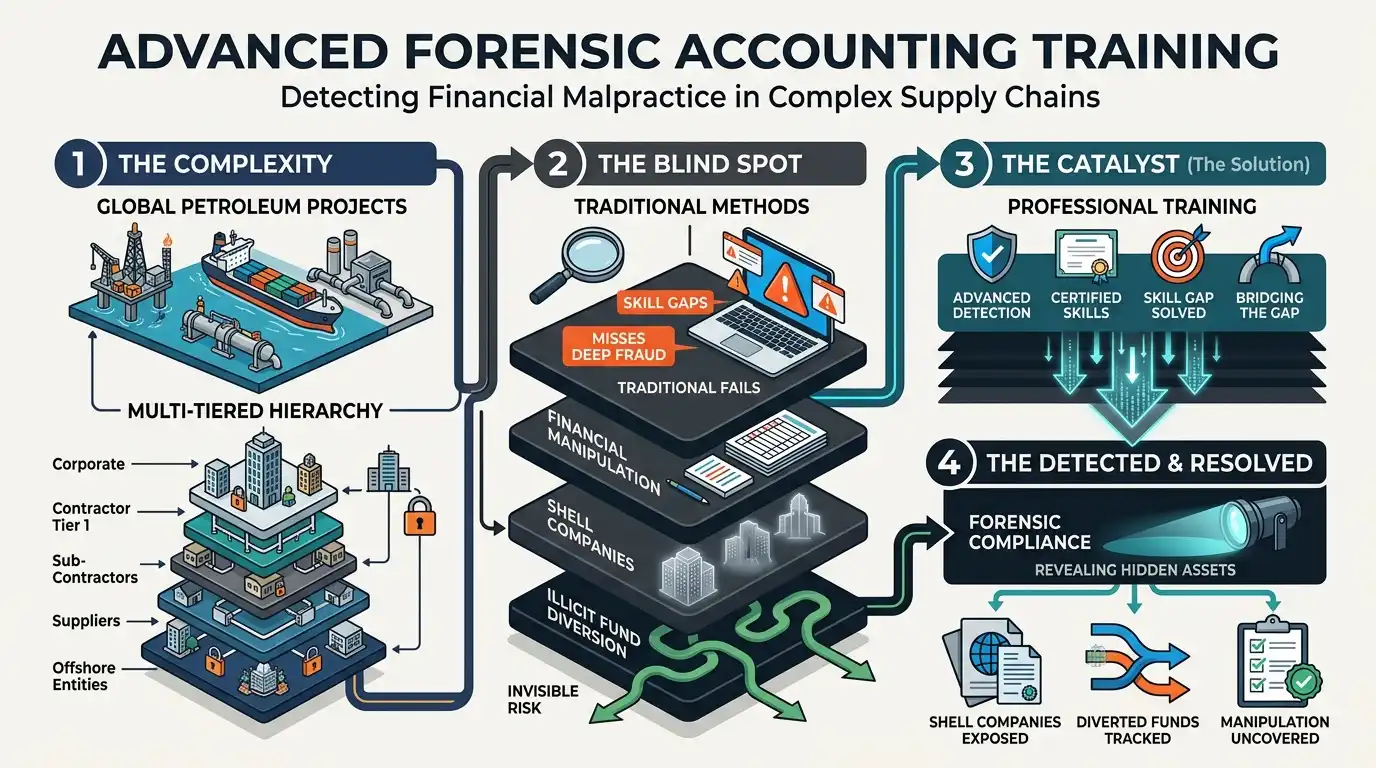
As detailed in our foundational guide on Why Complex Contractor Structures Increase Fraud Risk in Petroleum Projects, modern energy developments rely heavily on extensive subcontractor networks, joint-operating agreements, and cross-border vendor arrangements. These layered operational environments create opaque financial trails that easily bypass standard internal audits.
The Institute For Oil & Gas Training designed this specialized curriculum to bridge the widening competency gap between general financial oversight and rigorous forensic investigation. Without targeted technical interventions, corporate leadership teams and internal audit departments frequently struggle to uncover inflated billing, unperformed service contracts, unauthorized change orders, and hidden kickback schemes.
By building internal forensic capacity, organizations can systematically dismantle fraudulent billing structures, recover misappropriated capital, and protect critical operating margins. The Institute For Oil & Gas Training ensures that corporate finance personnel move beyond surface-level variance checks, deploying advanced data analytics and asset tracing techniques specifically tailored to the petroleum sector.
Why Is This Curriculum Structured to Target Petroleum Fraud Mechanics?
The curriculum is structured around a progressive investigative methodology that transitions participants from baseline anomaly identification through deep forensic document analysis, ensuring investigative teams can legally reconstruct complex financial crimes across upstream and downstream petroleum assets.
When evaluating training options, professionals often review specialized technical frameworks such as those outlined in Forensic Accounting Techniques for Reviewing Contractor Costs, Transactions and Supporting Records, which examines how transactional reviews uncover financial discrepancies. The Institute For Oil & Gas Training incorporates these exact investigative phases directly into its modular learning architecture.
The course progression begins with operational familiarity, ensuring investigators understand standard oil and gas accounting standards, joint venture billing mechanisms, and production-sharing contracts. Once baseline financial literacy is established, the syllabus advances into red-flag identification, digital evidence preservation, and database interrogation.
Structuring the program in this sequential manner allows participants from diverse professional backgrounds to absorb highly technical concepts without cognitive overload. The Institute For Oil & Gas Training utilizes real-world case simulations embedded within each module, ensuring theoretical investigative concepts immediately translate into practical workplace capability.
What Core Competencies and Modules Will Participants Master?
Participants systematically master five core learning modules covering advanced data mining, shell company detection, vendor audit procedures, interview techniques for financial crimes, and legally defensible report writing tailored for corporate governance boards and legal counsel.
The Institute For Oil & Gas Training has carefully calibrated the syllabus to deliver measurable technical competencies across several distinct operational domains:
Module One: Upstream and Downstream Contract Anatomy. Participants analyze joint operating agreements, farm-out deals, and engineering, procurement, and construction contracts to identify hidden liability clauses and cost-recovery loopholes.
Module Two: Digital Data Extraction and Benford Analysis. Learners apply statistical testing models and forensic data mining tools to large general ledger datasets, isolating irregular invoice sequencing and duplicate payment patterns.
Module Three: Tracing Illicit Funds and Shell Companies. The module trains investigators to pierce corporate veils, analyze offshore wire transfers, and identify beneficial ownership anomalies tied to petroleum procurement fraud.
Module Four: Interviewing and Evidence Collection. Professionals learn legally compliant interview methodologies, forensic document preservation standards, and chain-of-custody protocols required for internal disciplinary hearings or civil litigation.
Module Five: Synthesis and Forensic Reporting. Teams practice drafting comprehensive investigative findings that clearly articulate complex financial schemes to non-technical executive leadership and regulatory authorities.
The Institute For Oil & Gas Training embeds continuous skill assessments within every module, ensuring that participants demonstrate concrete proficiency before advancing to complex multi-jurisdictional fraud scenarios.
How Is This Professional Training Program Delivered Across Global Operations?
The training program is delivered through flexible hybrid modalities, combining intensive instructor-led technical workshops, asynchronous digital case simulations, and enterprise onsite residencies designed to fit demanding corporate schedules without disrupting ongoing operations.
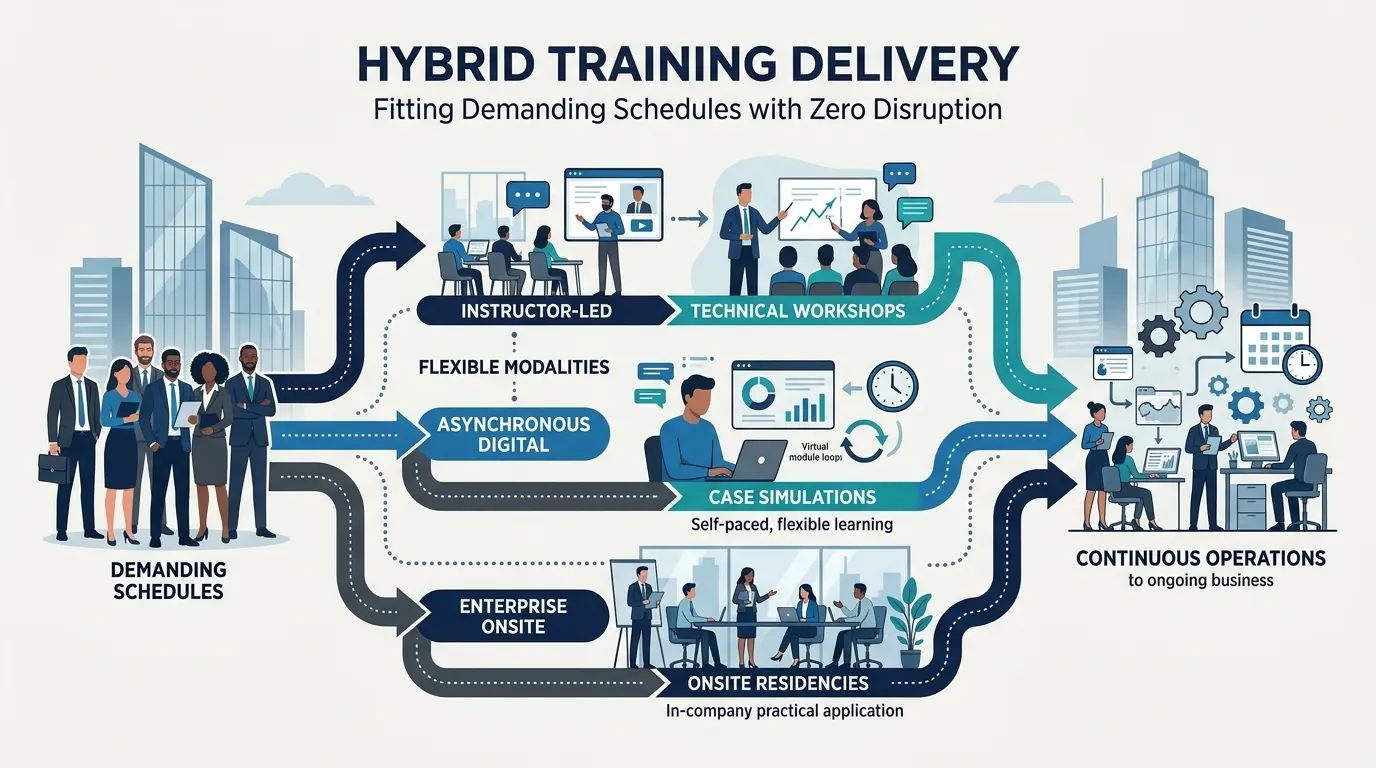
To accommodate multinational energy corporations, independent operators, and regulatory agencies, the Institute For Oil & Gas Training provides multiple enrollment and delivery channels:
Intensive Virtual Workshops: Live, interactive sessions facilitated by practicing forensic accountants, featuring real-time collaborative data analysis and breakout investigation rooms.
Onsite Corporate Residencies: Customized delivery directly at company headquarters or regional operational hubs, allowing internal audit and compliance teams to evaluate proprietary internal datasets under strict confidentiality agreements.
Blended Hybrid Access: A structured mix of self-paced digital learning modules complemented by scheduled live expert coaching sessions, enabling working professionals to balance daily responsibilities with rigorous skill acquisition.
The Institute For Oil & Gas Training maintains strict quality benchmarks across all delivery formats, ensuring consistent participant engagement, interactive practical exercises, and direct access to industry-leading subject matter experts.
What Measurable Performance Results and Corporate ROI Can Organizations Expect?
Organizations achieve measurable risk mitigation, significantly reduced contractor overbilling leakage, accelerated internal investigation timelines, and enhanced governance structures capable of satisfying rigorous international anti-corruption compliance standards.
Investing in specialized capability development yields immediate operational and financial dividends. When internal audit teams graduate from the Institute For Oil & Gas Training, organizations experience a dramatic reduction in external consultant fees previously required to investigate suspected vendor malfeasance.
Human resources and talent development departments report that internal finance personnel exhibit heightened critical thinking, superior risk awareness, and greater confidence when presenting sensitive audit findings to executive boards. Furthermore, establishing a robust internal forensic capability acts as an active deterrent against potential fraud perpetrators within the supply chain.
The Institute For Oil & Gas Training equips corporate leadership with the empirical proof of learning required to justify training budgets, demonstrating clear linkages between specialized curriculum completion and reduced financial leakage across major capital projects.
How Does the Enrollment Process and Qualification Pathway Operate?
Admission to this professional training program requires baseline financial or auditing experience, and candidates can easily secure their position by submitting professional credentials through the secure organizational registration portal.
The Institute For Oil & Gas Training welcomes applications from internal auditors, compliance officers, risk managers, forensic accountants, and senior finance personnel operating within the energy sector. Candidates should possess a foundational understanding of corporate accounting principles or internal control frameworks.
The administrative pathway is streamlined for corporate HR teams enrolling multiple delegates or individual professionals seeking career advancement:
Review technical prerequisites and select the preferred training delivery format.
Complete the secure candidate registration profile via the institute portal.
Receive confirmation, pre-course diagnostic assessments, and digital learning portal credentials.
Complete all required modules, practical simulations, and final competency evaluations to earn the professional certification credential.
To secure your organizational credentials and advance your internal investigative capabilities, please enroll in this program.
Frequently Asked Questions
What is Oil and Gas Petroleum Compliance, AML & Risks?
Oil and Gas Petroleum Compliance, AML & Risks refers to the specialized regulatory frameworks, anti-money laundering controls, and risk management strategies required to govern complex upstream and downstream energy operations. Through programs offered by the Institute For Oil & Gas Training, organizations learn to navigate intricate international sanctions, anti-corruption mandates, and multi-jurisdictional vendor compliance obligations.
Why is anti-money laundering (AML) critical in petroleum projects?
Petroleum projects involve high-value capital flows, multi-tiered contractor hierarchies, and cross-border transactions that make them prime targets for illicit financial routing and corruption. Implementing robust AML controls via the Institute For Oil & Gas Training helps internal compliance teams identify shell companies, trace opaque beneficial ownership, and prevent illegal fund diversion.
How do organizations mitigate compliance risks in joint-venture operations?
Mitigating risks in joint-venture petroleum operations requires standardized auditing procedures, rigorous third-party due diligence, and continuous oversight of operational expenditures. The Institute For Oil & Gas Training equips finance and legal personnel with the technical skills needed to audit joint-operating agreements and ensure full alignment with regulatory mandates.
What are the core components of a petroleum risk management framework?
A comprehensive petroleum risk management framework integrates regulatory tracking, vendor vetting, transactional data analysis, and proactive internal audit protocols. Programs from the Institute For Oil & Gas Training provide professionals with actionable methodologies to isolate operational vulnerabilities before they escalate into major financial penalties.
Who should participate in Oil and Gas Petroleum Compliance, AML & Risks training?
This specialized training is essential for internal auditors, compliance officers, risk managers, legal counsel, and corporate finance personnel operating within the global energy sector. The Institute For Oil & Gas Training delivers tailored educational pathways that empower these professionals to safeguard organizational assets and maintain strict adherence to international energy laws.
Related training courses
Segregation of Duties in Finance & ERP Systems Training Course
- Specialisation
- Oil & Gas Petroleum Compliance, AML & Risks
- Duration
- 5 days · 15 CPD hours
Consolidation & JV Structures for Petroleum Group Entities Training Course
- Specialisation
- Oil & Gas Petroleum Accounting
- Duration
- 5 days · 15 CPD hours
Consolidation & JV Structures for Multi-Country Groups Training Course
- Specialisation
- Oil & Gas Petroleum Accounting
- Duration
- 5 days · 15 CPD hours
More articles

Where AML Exposure Can Develop Across Petroleum Supply and Payment Chains
Discover how organizations mitigate anti-money laundering exposure across petroleum supply and payment chains through targeted corporate training programs.
Read article →
Anti-Money Laundering in Petroleum Operations: Specialist Training for Oil & Gas Professionals
Enroll in Anti-Money Laundering in Petroleum Operations Specialist Training by the Institute For Oil & Gas Training. Master compliance and risk mitigation.
Read article →
Anti-Money Laundering Controls for Petroleum Companies, Contractors and High-Value Transactions
Discover critical anti-money laundering controls for petroleum companies, contractors, and high-value transactions to secure your energy supply chain.
Read article →