
Financial crime risks in petroleum corporations extend far beyond operational fraud into complex money laundering schemes, sanctions evasion, trade misinvoicing, and high-value vendor corruption that compromise global supply chains and trigger severe regulatory penalties.
Oil and gas enterprises operate within complex geopolitical environments characterized by multi-jurisdictional transactions, state-owned enterprise interactions, and massive capital expenditures. Traditional risk management frameworks frequently isolate financial crime as internal embezzlement or procurement theft. This narrow focus ignores systemic vulnerabilities tied to international supply chains.
Petroleum organizations engage upstream exploration companies, midstream pipeline operators, and downstream refining contractors across high-risk territories. These relationships create exposure to illicit financial flows. Shell companies obscure the ultimate beneficial owners of joint ventures. Complex chartering agreements disguise illicit cargo transfers. High-value transactions involving engineering, procurement, and construction contracts generate opportunities for sophisticated bribe payments disguised as legitimate consulting fees.
Organizations combat these vulnerabilities through structured corporate training and professional development initiatives. L&D professionals deploy comprehensive anti-money laundering and compliance programs designed to educate commercial teams, legal counsels, and procurement officers on identifying red flags. Workforce education bridges the gap between regulatory mandates and daily operational decisions.
What structural mechanisms drive anti-money laundering controls across petroleum contractors and high-value transactions?
Anti-money laundering controls operate through rigorous customer due diligence, beneficial ownership verification, transaction monitoring algorithms, and mandatory staff training protocols implemented across every tier of the petroleum supply chain.
Implementing effective financial crime prevention requires systematic organizational workflows. Human resources and compliance departments collaborate to establish baseline knowledge across all operational units. Employees across commercial, legal, and financial departments undergo structured training that details the mechanics of trade-based money laundering and sanctions violations.
The implementation process follows a distinct multi-stage architecture:
Risk Assessment and Gap Analysis: Organizations evaluate existing exposure levels by auditing historical vendor payments, joint venture agreements, and high-value capital expenditures across active operational territories.
Curriculum Design and Customization: Learning and development teams design role-specific learning paths. Procurement specialists receive modules on vendor screening, while executive leadership studies governance obligations and director liabilities.
Multi-Format Training Delivery: Companies deploy blended learning models combining interactive workshops, simulation exercises based on historical corruption cases, and online digital modules completed across 4-week onboarding cycles.
Competency Assessment and Certification: Participants complete practical scenario assessments requiring the identification of suspicious transaction patterns, achieving a minimum passing score of 85% to validate proficiency.
Continuous Monitoring and Refresher Training: Organizations mandate annual refresher courses alongside real-time updates when international regulatory bodies issue new enforcement advisories or sanctions lists.
This systematic approach transforms abstract legal requirements into actionable operational behaviors. When petroleum contractors understand the precise mechanisms of illicit financial flows, risk detection rates increase significantly. Organizations that evaluate their training frameworks often discover that integrated learning models reduce compliance breaches by 35% within the first operational year.
Which core components, frameworks, and delivery formats constitute an effective corporate compliance curriculum?
Effective corporate compliance curricula incorporate regulatory frameworks like the Financial Action Task Force standards, practical case studies, interactive simulations, and multi-channel delivery formats tailored to distinct organizational roles.
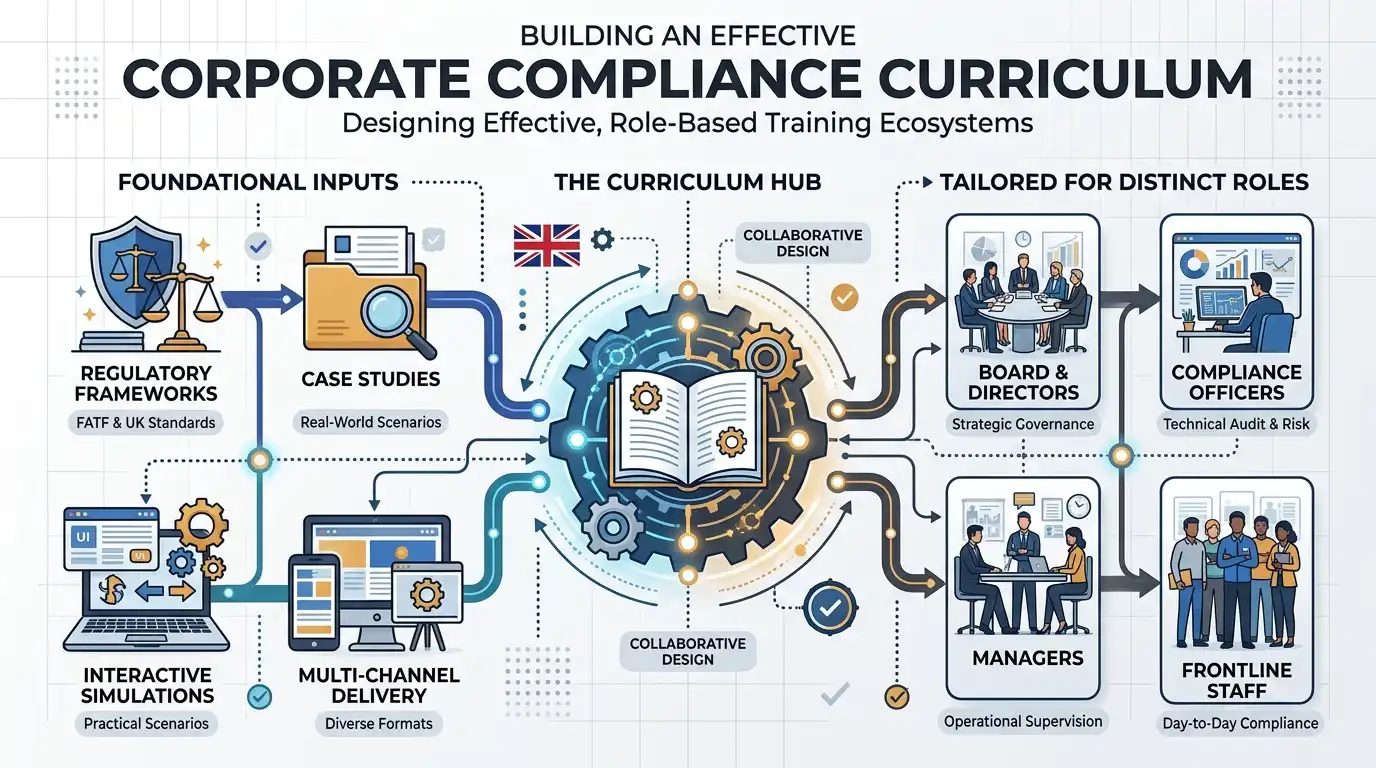
Constructing an impactful professional development program demands precise architectural components. Training programs must move beyond passive video lectures to incorporate active learning methodologies that mirror real-world decision-making pressures.
Regulatory Frameworks: Programs integrate global standards established by the Financial Action Task Force, the UK Bribery Act, and the Foreign Corrupt Practices Act. Learners dissect jurisdictional overlap and extraterritorial enforcement mechanisms.
Delivery Formats: Organizations utilize hybrid learning ecosystems. Instructor-led workshops facilitate complex discussions on geopolitical risk. Online asynchronous modules deliver regulatory updates to remote rig sites and international offices. Microlearning sessions provide 10-minute daily refreshers for high-volume traders.
Learning Methodologies: Case-based learning examines actual enforcement actions against multinational energy firms. Simulations place cross-functional teams in high-pressure negotiation scenarios where they must identify red flags such as abnormally inflated service invoices or opaque ownership structures.
Assessment Metrics: Knowledge retention is measured through pre-training baselines and post-training practical evaluations. Organizations track metrics including completion rates, error identification speeds in mock audits, and subsequent audit compliance scores.
Deploying these components ensures that workforce development directly supports organizational resilience. Teams develop the critical thinking required to challenge anomalous transactions rather than processing documentation mechanically.
What measurable organizational benefits and performance metrics validate investment in financial crime workforce development?
Investment in financial crime workforce development produces measurable organizational benefits including a 40% reduction in compliance audit exceptions, enhanced leadership pipelines, improved cross-functional collaboration, and protection against multi-million-dollar regulatory fines.
Measuring the return on investment for compliance training requires tracking both quantitative performance indicators and qualitative cultural shifts. Executive leadership demands clear data proving that learning initiatives protect corporate assets and optimize operational efficiency.
Metric Category | Performance Indicator | Average Improvement |
Audit & Compliance | Reduction in internal control exceptions | 40% decrease |
Operational Efficiency | Time required to vet new high-value vendors | 25% faster processing |
Talent Retention | Compliance specialist retention rate | 88% annual retention |
Risk Mitigation | Early detection of suspicious payment requests | 3.5x increase in flagged anomalies |
Beyond direct financial metrics, structured training transforms organizational culture. When multidisciplinary teams—comprising legal, procurement, and engineering personnel—participate in collaborative training workshops, communication silos dissolve. Teams establish shared vocabularies for risk identification. Leadership pipelines strengthen as mid-level managers demonstrate advanced risk governance capabilities during complex asset acquisitions.
How do distinct corporate teams, managers, and energy industry sectors apply financial crime risk frameworks?
Energy sector participants—including upstream exploration teams, midstream logistics operators, downstream refiners, and corporate procurement departments—apply financial crime risk frameworks to evaluate high-value vendor contracts and cross-border capital movements.
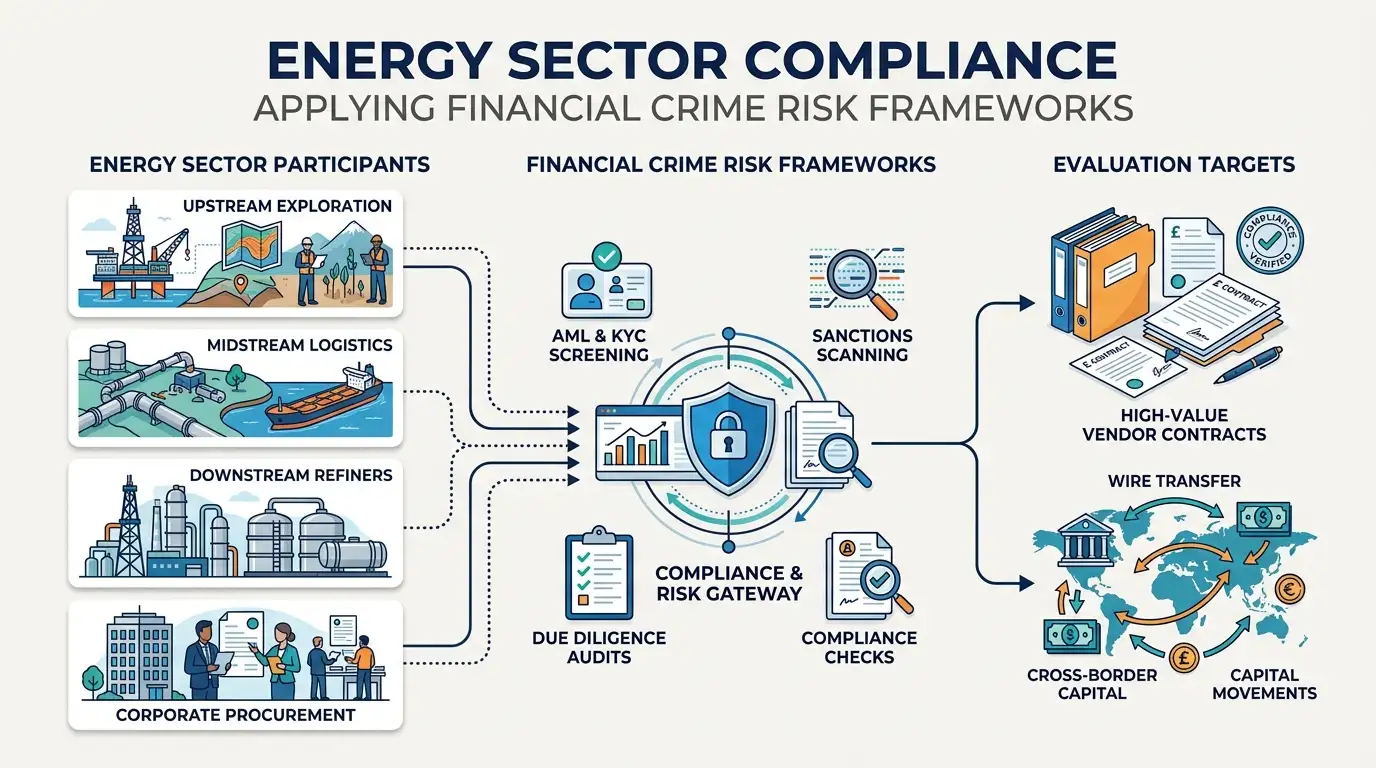
Financial crime risks manifest differently across various segments of the energy value chain. Tailored professional development ensures that specific departments receive training directly relevant to their daily operational environment.
Upstream Exploration Teams: Personnel managing joint operating agreements and production sharing contracts utilize anti-corruption frameworks to vet state-owned enterprise partners and local subcontractors. Training focuses on identifying improper facilitation payments disguised as community development funds.
Midstream Logistics and Shipping Operators: Vessel charterers and pipeline administrators apply trade compliance modules to verify cargo origins, monitor automatic identification system data tampering, and prevent illegal petroleum smuggling operations.
Downstream Refiners and Trading Desks: Commercial traders and supply chain managers analyze crude sourcing documentation, verifying that feedstock purchases comply with international oil price caps and sanctions regimes.
Corporate Procurement Departments: Sourcing managers implement rigorous vendor onboarding protocols, cross-referencing company registries against global beneficial ownership databases to eliminate front companies.
Organizations operating in high-risk jurisdictions require comprehensive workforce preparedness. When every department understands its specific exposure profile, the entire enterprise operates with heightened defensive readiness.
What common problems and misconceptions undermine corporate financial crime training programs?
Ineffective training programs suffer from generic content delivery, tick-the-box compliance mentalities, a lack of measurable performance metrics, and failure to address the nuanced operational realities of petroleum transactions.
Many organizations invest heavily in workforce development yet fail to achieve desired risk mitigation outcomes due to fundamental structural flaws in program design. Recognizing these pitfalls allows L&D professionals to re-engineer their educational offerings.
Generic Content: Programs utilizing off-the-shelf compliance modules that ignore industry-specific challenges fail to engage learners. Energy professionals require case studies addressing maritime chartering and joint venture agreements, not generic retail banking scenarios.
Tick-the-Box Mentality: Treating training as an annual administrative hurdle rather than a continuous developmental process destroys educational impact. Employees memorize answers for compliance quizzes without internalizing risk assessment principles.
Absence of Practical Application: Curricula that rely solely on passive reading or video viewing fail to build operational muscle memory. Without interactive simulations and role-play scenarios, staff cannot translate theoretical rules into real-world decisions.
Disconnected Metrics: Organizations measure training success purely by completion percentages rather than behavioral change, audit accuracy, or risk reduction.
Overcoming these misconceptions requires a commitment to rigorous, practical, and outcome-based professional development. When organizations align their training architectures with actual workplace complexities, workforce capabilities expand.
Frequently Asked Questions
What are the main financial crime risks in the petroleum sector?
Financial crime risks in the petroleum sector extend beyond operational fraud to encompass sophisticated money laundering schemes, sanctions evasion, and trade misinvoicing during multi-jurisdictional transactions. Through specialized professional development programs in Oil and Gas Petroleum Compliance, AML & Risks, the Institute For Oil & Gas Training equips commercial teams with the skills needed to identify illicit financial flows across international supply chains.
How do petroleum companies implement effective anti-money laundering controls?
Petroleum companies implement robust anti-money laundering controls by deploying rigorous customer due diligence, verifying beneficial ownership structures, and monitoring complex transactions across upstream and downstream operations. The Institute For Oil & Gas Training provides outcome-based courses focused on Oil and Gas Petroleum Compliance, AML & Risks that help legal, procurement, and compliance personnel operationalize these regulatory safeguards effectively.
Why is specialized compliance training essential for oil and gas contractors?
Specialized compliance training is essential for oil and gas contractors because standard financial crime modules fail to address the complexities of joint operating agreements, vessel chartering, and high-value capital projects. Programs offered through the Institute For Oil & Gas Training focusing on Oil and Gas Petroleum Compliance, AML & Risks bridge this gap by utilizing case-based simulations tailored specifically to the energy industry.
What regulatory frameworks govern financial crime prevention in energy organizations?
Energy organizations must navigate stringent global regulatory frameworks such as the Financial Action Task Force standards, the UK Bribery Act, and the Foreign Corrupt Practices Act. The Institute For Oil & Gas Training incorporates these critical mandates into its Oil and Gas Petroleum Compliance, AML & Risks curriculum, ensuring that workforce participants understand extraterritorial enforcement and corporate liability.
How can organizations measure the impact of compliance training on workforce performance?
Organizations measure the impact of compliance training by tracking key performance indicators such as reductions in audit exceptions, faster vendor vetting times, and increased early detection rates of suspicious payment requests. Through practical learning methodologies integrated into Oil and Gas Petroleum Compliance, AML & Risks courses, the Institute For Oil & Gas Training helps businesses transform theoretical regulations into measurable operational resilience.
Related training courses
Risk Management for Upstream & Midstream Projects: Exposures Training Course
- Specialisation
- Oil & Gas Petroleum Compliance, AML & Risks
- Duration
- 5 days · 15 CPD hours
Regulatory Compliance for Petroleum Entities Training Course
- Specialisation
- Oil & Gas Petroleum Compliance, AML & Risks
- Duration
- 5 days · 15 CPD hours
Consolidation & JV Structures for Petroleum Group Entities Training Course
- Specialisation
- Oil & Gas Petroleum Accounting
- Duration
- 5 days · 15 CPD hours
More articles

Where AML Exposure Can Develop Across Petroleum Supply and Payment Chains
Discover how organizations mitigate anti-money laundering exposure across petroleum supply and payment chains through targeted corporate training programs.
Read article →
Anti-Money Laundering in Petroleum Operations: Specialist Training for Oil & Gas Professionals
Enroll in Anti-Money Laundering in Petroleum Operations Specialist Training by the Institute For Oil & Gas Training. Master compliance and risk mitigation.
Read article →
Anti-Money Laundering Controls for Petroleum Companies, Contractors and High-Value Transactions
Discover critical anti-money laundering controls for petroleum companies, contractors, and high-value transactions to secure your energy supply chain.
Read article →