
Upstream accounting decisions dictate how field expenditure is captured, allocated, and reported across exploration and production assets. General ledger frameworks often fail to reflect the technical reality of capital-intensive drilling campaigns, joint venture billing, and complex production sharing contracts. This structural mismatch distorts management information, impairs cost control, and misleads leadership teams during critical capital allocation reviews. Organizations addressing these foundational capability gaps frequently examine Why Petroleum Accounting Requires More Than General Financial Reporting Knowledge to understand the specialized parameters required for extractive industry ledgers. Finance managers must evaluate how capital versus expense classifications, production sharing entitlements, and joint interest billings transform raw operational outlays into strategic data assets.
How Do Capitalization Policies for Exploratory and Development Wells Shape Field Cost Visibility?
Strict capitalization and successful efforts accounting policies dictate whether initial drilling outlays immediately burden operating statements or accumulate as long-term assets, directly dictating field-level cost visibility and periodic EBITDA stability. Under successful efforts accounting, exploratory dry hole costs are written off immediately, creating sharp quarterly earnings volatility that requires precise executive communication. Conversely, full cost methods pool all exploration expenditures within a defined geographic cost center, smoothing out dry hole impacts but obscuring the financial efficiency of individual prospects. Finance teams must establish rigorous capitalization thresholds that capture tangible drilling costs, casing strings, and completion equipment while isolating routine maintenance expenditures. When organizations deploy structured training via the Specialist Petroleum Industry Accounting Training Program provided by the Institute For Oil & Gas Training, accounting professionals learn to harmonize ledger design with technical operational realities. This alignment ensures that engineering departments and commercial controllers operate from a unified dataset when evaluating well-level profitability and field depletion charges.
What Impact Do Production Sharing Contracts and Concession Agreements Have on Revenue and Cost Accounting?
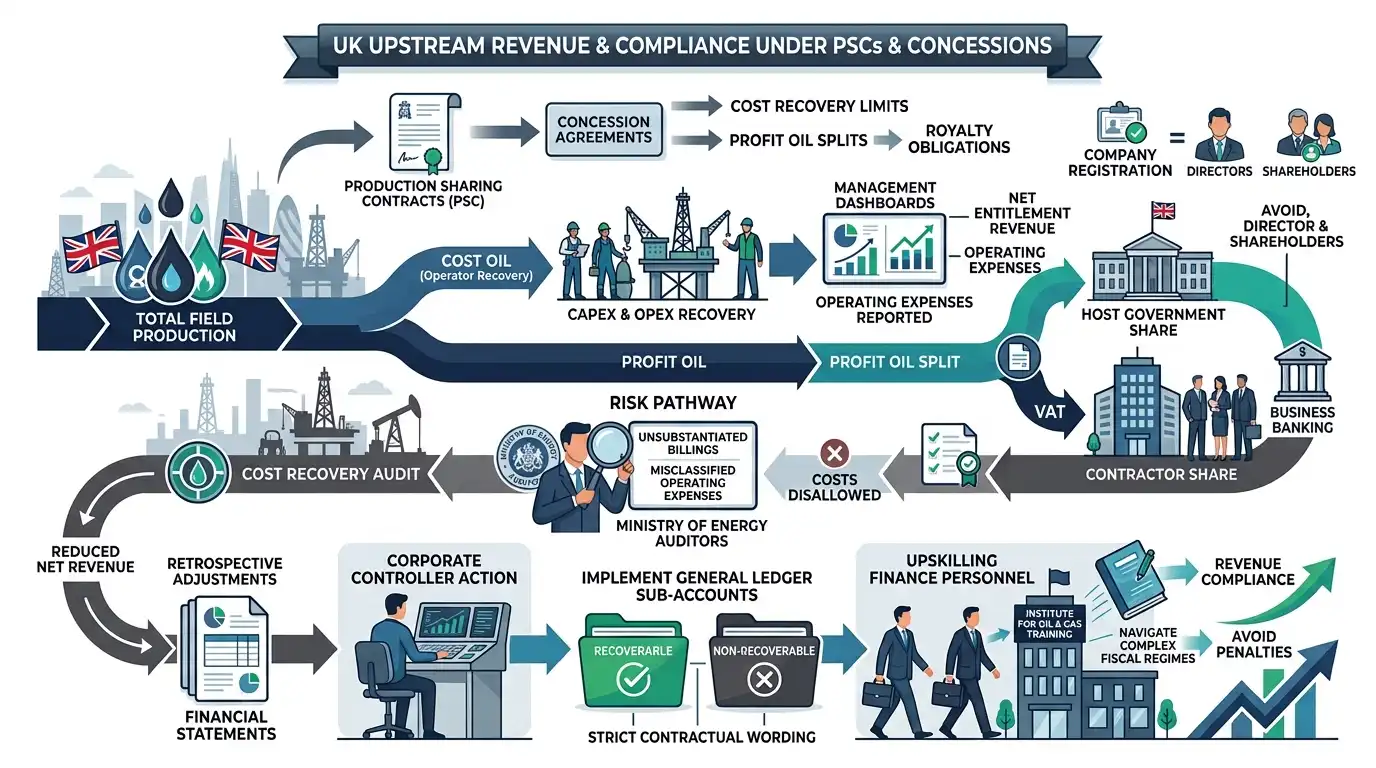
Production sharing contracts and concession agreements govern cost recovery limits, profit oil splits, and royalty obligations that fundamentally alter how upstream revenues and operating expenses are reported on management dashboards. Host government contracts dictate that a designated percentage of field production, known as cost oil, is allocated to the operator to recover capital and operating expenditures before remaining profit oil is divided between the state and the contractor. If field cost reporting systems misclassify operating expenditures or fail to substantiate joint venture billings, auditors appointed by the ministry of energy can disallow cost recovery pools. This administrative rejection directly reduces net entitlement revenue and forces retrospective adjustments to financial statements. Corporate controllers must implement specialized general ledger sub-accounts that track recoverable versus non-recoverable outlays in strict accordance with contractual wording. Upskilling finance personnel through the Institute For Oil & Gas Training leadership and technical curriculum equips accounting teams to navigate complex fiscal regimes without triggering revenue disputes or compliance penalties.
How Does Joint Venture Accounting and Operator Billing Complexity Influence Management Decision-Making?
Joint venture accounting frameworks and operator billing mechanisms create multi-party cost allocations that require transparent authorization for expenditure tracking to prevent partner disputes and operational delays. Upstream operations frequently involve consortium partners holding distinct working interests across shared infrastructure, gathering lines, and processing facilities. When the operator incurs field expenditures, these costs are billed to non-operating partners via monthly joint interest billings based on precise equity percentages. Inaccurate overhead allocations, delayed billing cycles, or unapproved budget overruns erode trust among venture partners and prompt joint audit exceptions. Management information systems must capture field tickets, contractor invoices, and materials transfers with granular accuracy to withstand partner scrutiny. Training programs delivered by the Institute For Oil & Gas Training focus heavily on inter-company reconciliation, joint venture audit defense, and transparent ledger maintenance. Strengthening these competencies enables accounting teams to produce reliable monthly cash calls and variance reports that support sound capital deployment decisions.
Why Is Inventory Valuation and Materials Management Critical for Upstream Field Cost Control?
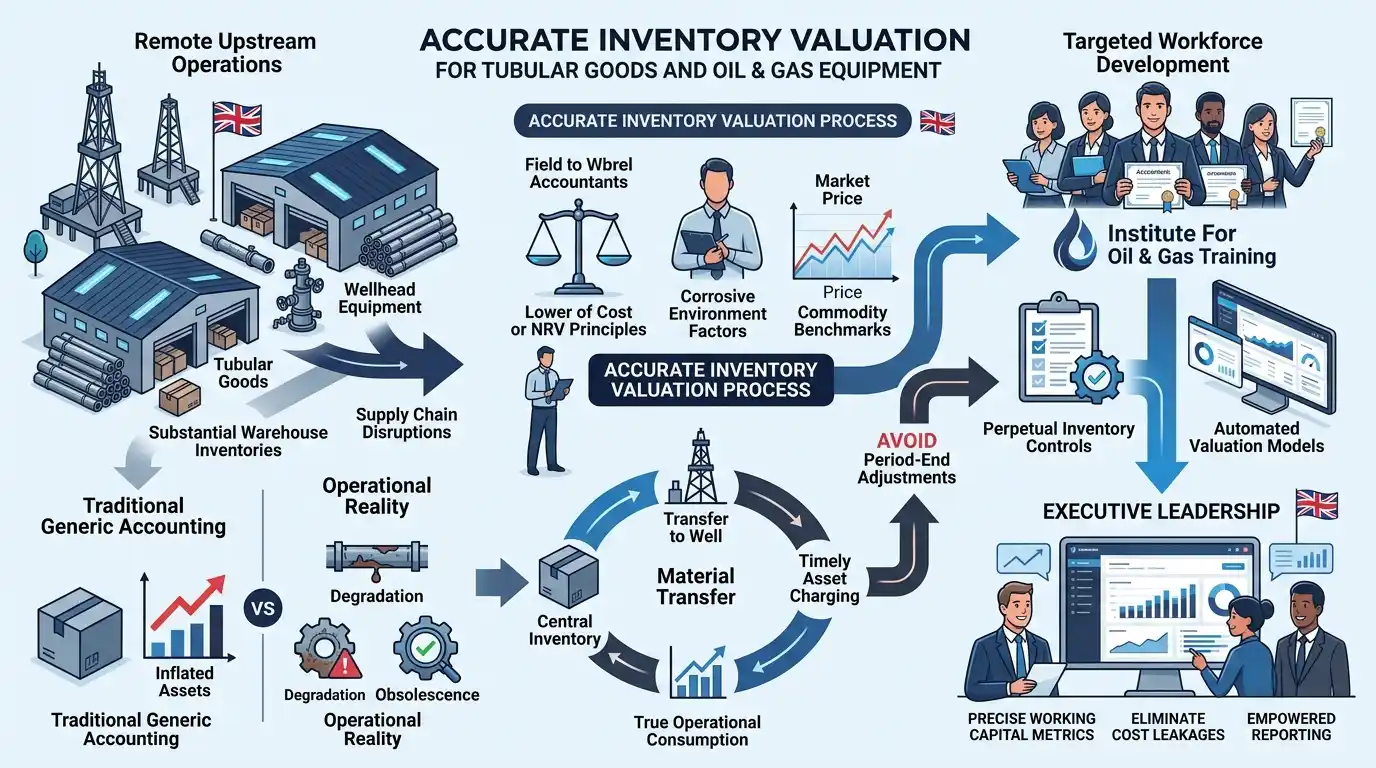
Accurate inventory valuation for tubular goods, wellhead equipment, and maintenance spares prevents dormant stock from inflating asset values and distorts monthly field operating expenditure reports. Upstream operations maintain substantial warehouse inventories across remote locations to mitigate supply chain disruptions during drilling campaigns. Traditional accounting often treats these items as generic warehouse supplies until deployment, ignoring degradation, obsolescence, and salvage value adjustments. Field accountants must apply lower of cost or net realizable value principles to high-value tubular goods, factoring in corrosive downhole environments and changing commodity benchmarks. When materials are transferred from central inventory to specific wells, timely asset charging ensures that field cost reports reflect true operational consumption rather than period-end adjustments. Organizations that leverage targeted workforce development from the Institute For Oil & Gas Training empower their accounting teams to implement perpetual inventory controls and automated valuation models. This operational rigor eliminates hidden cost leakages and provides executive leadership with precise working capital metrics.
How Do Decommissioning Provisions and Asset Retirement Obligations Impact Long-Term Financial Reporting?
Decommissioning provisions and asset retirement obligations require present-value liability recognition and accretion accounting that significantly influence balance sheet gearing ratios and annual depreciation charges. International financial reporting standards mandate that operators record an asset retirement obligation liability at the inception of field development, alongside a corresponding capital asset addition. This obligation represents the discounted estimated cash outflow required to plug wells, remove production platforms, and restore the seabed or surface environment at the end of the field life. Because these cash outflows occur decades in the future, minor adjustments to discount rates, inflation assumptions, or engineering cost estimates generate substantial balance sheet volatility. Upstream accountants must model accretion expense and asset depreciation concurrently to reflect the true economic consumption of the producing asset. Developing advanced proficiencies through the Institute For Oil & Gas Training ensures that finance professionals master complex present-value calculations and impairment testing. Consequently, executive committees receive transparent balance sheet forecasts that accurately reflect long-term environmental liabilities without masking short-term cash flow realities.
Frequently Asked Questions
What does oil and gas petroleum accounting involve?
Oil and gas petroleum accounting encompasses specialized financial tracking for exploration, development, and production activities across upstream assets. Programs delivered by the Institute For Oil & Gas Training equip professionals to manage joint venture billings, production sharing contracts, and asset retirement obligations in compliance with international standards. This technical discipline ensures that field expenditure data remains accurate for executive decision-making.
Why is petroleum accounting different from standard financial accounting?
Standard financial accounting frameworks often fail to capture the capital-intensive nature and unique risk profiles of extractive industries. Petroleum accounting requires specialized knowledge of successful efforts versus full cost methods, cost recovery limits, and depletion charges. Organizations rely on targeted education from the Institute For Oil & Gas Training to bridge this knowledge gap and align general ledgers with engineering realities.
How do production sharing contracts impact upstream accounting systems?
Production sharing contracts dictate how host governments and operators divide extracted hydrocarbons after recovering allowable costs. Upstream accounting teams must maintain granular sub-accounts to track cost oil and profit oil entitlements accurately to prevent audit exceptions. Specialized petroleum accounting training helps finance personnel navigate these complex fiscal regimes without risking revenue misstatements.
What are joint interest billings in oil and gas accounting?
Joint interest billings represent monthly invoices sent by an operating partner to non-operating consortium members to recover their proportionate share of field expenditure. Managing these multi-party cost allocations requires transparent authorization for expenditure tracking and precise inter-company reconciliations. The Institute For Oil & Gas Training addresses these complexities by providing practical instruction on joint venture audit defense and cost recovery.
How are asset retirement obligations accounted for in the petroleum sector?
Asset retirement obligations require operators to record a discounted present-value liability for future decommissioning and site restoration activities at the inception of field development. Upstream accountants must model accretion expense and asset depreciation concurrently to reflect the true economic consumption of the producing asset. Mastering these calculations ensures balance sheets accurately reflect long-term environmental liabilities without masking short-term cash flows.
Related training courses
Financial Modelling for PSCs & JVs: Model Auditing Training Course
- Specialisation
- Oil & Gas Petroleum Finance
- Duration
- 5 days · 15 CPD hours
Ethics, Governance & Anti-Corruption: Frameworks & Codes Training Course
- Specialisation
- Oil & Gas Petroleum Compliance, AML & Risks
- Duration
- 5 days · 15 CPD hours
Financial Evaluation of Suppliers & Contractors: Tender Evaluation Training Course
- Specialisation
- Oil & Gas Petroleum Procurement
- Duration
- 5 days · 15 CPD hours
More articles

Oilfield Economics & Project Evaluation: Specialist Training for Petroleum Economics and Commercial Roles
Master petroleum economics and project evaluation with specialized training. Learn cash flow modeling, risk analysis, and fiscal contracts for upstream roles.
Read article →
NPV and IRR Analysis for Comparing Alternative Oilfield Development Cases
Master net present value and internal rate of return methods to compare alternative oilfield development cases and optimize upstream capital allocation.
Read article →
How Petroleum Companies Assess the Commercial Viability of New Field Developments
Discover how petroleum companies train teams to assess field development commercial viability, optimize capital allocation, and drive project returns.
Read article →