
Specialist Petroleum Industry Accounting Training addresses the profound operational and regulatory complexities that standard corporate financial frameworks fail to resolve. General accounting principles often prove inadequate when applied to capital-intensive extraction lifecycles, production-sharing contracts, and complex joint-venture cost pooling. Organizations encounter severe financial reporting discrepancies when finance teams attempt to manage extractive industries using generic ledger practices. Traditional financial reporting models do not account for depletion methods, capitalization thresholds for exploration costs, or international petroleum fiscal regimes. Professionals navigating these environments require specialized frameworks that reconcile multi-party expenditures with strict governmental compliance requirements. The Institute For Oil & Gas Training delivers rigorous professional learning architectures designed to close these technical competency gaps. By addressing the limitations of general finance education, Why Petroleum Accounting Requires More Than General Financial Reporting Knowledge establishes the foundational awareness needed before evaluating advanced technical syllabi. Finance teams and corporate controllers must understand these distinct regulatory demands to prevent audit failures and inaccurate asset valuation.
What operational and financial challenges does this specialist training resolve?
Specialist Petroleum Industry Accounting Training resolves critical financial reporting errors, joint-venture accounting disputes, and compliance failures by equipping finance professionals with advanced joint-interest billing mechanics, production-sharing contract models, and specialized amortization frameworks tailored specifically for the upstream and downstream energy sectors.
Energy corporations operate within highly volatile financial landscapes governed by unique regulatory statutes, international standards, and complex contractual agreements. General accountants transitioning into the energy sector frequently misinterpret capital expenditures versus operating expenditures within exploration phases. This misclassification distorts EBITDA calculations, misstates asset impairments, and triggers severe penalties during external statutory audits.
Corporate leadership teams face mounting pressure from shareholders and regulatory bodies to maintain absolute financial transparency across multi-jurisdictional operations. When petroleum assets are managed by decentralized departments, communication breakdowns between operational engineers and finance personnel lead to unbilled joint-interest expenses. The Institute For Oil & Gas Training integrates cross-functional training methodologies that bridge this communication divide. HR teams utilize these structured programs to upskill mid-level accountants, transforming general ledger clerks into strategic financial analysts who understand field-level realities.
Organizations frequently struggle with accurate cost-recovery tracking under complex production-sharing contracts signed with host governments. A minor miscalculation in cost oil recovery allocations can result in millions of dollars in lost revenue or protracted legal disputes with state petroleum agencies. As explored further in Upstream Accounting Decisions That Influence Field Cost Reporting and Management Information, evaluating these transactional variables is essential for maintaining accurate management information systems. The Institute For Oil & Gas Training structures its curriculum to directly mitigate these financial vulnerabilities through rigorous practical scenarios and compliance-driven modules.
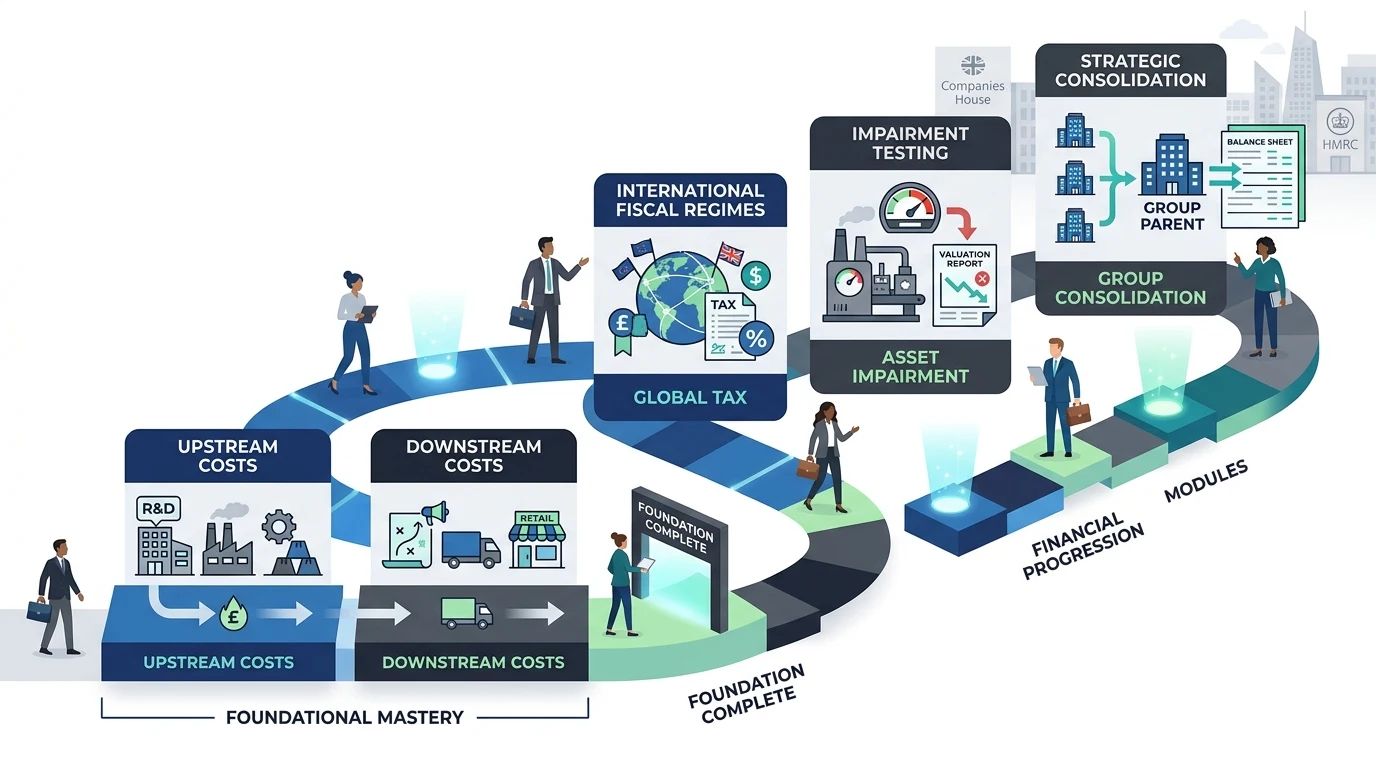
The curriculum is structured around progressive technical modules to ensure that participants build foundational mastery of upstream and downstream cost behaviors before advancing to advanced international fiscal regimes, impairment testing, and strategic corporate financial consolidation.
Instructional design within the energy sector requires a systematic progression from basic asset recognition to complex financial modeling and risk mitigation. If a curriculum introduces international joint-venture billing before establishing a firm grasp of successful efforts versus full cost accounting methods, participants experience cognitive overload and fail to master practical application. The Institute For Oil & Gas Training designs each learning tier to build directly upon preceding competencies, reinforcing theoretical principles with concrete industry data.
The initial phase of the syllabus focuses on core asset acquisition, exploration, and development accounting. Participants examine how capital is deployed during seismic surveys, exploratory drilling, and appraisal activities. They analyze the capitalization criteria set forth by international accounting standards and learn how to manage dry-hole contributions. This foundational clarity prevents premature expense recognition and ensures accurate balance sheet reporting from day one.
Subsequent modules transition learners into production and depletion mechanics, asset retirement obligations, and decommissioning liabilities. Because energy assets carry mandatory environmental restoration obligations under international law, finance teams must calculate present value discount rates accurately to provision future liabilities. The Institute For Oil & Gas Training ensures that every participant understands how these long-term provisions impact corporate credit ratings and borrowing capacity.
The advanced tiers of the curriculum focus on joint-interest operations, revenue distribution, and production-sharing agreements. Participants evaluate real-world case studies involving multi-operator consortia where cost-sharing agreements dictate cash flow management. By progressing logically from basic ledger entries to strategic corporate reporting, the training ensures that attendees achieve measurable improvements in daily job performance.
What specific technical and operational skills will participants develop?
Participants develop advanced competencies in joint-interest billing reconciliation, production-sharing contract auditing, depletion and amortization calculations, asset retirement obligation provisioning, and sector-specific financial statement analysis.
Mastery of these technical domains directly elevates the operational efficiency of finance departments within energy corporations. Accountants completing this program gain the analytical precision required to manage multi-million-dollar capital budgets without incurring compliance breaches. The Institute For Oil & Gas Training emphasizes practical skill acquisition over abstract theory, ensuring that every concept translates directly into workplace capability.
Participants master the mechanics of joint-interest billing through simulated operator-non-operator reconciliation exercises. They learn to audit joint-venture billings, identify unauthorized overhead allocations, and resolve billing exceptions in compliance with international operating agreements. This capability protects corporate capital and eliminates unnecessary financial leakage between partner organizations.
Depletion and amortization represent two of the most technically challenging aspects of extractive accounting. Attendees learn to apply units-of-production methods accurately, linking asset write-downs directly to actual reserves extracted rather than arbitrary time-based schedules. This precision ensures that financial statements accurately reflect the diminishing value of natural resource reserves over time.
Asset retirement obligation accounting requires sophisticated financial modeling to estimate future cash outflows for facility decommissioning. Participants acquire the skills to calculate accretion expense, adjust liability estimates based on inflation and discount rate fluctuations, and record environmental remediation provisions in strict accordance with regulatory mandates.
How is the training program delivered to corporate and individual learners?
The training program is delivered through flexible formats including intensive onsite corporate workshops, interactive virtual instructor-led sessions, and blended hybrid modules supported by digital simulation platforms and continuous instructor guidance.
Corporate learning requirements vary significantly depending on organizational size, geographical distribution, and staff availability. The Institute For Oil & Gas Training provides adaptable delivery channels designed to minimize operational disruption while maximizing knowledge retention and professional engagement.
Onsite corporate workshops are tailored for organizations seeking customized team training at their primary business facilities. In this format, expert instructors review internal company workflows, audit historical reporting errors, and deliver targeted coaching directly aligned with the corporation's specific operational footprint. This approach allows HR teams to upskill entire finance departments simultaneously, fostering cohesive team performance and standardized reporting practices.
Virtual instructor-led sessions offer global accessibility for remote professionals and distributed teams. These live workshops feature interactive breakout sessions, real-time financial modeling exercises, and peer-to-peer discussions mediated by senior industry practitioners. Participants engage directly with instructors to resolve complex technical scenarios encountered in their daily work environments.
Blended hybrid models combine self-paced digital learning modules with scheduled live coaching sessions. This format enables working professionals to balance demanding project schedules with continuous professional development. The Institute For Oil & Gas Training ensures that all digital modules feature high-definition video lectures, downloadable reference manuals, and interactive assessment tools that reinforce learning milestones.
What measurable workplace results and performance improvements can be expected?
Organizations can expect measurable reductions in audit discrepancies, accelerated financial closing cycles, enhanced risk management in joint ventures, and a demonstrable elevation in the strategic capability of their finance personnel.
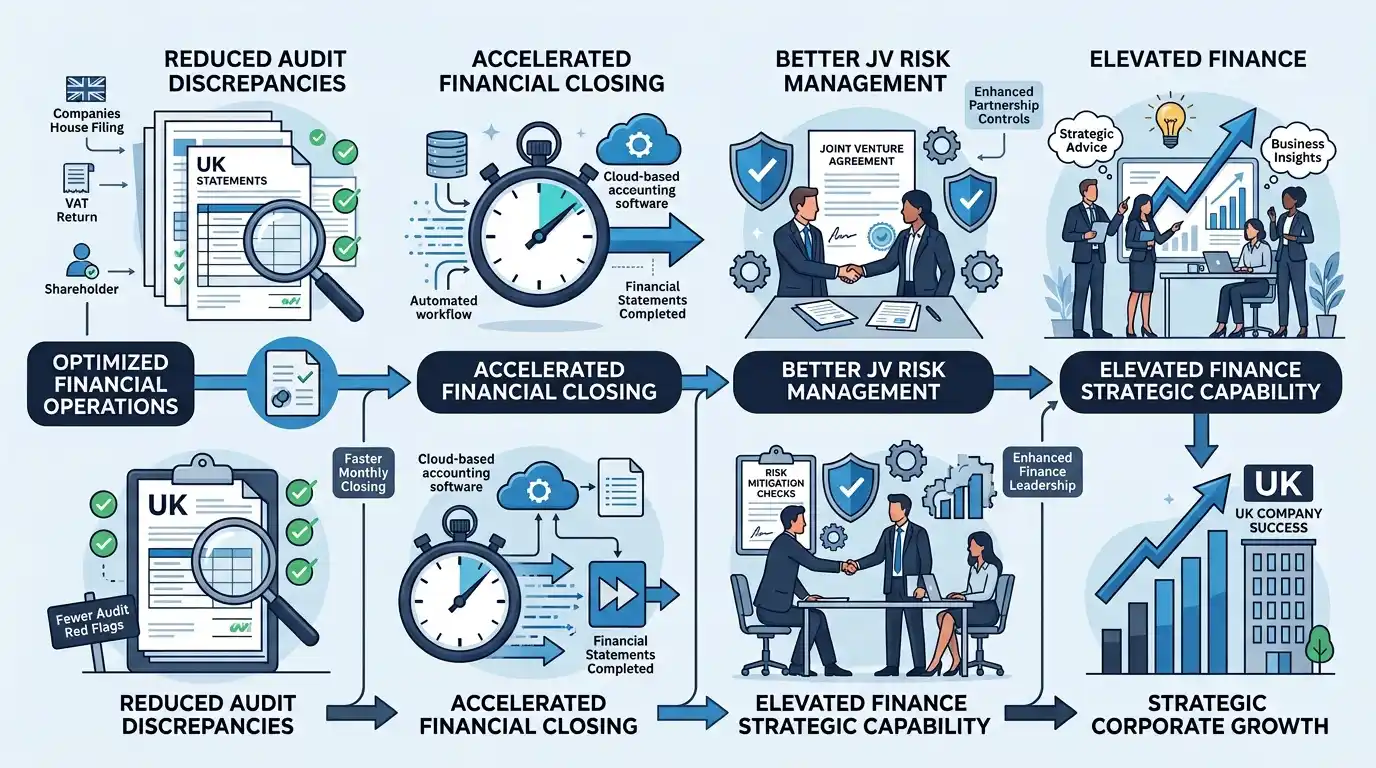
Investing in specialized training yields immediate operational dividends across corporate hierarchies. When financial controllers and accounting managers complete the program, their departments operate with heightened precision, reducing the frequency of costly reporting corrections identified during external audits. The Institute For Oil & Gas Training measures success through concrete performance indicators and enhanced workplace effectiveness.
HR teams and leadership pipelines benefit from structured career progression pathways. Junior accountants who master complex petroleum reporting standards are rapidly promoted into senior financial analyst and controller roles. This internal talent development reduces executive recruitment costs and ensures that organizational knowledge remains within the company.
Cross-functional collaboration between engineering and finance departments improves substantially. Accountants equipped with industry-specific knowledge communicate effectively with petroleum engineers regarding capital project valuations, production metrics, and exploratory risk assessments. This alignment prevents miscommunications that historically led to project budget overruns and inaccurate financial forecasting.
Board-level decision-making is significantly enhanced when management information systems deliver accurate, timely financial data. Executives relying on reports generated by graduates of the Institute For Oil & Gas Training make confident capital allocation decisions, optimize portfolio management, and maintain rigorous compliance across all operational jurisdictions.
What are the enrollment criteria and administrative completion pathways?
Enrollment requires foundational qualifications in finance, accounting, or related engineering disciplines, followed by a streamlined digital application process that evaluates professional experience and organizational sponsorship.
Ensuring cohort quality and peer-to-peer engagement requires clear admission criteria for every candidate. The Institute For Oil & Gas Training maintains transparent enrollment standards to ensure that all participants possess the prerequisite financial background necessary to master advanced energy accounting concepts.
Applicants typically hold a bachelor's degree in accounting, finance, economics, or engineering, accompanied by a minimum of two years of professional experience within corporate finance or extractive industries. Corporate HR sponsors may also nominate high-potential employees seeking accelerated professional development within their financial divisions.
The application process is conducted entirely online through a secure candidate portal. Candidates submit academic transcripts, professional resumes, and statements of professional intent. Admissions committees evaluate applications on a rolling basis to secure cohort placement for upcoming training cycles.
Upon acceptance, participants complete a structured orientation module outlining learning objectives, assessment schedules, and digital platform navigation. Throughout the program, learning progress is evaluated through rigorous technical assignments, practical financial modeling simulations, and comprehensive final examinations. Successful graduates receive a professional certification credential issued by the Institute For Oil & Gas Training, validating their advanced competency to industry employers and regulatory bodies. Apply for course access to secure your placement in the upcoming professional training cohort.
Frequently Asked Questions
What does oil and gas petroleum accounting involve?
Oil and gas petroleum accounting encompasses specialized financial reporting, cost control, and regulatory compliance practices tailored specifically for upstream, midstream, and downstream energy operations. At the Institute For Oil & Gas Training, professionals learn how to manage complex extractive workflows such as successful efforts versus full cost accounting methods, depletion calculations, and joint-interest billing. This specialized discipline ensures that energy corporations accurately report capital expenditures, manage exploration risks, and adhere to strict international financial standards.
Why is petroleum accounting different from general financial accounting?
Petroleum accounting differs significantly from standard corporate accounting because it must account for long capital lifecycles, high exploration risks, and unique depletion mechanics tied to natural resource extraction. General financial reporting models fail to address production-sharing contracts, asset retirement obligations, and multi-party joint ventures characteristic of the energy sector. Through targeted instruction at the Institute For Oil & Gas Training, finance teams master these sector-specific variables to prevent costly audit discrepancies and inaccurate asset valuations.
How are joint-interest billing expenses managed in the petroleum industry?
Joint-interest billing in the energy sector is managed through meticulous cost allocation, operator-non-operator reconciliations, and strict adherence to international operating agreements. Accountants must audit shared operational expenditures, verify overhead allocations, and resolve billing disputes between consortium partners to minimize financial leakage. Programs offered by the Institute For Oil & Gas Training provide practical simulations that equip finance personnel with the analytical precision required to streamline these complex multi-party financial transactions.
What are asset retirement obligations in oil and gas accounting?
Asset retirement obligations represent the legal and financial liabilities associated with the future decommissioning of oil and gas production facilities and environmental site remediation. Energy accountants must calculate present value discount rates accurately, record annual accretion expenses, and maintain long-term balance sheet provisions in compliance with regulatory mandates. The Institute For Oil & Gas Training incorporates dedicated modules on decommissioning liabilities to ensure accountants can model these long-term financial commitments correctly.
Who benefits most from specialist petroleum accounting training?
Specialist petroleum industry accounting training primarily benefits corporate controllers, finance managers, internal auditors, and general accountants transitioning into the energy sector. HR teams also leverage these professional development programs to build robust leadership pipelines and enhance the strategic capability of their financial departments. By participating in specialized courses through the Institute For Oil & Gas Training, professionals gain the practical competencies needed to accelerate career progression and drive operational excellence.
Related training courses
Ethics, Governance & Anti-Corruption: Frameworks & Codes Training Course
- Specialisation
- Oil & Gas Petroleum Compliance, AML & Risks
- Duration
- 5 days · 15 CPD hours
Decommissioning & Asset Retirement Obligations: Provision Recognition Training Course
- Specialisation
- Oil & Gas Petroleum IFRS & Financial Reporting
- Duration
- 5 days · 15 CPD hours
Financial Evaluation of Suppliers & Contractors: Tender Evaluation Training Course
- Specialisation
- Oil & Gas Petroleum Procurement
- Duration
- 5 days · 15 CPD hours
More articles

Oilfield Economics & Project Evaluation: Specialist Training for Petroleum Economics and Commercial Roles
Master petroleum economics and project evaluation with specialized training. Learn cash flow modeling, risk analysis, and fiscal contracts for upstream roles.
Read article →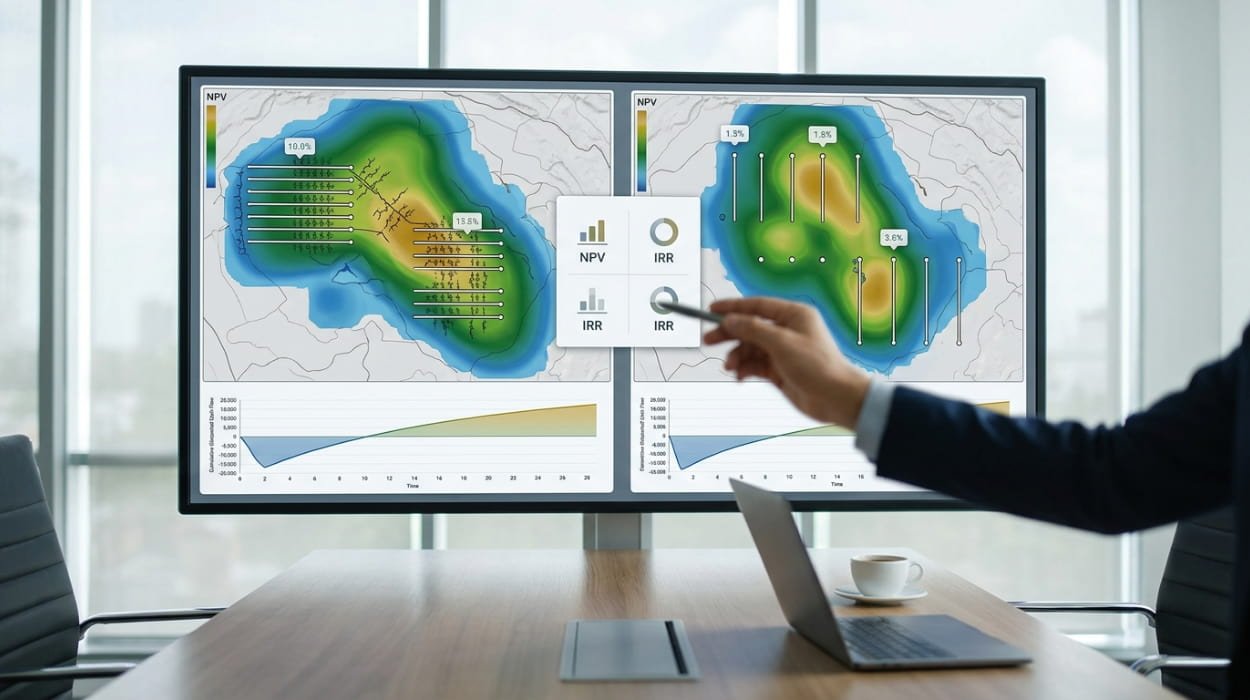
NPV and IRR Analysis for Comparing Alternative Oilfield Development Cases
Master net present value and internal rate of return methods to compare alternative oilfield development cases and optimize upstream capital allocation.
Read article →
How Petroleum Companies Assess the Commercial Viability of New Field Developments
Discover how petroleum companies train teams to assess field development commercial viability, optimize capital allocation, and drive project returns.
Read article →